Gadolery®
Ukraine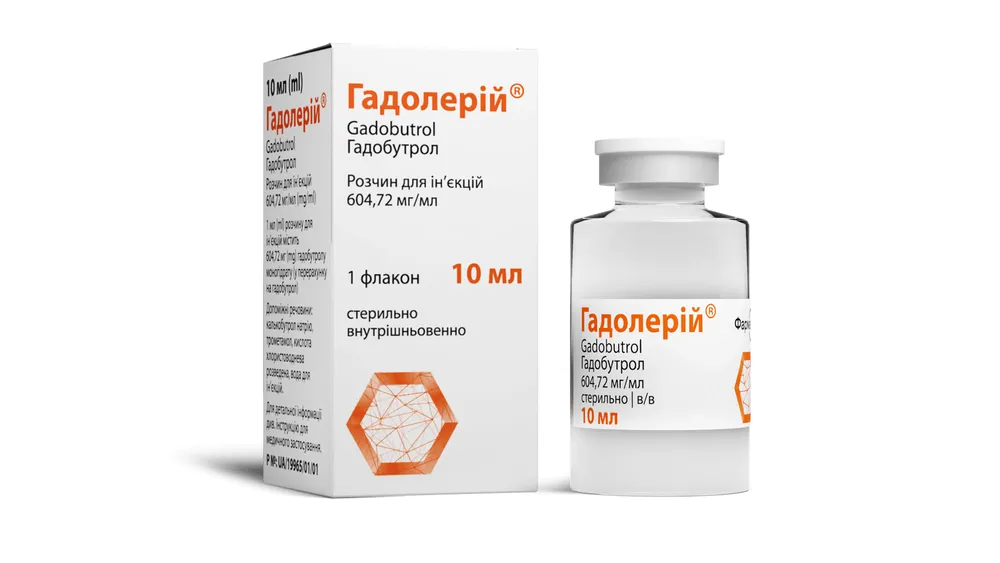
Table of Contents
INSTRUCTION FOR MEDICAL USE OF THE MEDICINAL PRODUCT GADOLERIY® (GADOLERIY)
Composition:
Active substance: gadobutrol;
1 ml of injection solution contains 604.72 mg of gadobutrol monohydrate (equivalent to gadobutrol);
Excipients: caldobutrol sodium, trometamol, diluted hydrochloric acid, water for injections.
Pharmaceutical form. Injection solution.
Main physicochemical properties: clear, colorless or slightly yellowish solution.
| Osmolality at 37 °C (mOsm/L solution) |
1117 |
| Osmolality at 37 °C (mOsm/kg H2O) |
1603 |
| pH of solution |
from 6.6 to 8 |
| Viscosity at 37 °C (mPa·s) |
4.96 |
Pharmacotherapeutic group. Paramagnetic contrast agents. ATC code V08CA09.
Pharmacological Properties
Pharmacodynamics.
The contrast-enhancing effect is achieved due to a neutral (non-ionic) complex composed of gadolinium (III) and the macrocyclic ligand dihydroxymethyl-propyltetraazacyclododecanetriacetic acid (butrol).
The relaxivity of gadobutrol, measured in vitro in human blood/plasma under physiological conditions and at clinically relevant magnetic field strengths (1.5 and 3.0 T), ranges from 3.47 to 4.97 L/mmol/sec.
At clinical doses, the pronounced relaxivity of gadobutrol results in shortening of the proton relaxation time of water in tissues.
The stability of the gadobutrol complex was studied in vitro under physiological conditions (in native human serum at pH 7.4 and 37°C) over 15 days. The amount of free gadolinium ions released from gadobutrol was below the limit of quantitative detection (0.1 mol.% of total gadolinium), indicating high complex stability of gadobutrol under the tested conditions.
Clinical Efficacy
In one Phase III clinical study evaluating gadobutrol for diagnosing liver diseases (using combined magnetic resonance imaging [MRI] before and after contrast agent administration), mean sensitivity was 79%. Specificity for detection and verification of liver lesions suspected of malignancy was 81% (analysis based on objective patient data).
In one Phase III kidney study, sensitivity for differential diagnosis of benign and malignant kidney lesions averaged 91% (analysis based on objective patient data) and 85% (analysis based on lesion assessment). Specificity averaged 52% in the analysis based on objective patient data and 82% in the analysis based on lesion assessment.
When using gadobutrol, the increase in MRI sensitivity before contrast agent administration and combined MRI before and after contrast agent administration was 33% in liver imaging (analysis based on objective patient data) and 18% in kidney imaging (analysis based on both objective patient data and lesion assessment). The increase in MRI specificity before contrast agent administration and combined MRI before and after contrast agent administration was 9% in liver imaging (analysis based on objective patient data), while no increase in specificity was observed in kidney imaging (analysis based on both objective patient data and lesion assessment).
Results were averaged based on anonymous evaluation by independent radiologists.
In one intrasubject crossover comparative study involving 132 patients, gadobutrol was compared with meglumine gadoterate (both at 0.1 mmol/kg) during visualization of brain neoplastic lesions.
The primary endpoint was overall preference for either gadobutrol or meglumine gadoterate, determined by mean scores calculated by independent experts. Preference for gadobutrol was indicated by p = 0.0004. Specifically, preference for gadobutrol was observed in 42 patients (32%) compared to overall preference for meglumine gadoterate in 16 patients (12%). In 74 patients (56%), no preference was expressed for either contrast agent.
For the secondary endpoint used in the analysis—the ratio of MRI signal intensity in the tumor to signal intensity in normal tissue—gadobutrol demonstrated statistically significantly higher efficacy (p < 0.0003). The percentage of signal enhancement was higher with gadobutrol (p < 0.0003) compared to meglumine gadoterate, with statistically significant differences according to independent experts.
Gadobutrol (129) showed a higher mean contrast-to-noise ratio compared to meglumine gadoterate (98). The difference was not statistically significant.
In a study designed as a crossover comparison, gadobutrol at a reduced dose of 0.075 mmol/kg was compared with meglumine gadoterate at its standard dose of 0.1 mmol/kg for contrast-enhanced CNS MRI in 141 patients with CNS lesions. Primary variables included lesion contrast enhancement, lesion morphology, and lesion border delineation. Images were analyzed by three independent "blinded" readers. Non-inferiority of meglumine gadoterate compared to unenhanced imaging was demonstrated for all three primary variables (at least 80% of effect retained) based on mean reader assessment. The mean number of lesions detected with gadobutrol (2.14) and gadoterate (2.06) was similar.
Children
Two Phase I/III studies were conducted using a single dose of the drug in 138 pediatric patients scheduled for contrast-enhanced magnetic resonance imaging (MRI) of the central nervous system (CNS), liver, and kidneys or contrast-enhanced magnetic resonance angiography (MRA), and in 44 subjects aged from birth to 2 years (including full-term newborns) scheduled for standard contrast-enhanced MRI of any body region. Diagnostic efficacy and improvement in diagnostic confidence for all evaluated parameters were observed, with no differences between pediatric patients and adults. Study results demonstrated very good tolerability of gadobutrol with a safety profile similar to that in adults.
Clinical Safety
Type and frequency of adverse reactions after administration of gadobutrol for various indications were evaluated in a large international prospective non-interventional study (GARDIAN). The safety population included 23,708 patients of all age groups, including children (n = 1,142; 4.8%) and elderly patients (n = 4,330; 18.3% aged 65 to < 80 years and n = 526; 2.2% aged ≥ 80 years). Mean age was 51.9 years.
Two hundred two patients (0.9%) reported a total of 251 adverse events, and 170 (0.7%) reported 215 events classified as adverse reactions, the majority of which (97.7%) were mild or moderate in intensity. The most frequently reported adverse reactions were nausea (0.3%), vomiting (0.1%), and dizziness (0.1%). The rate of adverse reactions was 0.9% in women and 0.6% in men. There were no differences in adverse reaction rates depending on the dose of gadobutrol. Of the 170 patients who experienced adverse reactions (0.02%), 4 patients had serious adverse reactions, one of which (anaphylactic shock) resulted in a fatal outcome. Adverse events were recorded in 8 of 1,142 (0.7%) pediatric patients. In six children, these adverse events were classified as adverse reactions (0.5%).
Renal Impairment
In a prospective pharmacoepidemiological study (GRIP) assessing the potential risk of nephrogenic systemic fibrosis (NSF) in patients with impaired renal function, 908 patients with varying degrees of renal impairment received gadobutrol at the standard approved dose for contrast MRI. All patients, including 234 patients with severe renal impairment (estimated glomerular filtration rate < 30 mL/min/1.73 m²) who did not receive other gadolinium-containing contrast agents, were monitored for two years for signs and symptoms of nephrogenic systemic fibrosis (NSF). No patient included in the study developed NSF.
Preclinical Safety Data.
Based on standard studies of safety pharmacology, repeated-dose toxicity, or genotoxicity, no specific risk to humans was identified.
In reproductive toxicity studies, repeated dosing (intravenous) caused delayed embryonic development in rats and rabbits, increased embryolethality in rats, rabbits, and monkeys at doses 8–16 times (based on body surface area) or 25–50 times (based on body weight) higher than diagnostic doses in humans. It is unknown whether these effects could also be induced by single-dose administration. Studies of single and repeated dose toxicity in neonatal and sexually immature rats do not indicate a specific risk for use in children of all age groups, including full-term newborns and infants.
Less than 0.1% of the administered dose of radiolabeled gadobutrol administered to lactating female rats was excreted into milk and transferred to pups. In rats, oral absorption was very low, approximately 5% (calculated from urinary excretion levels).
According to preclinical safety studies, transient dose-dependent increases in blood pressure and myocardial contractility were observed in the cardiovascular system. These effects were not observed in humans.
Environmental studies have shown that the persistence and mobility of gadolinium-containing contrast agents indicate potential spread in surface water and possibly in groundwater.
Pharmacokinetics.
Distribution
After intravenous administration, gadobutrol rapidly distributes into the extracellular space. Protein binding is negligible. The pharmacokinetic parameters of gadobutrol in humans are dose-proportional. After administration of gadobutrol at doses up to 0.4 mmol/kg body weight, plasma levels declined in a biphasic manner. After administration of 0.1 mmol/kg body weight, mean plasma concentrations were 0.59 mmol/L at 2 minutes and 0.3 mmol/L at 60 minutes post-injection.
Biotransformation
No metabolites were detected in plasma or urine.
Elimination
Gadobutrol is eliminated from plasma with a mean terminal half-life of 1.81 hours (range 1.3–2.1 hours). More than 50% of the intravenously administered dose is excreted in urine within two hours, and more than 90% within 12 hours. After a dose of 0.1 mmol/kg body weight, a mean of 100.3 ± 2.6% of the administered dose was excreted in urine within 72 hours post-injection. Renal clearance of gadobutrol is 1.1–1.7 mL/min/kg in essentially healthy individuals, similar to the renal clearance of inulin, indicating that gadobutrol is eliminated via glomerular filtration. Less than 0.1% is excreted in feces.
Pediatric Patients
The overall pharmacokinetic profile of gadobutrol in pediatric patients (< 18 years) is similar to that in adults (see section "Dosage and Administration").
Two Phase I/III studies were conducted involving pediatric patients (< 18 years). Pharmacokinetic profiles were determined in 130 pediatric patients aged 2 to < 18 years and in 43 pediatric patients aged < 2 years (including full-term newborns).
The pharmacokinetic profile of gadobutrol in children of all age groups is similar to that in adults, resulting in comparable values for area under the curve (AUC), total clearance (CLtot), volume of distribution (Vss), half-life, and excretion rate.
Approximately 99% (mean value) of the dose was excreted in urine within 6 hours (in the age group 2 to < 18 years).
Elderly Patients (aged ≥ 65 years)
Due to age-related physiological changes in renal function, systemic exposure in healthy elderly volunteers (aged ≥ 65 years) increases by 33% in men and 54% in women; terminal half-life increases by 33% in men and 58% in women. Plasma clearance decreases by 25% (men) and 35% (women). Renal excretion of the administered dose is complete in all patients within 24 hours, with no differences observed between elderly and younger healthy patients.
Renal Impairment
In patients with impaired renal function, the plasma half-life of the substance is prolonged due to reduced glomerular filtration. Mean terminal half-life is 5.8 hours in patients with moderate renal impairment (80 > creatinine clearance > 30 mL/min) and up to 17.6 hours in patients with severe renal impairment not on dialysis (creatinine clearance < 30 mL/min). Mean plasma clearance decreases to 0.49 mL/min/kg in patients with moderate renal impairment (80 > creatinine clearance > 30 mL/min) and to 0.16 mL/min/kg in patients with severe renal impairment not on dialysis (creatinine clearance < 30 mL/min).
Complete urinary excretion was observed within 72 hours in patients with mild or moderate renal impairment. In patients with severe renal impairment, at least 80% of the administered dose was excreted in urine within 5 days (see sections "Dosage and Administration", "Special Warnings and Precautions for Use"). In patients undergoing dialysis, gadobutrol is almost completely eliminated from plasma after the third dialysis session.
Clinical characteristics.
Indications.
The medicinal product is used for diagnostic purposes. Gadoleri® is indicated in adults, adolescents, and children of all age groups (including full-term newborns) for:
- Enhancement of image contrast during cranial and spinal MRI.
- Enhancement of image contrast during MRI of the liver or kidneys in patients with suspected or confirmed focal lesions, in order to classify them as benign or malignant.
- Enhancement of image contrast during magnetic resonance angiography (MRA).
Gadoleri® may also be used during magnetic resonance imaging of pathological lesions throughout the body.
Gadoleri® facilitates visualization of abnormal formations or lesions and enables differentiation between healthy and pathological tissues.
Gadoleri® should be administered only when diagnostic information is essential and cannot be obtained by non-contrast magnetic resonance imaging (MRI).
Contraindications.
Hypersensitivity to the active substance or to any of the excipients of the medicinal product.
Special precautions.
The medicinal product is intended for single use only (for one examination).
This medicinal product should be carefully inspected before use. Gadoleri® must not be used if there is a significant change in color, presence of particulate matter, or damage to the integrity of the plastic container.
Any unused contrast agent remaining after the examination must not be reused and should be discarded.
Syringes should be removed from the plastic container immediately before use.
The cap should be removed from the syringe only immediately before administration.
Gadoleri® should be drawn from the vial into a syringe only immediately before administration. The vial’s rubber stopper should not be punctured more than once.
If this medicinal product is to be administered using an automated delivery system, the suitability of its use with such system must be demonstrated by the manufacturer of the equipment / medical device. Any additional instructions provided by the manufacturer of the equipment / medical device must be followed.
Interaction with other medicinal products and other forms of interactions.
Studies on interactions with other medicinal products have not been conducted.
Special precautions for use.
Adverse reactions such as erythema and swelling may occur during intravenous administration of Gadoleri® into small-caliber veins.
Gadobutrol must not be administered intrathecally. Serious, life-threatening, and fatal cases, predominantly with neurological reactions (e.g., coma, encephalopathy, seizures), have been reported following intrathecal administration.
General safety rules applicable for MRI procedures, especially exclusion of ferromagnetic implants, also apply to the use of Gadoleri®.
- Hypersensitivity
Administration of Gadoleri®, like other intravenous contrast agents, may be associated with anaphylactoid reactions/hypersensitivity reactions or other idiosyncratic reactions manifesting as cardiovascular, respiratory, or cutaneous symptoms, up to severe reactions including shock. Patients with cardiovascular diseases are at greater risk of serious or even fatal outcomes from severe hypersensitivity reactions.
The risk of hypersensitivity reactions is increased in the presence of the following conditions or diseases:
- previous reaction to contrast media administration;
- history of bronchial asthma;
- history of allergic reactions.
The decision to administer Gadoleri® to patients with a predisposition to allergies should be made only after careful assessment of the risk-benefit ratio.
Most of these reactions occur within 30 minutes after administration. Therefore, it is recommended to monitor the patient after the procedure.
Appropriate medications for the treatment of hypersensitivity reactions and emergency equipment must always be readily available (see section "Administration and dosage").
Delayed reactions (occurring several hours or days after administration) have been observed in isolated cases (see section "Adverse reactions").
- Renal impairment
Before administering Gadoleri®, all patients should be screened for renal dysfunction based on laboratory results.
Cases of nephrogenic systemic fibrosis (NSF) associated with the use of gadolinium-containing contrast agents have been reported in patients with acute or chronic severe renal insufficiency (glomerular filtration rate < 30 mL/min/1.73 m²). Patients undergoing liver transplantation are at particular risk due to the high incidence of acute renal failure in this group.
Because of the risk of NSF with the use of Gadoleri®, the decision to administer the agent to patients with severe renal insufficiency or patients in the perioperative period of liver transplantation should be made only after careful evaluation of the risk-benefit ratio and only when diagnostic information is essential and cannot be obtained by non-contrast MRI.
Hemodialysis performed shortly after administration of Gadoleri® may help eliminate the agent from the body. However, there are no data on the use of hemodialysis for prevention or treatment of NSF in patients not previously on dialysis.
- Neonates and infants
Due to immature renal function, Gadoleri® should be used with caution in neonates up to 4 weeks of age and infants up to 1 year of age, and only after careful evaluation of the necessity of administration.
- Elderly patients
Since renal clearance of gadobutrol may be impaired in elderly patients, it is particularly important to assess renal function in patients aged 65 years and older.
- Seizures
As with other gadolinium-containing contrast agents, particular caution is advised when administering Gadoleri® to patients with a low seizure threshold.
- Excipients
Gadoleri® contains less than 1 mmol of sodium (23 mg) per dose (calculated based on the average dose for a patient weighing 70 kg), i.e., it is practically sodium-free.
Use during pregnancy or breastfeeding.
Pregnancy. Data on the use of gadolinium-based contrast agents, including gadobutrol, in pregnant women are limited. Gadolinium may cross the placenta. It is unknown whether gadolinium exposure is associated with adverse fetal effects.
In animal studies, repeated high doses of the drug showed reproductive toxicity (see section "Pharmacological properties").
Gadoleri® is not recommended during pregnancy unless there are compelling medical indications.
Lactation. Gadolinium-containing contrast agents are excreted in breast milk in very small amounts (see section "Pharmacological properties"). With clinical doses, no effect on infants is expected due to the minimal amount of active substance excreted in breast milk and poor gastrointestinal absorption. The decision on whether to continue or interrupt breastfeeding for 24 hours after administration of Gadoleri® should be made jointly by the physician and the breastfeeding woman.
Fertility. Animal studies did not indicate impairment of fertility.
Ability to affect reaction speed when driving or operating machinery.
Unknown.
Method of Administration and Dosage
Gadovist® must be administered only by qualified medical personnel experienced in clinical MRI practice.
The medicinal product is used for diagnosis only via intravenous administration.
The required dose should be administered intravenously as a bolus injection. Magnetic resonance imaging may begin immediately (after a short interval following injection, depending on the pulse sequence and imaging protocol). Optimal contrast enhancement occurs during the first pass through the arteries for MRA, as well as for approximately 15 minutes after injection of Gadovist® when used for CNS imaging (this duration depends on the type of lesion/tissue).
T1-weighted imaging sequences are particularly suitable for contrast-enhanced examinations.
Intravascular administration of the contrast agent should be performed, whenever possible, while the patient is in a supine position. After administration, the patient must remain under medical supervision for at least 30 minutes, as clinical experience with contrast agents indicates that most adverse reactions occur during this period (see section "Special Warnings and Precautions for Use").
Dosing
For diagnostic purposes, the lowest dose providing sufficient contrast enhancement should be used. The dose must be calculated according to the patient's body weight and must not exceed the recommended dose per kilogram of body weight as specified in this section.
Adults
Recommendations for MRI of the Brain and Spinal Cord
The recommended dose for adults is 0.1 mmol of Gadovist® per kg of body weight (mmol/kg body weight), equivalent to 0.1 mL per kg of body weight of the 1.0-M solution.
If suspicion of a lesion remains (based on clinical findings) despite normal MRI results, or if more precise information may influence patient management, a second dose of up to 0.2 mL per kg of body weight may be administered within 30 minutes after the first injection.
A dose of 0.075 mmol gadobutrol per kg of body weight (equivalent to 0.075 mL of Gadovist® per kg of body weight) may be administered as a minimum for CNS visualization (see section "Pharmacological Properties").
MRI of the Whole Body (excluding MRA)
Generally, administration of Gadovist® at a dose of 0.1 mL/kg body weight is sufficient to address major clinical questions.
Contrast Enhancement in Magnetic Resonance Angiography (CE-MRA)
Imaging of a single field of view:
7.5 mL if body weight is less than 75 kg;
10 mL if body weight is 75 kg or more (corresponding to 0.1–0.15 mmol/kg body weight).
Imaging of more than one field of view:
15 mL if body weight is less than 75 kg;
20 mL if body weight is 75 kg or more (corresponding to 0.2–0.3 mmol/kg body weight).
Special Patient Populations
Children
For children of all age groups (including full-term newborns), the recommended dose is 0.1 mmol of Gadovist® per kg of body weight (equivalent to 0.1 mL/kg body weight) for all indications.
Newborns (up to 4 weeks of age) and Infants (up to 1 year of age)
Due to the immaturity of renal function observed in newborns (up to 4 weeks of age) and infants (up to 1 year of age), Gadovist® should be administered to these patients only after careful assessment of benefit-risk balance and at a dose not exceeding 0.1 mmol/kg body weight. No more than a single dose should be administered during one imaging session. Due to insufficient data on repeated administration, the interval between repeated injections of Gadovist® should be at least 7 days.
Elderly Patients (aged 65 years and older)
No dose adjustment is required for elderly patients. However, special caution is necessary when administering Gadovist® to elderly patients (see section "Special Warnings and Precautions for Use").
Renal Impairment
The decision to administer Gadovist® to patients with severe renal impairment (glomerular filtration rate < 30 mL/min/1.73 m²) and to patients in the perioperative period of liver transplantation should be made only after careful assessment of the risk-benefit ratio and solely when diagnostic information is critically needed and cannot be obtained by non-contrast MRI (see section "Special Warnings and Precautions for Use"). If administration of Gadovist® is necessary, the dose should not exceed 0.1 mmol/kg body weight. No more than a single dose should be administered during one imaging session. Due to insufficient data on repeated administration, repeated injection of Gadovist® should not be performed unless the interval between injections is at least 7 days.
Children
Gadovist® is indicated for use in children of all age groups (including full-term newborns).
Overdose
The maximum single dose of gadobutrol administered in humans is 1.5 mmol per kg of body weight. To date, no signs of intoxication due to overdose have been observed during clinical use of the drug.
In case of accidental overdose, monitoring of the cardiovascular system (including ECG) and renal function is recommended.
In patients with renal impairment, Gadovist® can be removed from the body by hemodialysis. Approximately 98% of the active substance is eliminated from the body after three dialysis sessions. However, there are no data confirming that hemodialysis can prevent the development of nephrogenic systemic fibrosis.
Adverse reactions
Data on the safety profile of gadobutrol were obtained from clinical studies involving more than 6300 patients and from post-marketing surveillance. The most commonly reported adverse reactions (≥ 0.5%) in patients receiving gadobutrol were headache, nausea, and dizziness.
The most serious adverse reactions observed in patients receiving gadobutrol were cardiac arrest and severe anaphylactoid reactions (including respiratory arrest and anaphylactic shock).
Delayed anaphylactoid reactions (occurring from several hours after administration to several days) were observed rarely (see section "Special precautions").
Most adverse effects were of mild or moderate severity.
Adverse reactions observed during administration of gadobutrol are listed in the table below. They are classified by organ systems according to MedDRA [Medical Dictionary for Regulatory Activities]. Appropriate MedDRA terms were used to describe specific reactions, their symptoms, and symptomatically similar conditions.
The adverse reactions listed below, reported during clinical studies with gadobutrol, are categorized by frequency of occurrence: common (≥ 1/100 to < 1/10), uncommon (≥ 1/1000 to < 1/100), rare (≥ 1/10,000 to < 1/1000). The frequency of adverse reactions identified only during the post-marketing period is not known and is designated as "frequency not known". Within each frequency group, adverse reactions are listed in order of decreasing severity.
Adverse reactions identified during clinical studies and post-marketing surveillance in patients receiving gadobutrol.
| System organ |
Common |
Uncommon |
Rare |
Frequency not known |
| Immune system disorders |
Hypersensitivity/anaphylactoid reactions*# (e.g.: anaphylactic shock§*, circulatory collapse§*, respiratory arrest§*, pulmonary edema§*, bronchospasm§, cyanosis§, oropharyngeal edema§*, laryngeal edema§, hypotension*, increased blood pressure§, chest pain§, urticaria, facial swelling, angioedema§, conjunctivitis§, eyelid edema, flushing, hyperhidrosis§, cough§, sneezing§, feeling of warmth§, pallor) |
|||
| Nervous system disorders |
Headache |
Dizziness, dysgeusia, paraesthesia |
Loss of consciousness*, seizures, parosmia |
|
| Cardiac disorders |
Tachycardia, palpitations |
Cardiac arrest* |
||
| Respiratory, thoracic and mediastinal disorders |
Dyspnoea* |
|||
| Gastrointestinal disorders |
Nausea |
Vomiting |
Dry mouth |
|
| Skin and subcutaneous tissue disorders |
Erythema, pruritus (including generalized pruritus), rash (including generalized, macular, papular, pruritic rash) |
Nephrogenic systemic fibrosis (NSF) |
||
| General disorders and injection site conditions |
Injection site reactionsº, feeling of warmth |
Malaise, feeling of cold |
§ Hypersensitivity/anaphylactoid reactions have been reported only during post-marketing surveillance (frequency unknown).
* Adverse reactions that may be life-threatening.
º Injection site reactions (of various types), including the following clinical manifestations: local extravasation, local sensation of heat, local sensation of cold, local feeling of warmth, local erythema or rash, local pain, post-injection hematoma.
#Apart from urticaria, none of the symptoms listed in parentheses among the adverse reactions were observed in clinical trials at a frequency higher than "rare."
Patients with a predisposition to allergic reactions are more likely to experience hypersensitivity reactions.
Isolated cases of NSF development associated with the use of gadobutrol have been reported (see section "Special precautions").
Changes in renal function parameters, including increased creatinine levels, have been observed after administration of gadobutrol.
Children and adolescents
Data from two Phase I/III studies involving administration of a single dose to 138 subjects aged 2–17 years and 44 subjects under 2 years of age (see section "Pharmacological properties") indicate that the frequency, type, and severity of adverse reactions in children across all age groups (including full-term newborns) do not differ from the adverse reaction profile observed in adults. This conclusion has been confirmed by the results of a Phase IV study involving over 1,100 pediatric patients and post-marketing surveillance data.
Reporting suspected adverse reactions
Reporting of suspected adverse reactions after marketing authorization is important. It allows continued monitoring of the benefit-risk balance of the medicinal product. Healthcare professionals and pharmacists, as well as patients or their legal representatives, should report all suspected adverse reactions and lack of efficacy through the automated pharmacovigilance information system at the following link: https://aisf.dec.gov.ua.
Shelf life. 2 years.
Shelf life after first opening: Any unused portions of the injection solution should be discarded after use. Chemical, physical, and microbiological stability of the solution can be demonstrated for up to 24 hours. From a microbiological standpoint, the medicinal product should be used immediately. If not used immediately, the responsibility lies with the user.
Storage conditions. No special storage conditions required.
Incompatibilities.
Due to the absence of compatibility studies, this medicinal product must not be mixed with other medicinal products.
Packaging.
2 ml, 5 ml, 7.5 ml, 10 ml, 15 ml, 30 ml, or 65 ml in vials. 1 vial in a carton.
5 ml, 7.5 ml, 10 ml, or 15 ml in a pre-filled syringe. 1 pre-filled syringe in a blister. 1 or 5 blisters in a carton.
5 ml, 7.5 ml, 10 ml, or 15 ml in a pre-filled syringe. 1 pre-filled syringe with a separately included needle in a container and/or finger rest in a blister. 1 or 5 blisters in a carton.
5 ml, 7.5 ml, 10 ml, or 15 ml in a pre-filled syringe. 1 pre-filled syringe with a separately included needle in a container and/or finger rest in a blister pack. 1 or 5 blisters in a carton.
Prescription status. Prescription only.
Manufacturer: JSC "Farmak".
Manufacturer's address and location of its operations.
74, Kyrylivska Street, Kyiv, 04080, Ukraine.