Fermed®
Ukraine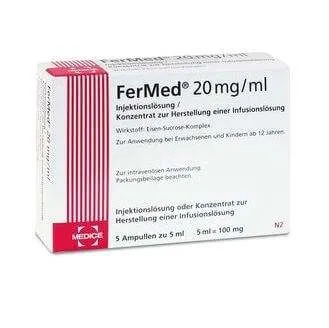
Table of Contents
- INSTRUCTION for medical use of the medicinal product FerMed® (FerMed®)
- The mixture should be prepared immediately before infusion administration; the infusion should be administered as indicated below:
- Before starting the first intravenous infusion, a test dose must be administered: 20 mg of iron should be given to adults over 15 minutes. If no adverse reactions occur, the remaining portion of the solution may be administered at the recommended rate. Intravenous bolus injection of the ampoule must be used immediately after opening. FerMed® can also be administered by slow intravenous injection at a rate of no more than 1 mL of undiluted solution per minute. This rate corresponds to 5 minutes for an ampoule containing 5 mL of concentrate. No more than 10 mL of solution (equivalent to 200 mg of iron) should be administered in a single injection. Prior to initiating administration, a test dose must be given: 1 mL (20 mg of iron) should be slowly administered to adults over 1–2 minutes. If no adverse effects occur during the observation period, which must last at least 15 minutes, the remaining portion of the therapeutic dose may be administered. Whenever possible, patients should be advised to keep their arm extended after administration and to apply pressure to the injection site to minimize paravenous reflux.
- Dose Calculation: Total Iron Deficiency [mg] = = Body Weight [kg] x (Target Hb – Actual Hb) [g/L] x 0.24\* + Iron Stores [mg], where:
- \*The coefficient 0.24 = 0.0034 x 0.07 x 1000 (iron content in Hb = 0.34%; blood volume = 7% of body weight; factor 1000 = conversion of grams (g) to milligrams (mg)). In patients with significant comorbidities (e.g., chronic kidney disease undergoing treatment with erythropoiesis-stimulating agents (ESAs)), the optimal target Hb may vary, and consequently, the dose calculation results may differ. In such cases, refer to the current treatment guidelines. The required amount of FerMedu® is calculated as shown below. Required Amount of FerMedu® [mL] = Total Iron Deficiency [mg] / 20 mg/mL
- If target hematological parameters are not achieved after 1–2 weeks of treatment, the initial diagnosis should be reviewed. Calculation of the dose for correction of iron deficiency due to blood loss or donation
- Adults and elderly patients
INSTRUCTION for medical use of the medicinal product FerMed® (FerMed®)
Composition:
Active substance: 1 ml of solution contains iron(III) hydroxide-sucrose complex, calculated as iron(III) – 20 mg.
Excipients: water for injections, sodium hydroxide.
Pharmaceutical form:
Injection solution.
Main physicochemical properties:
Dark brown solution, sweet in taste, free from precipitate.
Pharmacotherapeutic group:
Antianemic agents. Preparations of trivalent iron for parenteral use.
ATC code: B03AC.
Pharmacological properties:
Pharmacodynamics:
The surface of the polycyclic iron core is covered with a large number of non-covalently bound sucrose molecules, forming a complex with a molecular weight of approximately 43 kDa. This complex is sufficiently large to prevent renal elimination. The resulting complex is stable and does not release ionic iron under physiological conditions. Iron in the polycyclic core is bound in a structure similar to that of ferritin found in the body. Administration of FerMed® leads to physiological changes affecting iron absorption.
Pharmacokinetics:
Distribution: Maximum iron levels, averaging 538 µmol/L (30 mg/L), were reached within 10 minutes after injection. The volume of distribution of the central compartment corresponds almost entirely to plasma volume (approximately 3 L). The influence of age and gender on the pharmacokinetics of iron sucrose has not been studied.
Metabolism: Plasma clearance of 52Fe occurred within 60–100 minutes. 52Fe distributed to the liver, spleen, and bone marrow. Two to four weeks after administration, maximum utilization of 59Fe in erythrocytes ranged between 62–97%. Iron administered via injection was rapidly cleared from plasma, with an elimination half-life of approximately 6 hours. The volume of distribution during the plateau phase was approximately 8 L, indicating low distribution of iron into biological fluids. Due to the lower stability of iron sucrose compared to transferrin, competitive exchange of iron onto transferrin was observed. As a result, iron transport amounted to approximately 31 mg of iron over 24 hours.
Elimination: Renal excretion of iron occurring within the first 4 hours after injection accounted for less than 5% of total body clearance (approximately 20 mL/min). Within 24 hours, plasma iron levels returned to pre-dose levels, and approximately 75% of the administered sucrose dose was eliminated.
Clinical characteristics:
Indications:
Iron deficiency states in the following cases:
- Clinical necessity for rapid replenishment of iron stores;
- Intolerance to oral iron therapy;
- Active stage of inflammatory bowel disease, when oral iron preparations are ineffective.
Contraindications:
FerMed® is contraindicated in the following cases:
- Hypersensitivity to any component of the product or to other parenteral iron preparations;
- Anemia not associated with iron deficiency (e.g., hemolytic anemia, megaloblastic anemia due to vitamin B12 deficiency, disorders of erythropoiesis, bone marrow hypoplasia, anemia caused by lead poisoning);
- Conditions associated with iron overload (hemochromatosis, hemosiderosis) or hereditary disorders of iron metabolism (e.g., sideroblastic anemia, thalassemia, cutaneous porphyria).
Interaction with other medicinal products and other types of interactions:
Like all other parenteral iron preparations, FerMed® should not be administered concurrently with oral iron preparations, as absorption of oral iron is reduced. Therefore, treatment with oral iron preparations should be initiated no earlier than 5 days after the last injection of FerMed®.
Special precautions for use:
FerMed® should be administered only to patients whose diagnosis of anemia has been confirmed by appropriate laboratory tests (e.g., serum ferritin, hemoglobin (Hb), hematocrit (Ht), transferrin saturation, red blood cell count, or parameters such as mean corpuscular volume, mean corpuscular Hb content, or mean corpuscular Hb concentration).
Hypersensitivity reactions:
Parenterally administered iron preparations may cause hypersensitivity reactions, including serious and potentially fatal anaphylactic/anaphylactoid reactions. Hypersensitivity reactions have also been reported after previously uneventful parenteral administration of iron complexes. Cases of hypersensitivity reactions progressing to Kounis syndrome (acute allergic spasm of coronary arteries, which may lead to myocardial infarction) have been reported (see section "Adverse reactions").
Patients with known allergies, including drug intolerance, history of severe bronchial asthma, eczema, polyvalent allergy, allergic reactions to other parenteral iron preparations, or other forms of atopy, as well as patients with immunological and inflammatory diseases (e.g., systemic lupus erythematosus, rheumatoid arthritis), are at higher risk of hypersensitivity reactions.
FerMed® should be administered only when a physician experienced in the assessment and treatment of anaphylactic reactions is immediately available to provide full resuscitation therapy. Each patient should be monitored for adverse reactions for at least 30 minutes after each administration of FerMed®. If hypersensitivity reactions or signs of intolerance occur during administration, treatment must be discontinued immediately.
For immediate treatment of acute anaphylactic/anaphylactoid reactions, adrenaline (e.g., 0.3 mg intramuscularly) is recommended first, followed by antihistamines and/or corticosteroids (which have a delayed onset of action).
Parenteral iron preparations should be used with caution in patients with liver function disorders after careful benefit-risk assessment. Parenteral iron administration should be avoided in patients with liver dysfunction when iron overload is a triggering factor. Careful monitoring of iron levels is recommended to prevent iron overload.
In patients with elevated ferritin levels, parenteral iron preparations may negatively affect the course of bacterial or viral infections. Parenteral iron preparations should be used cautiously in cases of acute or chronic infection. In patients with chronic infection, a benefit-risk assessment should be performed. Administration of FerMed® should be discontinued in patients with bacteremia.
Caution is also required when administering the drug to individuals with low serum iron-binding capacity and/or folic acid deficiency. However, results from several studies in patients with hypersensitivity reactions to iron dextran or iron gluconate showed good tolerability of the drug in this patient group.
During administration, special attention must be paid to avoiding paravenous leakage. Paravenous leakage of the drug may cause pain, inflammation, tissue necrosis, and prolonged brown discoloration of the skin at the site. If paravenous leakage occurs, administration must be stopped immediately.
Decreased arterial blood pressure is commonly observed with intravenous iron preparations. Therefore, the drug should be used with caution. Recommended infusion rates must be strictly followed to prevent arterial hypotension. Higher incidence of adverse effects (particularly arterial hypotension) is associated with increased dose or infusion rate.
Particular caution is required when administering FerMed® to patients with hepatic insufficiency, decompensated liver cirrhosis, epidemic hepatitis, Rendu-Osler disease, acute-phase infectious kidney diseases, or uncontrolled hyperparathyroidism.
Before administration, ampoules should be inspected for the presence of precipitate or damage. Only a clear, homogeneous brown aqueous solution free from precipitate should be used. FerMed® should be administered immediately after opening the ampoule.
Stability after dilution:
Chemical and physical stability of the diluted solution has been demonstrated for 24 hours at 22 ± 2 °C. From a microbiological standpoint, the diluted infusion solution should be used immediately. If not used immediately, the responsibility for storage duration and conditions lies with the user. Storage should not exceed 24 hours at 2–8 °C.
Other components:
FerMed® contains less than 1 mmol (23 mg) of sodium per 5 mL, i.e., practically sodium-free.
Use during pregnancy or breastfeeding:
There is limited data on the use of iron sucrose complex in pregnant women during the first trimester. Further experience with FerMed® in pregnant women (from 300 to 1000 pregnancy outcomes) during the second and third trimesters has not shown safety concerns for mother or newborn. It is currently unknown whether iron(III) hydroxide-sucrose complex crosses the placenta. Iron bound to transferrin does not cross the placental barrier. Iron bound to lactoferrin passes into breast milk. Studies on the impact on iron levels in newborns have not been conducted.
FerMed® is contraindicated during the first trimester of pregnancy (see section "Contraindications"). Use during the second and third trimesters is possible only under strict medical indications. The benefit-risk ratio should be evaluated before administration during pregnancy, as hypersensitivity reactions may pose risks to both mother and fetus (see section "Special precautions for use").
Pre-pregnancy body weight should be considered when calculating the required iron dose to avoid overdose.
Bradycardia in the fetus may occur after parenteral iron administration, usually transient and secondary to maternal hypersensitivity reactions. Fetal status should be closely monitored during intravenous administration of parenteral iron preparations in pregnant women.
Data on excretion of iron into human breast milk after intravenous administration of iron sucrose are limited. In a clinical study of 10 healthy breastfeeding women with iron deficiency, 100 mg of iron as sucrose complex was administered. After four days of treatment, iron levels in breast milk were not elevated and did not differ from those in the control group (n = 5). An effect of iron from breast milk on the newborn/infant cannot be excluded; therefore, the benefit-risk ratio should be evaluated.
Reproductive toxicity studies in animals do not indicate direct or indirect harmful effects.
Ability to influence reaction speed when driving or operating machinery:
Generally, FerMed® does not affect the ability to drive or operate potentially hazardous machinery. However, patients experiencing dizziness or confusion after FerMed® administration should refrain from driving or operating machinery until symptoms have completely resolved.
Method of administration and dosage:
Route of administration:
FerMed® should be administered only intravenously via intravenous infusion or by slow intravenous injection, or directly into the vein of a limb connected to a dialysis apparatus. FerMed® must not be used for intramuscular injections.
Before the first therapeutic dose, a test dose should be administered. Resuscitation equipment must be available. If no adverse effects occur during the observation period (not less than 15 minutes), the remaining portion of the therapeutic dose may be administered.
Before administration, ampoules should be inspected for damage, and the injection solution should be checked for precipitate. Only homogeneous, precipitate-free solutions may be administered. If only part of the injection solution is used, the remaining portion must be discarded.
The maximum single dose of 200 mg of iron should not be exceeded, administered no more than 3 times per week.
Intravenous infusion of FerMed® should be diluted only in sterile 0.9% sodium chloride solution and administered primarily by infusion in the following dilution (in a 1:20 ratio):
1 ml of injection solution (equivalent to 20 mg of iron) – in 20 ml of 0.9 % saline solution; |
The mixture should be prepared immediately before infusion administration; the infusion should be administered as indicated below:
100 mg – |
at least 15 minutes; |
200 mg – 300 mg – |
within 30 minutes; |
Before starting the first intravenous infusion, a test dose must be administered: 20 mg of iron should be given to adults over 15 minutes. If no adverse reactions occur, the remaining portion of the solution may be administered at the recommended rate. Intravenous bolus injection of the ampoule must be used immediately after opening. FerMed® can also be administered by slow intravenous injection at a rate of no more than 1 mL of undiluted solution per minute. This rate corresponds to 5 minutes for an ampoule containing 5 mL of concentrate. No more than 10 mL of solution (equivalent to 200 mg of iron) should be administered in a single injection. Prior to initiating administration, a test dose must be given: 1 mL (20 mg of iron) should be slowly administered to adults over 1–2 minutes. If no adverse effects occur during the observation period, which must last at least 15 minutes, the remaining portion of the therapeutic dose may be administered. Whenever possible, patients should be advised to keep their arm extended after administration and to apply pressure to the injection site to minimize paravenous reflux.
Injection via dialysis apparatus
The solution must be used immediately after opening the ampoule. FerMed® may be administered directly into the venous limb of the dialysis circuit. The same dosage should be used as for intravenous injection or infusion.
Single and daily dose
The usual dose for adults is 5–10 mL of FerMed® (100–200 mg of iron), administered two or three times per week depending on the hemoglobin level.
Maximum individual dose |
By injection |
10 ml of FerMedu® (200 mg of iron) should be administered by injection over at least 10 minutes |
By infusion |
If necessary, according to clinical circumstances, the maximum single dose of FerMedu® that can be administered once weekly may be increased to 0.35 ml/kg body weight (corresponding to 7 mg iron/kg body weight). Overall, the single dose should never exceed 10 ml of FerMedu® (corresponding to 200 mg iron or 2 vials). It should be diluted in at least 200 ml of 0.9% (weight/vol.) sodium chloride solution for infusion and administered by infusion over at least 30 minutes |
Dose Calculation: Total Iron Deficiency [mg] = = Body Weight [kg] x (Target Hb – Actual Hb) [g/L] x 0.24* + Iron Stores [mg], where:
- for body weight up to 35 kg, the target Hb (hemoglobin) level is 130 g/L, and iron stores are 15 mg/kg;
- for body weight of 35 kg and above, the target Hb (hemoglobin) level is 150 g/L, and iron stores are 500 mg.
*The coefficient 0.24 = 0.0034 x 0.07 x 1000 (iron content in Hb = 0.34%; blood volume = 7% of body weight; factor 1000 = conversion of grams (g) to milligrams (mg)). In patients with significant comorbidities (e.g., chronic kidney disease undergoing treatment with erythropoiesis-stimulating agents (ESAs)), the optimal target Hb may vary, and consequently, the dose calculation results may differ. In such cases, refer to the current treatment guidelines. The required amount of FerMedu® is calculated as shown below. Required Amount of FerMedu® [mL] = Total Iron Deficiency [mg] / 20 mg/mL
Body weight [kg] |
Required amount of FerMed® [ml] |
|||
Hb 60 [g/L] |
Hb 75 [g/L] |
Hb 90 [g/L] |
Hb 105 [g/L] |
|
30 |
48 |
42 |
37 |
32 |
35 |
63 |
57 |
50 |
44 |
40 |
68 |
61 |
54 |
47 |
45 |
74 |
66 |
57 |
49 |
50 |
79 |
70 |
61 |
52 |
55 |
84 |
75 |
65 |
55 |
60 |
90 |
79 |
68 |
57 |
65 |
95 |
84 |
72 |
60 |
70 |
101 |
88 |
75 |
63 |
75 |
106 |
93 |
79 |
66 |
80 |
111 |
97 |
83 |
68 |
85 |
117 |
102 |
86 |
71 |
90 |
122 |
106 |
90 |
74 |
If target hematological parameters are not achieved after 1–2 weeks of treatment, the initial diagnosis should be reviewed. Calculation of the dose for correction of iron deficiency due to blood loss or donation
Known blood loss: |
|
Reduced Hb level: |
|
Example: |
body weight = 60 kg, Hb deficit = 10 g/l |
Adults and elderly patients
For injection: 10 mL of FerMedu® (200 mg iron), administered over not less than 10 minutes, given no more frequently than 3 times per week.
For infusion: depending on the indication, a single dose may reach up to 500 mg iron. The maximum recommended single dose is 7 mg iron per 1 kg body weight, administered once weekly, but should not exceed 25 mL of FerMedu® (500 mg iron). For administration time and dilution method, see above.
Children. The drug is indicated for use in children aged 12 years and older.
Overdose. Overdose may lead to acute iron overload, potentially resulting in hemochromatosis. In case of overdose, symptomatic treatment is recommended and, if necessary, administration of iron-chelating agents.
Adverse reactions. The most commonly reported adverse reaction in clinical trials was taste disturbance (dysgeusia), occurring at a frequency of 4.5 cases per 100 study participants. Other common adverse reactions included nausea, arterial hypotension, arterial hypertension, and infusion site pain, each occurring at a frequency of 1 to 2 cases per 100 individuals.
The most important serious adverse reactions observed in clinical trials were hypersensitivity reactions, occurring at a frequency of 0.25 cases per 100 study participants. Immediate-type hypersensitivity reactions (anaphylactoid/anaphylactic reactions) were rare. Overall, anaphylactoid and anaphylactic reactions are very serious adverse events that may be life-threatening (see section "Special precautions for use"). Symptoms include, among others, circulatory collapse, arterial hypotension, tachycardia, respiratory symptoms (bronchospasm, angioedema of the larynx and pharynx), gastrointestinal symptoms (abdominal pain, vomiting), or skin reactions (urticaria, erythema, pruritus).
Adverse reactions reported in 4064 participants of clinical trials following administration of iron sucrose, as well as adverse reactions reported during the post-marketing period, are listed below.
Adverse effects are classified by frequency of occurrence into the following categories:
- Very common (> 1/10)
- Common (> 1/100, < 1/10)
- Uncommon (> 1/1000, < 1/100)
- Rare (> 1/10000, < 1/1000)
- Very rare (< 1/10000)
- Frequency not known (available data do not allow estimation of frequency; these events were reported exclusively during post-marketing surveillance, not in clinical trials)
Infections and infestations
- Rare: pneumonia
Blood and lymphatic system disorders
- Uncommon: polycythemia1
Immune system disorders
- Uncommon: hypersensitivity reactions
- Rare: anaphylactoid reactions
- Frequency not known: angioedema
Metabolism and nutrition disorders
- Rare: iron overload
Nervous system disorders
- Common: transient taste disturbances, particularly metallic taste (dysgeusia)
- Uncommon: headache, dizziness, burning sensation, paresthesia, hypoesthesia
- Rare: syncope, migraine, somnolence
- Frequency not known: loss of consciousness, altered consciousness, confusion, anxiety, tremor
Cardiac disorders
- Common: arterial hypotension and collapse, tachycardia
- Rare: palpitations
- Frequency not known: bradycardia, Koilonychia syndrome
Vascular disorders
- Common: arterial hypotension, arterial hypertension
- Uncommon: thrombophlebitis, phlebitis
- Rare: flushing
- Frequency not known: circulatory collapse, superficial venous thrombosis
Respiratory, thoracic and mediastinal disorders
- Uncommon: dyspnea
- Frequency not known: bronchospasm
Renal and urinary disorders
- Uncommon: chromaturia
Gastrointestinal disorders
- Common: nausea
- Uncommon: vomiting, abdominal pain, diarrhea, constipation
- Rare: dry mouth
Skin and subcutaneous tissue disorders
- Uncommon: pruritus, rash
- Frequency not known: urticaria, erythema
Musculoskeletal and connective tissue disorders
- Uncommon: muscle cramps, myalgia, arthralgia, limb pain, back pain
- Rare: discomfort in limbs, muscle spasms
- Frequency not known: hypotonia
General disorders and administration site conditions
- Common: injection site pain, reactions at injection/infusion site
- Uncommon: chills, asthenia, fatigue, pain, irritation reactions, transudation, brown discoloration of the skin, burning sensation, swelling and inflammation at injection site, peripheral edema
- Rare: feeling of warmth, chest pain, hyperhidrosis, fever, pruritus at injection site, hematoma at injection site
- Very rare: cold sweat, pallor, malaise, edema, influenza-like illness with onset varying from several hours to several days
Investigations
- Uncommon: increased gamma-glutamyl transferase levels, increased ALT levels, increased AST levels, liver function test abnormalities
- Rare: increased serum ferritin levels1, increased blood creatinine levels, increased blood lactate dehydrogenase levels
1 May occur as a result of overdose or iron overload.
Reporting suspected adverse reactions
Reporting of suspected adverse reactions after drug authorization is important. It allows continued monitoring of the benefit-risk balance of the medicinal product. Healthcare professionals are encouraged to report any suspected adverse reactions in accordance with applicable reporting requirements.
Shelf life. 24 months.
Storage conditions. Store in the original packaging at a temperature not exceeding 25 °C. Keep out of the reach of children. Do not freeze.
Incompatibilities. FerMedu® should only be mixed with sterile 0.9% (w/v) sodium chloride solution. Mixing with other medicinal products is not permitted.
Packaging. 5 mL solution in an ampoule, 5 ampoules per cardboard box.
Prescription status. Prescription only.
Manufacturer. Medice Arzneimittel Putter GmbH & Co. KG.
Manufacturer's address. Kuhloweg 37, 58638 Iserlohn, Germany.