Entrop
Ukraine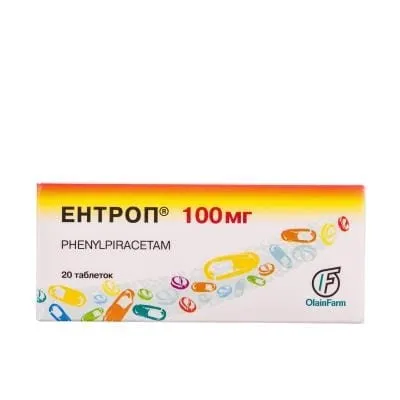
Table of Contents
INSTRUCTION FOR MEDICAL USE OF THE MEDICINAL PRODUCT ENTROP® (ENTROP®)
Composition:
Active substance: phenylpiracetam;
One tablet contains 50 mg or 100 mg of phenylpiracetam;
Excipients: potato starch; lactose monohydrate; povidone; sodium starch glycolate (type A); calcium stearate.
Pharmaceutical form. Tablets.
Main physico-chemical characteristics: flat cylindrical tablets with a bevel edge, white to white with a creamy shade.
Pharmacotherapeutic group.
Psychostimulants and nootropics. ATC code N06BX.
Pharmacological properties.
Pharmacodynamics.
Enthrop® exerts a direct stimulating effect on the integrative activity of the brain, promotes memory consolidation, improves attention concentration and mental performance, facilitates the learning process, increases brain tissue resistance to hypoxia and toxic influences, exhibits anticonvulsant action and anxiolytic activity, regulates activation and inhibition processes in the central nervous system, and improves mood.
The drug positively affects metabolic processes and cerebral circulation, stimulates oxidative-reduction processes, increases the body's energy potential by enhancing glucose utilization, and improves regional blood flow in ischemic areas of the brain. It increases the brain levels of norepinephrine, dopamine, and serotonin, does not affect the concentration of gamma-aminobutyric acid (GABA), does not bind to either GABAA or GABAB receptors, and has no significant effect on spontaneous bioelectrical brain activity.
Enthrop® does not affect respiration or the cardiovascular system, exhibits a mild diuretic effect, and has anorexigenic activity during course administration.
The stimulating action of Enthrop® is manifested in its ability to moderately enhance motor responses, increase physical performance, exhibit a pronounced antagonism to the cataleptic effect of neuroleptics, and reduce the sedative effects of ethanol and hexenal.
The psychostimulant effect of Enthrop® is predominantly expressed in the ideational domain. The moderate psychostimulant effect of the drug is combined with anxiolytic activity, improves mood, and produces a certain analgesic effect by increasing the pain sensitivity threshold.
The adaptogenic action of the drug is evident in increasing the body's resistance to stress under conditions of excessive mental and physical loads, increased fatigue, hypokinesia and immobilization, and low temperatures.
Administration of Enthrop® has been associated with improved vision, manifested by increased visual acuity and expansion of visual fields.
Enthrop® improves blood supply to the lower extremities.
Enthrop® stimulates antibody production in response to antigen administration, indicating its immunostimulatory properties; however, at the same time, it does not promote the development of immediate-type hypersensitivity and does not alter the skin allergic inflammatory reaction induced by foreign protein administration.
With repeated administration, Enthrop® does not lead to drug dependence, tolerance, or withdrawal syndrome.
The drug's effects are evident after a single dose, which is important for its use under extreme conditions.
The drug has no teratogenic, mutagenic, carcinogenic, or embryotoxic properties. Toxicity is low; the lethal dose in acute experiments is 800 mg/kg.
Pharmacokinetics.
The drug is rapidly absorbed, penetrates various organs and tissues, and readily crosses the blood-brain barrier. Absolute bioavailability after oral administration is 100%. Maximum blood concentration is reached within 1 hour; the elimination half-life is 3–5 hours. The drug is not metabolized in the body and is excreted unchanged. Approximately 40% is excreted in urine and 60% in bile and sweat.
Clinical characteristics.
Indications.
Diseases of the central nervous system of various origins, especially those associated with vascular disorders and metabolic disturbances in the brain, accompanied by impairment of intellectual and mnemonic functions, and decreased motor activity.
Neurotic states manifested by lethargy, increased fatigability, reduced psychomotor activity, attention deficits, memory deterioration, and impaired information acquisition.
Mild to moderate depressions.
Psychorganic syndromes characterized by intellectual-mnemonic disorders and apathetic-abulic symptoms, as well as lethargic-apathetic states in schizophrenia.
Convulsive states.
Prophylaxis of hypoxia, enhancement of stress resistance, correction of functional status under extreme conditions of professional activity to prevent fatigue development and to improve mental and physical performance, correction of circadian rhythm, inversion of the sleep-wake cycle.
Chronic alcoholism (to reduce asthenic symptoms, depression, and intellectual-mnemonic impairments).
Contraindications.
Hypersensitivity to the components of the drug.
Interaction with other medicinal products and other forms of interactions.
May enhance the effects of central nervous system stimulants, antidepressants, and nootropic agents; enhances and prolongs the action of hypnotics, narcotics, and antiparkinsonian agents.
Special precautions.
In cases of excessive psycho-emotional exhaustion against a background of chronic stress and fatigue, or chronic insomnia, a single dose of Enthropo® on the first day may cause a sudden need for sleep. Outpatients with such conditions should be advised to start the treatment course on non-working days.
Enthropo® should be used with caution in patients with severe liver or kidney impairment, severe arterial hypertension, atherosclerosis, as well as in patients with a history of panic attacks or acute psychotic states involving psychomotor agitation—due to the possibility of exacerbating symptoms of anxiety, panic, hallucinations, and delirium. It should also be used with caution in patients prone to allergic reactions to nootropic agents of the pyrrolidone class.
The drug contains lactose; therefore, it should not be administered to patients with rare hereditary forms of galactose intolerance, lactase deficiency, or glucose-galactose malabsorption syndrome.
Use during pregnancy or breastfeeding.
The drug is contraindicated during pregnancy or breastfeeding.
Ability to influence reaction speed when driving or operating machinery.
The drug is not recommended for use when driving or operating machinery that requires heightened attention.
Dosage and Administration.
Take orally, immediately after meals.
The dosage and duration of treatment are determined individually by a physician, depending on the patient's condition.
The average single dose is 150 mg (ranging from 100 mg to 250 mg); the average daily dose is 250 mg (ranging from 200 mg to 300 mg). The maximum allowable daily dose is 750 mg. The daily dose should be divided into 2 administrations.
A daily dose of up to 100 mg should be taken once in the morning, while doses exceeding 100 mg should be divided into two daily doses. The duration of treatment may vary from 2 weeks to 3 months. The average treatment duration is 30 days. If necessary, the course may be repeated after 1 month (following consultation with a physician).
For improved work capacity – 100–200 mg once in the morning for 2 weeks (for athletes – 3 days).
It is not recommended to take Enthrop® after 3:00 PM.
Children.
The drug should not be administered to children.
Overdose.
In case of overdose, adverse reactions may be intensified.
Treatment: symptomatic therapy.
Adverse Reactions
Adverse reactions are listed according to their frequency of occurrence: very common (≥ 1/10), common (≥ 1/100, < 1/10), uncommon (≥ 1/1000, < 1/100), rare (≥ 1/10000, < 1/1000), very rare (<1/10000), frequency not known (available data do not allow estimation of frequency).
Insomnia (when the drug is taken later than 3 p.m.) – frequency not known. In some patients, during the first 1–3 days of treatment, psychomotor agitation, skin hyperemia, and sensation of warmth may occur – frequency not known.
Central nervous system:
Uncommon – headache, irritability, dizziness, tearfulness, aggression, sleep disturbances, restlessness, insomnia, somnolence;
Rare – transient hypnagogic hallucinations, obsessive states, depression, weakness, apathy, hypomania.
Cardiovascular system:
Uncommon – increased arterial pressure, worsening of symptoms of coronary insufficiency.
Allergic reactions:
Uncommon – rash, pruritus;
Rare – hyperemia and hyperkeratosis of the skin of the palms;
Frequency not known – urticaria, angioedema.
Gastrointestinal tract:
Rare – dry mouth, dysgeusia (bitter taste in the mouth).
Shelf life.
4 years.
Storage conditions.
Store in a dry, light-protected place at a temperature not exceeding 25 °C.
Keep out of reach of children.
Packaging.
10 tablets in a blister pack. 1 or 2 blisters in a cardboard box.
Prescription status.
Tablets 50 mg № 10, № 20, 100 mg № 10 – over-the-counter.
Tablets 100 mg № 20 – prescription only.
Manufacturer.
JSC «Olainfarm».
Manufacturer’s address.
5 Rupnicu street, Olaine, LV-2114, Latvia.