Exifin
Ukraine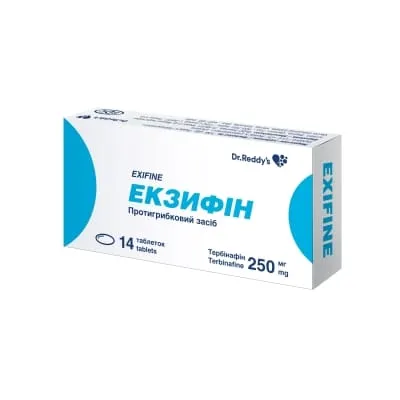
Table of Contents
INSTRUCTIONS FOR MEDICAL USE OF THE MEDICINAL PRODUCT EXIFINE (EXIFINE)
Composition:
Active substance: terbinafine;
1 tablet contains terbinafine hydrochloride equivalent to 250 mg of terbinafine;
Excipients: microcrystalline cellulose, anhydrous lactose, sodium croscarmellose, povidone, sodium starch glycolate (type A), talc, colloidal anhydrous silicon dioxide, magnesium stearate.
Pharmaceutical form. Tablets.
Main physicochemical properties: oval, biconvex tablets, white to almost white, smooth on both sides.
Pharmacotherapeutic group. Antifungal agents for dermatological use. Systemic antifungal agents. Terbinafine.
ATC code D01B A02.
Pharmacological Properties
Pharmacodynamics
Terbinafine is an allylamine with a broad spectrum of activity against fungal infections of the skin, hair, and nails caused by dermatophytes such as Trichophyton (e.g., T. rubrum, T. mentagrophytes, T. verrucosum, T. tonsurans, T. violaceum), Microsporum (e.g., Microsporum canis), Epidermophyton floccosum, as well as yeasts of the genus Candida (e.g., Candida albicans) and Pityrosporum. At low concentrations, terbinafine exerts a fungicidal effect against dermatophytes, molds, and some dimorphic fungi. Activity against yeasts may be either fungicidal or fungistatic, depending on the species.
Terbinafine specifically inhibits an early step in sterol biosynthesis within the fungal cell. This leads to a deficiency of ergosterol and intracellular accumulation of squalene, resulting in fungal cell death. Terbinafine acts by inhibiting the enzyme squalene epoxidase in the fungal cell membrane. This enzyme does not belong to the cytochrome P450 system. Inhibition of squalene epoxidase leads to ergosterol deficiency and intracellular accumulation of squalene, which causes fungal cell death.
When administered orally, the drug accumulates in the skin, hair, and nails at concentrations sufficient to exert a fungicidal effect.
Pharmacokinetics
After oral administration, terbinafine is well absorbed (˃ 70%); due to presystemic metabolism, the absolute bioavailability of terbinafine in Exifine tablets is approximately 50%. A single oral dose of 250 mg terbinafine results in a mean peak plasma concentration of 1.30 µg/mL, reached 1.5 hours after administration. At steady state, compared to a single dose, the maximum concentration of terbinafine is on average 25% higher, and the plasma AUC increases by a factor of 2.3. Based on the increase in plasma AUC, the effective half-life is estimated to be approximately 30 hours. Food has only a minor effect on terbinafine bioavailability (an increase in AUC of no more than 20%), so dose adjustment is not required. However, concomitant intake of a high-fat meal slows the absorption of terbinafine and increases its bioavailability by approximately 20%.
Terbinafine is highly bound to plasma proteins (99%). The volume of distribution exceeds 2000 L. It rapidly penetrates the superficial layers of the skin and accumulates in the lipophilic stratum corneum.
Terbinafine also penetrates into sebaceous gland secretions, resulting in high concentrations in hair follicles, hair, and skin rich in sebaceous glands. It has also been shown to penetrate into nail plates within the first few weeks of therapy. There are insufficient data on whether terbinafine crosses the placental barrier. Less than 0.2% of the administered dose is excreted in breast milk.
Terbinafine is rapidly and extensively metabolized by at least seven cytochrome P450 isoenzymes, primarily CYP2C9, CYP1A2, CYP3A4, CYP2C8, and CYP2C19. The metabolites formed during biotransformation lack antifungal activity and are primarily excreted in the urine. The terminal elimination half-life is 17 hours. There have been no reports of accumulation. Age does not affect the steady-state plasma concentration of terbinafine. However, in patients with impaired renal or hepatic function, elimination of the drug may be slowed, leading to higher blood concentrations of terbinafine.
The bioavailability of terbinafine is not affected by food intake.
Pharmacokinetic studies of single doses in patients with impaired renal function (creatinine clearance ˂ 50 mL/min) or pre-existing liver disease have shown that drug clearance may be reduced by approximately 50%.
Clinical characteristics.
Indications.
Fungal infections of skin and nails caused by Trichophyton (e.g., T. rubrum, T. mentagrophytes, T. verrucosum, T. violaceum), Microsporum canis, and Epidermophyton floccosum.
- Tinea infections (tinea of smooth skin, tinea cruris, and tinea pedis) in cases where the location, severity, or extent of infection warrants systemic (oral) therapy.
- Onychomycosis.
Contraindications.
Acute or chronic liver disease.
Hypersensitivity to terbinafine or to any of the excipients of the drug.
Interaction with other medicinal products and other forms of interaction.
Effect of other medicinal products on terbinafine.
Plasma clearance of terbinafine may be increased by drugs that induce metabolism and may be decreased by drugs that inhibit cytochrome P450. If concomitant treatment with such drugs is necessary, the dosage of terbinafine should be adjusted accordingly.
Medicinal products that may reduce the effect or plasma concentrations of terbinafine.
Rifampicin increases the clearance of terbinafine by 100%. AUC and Cmax values are reduced by 50% and 45%, respectively.
Medicinal products that may increase the effect or plasma concentrations of terbinafine.
Cimetidine reduces the clearance of terbinafine by 30%.
Fluconazole increases Cmax and AUC of terbinafine by 52% and 69%, respectively, due to inhibition of CYP2C9 and CYP3A4 enzymes. Similar increases in these parameters may occur when terbinafine is used concomitantly with other drugs that inhibit CYP2C9 and CYP3A4, such as azole antifungals (ketoconazole), macrolide antibiotics, and amiodarone.
Effect of terbinafine on other medicinal products.
Terbinafine has minimal potential to inhibit or enhance the clearance of drugs metabolized by the cytochrome P450 system (e.g., terfenadine, triazolam, tolbutamide, or oral contraceptives), except for drugs metabolized by CYP2D6.
CYP2D6 substrates.
In vitro and in vivo studies have shown that terbinafine inhibits CYP2D6-mediated metabolism. These findings are particularly relevant for substances primarily metabolized by this enzyme, especially those with a narrow therapeutic index. These data may be clinically significant for patients receiving drugs from the following classes: tricyclic antidepressants, beta-blockers, selective serotonin reuptake inhibitors (SSRIs), antiarrhythmic agents (including class IA, IB, and IC), or monoamine oxidase inhibitors type B (MAO-B inhibitors).
Terbinafine reduces the clearance of desipramine by 82% and increases AUC fivefold.
In rapid metabolizers of CYP2D6, terbinafine increased the urinary metabolic interaction ratio of dextromethorphan/dextrorphan on average by 16–97 times. This indicates that terbinafine slows the metabolism of CYP2D6 substrates in rapid metabolizers ("extensive metabolizers"), so that metabolism in these patients resembles that in slow metabolizers ("poor metabolizers").
Other metabolic pathways.
Terbinafine increases the clearance of cyclosporine by 15% (decrease in AUC by 13%).
Terbinafine does not affect the clearance of antipyrine or digoxin.
No effect of terbinafine on the pharmacokinetics of fluconazole was observed. Furthermore, no clinically significant interactions were observed between terbinafine and concomitantly administered medicinal products with potential for interaction, such as co-trimoxazole (trimethoprim and sulfamethoxazole), zidovudine, or theophylline.
There have been reports of some cases of menstrual cycle disturbances (intermenstrual bleeding and irregular menstrual cycles) in patients who concurrently took terbinafine and oral contraceptives, although the frequency of these events remains within the range of adverse reaction rates in patients taking only oral contraceptives.
Terbinafine may increase the effect or plasma concentrations of the following medicinal products:
Caffeine – terbinafine reduces the clearance of intravenously administered caffeine by 21%.
In vitro and in vivo studies have demonstrated that terbinafine inhibits CYP2D6-mediated metabolism. Therefore, close monitoring is required in patients who are concurrently receiving terbinafine and drugs metabolized by CYP2D6, such as tricyclic antidepressants (TCAs), beta-blockers, selective serotonin reuptake inhibitors (SSRIs), antiarrhythmic agents (including class IA, IB, and IC), and monoamine oxidase inhibitors (MAO-Is) type B – particularly when the co-administered drug has a narrow therapeutic concentration range.
Terbinafine reduces the clearance of desipramine by 82%.
In studies involving healthy volunteers who were rapid metabolizers of dextromethorphan (an antitussive agent and a marker substrate for CYP2D6), terbinafine increased the urinary metabolic interaction ratio of dextromethorphan/dextrorphan on average by 16–97 times. Thus, terbinafine administration may change the metabolic status of rapid CYP2D6 metabolizers to that of slow metabolizers.
Terbinafine may reduce the effect or plasma concentrations of the following medicinal products.
Terbinafine increases the clearance of cyclosporine by 15%.
In patients receiving terbinafine concomitantly with warfarin, changes in International Normalized Ratio (INR) and/or prothrombin time may occur.
Special precautions.
Liver function.
Terbinafine is contraindicated in patients with chronic or acute liver disease. Liver function should be assessed before initiating treatment in all patients with pre-existing liver disorders. In patients with pre-existing liver disease, the clearance of terbinafine may be reduced by approximately 50%.
Hepatotoxicity may occur in patients both with and without pre-existing liver disease; therefore, periodic monitoring of liver function is recommended (after 4–6 weeks of treatment). If liver function tests become elevated, the drug should be discontinued immediately.
Very rare cases of severe liver failure have been reported in patients taking terbinafine (some of which were fatal, and some required liver transplantation). In most of these cases, patients had serious underlying systemic diseases, and the causal relationship with oral terbinafine administration was questionable (see section "Adverse reactions").
Patients taking terbinafine should be informed to immediately report to their physician any signs or symptoms suggestive of liver dysfunction, such as pruritus, persistent unexplained nausea, decreased appetite, anorexia, jaundice, vomiting, increased fatigue, right upper abdominal pain, dark urine, or pale stools. In patients presenting with such symptoms, the drug should be discontinued immediately, and liver function should be promptly evaluated.
Taste disturbances.
Disturbances of taste and loss of taste have been reported during treatment with terbinafine. These may lead to reduced appetite, weight loss, anxiety, and depressive symptoms. If taste disturbances occur, the drug should be discontinued.
Smell disturbances.
Disturbances and loss of smell have also been reported. These disturbances may resolve after discontinuation of therapy, but may also be prolonged (more than 1 year) or permanent. If olfactory disturbances occur, the drug should be discontinued.
Depressive symptoms.
Depressive symptoms may occur during treatment with this drug, which may require medical intervention.
Cutaneous effects.
Very rare cases of serious skin reactions, including Stevens-Johnson syndrome and toxic epidermal necrolysis, have been reported during treatment with terbinafine. If progressive skin rashes occur, treatment with the drug should be discontinued. Terbinafine should be used with caution in patients with psoriasis or cutaneous or systemic lupus erythematosus, as very rare cases of exacerbation of these conditions have been reported.
Hematological effects.
Very rare cases of blood dyscrasias have been reported with terbinafine use, including neutropenia, agranulocytosis, thrombocytopenia, and pancytopenia.
Any blood dyscrasia in patients should be thoroughly evaluated, and consideration should be given to modifying the dosing regimen, including discontinuation of the drug.
The clearance of terbinafine may be reduced by 50% in patients with pre-existing liver disease.
Renal function.
The use of terbinafine has not been adequately studied in patients with renal impairment (creatinine clearance less than 50 mL/min or serum creatinine levels greater than 300 µmol/L), and therefore its use is not recommended in such patients.
Other.
Terbinafine should be used with caution in patients with lupus erythematosus, as very rare cases of symptom exacerbation have been reported.
General.
Personal hygiene measures should be followed to prevent reinfection (e.g., from infected underwear, socks, footwear, etc.).
Interactions.
In vitro and in vivo studies have shown that terbinafine is an inhibitor of the CYP2D6 enzyme. Patients should be closely monitored when concomitantly using drugs that are primarily metabolized by this enzyme (e.g., tricyclic antidepressants, beta-blockers, selective serotonin reuptake inhibitors, antiarrhythmic drugs (including class 1A, 1B, and 1C), or monoamine oxidase type B inhibitors), especially if they have a narrow therapeutic index.
Note.
Unlike topical terbinafine, oral terbinafine is not indicated for the treatment of pityriasis versicolor.
The product contains lactose and therefore should not be used in patients with rare hereditary conditions of galactose intolerance, lactase deficiency, or glucose-galactose malabsorption syndrome.
Use during pregnancy or breastfeeding.
Animal studies investigating the toxic effects of the drug on fertility and fetal development did not reveal any adverse effects.
Clinical experience with the use of terbinafine during pregnancy is very limited; therefore, it should not be used during pregnancy except when the woman's clinical condition requires treatment with oral terbinafine and the expected benefit to the mother outweighs any potential risk to the fetus.
The drug passes into breast milk. Therefore, if treatment with the tablet form is necessary, breastfeeding should be discontinued during the treatment period.
Ability to affect reaction speed when driving or operating machinery.
During treatment, some patients may experience central nervous system adverse events (e.g., headache, dizziness, depression, anxiety). Therefore, patients should refrain from driving or operating machinery.
Dosage and Administration
The duration of treatment depends on the nature and severity of the disease course.
Adults: The drug should be administered at a dose of 250 mg once daily.
Skin infections
Recommended duration of treatment:
- Tinea pedis (interdigital, plantar/moccasin type): 2–6 weeks;
- Tinea corporis: 4 weeks;
- Tinea cruris: 2 to 4 weeks;
- Cutaneous candidiasis: 2–4 weeks.
Complete resolution of infection symptoms and associated complaints may occur only several weeks after mycological cure.
Scalp infections
Recommended duration of treatment:
- Dermatophytic scalp infection: 4 weeks.
Fungal infections of the scalp occur predominantly in children.
Onychomycosis
Duration of treatment for most patients ranges from 6 weeks to 3 months. Treatment shorter than 3 months may be considered for patients with fingernail involvement, toenails excluding the great toe, or younger patients. For treatment of toenail infections, 3 months is usually sufficient, although some patients may require 6 months or longer. Longer treatment periods are necessary for patients with reduced nail growth rate during the initial weeks of therapy.
Complete resolution of signs and symptoms of infection may not occur until several weeks after mycological cure. This is due to the regrowth of healthy nail tissue.
Special populations
Patients with hepatic impairment
Terbinafine tablets are not recommended for patients with chronic or active liver disease.
Patients with renal impairment
The use of terbinafine tablets has not been adequately studied in patients with renal impairment and is therefore not recommended for this patient group.
Elderly patients
There is no evidence that dosage adjustment is required in elderly patients or that adverse reactions differ from those observed in younger patients. However, in this age group, potential impairment of liver or kidney function should be taken into account when administering the drug.
Missed dose
If a patient forgets to take a dose, the next dose should be taken as soon as remembered. However, considering the pharmacokinetic properties of terbinafine, a missed dose should not be taken if the interval between the missed dose and the next scheduled dose is less than 4 hours.
Children
Due to limited data on the use of the drug in children, it is not recommended for this age group.
Overdose
After administration of 5 g of terbinafine, headache, nausea, epigastric pain, and dizziness have been reported. Overdose may lead to an increase in the severity of adverse reactions.
Treatment: Gastric lavage and administration of activated charcoal. Symptomatic therapy if necessary.
Adverse Reactions
Adverse reactions are usually mild to moderate in intensity and transient. The undesirable effects listed below were observed during clinical studies of the drug or in the course of post-marketing surveillance.
The following classification was used to assess the frequency of various adverse reactions:
Very common (≥1/10); common (≥1/100, <1/10); uncommon (≥1/1000, <1/100); rare (≥1/10,000, <1/1000); very rare (<1/10,000), frequency not known (cannot be estimated based on available data).
Blood and lymphatic system disorders.
Very rare – neutropenia, agranulocytosis, thrombocytopenia, pancytopenia.
Frequency not known – anemia, pancytopenia.
Immune system disorders.
Very rare – anaphylactoid reactions (including Quincke's edema), cutaneous and systemic lupus erythematosus.
Frequency not known – anaphylactic reaction, serum sickness-like reactions (e.g., rash, pruritus, urticaria, edema, arthralgia, fever, and lymphadenopathy).
Metabolism and nutrition disorders.
Very common – decreased appetite.
Uncommon – weight loss (due to dysgeusia). Severe individual cases of reduced food intake leading to significant weight loss have been reported.
Psychiatric disorders.
Common – depression.
Uncommon – restlessness.
Nervous system disorders.
Very common – headache.
Common – dizziness, dysgeusia up to complete loss of taste. Taste disturbances, including loss of taste, which usually resolve within several weeks after discontinuation of the drug. Very rare reports of prolonged taste disturbance, sometimes leading to reduced food intake and significant weight loss.
Uncommon – paraesthesia, hypoaesthesia.
Very rare – persistent dysgeusia.
Frequency not known – hyposmia, including persistent anosmia, hyposmia.
Eye disorders.
Common – visual disturbances.
Frequency not known – blurred vision, decreased visual acuity.
Ear and labyrinth disorders.
Uncommon – tinnitus.
Frequency not known – hearing loss, hearing impairment, vertigo.
Vascular disorders.
Frequency not known – vasculitis.
Gastrointestinal disorders.
Very common – gastrointestinal symptoms (feeling of stomach fullness, dyspepsia, nausea, abdominal pain, diarrhea).
Frequency not known – pancreatitis.
Hepatobiliary disorders.
Rare – cases of serious liver function abnormalities, including liver failure, elevated liver enzymes, jaundice, cholestasis, and hepatitis. If liver function abnormalities develop, treatment with Exifin must be discontinued. Very rare reports of severe liver failure (some cases fatal or requiring liver transplantation). In most cases of liver failure, patients had serious underlying systemic diseases, and the causal relationship with terbinafine intake was questionable.
Skin and subcutaneous tissue disorders.
Very common – mild skin reactions (rash, urticaria).
Uncommon – photosensitivity (e.g., photodermatosis, photosensitization reaction, polymorphic light eruption).
Very rare – serious skin reactions (e.g., erythema multiforme, Stevens-Johnson syndrome, toxic epidermal necrolysis). Alopecia. Treatment with Exifin must be discontinued if progressive skin rashes occur.
Psoriasis-like rashes or exacerbation of psoriasis. Serious skin reactions (e.g., acute generalized exanthematous pustulosis).
Frequency not known – rash with eosinophilia and systemic symptoms (DRESS syndrome).
Musculoskeletal and connective tissue disorders.
Very common – musculoskeletal reactions (arthralgia, myalgia).
Frequency not known – rhabdomyolysis.
General disorders.
Common – increased fatigue.
Rare – malaise.
Uncommon – fever.
Frequency not known – influenza-like illness, pyrexia.
Laboratory test results.
Frequency not known – elevated blood creatine phosphokinase.
Other adverse drug reactions reported during post-marketing surveillance based on spontaneous reports.
The adverse drug reactions listed below have been identified from post-marketing spontaneous reports and are categorized by system organ classes.
Since these reports are voluntary and from an unknown population size, it is not always possible to reliably estimate their frequency.
Immune system disorders: anaphylactic reactions, serum sickness-like reactions, hypersensitivity reactions, including allergic reactions (e.g., anaphylaxis).
Nervous system disorders: anosmia, including persistent anosmia, hyposmia, hypoesthesia, paraesthesia.
Eye disorders: blurred vision, decreased visual acuity.
Vascular disorders: vasculitis.
Gastrointestinal disorders: pancreatitis.
Skin and subcutaneous tissue disorders: rash with eosinophilia and systemic symptoms, exfoliative and bullous dermatitis.
Musculoskeletal and connective tissue disorders: rhabdomyolysis.
General disorders: influenza-like illness.
Investigations: elevated blood creatine phosphokinase, changes in prothrombin time (prolongation, shortening) in patients concurrently receiving warfarin.
Shelf life. 3 years.
Storage conditions.
Store at temperatures not exceeding 30 °C. Keep out of reach of children.
Packaging.
7 tablets per blister; 1 or 2 blisters per cardboard box.
A holographic strip with the name of the manufacturer is located on the blister.
Prescription status. Prescription only.
Manufacturer.
FDC Limited.
Manufacturer's address and place of business.
L-56/57, Phase II-D, Verna Industrial Estate, Verna, Salcete, Goa - 403 722, India.