Dentol 10 %
Ukraine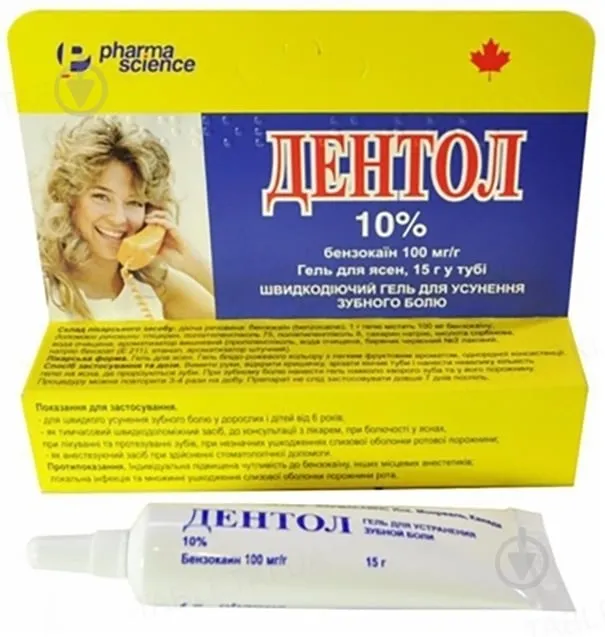
Table of Contents
INSTRUCTIONS FOR MEDICAL USE OF THE MEDICINAL PRODUCT DENTOL 7.5%, 10% (DENTOL 7.5%, 10%)
Composition:
Active ingredient: benzocaine;
Dentol 7.5%, 1 g of gel contains 75 mg of benzocaine;
Excipients: glycerol, polyethylene glycol 75, polyethylene glycol 8, sodium saccharin, sorbic acid, purified water, FD&C Red No. 40 lake dye (E 129), cherry flavor (propylene glycol, purified water, Red No. 2 lake dye, sodium benzoate (E 211), ethanol, artificial flavor).
Dentol 10%, 1 g of gel contains 100 mg of benzocaine;
Excipients: glycerol, polyethylene glycol 75, polyethylene glycol 8, sodium saccharin, sorbic acid, purified water, cherry flavor (propylene glycol, purified water, Red No. 2 lake dye, sodium benzoate (E 211), ethanol, artificial flavor).
Pharmaceutical form. Gel for gums.
Main physicochemical properties: pale pink gel with a mild fruity odor, of uniform consistency.
Pharmacotherapeutic group. Local anesthetics.
ATC code N01BA05.
Pharmacological Properties.
Pharmacodynamics.
Benzocaine is a local anesthetic that reduces membrane permeability to sodium ions and blocks nerve impulse conduction.
Pharmacokinetics.
Benzocaine is poorly absorbed. The effect begins 1 minute after application and lasts for 15–20 minutes. Absorbed drug is rapidly hydrolyzed by blood and liver cholinesterases and is excreted by the kidneys.
Clinical Characteristics.
Indications.
Dentol 7.5 %:
- for rapid relief of teething pain in children from 4 months of age and older;
- as a temporary emergency aid for toothache in children of all ages;
- for pain relief during dental treatment, minor injuries of the oral mucosa, and aphthous stomatitis.
Dentol 10 %:
- for rapid relief of toothache in adults and children aged 6 years and older;
- as a temporary emergency aid, prior to consulting a physician, for painful gums, during dental treatment and denture fitting, and in minor injuries of the oral mucosa;
- as an anesthetic agent during dental procedures.
Contraindications.
Hypersensitivity to benzocaine or other local anesthetics; local infection and multiple injuries of the oral mucosa.
Interaction with other medicinal products and other forms of interaction.
Cholinesterase inhibitors may suppress benzocaine metabolism, increasing the risk of systemic toxicity. Benzocaine may reduce the antibacterial activity of sulfonamides.
Special precautions for use.
Do not exceed the recommended dose, frequency, or duration of administration. It is not recommended to use the product more than 4 times daily or for longer than 7 consecutive days.
If symptoms do not resolve within 7 days, or if irritation, pain, or redness persist or worsen, or if swelling, rash, or fever develop, consult a physician immediately.
There have been reports that products containing benzocaine may cause methemoglobinemia. Symptoms such as cyanosis of the skin, lips, and nail beds, headache, dizziness, shortness of breath (difficulty breathing), weakness, and tachycardia observed during treatment may indicate potentially life-threatening methemoglobinemia and require immediate medical intervention.
Use during pregnancy or breastfeeding.
Use with caution during pregnancy or breastfeeding, weighing the benefit-risk ratio.
Ability to affect reaction speed when driving or operating machinery.
The product does not affect the ability to drive or operate machinery.
Method of administration and dosage.
Wash your hands, open the cap, cut the tip of the tube, and apply a small amount of the gel to the gums where teeth are erupting. In case of toothache, apply the gel around the affected tooth and into its cavity. The procedure can be repeated 3–4 times a day.
The drug should not be used for longer than 7 consecutive days.
Children. Do not use the drug in children under 4 months of age.
Use of the drug in children under 2 years of age is recommended under the supervision of a physician or healthcare professional.
Overdose.
Overdose is unlikely when all recommendations are followed. However, in individual cases, toxic effects on the central nervous system may occur (visual disturbances, convulsions, tinnitus, drowsiness, sensation of heat or cold, excitement, confusion, dizziness, numbness, anxiety, restlessness); cardiovascular depression (sweating, arterial hypotension, pallor, arrhythmia, cardiac arrest); and development of methemoglobinemia.
Treatment. In case of overdose, rinse the mouth with warm soda solution and seek immediate medical attention. Treatment is symptomatic.
Side effects.
Adverse reactions may occur due to exceeding the recommended doses, increased absorption rate, or hypersensitivity, including allergic contact dermatitis (skin rash, redness, itching, or urticaria); angioneurotic edema (swelling of the skin or mucous membranes of the mouth and throat); burning sensation, fever. If any of these symptoms occur, discontinue use of the product and consult a physician.
When using benzocaine, methemoglobinemia may very rarely occur (manifested as cyanosis of the skin, lips, and nail beds, headache, dizziness, shortness of breath, weakness, tachycardia).
Shelf life. 4 years.
Storage conditions.
Store out of reach of children at a temperature not exceeding 30 °C.
Packaging.
15 g per tube, 1 tube in a cardboard box.
Availability. Over-the-counter (without prescription).
Manufacturer. Pharmascience Inc.
Manufacturer's address.
6111 Royalmount Avenue, Suite 100, Montreal, Quebec H4P 2T4, Canada.
Date of last review.