Biovien
Ukraine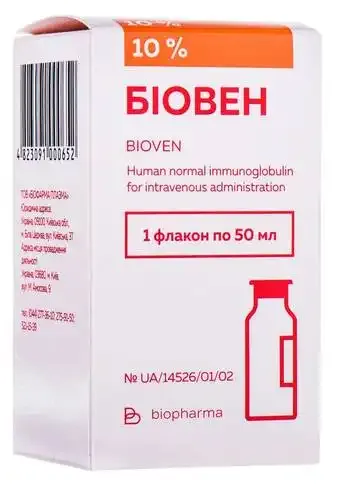
Table of Contents
I N S T R U C T I O N for medical use of the medicinal product BIOVEN (BIOVEN)
Composition:
Active substance: human normal immunoglobulin;
1 ml of the preparation contains 0.1 g of human normal immunoglobulin (including not less than 98% immunoglobulin G (IgG));
Excipients: glycine; water for injections.
Dosage form. Solution for infusion.
Main physico-chemical properties: clear or slightly opalescent, colorless or slightly yellowish liquid.
Pharmacotherapeutic group. Human normal immunoglobulin for intravenous administration.
ATC code J06BA02.
Pharmacological properties.
Pharmacodynamics.
The product is an immunologically active protein fraction (subclass distribution of immunoglobulin G in the product: IgG1: 65.6%, IgG2: 22.1%, IgG3: 10.8%, IgG4: 1.5%). The maximum content of immunoglobulin A in the product is 50 mcg/ml.
The active component of the product is antibodies possessing specific activity against various disease-causing agents—viruses and bacteria, including hepatitis A and B, cytomegalovirus, human herpesvirus types 1, 2, and 6, Epstein-Barr virus, varicella-zoster virus, influenza, measles, mumps, poliomyelitis, rubella, pertussis, staphylococcus, Escherichia coli, pneumococcus, tetanus and diphtheria toxins. It also has non-specific activity manifested by increasing the body's resistance.
The product has low spontaneous anticomplementary activity.
The product is native immunoglobulin G, preserving all biological properties: complement activation, effector and opsono-phagocytic functions.
The product is an immunologically active protein fraction isolated from human serum or plasma tested for the absence of antibodies to HIV-1, HIV-2, hepatitis C virus, and hepatitis B surface antigen, purified and concentrated by alcohol-water fractionation, and subjected to viral inactivation by solvent-detergent method and nanofiltration.
Clinical studies.
In an open, international, multicenter Phase III study conducted in accordance with the "Guideline on the clinical investigation of human normal immunoglobulin for intravenous administration (IVIg)" dated 28 June 2018 (EMA/CHMP/BPWP/94033/2007 rev.3, Committee for Medicinal Products for Human Use [CHMP]), the efficacy, safety, and some pharmacokinetic parameters of Bioven were evaluated in patients with primary immunodeficiencies (PID). Patients received Bioven once every 4 weeks for 1 year at an average dose of 0.5 g/kg body weight. Immunoglobulin levels, frequency of infections, and clinical and biochemical blood parameters were assessed. Additionally, key parameters of cardiac and respiratory function, body temperature, and all possible adverse reactions were monitored.
During 1 year of treatment, one case of severe infection was recorded (2.3%, or 0.023 cases per patient per year). The median minimum immunoglobulin concentration in plasma was significantly higher than the minimal target level of 5 g/L, reaching 8.6 g/L after 6 months and 8.8 g/L after 1 year.
In a group of 49 patients receiving Bioven, 20 adverse events of mild (2%) and moderate (0.5%) severity were recorded, totaling 2.5% of infusion episodes. No clinically significant laboratory abnormalities related to the product administration or requiring treatment discontinuation were observed. Bioven was administered to 18 patients (adults and children) with gradually increasing infusion rates. During the first stage, the infusion rate increased up to 5.0 ml/kg/h (0.08 ml/kg/min); during the second stage, up to 7.0 ml/kg/h (0.11 ml/kg/min). The maximum infusion rate during the third stage was 8.5 ml/kg/h (0.14 ml/kg/min). The incidence of adverse events was low (2 events in 35 individual infusions), all were mild and not correlated with infusion rate. Based on the frequency of adverse events and assessment of vital parameters, the tolerability of Bioven at the maximum infusion rate of 8.5 ml/kg/h (0.14 ml/kg/min) was rated as good in 94.0% of patients and satisfactory in 6.0%.
The clinical efficacy of Bioven used as part of combination therapy in patients with severe pneumonia caused by coronavirus infection COVID-19/SARS-CoV-2 is attributed to its immunomodulatory properties. As a result, the severity of acute respiratory distress syndrome is reduced, leading to a decrease in respiratory failure.
Clinical efficacy was confirmed in the clinical trial titled "Open multicenter randomized study to evaluate the efficacy of Bioven manufactured by LLC 'Biopharma Plasma' in combination therapy of patients with pneumonia caused by coronavirus infection COVID-19/SARS-CoV-2" (study code — 2020-BV-BP).
The study included 76 patients with a diagnosis confirmed according to all criteria. Of 66 patients who passed screening and had no exclusion criteria, participants were randomized into two groups (study group — Bioven + standard therapy; control group — standard therapy only).
Respiratory function, general condition, duration of intensive care needs, need for mechanical ventilation (MV), and total treatment duration were assessed. Additionally, survival during the 28-day observation period, blood laboratory parameters (complete and biochemical analyses), cytokine levels, inflammatory markers, and other immune system parameters were evaluated.
The study results demonstrated superior efficacy for the primary endpoint.
Significantly faster improvement in clinical status was observed: in the study group on day 5 (interquartile range — 3.50–7.25 days), in the control group on day 9 (interquartile range — 6.00–14.75 days), p = 0.0073. The probability of achieving clinical stabilization was significantly higher in the study group by a factor of 2.27 (95% confidence interval [CI] — 1.26–4.11, p = 0.006) compared to the control group.
Superior efficacy was also confirmed for secondary endpoints. When Bioven was used in the treatment regimen, mortality from COVID-19 was significantly lower: in the study group — 6.25% (2 out of 32 participants), in the control group — 23.63% (8 out of 34 participants), p = 0.039.
A significant reduction in the duration of lymphopenia was also observed. The median time to reach lymphocyte levels of 1000 cells/mm³ or higher was 4 days (interquartile range — 3.00–5.00 days) in the study group and 7 days (interquartile range — 3.00–7.50 days) in the control group, p = 0.0097.
Pharmacokinetics.
High efficacy of the product is ensured by rapid and 100% delivery of antibodies into the bloodstream and normal elimination half-life.
After intravenous administration, the bioavailability of normal human immunoglobulin in the recipient's circulation is immediate and complete. It rapidly distributes between plasma and extravascular fluid, with equilibrium between intravascular and extravascular compartments achieved approximately within 3–5 days.
Normal human immunoglobulin has a half-life of approximately 40 days. This half-life may vary among individual patients, especially in those with primary immunodeficiency. IgG and IgG complexes are degraded in cells of the reticuloendothelial system.
A clinical study evaluating selected pharmacokinetic parameters of Bioven was conducted in 22 patients. Cmax was 19.94 ± 4.73 g/L, Tmax was 0.63 hours, AUC (0–t) was 8309.60 ± 2631.49 g·h/L. Immunoglobulin levels in plasma remained stably above the minimal target level of 5 g/L for at least 28 days after a single dose of Bioven.
Clinical characteristics.
Indications.
The medicinal product is indicated for replacement immunotherapy in adults, children and adolescents in the treatment of primary and secondary immunodeficiency states and associated diseases:
- primary immunodeficiency syndromes: congenital agammaglobulinaemia or hypogammaglobulinaemia, severe combined immunodeficiency, unclassified variable immunodeficiency, Wiskott–Aldrich syndrome;
- secondary antibody deficiency syndrome: cytopenias of various etiologies (acute and chronic leukaemia, aplastic anaemia, condition after cytostatic therapy), severe forms of bacterial-toxic and viral infections (including surgical complications accompanied by bacteraemia and septicopyaemic conditions, and complications during preparation of surgical patients for operation);
- autoimmune diseases: idiopathic thrombocytopenic purpura with high risk of bleeding or prior to surgical intervention — for correction of platelet count, Guillain–Barré syndrome, chronic inflammatory demyelinating neuropathy, inflammatory myopathy, Wegener's granulomatosis, dermatomyositis, connective tissue systemic diseases (rheumatoid arthritis), Kawasaki syndrome;
- bone marrow transplantation.
Replacement therapy in adults, children and adolescents (0–18 years) in cases of:
- primary immunodeficiency syndromes (PID) with impaired antibody production;
- secondary immunodeficiencies (SID) in patients suffering from severe or recurrent infections, ineffective antimicrobial treatment, or when specific antibody deficiency (SAD*) or serum IgG level <4 g/L has been demonstrated.
*SAD – inability to achieve at least a two-fold increase in IgG titre against pneumococcal polysaccharide and polypeptide antigen vaccines.
Use as part of combination therapy in adult patients with severe pneumonia caused by coronavirus infection COVID-19 / SARS-CoV-2.
Contraindications.
Hypersensitivity to any of the components of the drug. Hypersensitivity to homologous immunoglobulins, especially in very rare cases of IgA deficiency when the patient has antibodies to IgA. Administration of immunoglobulin is contraindicated in individuals with a history of severe allergic reactions to administration of human blood protein products. Patients suffering from allergic diseases or predisposed to allergic reactions should receive antihistamines during immunoglobulin administration and for the following 8 days. The drug should be administered to patients with immunopathological systemic diseases (immune blood disorders, collagenoses, nephritis) only after consultation with the appropriate specialist. Administration of the drug during exacerbation of allergic conditions should be performed only after allergist evaluation and based on vital indications.
Special safety precautions.
Some serious adverse reactions may be related to the rate of infusion. Patients receiving immunoglobulin for the first time usually experience mild adverse effects more frequently than those on regular immunoglobulin therapy. The infusion rate parameters specified below should be strictly followed, and patients must be closely monitored during and for 1 hour after the first infusion. If adverse reactions occur, the infusion rate should be reduced or administration stopped until symptoms resolve. If symptoms persist after stopping administration, symptomatic therapy is recommended. In case of shock, anti-shock therapy guidelines should be followed. For patients with diabetes mellitus and risk of renal impairment, as well as for patients with systemic lupus erythematosus with kidney involvement, creatinine levels should be measured for 3 days after administration. During subsequent infusions, patients should be closely monitored for 20 minutes after completion of administration.
BIOVEN should be administered only in hospital settings under strict aseptic conditions.
A dedicated infusion system must be used for administration of the drug.
Prior to use, BIOVEN should be equilibrated at (20±2) °C for at least 2 hours.
The solution should be clear or slightly opalescent, colourless or slightly yellow. Solutions that are cloudy, contain particulate matter, or have sediment must not be used.
Interaction with other medicinal products and other forms of interaction. Treatment with this medicinal product may be combined with any other medicinal products.
Live attenuated viral vaccines
Administration of immunoglobulins may reduce the efficacy of live attenuated viral vaccines against measles, rubella, mumps, and varicella for a period ranging from 6 weeks to 3 months. At least 3 months should elapse after administration of this product before vaccination with live attenuated viral vaccines. In the case of measles vaccination, this reduction in vaccine efficacy may last up to 1 year. Therefore, antibody status should be checked in patients receiving measles vaccine.
The drug should not be administered earlier than 2 weeks after vaccination; if earlier administration of BIOVEN is required, measles or mumps vaccination should be repeated. Vaccinations against other infections may be performed at any time before or after administration of the drug.
Effect on serological test results
Following immunoglobulin injection, transient elevation in blood levels of various passively transferred antibodies may lead to false-positive results in serological tests.
Passive transfer of antibodies to erythrocyte antigens, such as A, B or D, may affect certain serological tests for detection of alloantibodies to erythrocytes (e.g. Coombs test), reticulocyte count, and haptoglobin levels.
Special precautions for use.
Warnings regarding administration of the drug
Some severe adverse reactions may be associated with the rate of infusion. The recommended infusion rate must be strictly observed. The patient should be closely monitored, and careful observation for any symptoms should be maintained throughout the entire infusion period.
Some adverse reactions may occur more frequently:
- in case of high infusion rate;
- in patients receiving normal human immunoglobulin for the first time, and rarely when switching to normal human immunoglobulin or when a long interval has passed since the previous infusion.
Potential complications can be avoided by ensuring that:
- patients are tolerant to normal human immunoglobulin during the first slow infusion;
- patients are under careful monitoring for any symptoms throughout the entire infusion period. In particular, to detect signs of potential adverse effects, patients should be monitored during the first infusion and for 1 hour after the first infusion, including those who have not previously received immunoglobulin products, those who have received treatment with an alternative product, and those who have had a prolonged interval since the last immunoglobulin administration. Such patients require monitoring throughout the entire first infusion period and for 1 hour after completion of the infusion. All other patients should be under medical supervision for the first 20 minutes after administration.
If an adverse reaction occurs, the infusion rate should be reduced or the infusion stopped. The necessary treatment depends on the nature and severity of the adverse reaction. In case of shock development, appropriate therapeutic measures should be implemented according to established guidelines for anti-shock therapy.
For all patients receiving IgG, the following should be ensured:
- adequate hydration prior to starting IgG infusion;
- monitoring of diuresis;
- monitoring of serum creatinine levels;
- avoidance of concomitant use of loop diuretics.
Hypersensitivity
Serious allergic reactions may occur. Therefore, individuals who have received the drug should remain under medical supervision for 30 minutes. In case such reactions occur, the infusion of Bioven should be immediately discontinued and appropriate treatment initiated. Patients with IgA deficiency and pre-existing antibodies to IgA are at significant risk of developing serious allergic and anaphylactoid reactions that may occur following administration of Bioven.
In rare cases, normal human immunoglobulin may cause a decrease in blood pressure with anaphylactic reaction, even in patients who have previously received immunoglobulin therapy.
Renal impairment
Cases of acute renal failure, including acute renal failure, acute tubular necrosis, proximal tubular nephropathy, and osmotic nephrosis, have been reported in patients undergoing IgG therapy. In most cases, risk factors were identified, such as pre-existing renal impairment, diabetes mellitus, hypovolemia, obesity, concomitant nephrotoxic drugs, age of 65 years or older, sepsis, or paraproteinemia.
Reports of renal dysfunction and acute renal failure have been associated with the use of many licensed IgG products containing various excipients such as sucrose, glucose, and maltose. A particularly high proportion of cases relates to products containing sucrose as a stabilizer. For patients at increased risk, consideration should be given to using IgG products that do not contain the aforementioned excipients.
Prior to initiating Bioven infusion, it should be ensured that the patient shows no signs of dehydration.
For patients at potential risk of developing acute renal failure, periodic monitoring of renal function and diuresis should be performed. Renal function parameters, including blood urea nitrogen (BUN)/serum creatinine levels, should be assessed before the first administration of Bioven and at regular intervals thereafter. If renal function deteriorates, administration of the drug should be discontinued.
For patients at potential risk of developing renal dysfunction and/or thrombotic complications, the amount of Bioven administered per unit of time should be cautiously reduced.
Hyperproteinemia
Hyperproteinemia, increased serum viscosity, and hyponatremia may occur in patients receiving immunoglobulin therapy. Hyponatremia may manifest as pseudohyponatremia, characterized by decreased calculated plasma osmolality or increased osmolar gap. It is clinically important to distinguish true hyponatremia from pseudohyponatremia, as in cases of reduced free water in serum, targeted treatment of patients with pseudohyponatremia may lead to dehydration, thereby increasing serum viscosity and potentially causing thromboembolic complications.
Thromboembolic complications
Thrombosis may occur as a result of treatment with immunoglobulin products. Risk factors include obesity, history of atherosclerosis, impaired cardiac output, arterial hypertension, diabetes mellitus with history of vascular disease and thrombosis, acquired or hereditary thrombophilia, severe hypovolemia, conditions increasing blood viscosity, advanced age, prolonged immobilization, hypercoagulable states, history of venous or arterial thrombosis, estrogen use, use of permanent central vascular catheters, increased blood viscosity, and cardiovascular disease risk. Thrombosis may also occur even in the absence of known risk factors.
A general assessment of blood viscosity should be performed in patients at risk of increased viscosity, including conditions associated with cryoglobulins, fasting chylomicronemia/notably high triglyceride (triglyceride) levels, or monoclonal gammopathy. For patients at risk of thrombosis, administration of immunoglobulin products should be performed at the lowest possible doses and at the minimal infusion rate. Adequate hydration of the patient should be ensured before administration. Patients at risk of increased viscosity should be monitored for symptoms of thrombosis and blood viscosity should be assessed.
Aseptic meningitis syndrome
Aseptic meningitis syndrome (AMS) has been reported to occur rarely in association with immunoglobulin therapy. Discontinuation of treatment with such products leads to AMS remission without complications within several days. This syndrome typically appears within several hours to two days after immunoglobulin treatment and rapid infusion. It is characterized by symptoms including severe headache, nuchal rigidity, drowsiness, fever, photophobia, pain on eye movement, nausea, and vomiting. Cerebrospinal fluid (CSF) analysis results often show pleocytosis with several thousand cells per mm³, predominantly granulocytic, and elevated protein levels up to several hundred mg/dL. Patients presenting with such symptoms should undergo neurological evaluation, including CSF analysis, to exclude other causes of meningitis. Patients with a history of migraines are more susceptible. Meningitis syndrome may occur more frequently with high-dose IgG treatment.
Hemolysis
Immunoglobulin products may contain blood group antibodies that can act as hemolysins and promote in vivo coating of erythrocytes with immunoglobulin, leading to a positive direct antiglobulin test and, rarely, hemolysis. Hemolytic anemia may occur as a result of immunoglobulin therapy due to increased erythrocyte sequestration. Patients receiving immunoglobulin therapy should be monitored for clinical signs of hemolysis. If such symptoms appear after intravenous immunoglobulin infusion, laboratory tests should be performed to confirm hemolysis.
Transfusion-related acute lung injury (TRALI)
Non-cardiogenic pulmonary edema (transfusion-related acute lung injury (TRALI)) has been reported in patients receiving immunoglobulin. TRALI is characterized by severe respiratory distress, pulmonary edema, hypoxemia, normal left ventricular function, and fever, typically occurring within 1–6 hours after transfusion. Patients with TRALI may require oxygen therapy with appropriate additional lung ventilation.
Patients receiving immunoglobulin should be monitored for respiratory adverse reactions. If TRALI is suspected, appropriate testing for anti-neutrophil antibodies should be performed both in the product and in the patient's serum.
Laboratory tests
Appropriate laboratory tests should be performed to confirm hemolysis if symptoms of hemolysis occur after intravenous immunoglobulin infusion.
If TRALI is suspected, appropriate testing for anti-neutrophil antibodies should be performed both in the product and in the patient's serum.
Due to the potential increased risk of thrombosis, blood viscosity should be evaluated in patients at risk of increased viscosity, including cryoglobulinemia, fasting chylomicronemia/notably high triglyceride (triglyceride) levels, or monoclonal gammopathy.
General information
The product is manufactured from human plasma. Standard measures to prevent infection transmission through medicinal products prepared from human blood or plasma include donor selection, testing of donor blood samples and plasma pools for specific infection markers, and inclusion of effective manufacturing steps for virus inactivation/removal. Nevertheless, when administering medicinal products prepared from human blood or plasma, it is impossible to completely exclude the risk of transmission of infections. This also applies to unknown and new viruses and other pathogens.
The measures taken are considered effective against enveloped viruses such as HIV, hepatitis B virus, and hepatitis C virus. Regarding non-enveloped viruses such as hepatitis A virus and parvovirus B19, these measures may have limited effectiveness. Clinical experience convincingly demonstrates absence of transmission of hepatitis A virus and parvovirus B19 with administration of human immunoglobulin products. Furthermore, the presence of antibodies is expected to significantly contribute to enhanced viral safety.
The product does not contain preservatives or antibiotics.
Elderly patients
In patients aged 65 years and older, there may be a risk of developing certain adverse reactions, such as thromboembolic complications and acute renal failure.
Use during pregnancy or breastfeeding
The safety of using this product in pregnant women has not been established by controlled clinical trials; therefore, it should be used cautiously in pregnant women and nursing mothers. Studies of IgG administration during pregnancy have shown that it crosses the placenta, particularly in the third trimester. Clinical experience with immunoglobulins suggests that no harmful effects on pregnancy, the fetus, or the newborn are expected.
Immunoglobulins pass into breast milk and may contribute to transfer of protective antibodies to the newborn.
Clinical experience with immunoglobulins shows no effect on fertility.
Ability to influence the speed of reactions when driving vehicles or operating machinery
No influence on the ability to drive vehicles or operate machinery has been observed.
Administration and Dosage
Bioven should be administered intravenously by drip infusion at an initial rate of 0.5–1.0 mL/kg body weight/hour for 30 minutes. If no adverse reactions occur, the infusion rate may be gradually increased (recommended increment: 0.5–1.5 mL/kg body weight/hour every 10 minutes). According to clinical studies, the maximum infusion rate is 8.5 mL/kg body weight/hour.
For congenital agammaglobulinemia or hypogammaglobulinemia, severe combined immunodeficiency, Wiskott–Aldrich syndrome, and unclassified variable immunodeficiency: 4–5 mL (0.4–0.5 g)/kg (minimum dose – 2 mL (0.2 g)/kg, maximum dose – 8 mL (0.8 g)/kg) every 3–4 weeks. The dose should be individually adjusted depending on the severity of infectious manifestations (optimal is achieving a serum IgG level of 5 g/L, but not less than 3–4 g/L).
For replacement therapy in secondary immunodeficiency: usually 2–4 mL (0.2–0.4 g)/kg every 3–4 weeks.
For cytopenias of various etiologies (acute and chronic leukemia, aplastic anemia, post-cytostatic therapy condition): 2–4 mL (0.2–0.4 g)/kg/day for 4–5 days or 10 mL (1 g)/kg/day for 2 days.
For severe bacterial-toxic and viral infections (including surgical complications associated with bacteremia and septicopyemic conditions, and in preparation of surgical patients for surgery): 4 mL (0.4 g)/kg/day for 1–4 days.
For idiopathic thrombocytopenic purpura: 2–4 mL (0.2–0.4 g)/kg/day for 2–5 days or 8–10 mL (0.8–1 g)/kg/day on the first day and, if necessary, on the third day.
For Guillain–Barré syndrome, chronic inflammatory demyelinating neuropathy, inflammatory myopathy, and Wegener’s granulomatosis: 2–4 mL (0.2–0.4 g)/kg/day for 3–7 days; if necessary, 5-day treatment courses may be repeated every 4 weeks.
For dermatomyositis: 10 mL (1 g)/kg/day for 3–5 days.
For systemic connective tissue diseases (rheumatoid arthritis, etc.): 2–5 mL (0.2–0.5 g)/kg/day for 5 days.
For Kawasaki syndrome: 10–20 mL (1–2 g)/kg in equal doses over 2–5 days or 20 mL (2 g)/kg as a single dose (in addition to acetylsalicylic acid therapy).
For bone marrow transplantation: 5 mL (0.5 g)/kg as a single dose 7 days before transplantation, followed by weekly infusions for 3 months after transplantation.
For use as part of combination therapy in adult patients with severe pneumonia caused by coronavirus infection COVID-19 / SARS-CoV-2 (see section "Indications"), the recommended dose is 0.8–1.0 g/kg body weight/day for 2 days (total course dose: 1.6–2.0 g/kg body weight).
The frequency of infusions and the infusion rate are determined by the physician based on the patient’s condition. The daily dose may be adjusted to avoid exceeding the maximum allowable daily volume of infusion therapy. Monitoring of the blood coagulation system and diuresis is mandatory, especially in patients with excess body weight.
Pediatric patients. Doses for children (aged 0 to 18 years) do not differ from those for adults, as the dose for each indication is based on body weight and adjusted according to clinical response.
Children. The medicinal product may be used in pediatric practice (see section "Indications").
Overdose.
Overdose may lead to hypervolemia and increased blood viscosity, particularly in at-risk patients, including elderly patients or those with impaired renal function.
Adverse reactions.
Blood and lymphatic system disorders: anemia, lymphadenopathy, hemolysis, leukopenia, hemolytic anemia.
Immune system disorders: hypersensitivity, anaphylactic shock, anaphylactic reaction, anaphylactoid reaction, angioneurotic edema, facial swelling.
Endocrine disorders: thyroid function disorders.
Nervous system disorders: headache, cerebrovascular disorder, aseptic meningitis, migraine, dizziness, paresthesia, hypoesthesia, amnesia, burning sensation, dysarthria, dysgeusia, loss of balance, transient ischemic attack, tremor.
Psychiatric disorders: excitement, anxiety, insomnia.
Cardiac disorders: myocardial infarction, tachycardia, palpitations, cyanosis.
Vascular disorders: peripheral vascular insufficiency, arterial hypotension, arterial hypertension, peripheral coldness, phlebitis, deep vein thrombosis.
Respiratory, thoracic and mediastinal disorders: respiratory failure, pulmonary embolism, pulmonary edema, bronchospasm, dyspnea, cough, increased respiratory rate, rhinorrhea, asthma, nasal congestion, oropharyngeal edema, pharyngolaryngeal pain.
Gastrointestinal disorders: nausea, vomiting, diarrhea, abdominal pain.
Skin and subcutaneous tissue disorders: eczema, urticaria, rash, erythematous rash, dermatitis, pruritus, alopecia, cold sweat, photosensitivity reactions, night sweats.
Musculoskeletal and connective tissue disorders: back pain, limb pain, arthralgia, muscle spasms, muscle twitching, myalgia.
Renal and urinary disorders: acute renal failure, proteinuria.
Eye disorders: conjunctivitis, eye pain, eye swelling.
Ear disorders: vertigo, fluid in the inner ear.
General disorders and administration site conditions: fever, influenza-like symptoms, weakness, chest discomfort, pain, chest tightness, asthenia, malaise, peripheral edema, hot flushes, fatigue, chills, flushing, hyperemia, hyperhidrosis; reactions at the infusion site including pain, increased sensitivity, hyperemia, swelling, phlebitis, pruritus.
Investigations: increased liver enzymes, false positive blood glucose levels, increased blood creatinine, elevated blood cholesterol, elevated blood urea, decreased hematocrit, decreased erythrocyte count, positive direct Coombs test, decreased oxygen saturation.
Infections and infestations: bronchitis, nasopharyngitis, chronic sinusitis, mycosis, infection, kidney infection, sinusitis, upper respiratory tract infection, urinary tract infection, bacterial urinary tract infection.
Injury, poisoning and procedural complications: contusion, transfusion-related acute lung injury.
Children. In clinical studies of the drug Bioven, most adverse reactions in children were mild and resolved spontaneously or in response to simple interventions (reducing the rate of intravenous infusion or temporarily stopping the infusion).
Reporting of adverse reactions after drug registration is important. It allows continuous monitoring of the benefit-risk balance of the drug. Medical and pharmaceutical professionals, as well as patients or their legal representatives, should report all suspected adverse reactions and lack of efficacy of the drug via the Automated Information System for Pharmacovigilance at the following link: https://aisf.dec.gov.ua.
Shelf life. 3 years.
Shelf life when stored at temperatures not exceeding 25°C – 6 months.
Storage conditions.
Store in the original packaging to protect from light at a temperature between 2°C and 8°C. Do not freeze. When stored at temperatures not exceeding 25°C, the shelf life is 6 months. After this period, the product must not be placed in the refrigerator and must be disposed of.
Any unused product or waste should be disposed of in accordance with current legislation.
Packaging. 50 ml or 100 ml in a vial. 1 vial in a box.
Prescription status. Prescription only.
Manufacturer. LLC "BIOPHARMA PLAZMA", Ukraine.
Manufacturer's address and location of manufacturing site.
Legal address: 37-V Kyivska St., Bila Tserkva, Kyiv Oblast, 09100, Ukraine.
Address of manufacturing site:
37-V Kyivska St., Bila Tserkva, Kyiv Oblast, 09100, Ukraine.