Azopt
Ukraine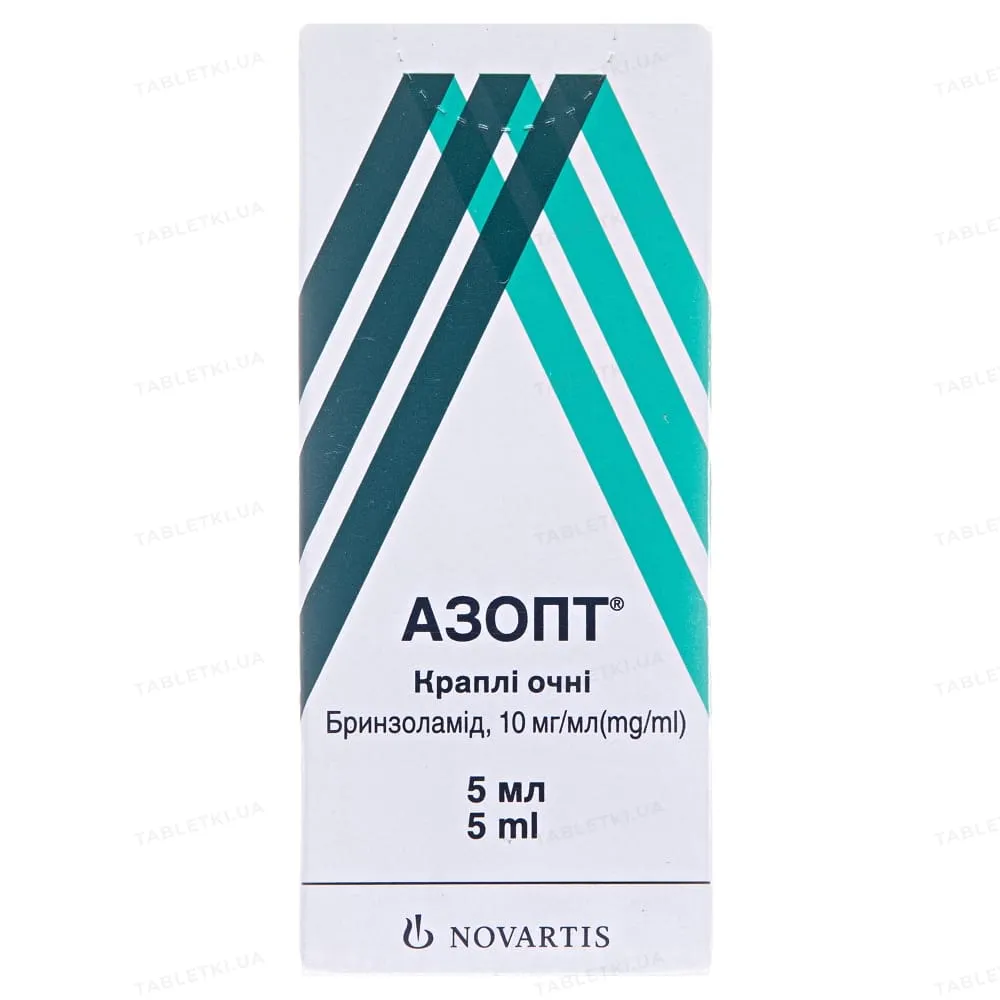
|
INSTRUCTION for medical use of medicinal product AZOPT® (AZOPT®) Composition: active substance: brinzolamide; 1 ml of suspension contains 10 mg of brinzolamide; excipients: benzalkonium chloride, mannitol (E 421), carbomer 974P, tyloxapol, disodium edetate, sodium chloride, hydrochloric acid concentrated and/or sodium hydroxide (for pH adjustment), purified water. Pharmaceutical form. Eye drops. Main physicochemical properties: white or almost white homogeneous suspension. Pharmacotherapeutic group. Medicinal products used in ophthalmology. Antiglaucoma agents and miotics. Carbonic anhydrase inhibitors. ATC code S01E C04. Pharmacological properties. Pharmacodynamics. Carbonic anhydrase (CA) is an enzyme found in many tissues of the human body, including ocular tissues. Carbonic anhydrase catalyzes the reversible reaction of carbon dioxide hydration and carbonic acid dehydration. Inhibition of carbonic anhydrase in the ciliary body of the eye reduces aqueous humor secretion, primarily by slowing the formation of bicarbonate ions, followed by a reduction in sodium and fluid transport. As a result, intraocular pressure (IOP), which is a major risk factor in the pathogenesis of optic nerve damage and visual field loss due to glaucoma, is reduced. Brinzolamide is an inhibitor of carbonic anhydrase II (CA-II), the predominant isoenzyme in the eye, with in vitro IC50 of 3.2 nM and Ki of 0.13 nM against CA-II. The IOP-lowering effect of AZOPT® used in combination with the prostaglandin analogue travoprost was studied. After 4 weeks of travoprost treatment, patients with IOP ≥ 19 mmHg were additionally randomized to receive brinzolamide or timolol. Additional reduction in mean diurnal IOP ranged from 3.2 to 3.4 mmHg in the brinzolamide group and from 3.2 to 4.2 mmHg in the timolol group. Ophthalmological adverse reactions of mild severity, mainly related to local irritation, were most frequently observed in the brinzolamide-travoprost groups. Adverse effects were mild and generally did not influence the decision to discontinue participation in the study (see also section "Adverse reactions"). A clinical study of AZOPT® use was conducted in 32 children under 6 years of age diagnosed with glaucoma and ocular hypertension. Some patients had not previously received treatment for IOP, while others were already using other IOP-lowering medications. Patients using IOP-lowering agents did not discontinue their medications prior to starting monotherapy with AZOPT®. In patients treated with AZOPT® who had not previously received IOP-lowering therapy (10 patients), efficacy was similar to that observed in adults, with mean IOP reduction up to 5 mmHg from baseline. Mean IOP tended to slightly increase in patients who had previously used topical IOP-lowering medications (22 patients) from baseline in the group receiving AZOPT®. Based on results of conventional safety preclinical studies, including single-dose toxicity, repeated-dose toxicity, genotoxicity, and carcinogenicity, no specific risk for humans with brinzolamide use was identified. In rabbit studies with oral administration of brinzolamide at doses up to 6 mg/kg/day (125 times higher than the recommended therapeutic dose for ophthalmic use), no effect on fetal development was observed despite significant maternal toxicity. Similar studies in rats revealed minor reductions in fetal skull and sternum ossification in dams receiving brinzolamide at 18 mg/kg/day (375 times higher than the recommended therapeutic dose for ophthalmic use), but this effect was not observed in dams receiving 6 mg/kg/day. These results were obtained at doses causing metabolic acidosis, reduced maternal body weight gain, and reduced fetal weight. Dose-dependent reduction in fetal weight was observed in dams receiving oral brinzolamide: approximately 5–6% reduction at 2 mg/kg/day and up to approximately 14% at 18 mg/kg/day. During lactation, the no-observed-adverse-effect dose was 5 mg/kg/day. Pharmacokinetics. After topical ocular administration, brinzolamide is absorbed into the systemic circulation. Due to its high affinity for CA-II, brinzolamide actively penetrates red blood cells (erythrocytes) and demonstrates a prolonged half-life in blood (on average approximately 24 weeks). In clinical practice, the metabolite N-desethylbrinzolamide has been observed, which also binds to CA and accumulates in erythrocytes. This metabolite binds primarily to CA-I in the presence of brinzolamide. Plasma concentrations of both brinzolamide and N-desethylbrinzolamide are low and generally below the limit of quantification (< 7.5 ng/ml). Plasma protein binding is not complete (approximately 60%). Brinzolamide is primarily excreted by the kidneys (approximately 60%). Nearly 20% of the dose is found in urine as metabolite. Brinzolamide and N-desethylbrinzolamide are the predominant components excreted in urine, along with trace amounts (< 1%) of N-desmethoxypropyl and O-desmethyl metabolites. In pharmacokinetic studies, healthy volunteers received oral brinzolamide 1 mg capsules twice daily for 32 weeks. To assess systemic CA inhibition, CA activity in erythrocytes was measured. Saturation of erythrocyte CA-II by brinzolamide was achieved within 4 weeks (concentration approximately 20 µM). N-desethylbrinzolamide accumulated in erythrocytes until reaching steady-state concentrations ranging from 6 to 30 µM over 20–28 weeks. Steady-state inhibition of total erythrocyte CA-II activity was approximately 70–75%. Patients with moderate renal impairment (creatinine clearance 30–60 ml/min) received oral brinzolamide 1 mg twice daily for 54 weeks. Brinzolamide concentration in erythrocytes at 4 weeks ranged from 20 to 40 µM. At steady state, brinzolamide and its metabolite concentrations in erythrocytes ranged from 22 to 46.1 µM and from 17.1 to 88.6 µM, respectively. With decreasing creatinine clearance, N-desethylbrinzolamide concentrations in erythrocytes increased, and total CA activity in erythrocytes decreased, but brinzolamide concentrations in erythrocytes and CA-II activity remained unchanged. In patients with severe renal impairment, total CA activity inhibition was greater, although it remained below 90% at steady state. In studies of topical ocular administration, steady-state brinzolamide concentrations in erythrocytes were similar to those observed after oral administration, but N-desethylbrinzolamide concentrations were lower. Carbonic anhydrase activity was approximately 40–70% of its pre-dose level. Clinical characteristics. Indications. AZOPT® is indicated for reduction of elevated intraocular pressure in:
as monotherapy in adult patients unresponsive to beta-blockers, or in adult patients for whom beta-blockers are contraindicated, or as adjunctive therapy to beta-blockers or prostaglandin analogues. Contraindications.
Interaction with other medicinal products and other types of interaction. No specific studies on interaction of AZOPT® with other medicinal products have been conducted. In clinical studies, AZOPT® was used in combination with prostaglandin analogues and timolol eye drops; no evidence of unfavorable interaction was found. Interaction between AZOPT® and miotics or adrenergic receptor agonists in combined glaucoma therapy has not been evaluated. AZOPT® is a carbonic anhydrase inhibitor, and although administered topically, it is systemically absorbed. Disturbances in acid-base balance have been reported with oral carbonic anhydrase inhibitors. This potential interaction should be considered in patients using AZOPT®. Cytochrome P450 isoenzymes responsible for brinzolamide metabolism are CYP3A4 (primary), CYP2A6, CYP2C8, and CYP2C9. Inhibitors of CYP3A4 such as ketoconazole, itraconazole, clotrimazole, ritonavir, and troleandomycin are expected to inhibit brinzolamide metabolism by CYP3A4. Caution is advised when co-administering CYP3A4 inhibitors. Since brinzolamide is primarily excreted by the kidneys, accumulation is unlikely. Brinzolamide is not an inhibitor of cytochrome P450 isoenzymes. Special precautions for use. Systemic effects AZOPT® is a sulfonamide-class carbonic anhydrase inhibitor, and although administered topically, it is systemically absorbed. The same adverse reactions characteristic of sulfonamides may occur with topical use, including Stevens-Johnson syndrome (SJS) and toxic epidermal necrolysis (TEN). Patients treated with AZOPT® eye drops should be informed about signs and symptoms of adverse reactions and the need for careful monitoring of skin reactions. If signs of serious adverse reactions or hypersensitivity occur, administration of the medicinal product should be discontinued immediately. Disturbances in acid-base balance have been reported with oral carbonic anhydrase inhibitors. Since there is a risk of metabolic acidosis, the medicinal product should be used with caution in patients at risk of kidney damage (see section "Dosage and administration"). Use of brinzolamide in premature newborns (gestational age less than 36 weeks) or newborns under 1 week of age has not been studied. Brinzolamide may be used in patients with significant functional immaturity or renal tubular abnormalities only after appropriate risk-benefit assessment, due to the risk of metabolic acidosis. Oral carbonic anhydrase inhibitors may impair the ability to perform activities requiring mental concentration and/or physical coordination. AZOPT® is systemically absorbed; therefore, such effects may also occur with topical administration. Concomitant use In patients taking oral carbonic anhydrase inhibitors and AZOPT®, there is a possibility of enhanced known systemic adverse effects of carbonic anhydrase inhibitors. Concomitant use of AZOPT® and oral carbonic anhydrase inhibitors has not been studied and is therefore not recommended (see also section "Interaction with other medicinal products and other types of interaction"). AZOPT® has primarily been evaluated in combination with timolol for combined glaucoma treatment. Additionally, the IOP-lowering effect of AZOPT® used with the prostaglandin analogue travoprost in combination therapy has been studied. Data on long-term use of AZOPT® with travoprost as combination therapy are lacking (see section "Pharmacodynamics"). There is limited experience with AZOPT® use in patients with pseudoexfoliative glaucoma and pigmentary glau游戏副本 In clinical trials with AZOPT® eye drops, a systemic adverse reaction frequently reported was dysgeusia (bitter or unusual taste in the mouth after instillation). This was most likely due to the entry of eye drops into the nasopharynx via the nasolacrimal duct. Applying pressure to the tear duct area or closing the eyelids tightly after instillation may reduce the likelihood of this reaction (see also section "Dosage and administration"). AZOPT® is a systemic absorption sulfonamide carbonic anhydrase inhibitor. Generally, when systemic carbonic anhydrase inhibitors are used, adverse reactions involving the gastrointestinal and nervous systems, as well as hematological, renal, and metabolic disturbances, may occur. The same types of adverse reactions associated with orally administered carbonic anhydrase inhibitors may also occur with topical administration. No unexpected adverse reactions were observed during combined therapy with AZOPT® eye drops and travoprost. Adverse reactions observed during combination treatment were those previously seen with each drug used separately. Children During short-term clinical trials, adverse reactions related to the use of this medicinal product were observed in approximately 12.5% of children. Most were mild, non-serious local ocular reactions, including conjunctival hyperemia, eye irritation, eye discharge, and increased lacrimation (see section "Pharmacodynamics"). Reporting of suspected adverse reactions After marketing authorization, it is important to report suspected adverse reactions. This ensures ongoing monitoring of the benefit/risk balance of the medicinal product. Healthcare professionals are asked to report any suspected adverse reactions via the national reporting system. Shelf life. 2 years. The shelf life after first opening the container is 4 weeks. Storage conditions. No special storage conditions are required. Store out of reach and sight of children. Packaging. 5 ml in a unit-dose container (dropper bottle); 1 dropper bottle per cardboard box. Prescription status. Prescription only. Manufacturer. Alcon Couvreur/Alcon Couvreur. Manufacturer's address and location of its operations Rijksweg 14, Puurs-Sint-Amands, 2870, Belgium/Rijksweg 14, Puurs-Sint-Amands, 2870, Belgium. |