Atropine sulfate
Ukraine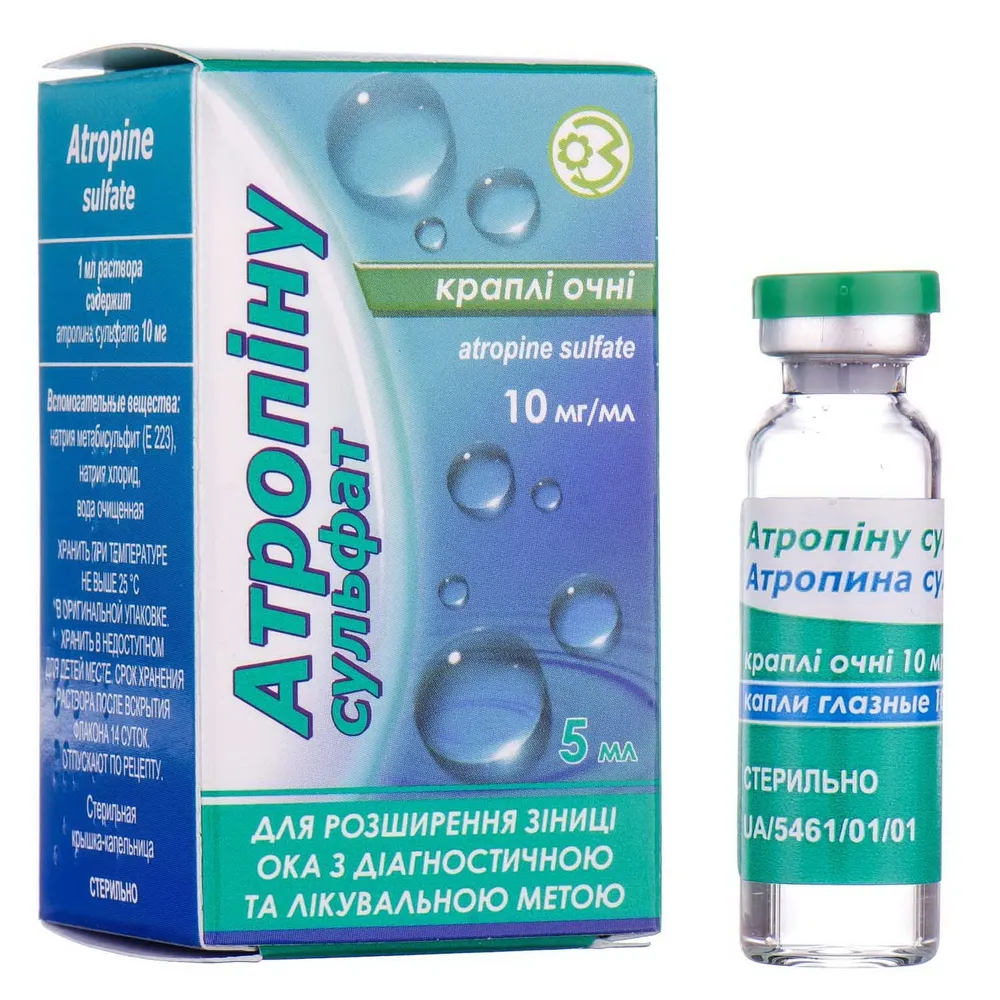
Table of Contents
INSTRUCTIONS FOR MEDICAL USE OF THE MEDICINAL PRODUCT ATROPINE SULFATE
Composition:
Active substance: atropine;
1 ml of solution contains 10 mg of atropine sulfate;
Excipients: sodium metabisulfite (E 223), sodium chloride, water for injections.
Pharmaceutical form. Eye drops.
Main physicochemical properties: clear, colorless liquid.
Pharmacotherapeutic group. Agents acting on the sensory organs. Mydriatics and cycloplegics. ATC code S01F A01.
Pharmacological properties.
Pharmacodynamics.
Atropine sulfate reduces secretion of salivary and other glands, causes tachycardia, improves atrioventricular conduction, decreases tone of smooth musculature of organs, markedly dilates the pupil (which may lead to increased intraocular pressure), and causes paralysis of accommodation.
The mechanism of action is due to selective blockade by atropine of muscarinic cholinoreceptors (with lesser effect on nicotinic cholinoreceptors), rendering them insensitive to acetylcholine produced at the endings of postganglionic parasympathetic nerves. Atropine's ability to bind to cholinoreceptors is explained by the presence within its molecule of a fragment that confers affinity to the molecule of the endogenous ligand—acetylcholine. The pupil dilated by atropine does not constrict upon instillation of cholinomimetic agents. Maximum mydriasis develops within 30–40 minutes and persists for 7–10 days; paralysis of accommodation occurs within 1–3 hours and lasts 8–12 days.
The systemic effect of atropine is due to its anticholinergic (cholinolytic) action, manifested as inhibition of secretions from salivary, gastric, bronchial, sweat, and pancreatic glands, increased heart rate (due to reduced inhibitory effect of the n. vagus on the heart), and decreased tone of smooth musculature of organs (bronchial tree, abdominal organs).
Atropine penetrates the blood-brain barrier and affects the central nervous system. The drug reduces muscle tone and tremor in patients with Parkinsonism (central cholinolytic effect). In therapeutic doses, atropine stimulates the respiratory center; large doses of atropine cause motor and mental disturbances, convulsions, hallucinations, and respiratory paralysis.
Pharmacokinetics.
Considering the systemic effects of atropine following ingestion of eye drops that have drained via the nasolacrimal duct into the nasopharynx, the drug is readily absorbed in the gastrointestinal tract. The bioavailability of atropine is approximately 50%. The elimination half-life ranges from 13 to 38 hours. Atropine is 50% bound to plasma proteins, metabolized in the liver, and excreted by the kidneys, with 50% excreted unchanged.
Clinical characteristics.
Indications. Diagnostic dilation of the pupil during examination of the fundus, to achieve paralysis of accommodation for determining the true refraction of the eye, as part of combined therapy for inflammatory diseases, eye injuries, and embolies, as well as for spasm of the central retinal artery.
Contraindications. Hypersensitivity to the components of the drug.
Cardiovascular diseases in which an increased heart rate may be undesirable: atrial fibrillation, tachycardia, chronic heart failure, ischemic heart disease, mitral stenosis, severe arterial hypertension. Acute bleeding. Thyrotoxicosis. Hyperthermic syndrome. Gastrointestinal tract disorders associated with obstruction (esophageal achalasia, pyloric stenosis, intestinal atony). Glaucoma. Hepatic and renal insufficiency. Myasthenia gravis. Urinary retention or predisposition to it. Brain injury.
Interaction with other medicinal products and other types of interactions. When atropine sulfate is used concomitantly with monoamine oxidase inhibitors, cardiac arrhythmias may occur; when used with quinidine or procainamide, potentiation of the anticholinergic effect is observed.
When used simultaneously with preparations of Convallaria or with tannins, a physicochemical interaction occurs, resulting in mutual weakening of effects.
Atropine sulfate reduces the duration and depth of action of general anesthetics and diminishes the analgesic effect of opioids.
When used concurrently with diphenhydramine or diprazine, the effect of atropine is enhanced; when used with nitrates, haloperidol, or systemic corticosteroids, the risk of increased intraocular pressure rises; when used with sertraline, the depressive effect of both drugs is enhanced; when used with spironolactone or minoxidil, the effects of spironolactone and minoxidil are reduced; when used with penicillins, the effect of both drugs is enhanced; when used with nizatidine, the action of nizatidine is enhanced; when used with ketoconazole, absorption of ketoconazole is reduced; when used with ascorbic acid or attapulgite, the effect of atropine is diminished; when used with pilocarpine, the effect of pilocarpine in glaucoma treatment is reduced; when used with oxprenolol, the antihypertensive effect of the drug is reduced. Under the influence of octadine, a possible reduction in the antisecretory effect of atropine may occur, which weakens the action of M-cholinomimetics and anticholinesterase agents. When used concomitantly with sulfonamide drugs, the risk of kidney damage increases; when used with potassium-containing preparations, intestinal ulceration may occur; when used with nonsteroidal anti-inflammatory drugs, the risk of gastric ulceration and bleeding increases.
The effect of atropine sulfate may be enhanced when used concomitantly with other drugs having antimuscarinic effects: M-cholinoblockers, antiparkinsonian agents (amantadine), spasmolytics, certain antihistamines, butyrophenone-group drugs, phenothiazines, disopyramides, quinidine, and tricyclic antidepressants, as well as nonselective inhibitors of neuronal reuptake of monoamines.
Atropine-induced suppression of peristalsis may lead to altered absorption of other medicinal products.
Special precautions for use.
When instilling the drug into the conjunctival sac in the form of drops, it is necessary to compress the area of the tear ducts to prevent the solution from entering the nasolacrimal canal and its subsequent absorption. In ophthalmological practice, atropine sulfate should primarily be used for therapeutic purposes; for diagnostic purposes, it is preferable to use mydriatics with shorter duration of action, such as homatropine (maximum mydriasis occurs within 40–60 minutes, duration of pupil dilation and cycloplegia lasting 1–2 days).
To reduce tachycardia, administer valeridol sublingually when administering the drug subconjunctivally or parabulbarly.
Due to the systemic effects of atropine following ingestion of eye drops that have passed through the nasolacrimal duct into the nasopharynx, use with caution in patients with prostatic hypertrophy without urinary tract obstruction, Down syndrome, cerebral palsy, reflux esophagitis, hiatal hernia associated with reflux esophagitis, ulcerative colitis, megacolon, xerostomia, elderly patients or debilitated patients, chronic lung diseases without irreversible obstruction, chronic lung diseases characterized by low production of thick, difficult-to-expectorate sputum—particularly in young children and debilitated patients—and in patients with autonomic (vegetative) neuropathy.
There are no data regarding the use of contact lenses during administration of atropine sulfate.
Use with caution in elderly patients (over 60 years of age).
If other eye drops are required during treatment, the interval between instillations should be at least 15 minutes.
Use during pregnancy or breastfeeding. The drug is contraindicated during pregnancy.
During breastfeeding, atropine may pass into breast milk and, due to possible systemic effects following maternal use of eye drops, may cause respiratory depression and drowsiness in the infant. The use of atropine sulfate during breastfeeding is contraindicated due to the risk of toxic effects on the infant.
Ability to affect reaction speed when driving or operating machinery. During treatment, patients should refrain from driving vehicles and engaging in other potentially hazardous activities requiring increased attention, high psychomotor speed, and sharp vision.
Administration and Dosage
For therapeutic purposes, administer 1-2 drops 2-6 times daily to adults and children aged 7 years and older.
Maximum pupil dilation with atropine, which promotes relaxation of the eye muscles and accelerates regression of the pathological process, occurs within 30-40 minutes and persists for 7-10 days. Cycloplegia develops correspondingly within 1-3 hours and lasts 8-12 days.
Children. Do not use in children under 7 years of age.
In children, the drug should be administered in lower concentrations (0.125%, 0.25%, 0.5%).
Overdose. The drug is generally well tolerated, but in isolated cases, side effects may be intensified.
Symptoms: Exacerbation of adverse reactions, nausea, vomiting, decreased arterial blood pressure, excitement, tremor, seizures, insomnia, drowsiness, hallucinations, irritability, hyperthermia, central nervous system depression, respiratory and vasomotor center depression.
Treatment: Gastric lavage, parenteral administration of cholinomimetics and anticholinesterase agents. For hyperthermia, wet sponging and antipyretic agents are indicated; for agitation, intravenous administration of sodium thiopental or sodium oxybutyrate; for mydriasis, topical application in the form of eye drops of phosphacol, physostigmine, or pilocarpine. In the event of an acute glaucoma attack, instill 2 drops of 1% pilocarpine solution into the conjunctival sac every hour and administer subcutaneously 1 mL of 0.05% proserine solution 3-4 times daily.
Adverse reactions.
Local effects: hyperemia of the eyelid skin, hyperemia and swelling of the conjunctiva, eyelids and eyeball, itching, photophobia, mydriasis, accommodation paralysis, increased intraocular pressure.
Systemic effects: dry mouth, thirst sensation, taste disturbances, dysphagia, reduced intestinal motility up to atony, constipation, urinary retention, bladder atony, tachycardia, arrhythmia including extrasystoles, myocardial ischemia, facial flushing, sensation of hot flushes, headache, dizziness, drowsiness, nervousness, insomnia, dysarthria, visual disturbances; reduced secretory activity and bronchial tone leading to formation of viscous sputum difficult to expectorate; skin rashes, urticaria, exfoliative dermatitis, dry skin, skin hyperemia, swelling, allergic reactions, hypersensitivity reactions, anaphylactic reactions, anaphylactic shock, impaired tactile sensation, increased body temperature, decreased sweating.
Allergic reactions may occur due to the presence of sodium metabisulfite.
Shelf life. 3 years.
The shelf life of the solution after opening the bottle is 14 days.
Storage conditions. Store in the original packaging at a temperature not exceeding 25 °C.
Keep out of reach of children.
Packaging. 5 ml or 10 ml in a bottle with dropper cap in a box.
Prescription status. Prescription only.
Manufacturer.
Limited Liability Company "Research Plant 'GNCLS'".
Limited Liability Company "FARMEKS GROUP".
Manufacturer's address and place of business.
Ukraine, 61057, Kharkiv region, city of Kharkiv, Vorobiova Street, building 8.
(Limited Liability Company "Research Plant 'GNCLS'")
Ukraine, 08301, Kyiv region, Boryspil, Shevchenka Street, building 100.
(Limited Liability Company "FARMEKS GROUP")