Askorbinca®-kv
Ukraine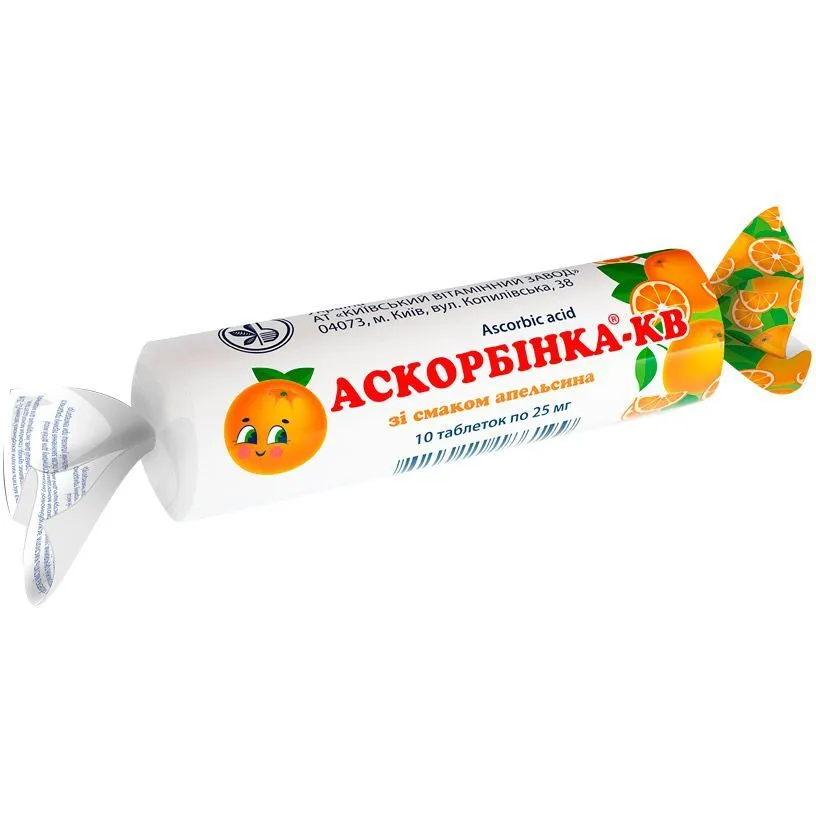
Table of Contents
INSTRUCTION FOR MEDICAL USE OF THE MEDICINAL PRODUCT ASKORBINKA®-KV
Composition:
active substance: ascorbic acid;
1 tablet contains ascorbic acid (vitamin C) 25 mg;
excipients: sugar, stearic acid, potato starch, glucose monohydrate, orange flavor flavoring.
Pharmaceutical form. Tablets.
Main physicochemical properties: flat cylindrical tablets with beveled edges, white in color.
Pharmacotherapeutic group. Simple ascorbic acid (vitamin C) preparations. Ascorbic acid (vitamin C). ATC code A11G A01.
Pharmacological properties.
Pharmacodynamics.
Ascorbic acid (vitamin C) has pronounced reducing properties. It belongs to the group of water-soluble vitamins. It participates in redox reactions, regulation of carbohydrate metabolism, influences the metabolism of aromatic amino acids, thyroxine metabolism, biosynthesis of catecholamines, steroid hormones and insulin. It is necessary for blood coagulation, synthesis of collagen and procollagen, and regeneration of connective and bone tissues. It improves capillary permeability. It promotes iron absorption in the intestine and participates in hemoglobin synthesis. It enhances the nonspecific resistance of the organism and has antidotal properties. Deficiency of vitamin C in the diet leads to the development of hypovitaminosis and avitaminosis C, since this vitamin is not synthesized in the body.
Pharmacokinetics.
Absorption of ascorbic acid occurs predominantly in the small intestine. The absorption process may be impaired in intestinal dyskinesias, enteritis, achylia, helminthic invasion, giardiasis, as well as when consuming alkaline drinks, fresh fruit and vegetable juices. Maximum concentration of the drug in blood plasma after oral administration is reached within 4 hours. It readily penetrates into leukocytes and platelets, and then into all tissues; it accumulates in the posterior part of the pituitary gland, adrenal cortex, ocular epithelium, interstitial cells of the testes, ovaries, liver, brain, spleen, pancreas, lungs, kidneys, intestinal wall, heart, muscles, and thyroid gland. It is mainly metabolized in the liver into dehydroascorbic acid, and further into oxalic acid and diketogulonic acid. Unchanged ascorbate and metabolites are excreted in urine and feces; they also pass into breast milk. When high doses are administered, and plasma concentration exceeds 1.4 mg/dL, excretion is markedly enhanced, and increased excretion may persist after discontinuation of the drug.
Clinical characteristics.
Indications.
Prevention and treatment of vitamin C deficiency.
Meeting increased bodily requirements for vitamin C during periods of growth, pregnancy or breastfeeding, during high physical and mental stress, in infectious diseases and intoxications, hemorrhagic diatheses, as part of combined therapy for bleeding (nasal, pulmonary, uterine), in radiation sickness, Addison's disease, anticoagulant overdose, soft tissue injuries, and slowly healing infected wounds, as well as in bone fractures.
Contraindications.
Hypersensitivity to ascorbic acid or to any of the excipients of the medicinal product. Thrombosis, predisposition to thrombosis, thrombophlebitis, diabetes mellitus, severe kidney disease. Urolithiasis — when doses exceeding 1 g per day are used. Fructose intolerance, glucose-galactose malabsorption syndrome.
Interaction with other medicinal products and other forms of interaction.
Oral ascorbic acid enhances the absorption of penicillin, tetracyclines, and iron; promotes aluminum absorption in the intestine, which should be considered during concomitant treatment with aluminum-containing antacids.
Concomitant use of vitamin C and deferoxamine increases tissue iron toxicity, especially in the myocardium, potentially leading to circulatory decompensation. Vitamin C may be administered only 2 hours after deferoxamine injection.
Prolonged use of high doses in patients treated with disulfiram inhibits the "disulfiram–alcohol" reaction.
High doses of the drug reduce the efficacy of tricyclic antidepressants, phenothiazine-derived neuroleptics, decrease tubular reabsorption of amphetamine, impair renal elimination of mexiletine, and affect vitamin B12 resorption.
Ascorbic acid increases the total clearance of ethanol.
The drug reduces the toxicity of sulfonamide medicinal products, decreases the effectiveness of heparin and indirect anticoagulants.
Vitamin C enhances oxalate excretion in urine, thereby increasing the risk of calcium oxalate stone formation in urine, and increases the risk of crystalluria during salicylate therapy.
Acetylsalicylic acid (aspirin) may reduce the absorption of ascorbic acid.
Concomitant use of salicylates and ascorbic acid may increase renal excretion of ascorbic acid.
Medicinal products of the quinolone series, calcium chloride, salicylates, and corticosteroids, when used long-term, reduce ascorbic acid reserves in the body.
Absorption of ascorbic acid is reduced when used concomitantly with oral contraceptives, fruit or vegetable juices, or alkaline beverages.
Special precautions for use.
When using high doses or prolonged administration of the medicinal product, it is necessary to monitor kidney function, arterial blood pressure, and pancreatic function. The medicinal product should be used with caution in patients with a history of kidney disease.
In patients with urolithiasis, the daily dose of ascorbic acid should not exceed 1 g.
Large doses of the medicinal product should not be prescribed to patients with increased blood coagulation.
Since ascorbic acid enhances iron absorption, its use in high doses may be hazardous in patients with hemochromatosis, thalassemia, polycythemia, leukemia, and sideroblastic anemia. Patients with high iron levels in the body should receive the medicinal product in minimal doses.
Concurrent use of the medicinal product with alkaline beverages reduces absorption of ascorbic acid; therefore, it should not be taken with alkaline mineral water. Also, absorption of ascorbic acid may be impaired in intestinal dyskinesia, enteritis, and achylia.
Use with caution in the treatment of patients with glucose-6-phosphate dehydrogenase deficiency.
As a reducing agent, ascorbic acid may interfere with laboratory test results, for example, in determining blood levels of glucose, bilirubin, and activities of transaminases and lactate dehydrogenase.
Since ascorbic acid has a mild stimulating effect, it is not recommended to administer the medicinal product late in the day. Due to the stimulatory effect of ascorbic acid on corticosteroid hormone production, kidney function and arterial blood pressure should be monitored when the medicinal product is used in high doses.
Ascorbic acid should be used with caution in patients with progressive malignant disease, as its use may exacerbate the course of the disease.
Use during pregnancy or breastfeeding.
The medicinal product may be used during pregnancy or breastfeeding only when the potential benefit to the mother outweighs the possible risk to the fetus, according to dosage recommendations and under medical supervision. Recommended doses should be strictly followed, and exceeding them should be avoided.
Ability to influence reaction rate when driving or operating machinery.
When used in therapeutic doses, the medicinal product does not affect reaction speed.
Dosage and Administration.
The medicinal product should be taken orally, after meals.
For prophylactic purposes, adults and children aged 14 years and older should take 2–4 tablets (50–100 mg) daily; children aged 3 to 14 years should take 2 tablets (50 mg) daily.
Treatment doses:
For adults and children aged 14 years and older: 2–4 tablets (50–100 mg) 3–5 times daily.
For children aged 3 to 7 years: 2–4 tablets (50–100 mg) 2–3 times daily.
For children aged 7 to 10 years: 4 tablets (100 mg) 2–3 times daily.
For children aged 10 to 14 years: 4–6 tablets (100–150 mg) 2–3 times daily.
Pregnant women, postpartum women, and women with low levels of vitamin C in breast milk should take 12 tablets (300 mg) daily for 10–15 days, followed by 4 tablets (100 mg) daily for prophylaxis throughout the entire breastfeeding period.
The duration of treatment depends on the nature and course of the disease and is determined individually by the physician.
Children.
The medicinal product is indicated for children aged 3 years and older.
Overdose.
Ascorbic acid is well tolerated. It is a water-soluble vitamin, and any excess is excreted in the urine.
Symptoms. Prolonged use of high doses of vitamin C may lead to suppression of the pancreatic islet apparatus function, requiring monitoring of pancreatic status. Overdose may alter renal excretion of ascorbic and uric acids during urine acidification, increasing the risk of precipitation of oxalate stones.
Administration of high doses of the drug may cause vomiting, nausea, or diarrhea, which resolve after discontinuation of the drug.
Treatment. Symptomatic therapy.
Adverse Reactions.
Gastrointestinal tract: when administered in doses exceeding 1 g per day – irritation of the gastrointestinal mucosa, heartburn, nausea, vomiting, diarrhea.
Renal and urinary system: damage to renal glomerular apparatus, crystalluria, formation of urate, cystine and/or oxalate calculi in kidneys and urinary tract, renal failure.
Immune system: angioedema, occasionally anaphylactic shock in cases of sensitization.
Skin and subcutaneous tissue: skin rashes, pruritus, urticaria, eczema.
Endocrine system: damage to pancreatic islet apparatus (hyperglycemia, glucosuria) and impaired glycogen synthesis, up to the development of diabetes mellitus.
Cardiovascular system: arterial hypertension, myocardial dystrophy.
Blood and lymphatic system: thrombocytosis, hyperprothrombinemia, thrombus formation, erythrocytopenia, neutrophilic leukocytosis; in patients with glucose-6-phosphate dehydrogenase deficiency of erythrocytes may cause hemolysis of erythrocytes, hemolytic anemia (in patients with glucose-6-phosphate dehydrogenase deficiency).
Nervous system: increased excitability, sleep disturbances, headache, sensation of warmth, fatigue.
Metabolism: disturbances in zinc and copper metabolism.
Shelf life. 2 years.
Storage conditions.
Store in original packaging at a temperature not exceeding 25 °C.
Keep out of reach of children.
Packaging. 10 tablets per blister pack.
Availability category. Over-the-counter.
Manufacturer: JSC "KYIV VITAMIN PLANT".
Manufacturer's address and location of business activity.
38, Kopilivska St., Kyiv, 04073, Ukraine.
Website: www.vitamin.com.ua