Ambroxol-teva
Ukraine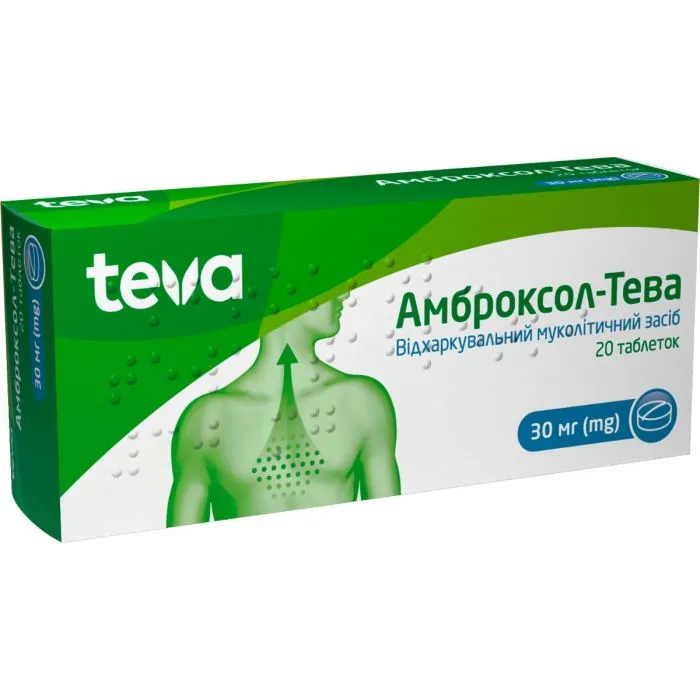
Table of Contents
INSTRUCTIONS FOR MEDICAL USE OF THE MEDICINAL PRODUCT AMBROXOL-TEVA (AMBROXOL-TEVA)
Composition:
Active substance: ambroxol hydrochloride;
1 tablet contains 30 mg of ambroxol hydrochloride;
Excipients: lactose monohydrate, maize starch, magnesium stearate, colloidal anhydrous silicon dioxide.
Pharmaceutical form. Tablets.
Main physicochemical properties: white, round, biconvex tablets with a break line on one side.
Pharmacotherapeutic group. Agents used for cough and colds. Mucolytic agents. ATC code R05C B06.
Pharmacological Properties.
Pharmacodynamics.
Ambroxol is a substituted benzylamine and a metabolite of bromhexine. It differs from bromhexine by the absence of a methyl group and the presence of a hydroxyl group in the para-trans-position of the cyclohexyl ring. Various studies have demonstrated evidence of mucolytic and secretolytic activity.
In general, the effect of the drug begins within 30 minutes after oral administration; the effect lasts for 6–12 hours, depending on the individual dose.
Ambroxol has been reported to increase the serous component of bronchial secretion. It is believed to enhance mucus clearance by reducing viscosity and activating the ciliated epithelium.
Ambroxol activates the surfactant system by directly acting on type II pneumocytes in the alveoli and Clara cells in the bronchioles. It stimulates the formation and secretion of surfactant in the alveolar and bronchial regions of the lungs in both fetus and adult. These effects have been demonstrated in cell cultures and in vivo.
Ambroxol has been reported to have antioxidant effects. Administration of ambroxol increases the concentration of antibiotics—amoxicillin, cefuroxime, erythromycin, and doxycycline—in sputum and bronchopulmonary secretions.
Pharmacokinetics.
Absorption. After oral administration, ambroxol is rapidly and almost completely absorbed. Maximum concentration (Tmax) is achieved within 1–3 hours after oral intake. Absolute bioavailability of ambroxol is reduced by one-third after oral administration due to first-pass metabolism.
Distribution. Plasma protein binding is approximately 85%.
Ambroxol penetrates into cerebrospinal fluid, crosses the placental barrier, and is excreted into breast milk.
Metabolism. Metabolite formation (dibromoanthranilic acid, glucuronides) occurs in the liver.
Elimination. Nearly 90% of the drug is excreted by the kidneys in the form of metabolites. Less than 10% of ambroxol is excreted unchanged by the kidneys.
Due to the high degree of protein binding, large volume of distribution, and slow redistribution of the drug from tissues into blood, significant elimination of ambroxol during dialysis or forced diuresis is unlikely. The terminal elimination half-life from plasma is 7–12 hours. The elimination half-life of ambroxol and its metabolites from plasma is approximately 22 hours.
Hepatic and renal impairment
In patients with severe liver disease, the clearance of ambroxol is reduced by 20–40%. In patients with severe renal impairment, a prolonged elimination half-life of ambroxol metabolites is observed.
Clinical characteristics.
Indications.
Secretolytic therapy in acute and chronic bronchopulmonary diseases associated with impaired bronchial secretion and weakened mucus clearance.
Contraindications.
Hypersensitivity to ambroxol and/or any of the excipients of the medicinal product.
Rare hereditary conditions that may lead to incompatibility with the excipient of the drug (see section "Special precautions for use").
Interaction with other medicinal products and other forms of interaction.
Concomitant use of Ambroxol-Teva tablets with cough suppressants may result in excessive mucus accumulation due to suppression of the cough reflex. Therefore, such combination should be used only after careful assessment by a physician of the benefit-risk ratio.
Administration of Ambroxol-Teva tablets in combination with antibiotics (such as amoxicillin, cefuroxime, erythromycin, doxycycline) may improve antibiotic delivery into lung tissue. The interaction with doxycycline is widely used for therapeutic purposes.
There are no reports of undesirable interactions with other medicinal products.
Special precautions for use
There have been only a few reports of severe skin reactions: Stevens-Johnson syndrome and toxic epidermal necrolysis (Lyell's syndrome) associated with the use of expectorants such as ambroxol hydrochloride. In most cases, these could be explained by the severity of the underlying disease in patients and concomitant use of other medications. There have also been reports of the development of other severe skin reactions such as erythema multiforme and acute generalized exanthematous pustulosis associated with the use of ambroxol. If skin rashes develop or worsen (sometimes associated with blistering or mucosal involvement), ambroxol should be discontinued immediately and medical advice should be sought.
In the early stages of Stevens-Johnson syndrome or Lyell's syndrome, patients may present with non-specific symptoms resembling the onset of influenza, such as fever, malaise, rhinitis, cough, and sore throat. These non-specific, flu-like symptoms may lead to inappropriate symptomatic treatment with cough and cold remedies.
Since ambroxol may increase mucus secretion, Ambroxol-Teva tablets should be used with caution in patients with impaired bronchial motility and increased mucus secretion (e.g., in rare conditions such as primary ciliary dyskinesia).
In patients with severe renal impairment, accumulation of hepatic metabolites of ambroxol may occur. Patients with renal dysfunction or severe hepatic disorders should use ambroxol only after consultation with a physician.
If a patient has known intolerance to certain sugars, medical advice should be sought before taking this medicinal product. This product should not be taken by patients with rare hereditary problems of galactose intolerance, Lapp lactase deficiency, or glucose-galactose malabsorption.
Use during pregnancy or breastfeeding
Pregnancy
Ambroxol hydrochloride crosses the placental barrier. Animal studies have not revealed any direct or indirect adverse effects on pregnancy, embryonal/fetal development, parturition, or postnatal development.
Clinical studies have shown no harmful effects on the fetus when the drug is used after the 28th week of pregnancy.
However, usual precautions regarding medication use during pregnancy should be observed. The use of this medicinal product is not recommended during the first trimester of pregnancy.
Breastfeeding
Ambroxol hydrochloride is excreted in breast milk. Although adverse effects on infants are not expected, ambroxol is not recommended during breastfeeding.
Fertility
Preclinical studies do not indicate any direct or indirect adverse effects on fertility.
Ability to affect reaction speed when driving or operating machinery
There are no data regarding the effect on reaction speed when driving or operating machinery. Studies on the effect of ambroxol on reaction speed during driving or operating machinery have not been conducted.
Method of Administration and Dosage
Ambroxol-Teva, 30 mg tablets, should be taken orally. The tablets should be swallowed whole with a sufficient amount of warm liquid (e.g., tea or broth) after meals. The mucolytic effect of ambroxol is enhanced by drinking large amounts of fluids.
Children aged 6 to 12 years: The usual dose is 1/2 tablet 2–3 times daily (equivalent to 30–45 mg of ambroxol hydrochloride per day).
Children aged 12 years and older, and adults: The usual dose is 1 tablet 3 times daily for the first 2–3 days (equivalent to 90 mg of ambroxol hydrochloride per day). Treatment should then continue with 1 tablet 2 times daily (equivalent to 60 mg of ambroxol hydrochloride per day).
If necessary, the therapeutic effect in adults and children aged 12 years and older may be enhanced by taking 2 tablets 2 times daily (equivalent to 120 mg of ambroxol hydrochloride per day).
The duration of treatment depends on the course of the disease. In general, there are no restrictions on the duration of use, but prolonged therapy should be conducted under medical supervision.
Ambroxol-Teva tablets should not be used for longer than 4–5 days without consulting a physician.
In case of renal impairment or severe liver disease, the drug should be taken only under medical supervision. In such cases, it is recommended to reduce the dose and increase the interval between doses.
Children. For children aged 6 years and older who cannot tolerate syrup or solution for inhalation and oral use.
For children under 6 years of age, Ambroxol-Teva should be administered in the form of syrup or drops.
Overdose
Currently, there are no reports of specific symptoms of overdose in humans.
Symptoms reported in isolated cases of overdose and/or medication errors correspond to the known adverse effects of ambroxol at recommended doses and require symptomatic treatment.
Side effects.
The side effects are categorized by frequency as follows: very common (≥ 1/10); common (≥ 1/100, < 1/10); uncommon (≥ 1/1000, < 1/100); rare (≥ 1/10000, < 1/1000); very rare (< 1/10000); not known (cannot be estimated from the available data).
Immune system disorders:
rare – hypersensitivity reactions;
not known – angioneurotic edema, pruritus, anaphylactic reactions including anaphylactic shock, other allergic reactions.
Skin and subcutaneous tissue disorders:
rare – skin rash, urticaria;
not known – erythema, severe skin reactions (including Stevens-Johnson syndrome, Lyell's syndrome, erythema multiforme, and acute generalized exanthematous pustulosis).
Gastrointestinal disorders:
common – nausea;
uncommon – vomiting, dyspepsia, abdominal pain, diarrhea;
very rare – hypersalivation.
Respiratory system disorders:
not known – dyspnea (as a hypersensitivity reaction).
General disorders:
uncommon – mucosal reactions, fever.
Shelf life.
5 years.
Storage conditions. The medicinal product does not require special storage conditions. Keep out of reach of children.
Packaging.
10 tablets per blister pack, 2 blister packs per carton.
Supply category. Over-the-counter.
Manufacturer. Merckle GmbH.
Manufacturer's address and place of business.
Ludwig-Merckle-Straße 3, 89143 Blaubeuren, Germany.