Alpharekin®
Ukraine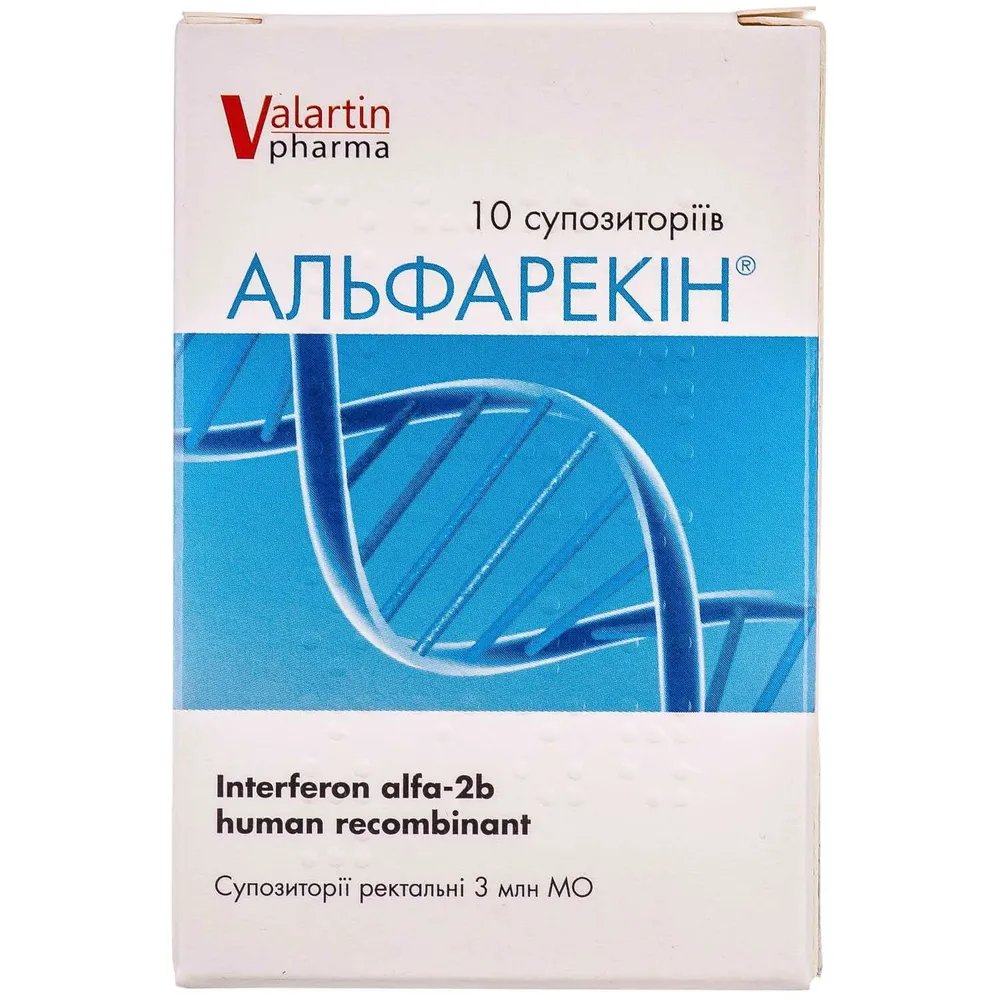
Table of Contents
INSTRUCTIONS FOR MEDICAL USE OF THE MEDICINAL PRODUCT ALPHAREKIN® ALPHAREKIN®
Composition:
Active substance: recombinant human interferon alpha-2b;
1 suppository contains recombinant human interferon alpha-2b 250 thousand IU, or 500 thousand IU, or 1 million IU, or 3 million IU;
Excipients: dextran; disodium edetate; emulsifier T2; citric acid monohydrate; sodium hydroxide; polysorbate; hard fat.
Pharmaceutical form. Rectal suppositories.
Main physicochemical properties: cylindrical-shaped suppositories with a pointed end, white to light yellow in color, of uniform consistency; non-uniformity of color in the form of marbling and the presence of a cup-shaped depression on the cross-section may be observed.
Pharmacotherapeutic group.
Immunostimulants. Interferon alpha-2b.
ATC code L03A B05.
Pharmacological properties / Immunological and biological properties
Immunological properties.
Alpharekin® is a medicinal formulation of recombinant human interferon alpha-2b, synthesized by Escherichia coli cells based on a gene encoding a product identical to human alpha-2b interferon, using phage-dependent genetic engineering biotechnology.
Alpharekin®, like natural leukocyte interferon, has a broad spectrum of biological activity.
Pharmacodynamics.
Of primary importance are pronounced antiviral and immunostimulatory effects, as well as activation of antitumor defense. Interferons (IFN) regulate interactions between cellular and humoral immunity components. Under the influence of IFN, differentiation and activity of natural killer cells and T-lymphocytes are enhanced, determining the active course of cellular immune reactions. IFNs regulate the production of inflammatory mediators, affect migration of inflammatory cells into the pathological focus, stimulate phagocytosis and other bactericidal reactions, thereby normalizing the dynamics of the inflammatory process. The anti-allergic effect of interferons is determined by their influence on the expression of major histocompatibility complex molecules and cytokine profiles.
IFNs directly affect key stages of intracellular pathogen replication, inhibit their proliferation, and ensure effective lysis of infectious agents. IFNs are characterized by high antiviral and anti-chlamydial activity.
Use of Alpharekin® as part of combined therapy for chronic infectious-inflammatory diseases enables increased efficacy of antibacterial and other drugs used in treatment, as well as reduction of their systemic toxic effects and shortening of treatment duration.
Pharmacokinetics.
Not studied.
Clinical characteristics.
Indications.
Alfarekin® in suppositories is used in children and adults as monotherapy and as part of combination therapy for various viral and viral-bacterial infections. The drug is indicated for infectious-inflammatory diseases of the respiratory and urogenital tracts, cervical dysplasia, meningitis, sepsis, pediatric viral infectious diseases (measles, rubella, varicella, epidemic parotitis), and for rehabilitation of children frequently suffering from respiratory infections.
Contraindications.
Hypersensitivity to interferon alpha-2b or to any other component of the drug; thyroid dysfunction in patients; presence of severe visceral disorders in patients with Kaposi's sarcoma; severe cardiovascular diseases; psoriasis; pronounced impairment of liver and/or kidney function; epilepsy and other CNS disorders (including functional ones); chronic hepatitis on the background of progressive or decompensated cirrhosis of the liver; chronic hepatitis in patients receiving or who have recently received immunosuppressive therapy (except for a short course of corticosteroid therapy); autoimmune hepatitis or other autoimmune disorders in medical history. Myeloid hematopoiesis suppression.
Interaction with other medicinal products and other types of interactions.
Alfarekin® is compatible with antibiotics and hormones used in the treatment of viral, viral-bacterial, and autoimmune diseases.
When used concomitantly with drugs metabolized via oxidation pathways (including xanthine derivatives—aminophylline and theophylline), possible influence of Alfarekin® on oxidative metabolic processes should be considered. Serum theophylline concentration should be monitored and dosage regimen adjusted if necessary.
When used in combination with chemotherapeutic agents (cytarabine, doxorubicin, teniposide, cyclophosphamide), the risk of life-threatening toxic effects (in terms of severity and duration) increases.
The drug should be used with caution when administered simultaneously with opioid drugs, analgesics, hypnotics, and sedatives (potentially causing myelosuppressive effects).
Concomitant use with zidovudine increases the risk of developing neutropenia.
Special precautions for use
Treatment with Alfarekin® should be carried out under medical supervision.
Alcohol consumption must be avoided during treatment with this medicinal product.
During prolonged use of the drug, monitoring of complete blood count, liver and kidney function, and thyroid function should be performed.
All patients should undergo an extended analysis of peripheral blood before starting treatment and at regular intervals during therapy, including mandatory qualitative and quantitative assessment of blood parameters, as well as biochemical blood analysis, including determination of electrolytes, calcium, liver enzymes, and creatinine.
All patients receiving the drug should have careful monitoring of serum albumin levels and prothrombin time.
The drug should be prescribed with caution in patients with a history of diseases such as diabetes mellitus with episodes of ketoacidosis, chronic obstructive pulmonary diseases, coagulation disorders (including pulmonary artery thrombophlebitis), and severe myelosuppression.
Adequate hydration must be maintained during treatment; if fever occurs, other potential causes should be ruled out.
The use of the drug is recommended concomitantly with antihistamine and antipyretic therapy.
Development of severe or moderate adverse effects requires dose adjustment or, in some cases, discontinuation of treatment.
Discontinue the drug if the following occur: prolonged blood coagulation time (in patients with chronic hepatitis), pulmonary syndrome symptoms and radiological detection of infiltrates or impaired lung function, onset or worsening of visual disturbances, thyroid dysfunction (deviation from normal TSH levels), decreased serum albumin levels, or reduced prothrombin time values.
In case of immediate-type hypersensitivity reactions (urticaria, angioneurotic edema, bronchospasm, anaphylaxis), the drug must be discontinued immediately and appropriate measures taken.
After the expiry date, use of the medicinal product is not permitted. The product must not undergo repeat quality control or have its shelf life extended beyond the expiry date.
Use during pregnancy or breastfeeding
There are no data available regarding the use of the drug during pregnancy or breastfeeding.
Ability to affect reaction speed when driving or operating machinery
Depending on dose, treatment regimen, and individual sensitivity to alpha interferon, treatment may occasionally be associated with somnolence, weakness, fatigue, and reduced psychomotor reaction speed. In such cases, patients should refrain from driving vehicles or operating machinery.
Method of Administration and Dosage
The drug is administered rectally.
For the treatment of diseases with a prolonged course, the treatment regimen with Alfarekin® is established individually, taking into account the clinical picture and disease dynamics.
In complex therapy of infectious-inflammatory diseases (respiratory viral infections, influenza, pneumonia, sepsis, meningitis, etc.), children aged 3 months to 1 year should be administered Alfarekin® at a dose of 250,000 IU twice daily for 5 days. If necessary, treatment courses may be repeated with a 5-day interval.
In complex therapy of viral-bacterial infections, Alfarekin® is administered to children aged 1–7 years at a dose of 250,000 IU twice daily for 10 days; for children aged 7 years and older, and adults – at a dose of 500,000 IU twice daily for 10 days. Subsequently, maintenance interferon therapy may be prescribed for 1–12 months according to an individual regimen.
Treatment of influenza and respiratory viral infections in children aged 1–7 years is carried out with Alfarekin® at a dose of 250,000 IU twice daily for 5 days; in children aged 7 years and older – at a dose of 500,000 IU twice daily for 5 days. In severe cases of respiratory viral infections and influenza, the single dose should be doubled.
For the treatment of epidemic parotitis, measles, rubella, and varicella, Alfarekin® is prescribed to children aged 1–7 years at a dose of 250,000 IU twice daily for 5 days. For children older than 7 years, the drug is prescribed at a dose of 500,000 IU twice daily for 5 days.
For the treatment of rotavirus infection, Alfarekin® is prescribed to children aged 3 months to 1 year at a dose of 250,000 IU once daily; to children aged 1 to 3 years – at a dose of 500,000 IU once daily; to children aged 3 to 7 years – at a dose of 500,000 IU twice daily. The duration of treatment is 5 days.
In complex treatment of chronic infectious-inflammatory diseases of the urogenital tract, Alfarekin® is administered to adults at a dose of 1 million IU once daily for 10 days. Treatment should be administered to both sexual partners.
In complex treatment of cervical dysplasia, Alfarekin® is administered at a dose of 3 million IU daily for 10 days. A combination of antibacterial (based on identified pathogens) and antiviral therapy with Alfarekin® should precede instrumental destruction of the damaged dysplastic epithelium. If electrocoagulation or cryodestruction of the cervix is required, treatment with Alfarekin® should also be continued during the rehabilitation period at the same dosage.
Rehabilitation therapy in children aged 1–7 years suffering from recurrent viral-bacterial respiratory tract infections, ENT organ infections, and recurrent type 1 herpes is performed using Alfarekin® suppositories according to the following regimen:
- 250,000 IU twice daily for 10 days, followed by
- 250,000 IU twice daily 3 times per week for 2 weeks, followed by
- 250,000 IU twice daily 2 times per week for 2 weeks, followed by
- 250,000 IU once nightly 2 times per week for 2 weeks, followed by
- 250,000 IU once nightly 1 time per week for 2 weeks.
For children aged 7–14 years, therapy is administered according to the same regimen using a therapeutic dose of 500,000 IU.
The total duration of the treatment course is 2 months.
Children
Alfarekin® suppositories are used in pediatric practice (see section "Method of Administration and Dosage").
Overdose
No cases of acute overdose have been reported.
Side effects.
When using Alfarekin® suppositories in the recommended doses, adverse effects are not observed. The rectal route of administration does not lead to pronounced side effects typically associated with parenteral interferon administration. In individual cases, during the first days of treatment, influenza-like symptoms may occur, which subsequently diminish and disappear. To prevent these symptoms, paracetamol preparations can be used at doses appropriate for the patient's age.
General disorders. Influenza-like symptoms may occur after administration of Alfarekin®: chills, fever, fatigue, malaise, as well as headache, muscle and joint pain, sweating; rarely – vomiting, dizziness, hot flushes. Hypersensitivity reactions to the drug are possible.
Blood and lymphatic system disorders. With prolonged use, leukopenia, thrombocytopenia, anemia, and nosebleeds are possible.
Gastrointestinal and hepatic disorders. Increased levels of ALT and AST, increased alkaline phosphatase (ALP) levels, loss of appetite. Liver function abnormalities.
Endocrine disorders. Thyroid gland dysfunction.
Nervous system disorders. With prolonged use, dizziness, sleep disturbances, confusion, anxiety and depressive states, increased excitability, somnolence, ataxia, and paresthesia are possible.
Cardiovascular disorders. Possible arterial hypertension or hypotension; rarely – tachycardia.
Skin and subcutaneous tissue disorders. Allergic reactions, including rashes (including herpetic), pruritus, hyperemia, urticaria, anaphylactic shock.
Respiratory system disorders: cough.
Other: local reactions at the site of administration, visual disturbances, kidney function disorders, electrolyte imbalance.
Shelf life. 1.5 years.
Storage conditions. Store in the original packaging at a temperature between 2 and 8 °C. Keep out of reach of children.
Packaging. 5 rectal suppositories with activity of 250,000 IU, 500,000 IU, 1,000,000 IU, or 3,000,000 IU per strip.
2 strips per cardboard box.
Prescription status. Prescription only.
Manufacturer. LLC "Scientific-Production Company "Interpharmbiotek", Ukraine.
Manufacturer's address.
150 Zabolotnoho Street, Kyiv, 03143, Ukraine.
Marketing Authorization Holder. LLC "VALARTIN PHARMA"
Address of the Marketing Authorization Holder.
60 Hrushevskoho Street, Chayky, Kyiv-Sviatoshyn District, Kyiv Oblast, 08135, Ukraine.