Alpha-tocopherol acetate (vitamin e)
Ukraine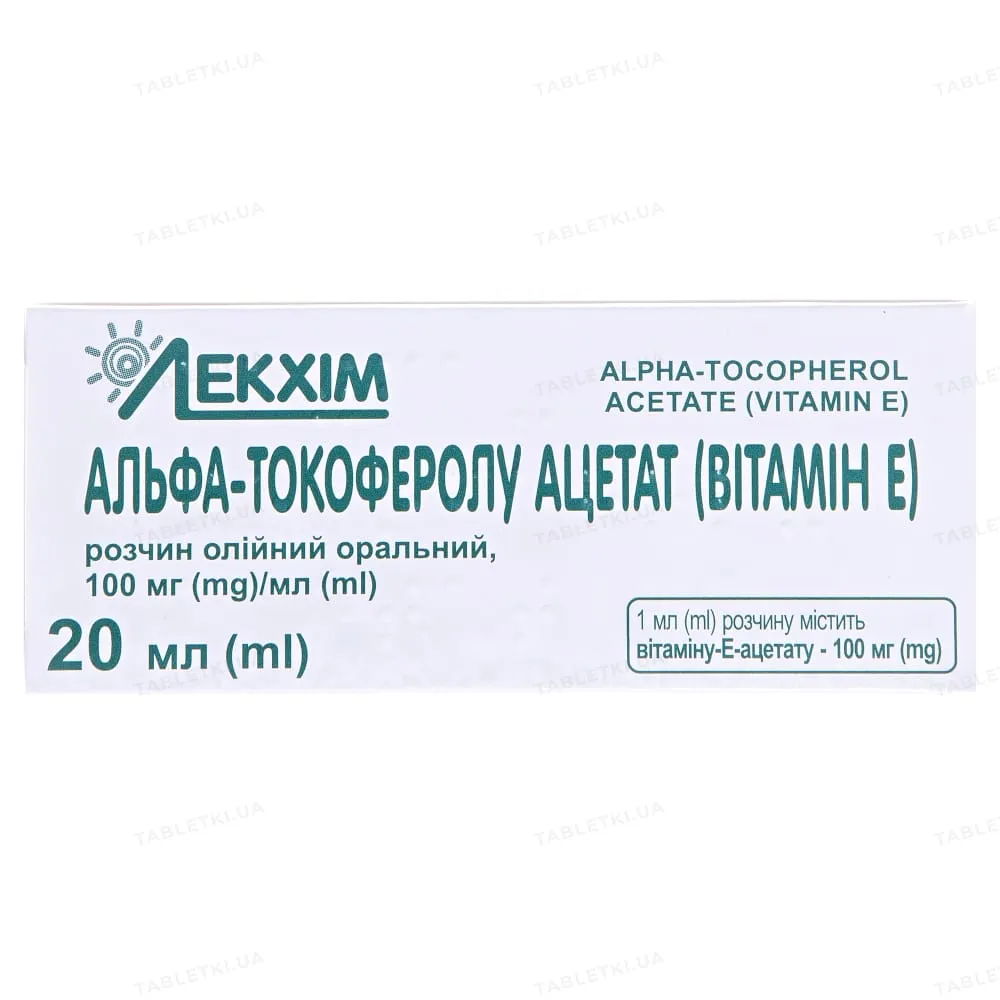
Table of Contents
INSTRUCTIONS FOR MEDICAL USE OF THE MEDICINAL PRODUCT ALPHA-TOCOPHEROL ACETATE (VITAMIN E) (ALPHA-TOCOPHEROL ACETATE (VITAMIN E))
Composition:
Active substance: vitamin E acetate;
1 ml of the preparation contains vitamin E acetate equivalent to 50 mg, or 100 mg, or 300 mg of 100% substance;
Excipient: sunflower oil.
Dosage form. Oral oily solution.
Main physicochemical properties: clear oily liquid of light yellow to dark yellow color, without rancid odor. A greenish tint is permissible.
Pharmacotherapeutic group. Other simple vitamin preparations. Tocopherol (vitamin E).
ATC code A11H A03.
Pharmacological properties.
Pharmacodynamics.
Vitamin E is an antioxidant agent that protects various endogenous substances in the body from oxidation. It slows down lipid peroxidation, which is activated in many diseases. It participates in tissue respiration, heme and protein biosynthesis, metabolism of fats and carbohydrates, and cell proliferation. Vitamin E deficiency leads to degenerative changes in muscles, increased capillary permeability and fragility, degeneration of the epithelium of the seminiferous tubules and testes, and degenerative processes in nervous tissue and hepatocytes. Vitamin E deficiency may cause hemolytic jaundice in newborns, malabsorption syndrome, and steatorrhea.
Pharmacokinetics.
The drug is absorbed in the intestine in the presence of fat and bile acids; the absorption mechanism is passive diffusion. It is transported by blood β-lipoproteins; maximum blood concentration is reached by the 4th hour after administration. It is excreted in feces; conjugates and tocopheronic acid are excreted in urine.
Clinical characteristics.
Indications.
As part of complex therapy:
- muscular dystrophies of various nature and etiology;
- joint and tendinous-muscular contractures (Dupuytren's contracture);
- spinal cord lesions (amyotrophic lateral sclerosis);
- systemic connective tissue diseases (rheumatoid arthritis, dermatomyositis, rheumatism, and fibrositis);
- disorders of male genital gland functions and menstrual cycle, in threatened miscarriage;
- peripheral vascular lesions, vascular atherosclerosis, myocardiodystrophy, hypertensive disease;
- allergic and ulcerative skin lesions, psoriasis;
- endocrine disorders of the thyroid gland, diabetes mellitus;
- periodontosis;
- pathologies requiring antioxidant therapy;
- in children – for treatment of neonatal hemolytic jaundice, increased capillary permeability in infants, hypotrophy, rickets, developmental disorders, systemic connective tissue diseases (scleroderma, juvenile rheumatoid arthritis), hypochromic anemia.
Contraindications.
Hypersensitivity to the components of the drug, severe cardiac sclerosis, myocardial infarction, vitamin E hypervitaminosis, thyrotoxicosis.
Interaction with other medicinal products and other types of interactions.
Vitamin E should not be administered orally in combination with iron preparations, silver, alkaline-acting agents, or indirect-acting anticoagulants.
Vitamin E facilitates absorption and assimilation of retinol, preventing the development of vitamin A deficiency.
Vitamin E and its metabolites exhibit antagonistic effects toward vitamin K. Vitamin E enhances the action of steroid and non-steroidal anti-inflammatory drugs (sodium diclofenac, ibuprofen, prednisolone, etc.); reduces the toxic effects of cardiac glycosides (digoxin, digitoxin, etc.), vitamin A and D.
Vitamin E may increase the efficacy of anticonvulsant agents in patients with epilepsy who have elevated concentrations of lipid peroxidation products in the blood.
Cholestyramine, colestipol, and mineral oils reduce vitamin E absorption.
Special precautions.
Use with caution in patients with atherosclerosis and an increased risk of thromboembolism.
When using the drug, it is necessary to strictly follow the dosage and duration of treatment prescribed by a physician to prevent overdose and the development of vitamin E hypervitaminosis.
When using high doses of the drug for a prolonged period, blood coagulation time should be monitored.
Use during pregnancy or breastfeeding.
During pregnancy or breastfeeding, the drug should be used only as directed by a physician.
Ability to affect reaction speed when driving or operating machinery.
If dizziness or blurred vision occurs, refrain from driving or operating machinery.
Method of administration and dosage.
Alpha-Tocopherol acetate (vitamin E) is administered orally.
Each 1 ml of solution contains 50 mg, 100 mg, or 300 mg of vitamin E, respectively (1 ml of solution corresponds to 25 drops from the dropper cap).
| Indications |
Daily dose, mg |
Daily dose in drops, 300 mg/ml solution |
Daily dose in drops, 100 mg/ml solution |
Daily dose in drops, 50 mg/ml solution |
Notes |
| For muscular dystrophies, amyotrophic lateral sclerosis, and other neuromuscular disorders |
50 – 100 mg |
4 – 8 drops |
13 – 25 drops |
|
Take for 30–60 days, repeat the course after 2–3 months. |
| For impaired spermatogenesis and potency in men |
100 – 300 mg |
8 – 25 drops |
- |
|
Administer in combination with hormonal therapy for 30 days. |
| For threatened miscarriage |
100 – 150 mg |
8 – 13 drops |
25 – 37 drops |
|
Take for 7–14 days. |
| For abortion and impaired fetal development |
100 – 150 mg |
8 – 13 drops |
25 – 37 drops |
|
Daily or every other day during the first 2–3 months of pregnancy. |
| For atherosclerosis, myocardiodystrophy, peripheral vascular diseases |
100 mg |
8 drops |
25 drops |
|
Treatment course is 20–40 days, with possible repetition after 3–6 months. |
| For cardiovascular disease therapy |
50 – 100 mg |
4 – 8 drops |
13 – 25 drops |
|
Take 1–2 times daily. Treatment course – 1–3 weeks. |
| For dermatological diseases |
50 – 100 mg |
4 – 8 drops |
13 – 25 drops |
|
Treatment course lasts 20–40 days. |
| For hemolytic jaundice in infants, increased capillary permeability in infants, hypotrophy, rickets, developmental delays, systemic connective tissue diseases (scleroderma, juvenile rheumatoid arthritis), hypochromic anemia. |
5 – 10 mg |
|
1 – 2 drops |
2 – 5 drops |
The duration of treatment is determined individually by the physician. |
Children.
The medication may be used in children from birth only as prescribed and under medical supervision.
Overdose.
When taken at recommended doses, adverse reactions do not occur. Intake of high doses of vitamin E (400–800 mg per day over a prolonged period) may cause visual disturbances, diarrhea, dizziness, headache, nausea or abdominal cramps, extreme fatigue or weakness.
Very high doses (over 800 mg per day over a prolonged period) may lead to an increased risk of bleeding in patients with vitamin K deficiency; disturbances in thyroid hormone metabolism; increased risk of thrombophlebitis and thromboembolism in susceptible patients; elevated creatine kinase activity; increased serum cholesterol and triglyceride levels; and increased urinary excretion of estrogens and androgens.
Treatment: discontinue the drug, symptomatic therapy.
Side effects.
Allergic reactions (including itching, skin hyperemia). With prolonged use of large doses of vitamin E, impaired blood coagulation, gastrointestinal bleeding, liver enlargement, creatinuria, fatigue, weakness, headache, nausea, dizziness, and blurred vision may occur.
Shelf life. 2 years.
Storage conditions.
Store in the original packaging at a temperature not exceeding 25 °C.
Keep out of reach of children.
Packaging.
20 ml in a glass container sealed with a dropper plug and screw cap. One container per cardboard box.
Availability. Over-the-counter (without prescription).
Manufacturer.
JSC "Tekhnolog".
Manufacturer's address.
8 Stara Prorizna Street, Uman, Cherkasy region, 20300, Ukraine.