Alpha-lipon
Ukraine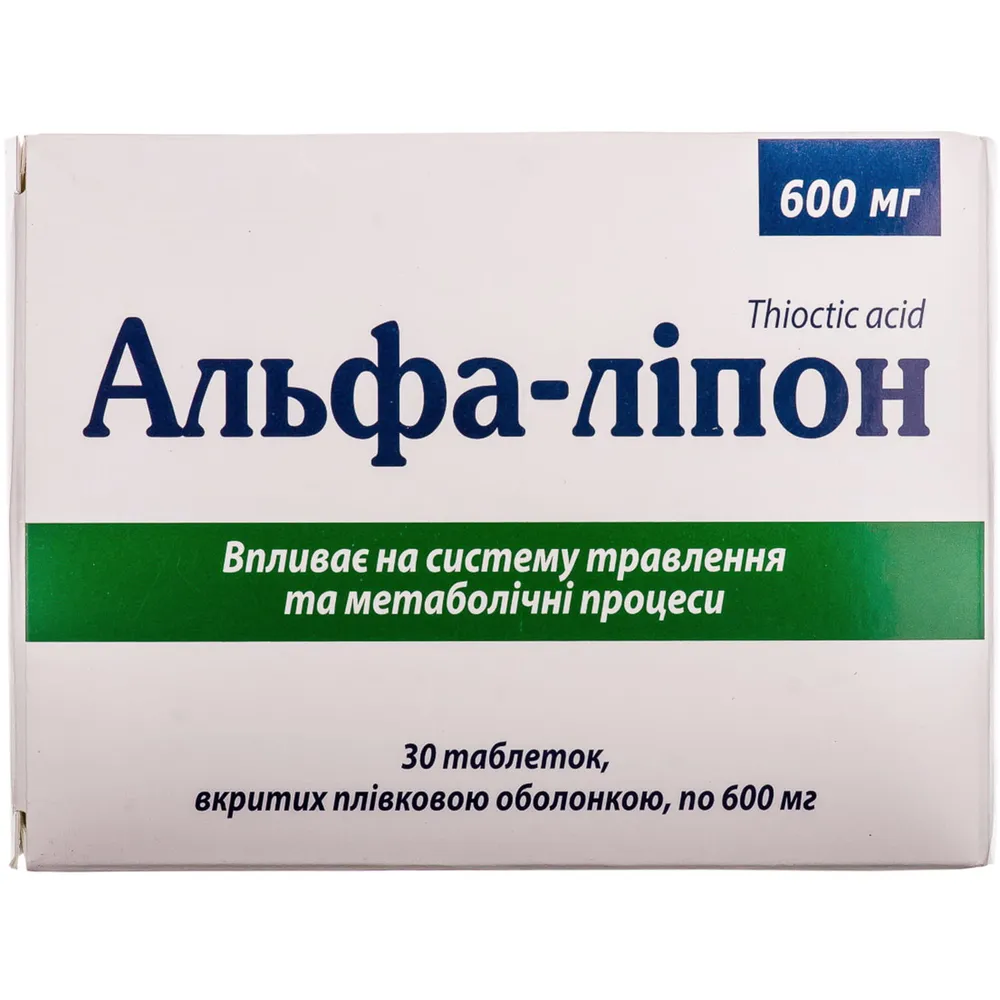
Table of Contents
INSTRUCTIONS for medical use of the medicinal product ALFA-LIPON (Alfa-lipon)
Composition:
Active substance: 1 tablet contains 300 mg or 600 mg of alpha-lipoic (thioctic) acid;
Excipients: lactose monohydrate; microcrystalline cellulose; sodium croscarmellose; maize starch; sodium lauryl sulfate; colloidal anhydrous silicon dioxide; magnesium stearate; coating: Opadry II Yellow film-coating mixture (lactose monohydrate; hypromellose (hydroxypropylmethylcellulose); polyethylene glycol (macrogol); indigo carmine (E 132); yellow FCF (E 110); quinoline yellow (E 104); titanium dioxide (E 171); triacetin).
Pharmaceutical form. Film-coated tablets.
Main physicochemical properties:
300 mg: yellow, round, biconvex film-coated tablets;
600 mg: yellow, oval-shaped, biconvex film-coated tablets, with notches on both sides.
Pharmacotherapeutic group. Agents affecting the digestive system and metabolic processes. ATC code: A16AX01.
Pharmacological properties.
Pharmacodynamics.
Thioctic acid is an endogenous vitamin-like substance that functions as a coenzyme and participates in the oxidative decarboxylation of α-keto acids. In hyperglycemia occurring in diabetes mellitus, glucose binds to structural proteins of blood vessels, leading to the formation of so-called "advanced glycation end-products." This process results in reduced endoneurial blood flow and endoneurial hypoxia/ischemia, which in turn leads to increased generation of oxygen-containing free radicals damaging peripheral nerves. A decreased level of antioxidants such as glutathione in peripheral nerves has also been observed.
Pharmacokinetics.
After oral administration, thioctic acid is rapidly absorbed. Due to significant presystemic metabolism, the absolute bioavailability of thioctic acid is approximately 20%. As a result of rapid tissue distribution, the half-life of thioctic acid in blood plasma is approximately 25 minutes. The relative bioavailability of thioctic acid following oral administration of solid dosage forms is over 60% compared to the oral solution. A maximum plasma concentration of approximately 4 μg/mL was measured about 30 minutes after oral administration of 600 mg of thioctic acid. Only a negligible amount of the unchanged substance is excreted in urine. Biotransformation occurs via oxidative shortening of the side chain (β-oxidation) and/or S-methylation of the corresponding thiols. In vitro, thioctic acid reacts with metal ion complexes, for example cisplatin, and forms moderately soluble complexes with sugar molecules.
Clinical characteristics.
Indications.
Paresthesia in diabetic polyneuropathy.
Contraindications.
Hypersensitivity to thioctic acid or to any of the excipients of the medicinal product.
Interaction with other medicinal products and other forms of interaction.
The efficacy of cisplatin is reduced when administered concomitantly with the medicinal product Alpha-lipoic. Thioctic acid acts as a metal chelator; therefore, according to basic principles of pharmacotherapy, it should not be administered simultaneously with metal-containing compounds (e.g., dietary supplements containing iron or magnesium, or dairy products, as they contain calcium). If the total daily dose of the medicinal product is administered 30 minutes before breakfast, dietary supplements containing iron and magnesium should be taken during the day or in the evening. Thioctic (α-lipoic) acid forms poorly soluble complex compounds with sugar molecules (e.g., with fructose solution).
When thioctic acid is administered to patients with diabetes mellitus, a potentiation of the glucose-lowering effect of insulin and oral antidiabetic agents may occur. Therefore, especially during the initial phase of treatment, careful monitoring of blood glucose levels is recommended. In some cases, to avoid symptoms of hypoglycemia, a reduction in the dose of insulin or oral antidiabetic agents may be required.
Regular consumption of alcoholic beverages is a significant risk factor for the development and progression of polyneuropathy and may interfere with treatment success; therefore, alcohol consumption should be avoided during treatment and between treatment courses.
Special precautions for use
At the beginning of treatment for polyneuropathy, transient intensification of paraesthesia with a sensation of "pins and needles" may occur due to regenerative processes. When using thioctic acid in patients with diabetes mellitus, frequent monitoring of blood glucose levels is required. In some cases, it may be necessary to reduce the doses of antidiabetic medications to prevent the development of hypoglycaemia.
Cases of autoimmune insulin syndrome (AIS) have been reported during treatment with thioctic acid. Patients with certain HLA genotypes (human leukocyte antigen system), such as HLA-DRB1*04:06 and HLA-DRB1*04:03, are more susceptible to developing AIS during treatment with thioctic acid. The HLA-DRB1*04:03 allele (odds ratio for possible susceptibility to AIS – 1.6) is predominantly found among individuals of Caucasian descent, with higher prevalence in Southern Europe than in Northern Europe. The HLA-DRB1*04:06 allele (odds ratio for possible susceptibility to AIS – 56.6) is mainly prevalent among patients in Japan and Korea. The possibility of developing AIS should be considered in patients receiving thioctic acid when making a differential diagnosis of spontaneous hypoglycaemia (see section "Adverse reactions").
The medicinal product Alpha-Lipon contains lactose; therefore, it should not be used in patients with rare hereditary conditions such as galactose intolerance, lactase deficiency, or glucose-galactose malabsorption syndrome.
The colouring agent E 110 contained in the tablet coating may cause allergic reactions.
Use during pregnancy or breastfeeding.
Pregnancy. The use of thioctic acid during pregnancy is not recommended due to the lack of adequate clinical data.
Breastfeeding. There are no data on the passage of thioctic acid into breast milk; therefore, its use during breastfeeding is not recommended.
Fertility. Studies on toxic effects on reproductive function have not revealed any evidence of effects on fertility.
Ability to affect reaction speed when driving vehicles or operating machinery.
Caution is required when driving vehicles, operating machinery, or engaging in other potentially hazardous activities requiring increased attention and rapid psychomotor reactions, due to the possibility of adverse reactions such as hypoglycaemia (dizziness and visual disturbances).
Method of Administration and Dosage
The daily dose is 600 mg of thioctic acid (2 tablets of 300 mg or 1 tablet of 600 mg), to be taken as a single dose 30 minutes before the first meal. Concomitant food intake impairs absorption; therefore, it is especially important for patients with prolonged gastric emptying to take the medication before meals. Tablets must not be chewed and should be taken with sufficient fluid, for example, one glass of water.
In cases of severe parasthesia, treatment may be initiated with parenteral administration of thioctic acid using appropriate dosage forms.
Children
Alpha-lipo should not be administered to children, as there is insufficient clinical experience regarding its use in this age group.
Overdose
Symptoms
In cases of overdose, nausea, vomiting, and headache may occur. Following accidental ingestion or suicide attempts involving oral administration of thioctic acid in doses ranging from 10 g to 40 g in combination with alcohol, severe intoxications have been observed, in some cases resulting in fatality.
In the initial phase, the clinical picture of intoxication may present as psychomotor agitation or impaired consciousness. Subsequently, generalized seizures and lactic acidosis may develop. Additionally, high-dose thioctic acid intoxication has been associated with hypoglycemia, shock, rhabdomyolysis, acute skeletal muscle necrosis, hemolysis, disseminated intravascular coagulation syndrome, bone marrow suppression, and multiorgan failure.
Treatment
Even in suspected cases of severe intoxication with the medicinal product Alpha-lipo (e.g., ingestion of more than 20 tablets of 300 mg in adults or a dose exceeding 50 mg/kg body weight in children), immediate hospitalization and measures for accidental poisoning are recommended (e.g., induction of vomiting, gastric lavage, administration of activated charcoal). Treatment of life-threatening complications such as generalized seizures and lactic acidosis should be symptomatic and carried out in accordance with principles of modern intensive care. To date, the benefit of hemodialysis, hemoperfusion, or forced elimination techniques via filtration for removing thioctic acid has not been established.
Adverse reactions.
The following classification is used to assess the frequency of adverse reactions: very common: ≥1/10; common: ≥1/100 and <1/10; uncommon: ≥1/1000 and <1/100; rare: ≥1/10,000 and <1/1000; very rare: <1/10,000; frequency not known (cannot be estimated based on available data).
Nervous system disorders: common – dizziness; very rare – dysgeusia, headache, hyperhidrosis, alteration or disturbance of taste sensations.
Eye disorders: very rare – visual disturbances.
Gastrointestinal disorders: common – nausea; very rare – vomiting, abdominal pain and gastro-intestinal pain, diarrhea.
Metabolism and nutrition disorders: very rare – hypoglycemia.
Immune system disorders: very rare – allergic reactions, including skin rash, urticaria, pruritus, dyspnea; frequency not known – autoimmune insulin syndrome (see section "Special precautions"), eczema.
General disorders: very rare – decreased blood glucose levels associated with improved glucose utilization. Hypoglycemia-like symptoms: dizziness, sweating, headache, and visual disturbances.
Shelf life. 3 years.
Storage conditions.
Store in original packaging at a temperature not exceeding 25 °C.
Keep out of reach of children.
Packaging.
10 tablets in a blister; 3 blisters per carton.
10 tablets in a blister; 6 blisters per carton.
Prescription category. Prescription only.
Manufacturer. JSC "KYIV VITAMIN PLANT".
Manufacturer's address and place of business.
38 Kopilivska Street, Kyiv, 04073, Ukraine.
Web-site: www.vitamin.com.ua