Advait
UkraineTable of Contents
INSTRUCTION FOR MEDICAL USE OF THE MEDICINAL PRODUCT ADYVATE (ADVATE)
Composition:
Active substance: coagulation factor VIII (octocog alfa);
1 vial contains:
250 IU* of recombinant human blood coagulation factor VIII (rDNA)**, octocog alfa, which after reconstitution yields approximately 50 IU/mL of recombinant human blood coagulation factor VIII, octocog alfa;
500 IU* of recombinant human blood coagulation factor VIII (rDNA)**, octocog alfa, which after reconstitution yields approximately 100 IU/mL of recombinant human blood coagulation factor VIII, octocog alfa;
1000 IU* of recombinant human blood coagulation factor VIII (rDNA)**, octocog alfa, which after reconstitution yields approximately 200 IU/mL of recombinant human blood coagulation factor VIII, octocog alfa;
1500 IU* of recombinant human blood coagulation factor VIII (rDNA)**, octocog alfa, which after reconstitution yields approximately 300 IU/mL of recombinant human blood coagulation factor VIII, octocog alfa;
2000 IU* of recombinant human blood coagulation factor VIII (rDNA)**, octocog alfa, which after reconstitution yields approximately 400 IU/mL of recombinant human blood coagulation factor VIII, octocog alfa;
3000 IU* of recombinant human blood coagulation factor VIII (rDNA)**, octocog alfa, which after reconstitution yields approximately 600 IU/mL of recombinant human blood coagulation factor VIII, octocog alfa;
Excipients: trehalose, histidine, tris(hydroxymethyl)aminomethane, sodium chloride, calcium chloride, glutathione (reduced), polysorbate 80, mannitol.
* Activity (in international units) is determined using a chromogenic quantitative assay relative to an internal standard calibrated against the WHO standard. Specific activity is approximately 4000 – 10000 IU/mg protein.
** Recombinant human blood coagulation factor VIII is produced using recombinant DNA technology in Chinese hamster ovary cells. No (exogenous) human or animal-derived proteins are added during cell culture, purification, or final formulation steps.
Pharmaceutical form. Powder and solvent for solution for injection.
Main physicochemical properties: friable white or almost white powder; after reconstitution – clear, colorless solution free from foreign particles.
Pharmacotherapeutic group. Blood and blood-forming organs. Antihemorrhagics. Vitamin K and other hemostatics. Coagulation factors. Blood coagulation factor VIII.
ATC code B02BD02.
Pharmacological properties.
Pharmacodynamics.
The factor VIII/von Willebrand factor complex consists of two molecules (factor VIII and von Willebrand factor) with distinct physiological functions. ADVATE contains recombinant human coagulation factor VIII (octocog alfa), a glycoprotein that is biologically equivalent to the factor VIII glycoprotein in human plasma.
Octocog alfa is a glycoprotein composed of 2332 amino acids with an approximate molecular weight of 280 kDa. When infused into a patient with haemophilia, octocog alfa binds to endogenous von Willebrand factor in the patient's circulatory system. Activated factor VIII acts as a cofactor for activated factor IX, accelerating the conversion of factor X to activated factor X. Activated factor X then converts prothrombin to thrombin. Thrombin subsequently converts fibrinogen into fibrin, leading to the formation of a fibrin clot. Haemophilia A is an X-linked inherited bleeding disorder caused by reduced levels of factor VIII activity, resulting in spontaneous or trauma- or surgery-related bleeding into joints, muscles, or internal organs. Plasma levels of factor VIII are increased by replacement therapy, enabling temporary correction of factor VIII deficiency and reducing bleeding frequency and tendency.
Data on immune tolerance induction (ITI) in patients with inhibitors to factor VIII have been collected. In the sub-study 060103 involving previously untreated children, ITI procedures were documented in 11 such patients. A retrospective analysis was performed on 30 paediatric patients undergoing ITI (in study 060703). Immune tolerance induction was documented in 44 paediatric and adult patients in a non-interventional prospective registry (PASS-INT-004), of whom 36 completed ITI therapy. The data indicate that immune tolerance can be achieved.
In study 060201, 53 previously treated patients were enrolled to compare two long-term prophylactic treatment regimens: an individualized pharmacokinetic dosing regimen (20–80 IU factor VIII per kg body weight at intervals of 72 ± 6 hours, n = 23) versus a standard prophylactic dosing regimen (20–40 IU/kg every 48 ± 6 hours, n = 30). The pharmacokinetic-based dosing regimen was designed to maintain trough levels of factor VIII ≥ 1% throughout the 72-hour dosing interval. Data from this study indicate that both prophylactic regimens are comparable in reducing bleeding frequency.
The European Medicines Agency has waived the obligation to submit results of clinical trials of ADVATE in all paediatric subgroups of patients with haemophilia A (congenital factor VIII deficiency) for the following indications: «Immune tolerance induction (ITI) in patients with haemophilia A (congenital factor VIII deficiency) who have developed inhibitors to factor VIII» and «Treatment and prevention of bleeding in patients with haemophilia A (congenital factor VIII deficiency)» (see section «Posology and method of administration» for information on use in paediatric patients).
Pharmacokinetics.
All pharmacokinetic studies of ADVATE were conducted in previously treated patients with severe and moderately severe haemophilia A (baseline factor VIII levels ≤ 2%). Plasma samples were analysed at a central laboratory using a one-stage assay.
A total of 195 patients with severe haemophilia A (baseline factor VIII < 1%) provided pharmacokinetic parameters that were included in the per-protocol pharmacokinetic analysis set. Categories for infants (aged ≥1 month to <2 years), young children (aged ≥2 to <5 years), older children (aged ≥5 to <12 years), adolescents (aged ≥12 to <18 years), and adults (aged ≥18 years) were used to summarize pharmacokinetic parameters, with age defined as the age at the time of the PK infusion.
Table 1
| Summary of pharmacokinetic parameters of ADYETI in patients with severe haemophilia A (baseline factor VIII < 1%) |
|||||
| Parameter (mean ± standard deviation) |
Infants (n = 5) |
Young children (n = 30) |
Older children (n = 18) |
Adolescents (n = 33) |
Adults (n = 109) |
| Total AUC (IU*h/dL) |
1362.1 ± 311.8 |
1180.0 ± 432.7 |
1506.6 ± 530.0 |
1317.1 ± 438.6 |
1538.5 ± 519.1 |
| Adjusted incremental recovery at Cmax (IU/dL per IU/kg)a |
2.2 ± 0.6 |
1.8 ± 0.4 |
2.0 ± 0.5 |
2.1 ± 0.6 |
2.2 ± 0.6 |
| Half-life (hours) |
9.0 ± 1.5 |
9.6 ± 1.7 |
11.8 ± 3.8 |
12.1 ± 3.2 |
12.9 ± 4.3 |
| Maximum plasma concentration after infusion (IU/dL) |
110.5 ± 30.2 |
90.8 ± 19.1 |
100.5 ± 25.6 |
107.6 ± 27.6 |
111.3 ± 27.1 |
| Elimination half-life (hours) |
11.0 ± 2.8 |
12.0 ± 2.7 |
15.1 ± 4.7 |
15.0 ± 5.0 |
16.2 ± 6.1 |
| Volume of distribution at steady state (L/kg) |
0.4 ± 0.1 |
0.5 ± 0.1 |
0.5 ± 0.2 |
0.6 ± 0.2 |
0.5 ± 0.2 |
| Clearance (mL/kg*h) |
3.9 ± 0.9 |
4.8 ± 1.5 |
3.8 ± 1.5 |
4.1 ± 1.0 |
3.6 ± 1.2 |
a Calculated as Cmax – baseline factor VIII level, divided by the dose in IU/kg, where Cmax is the maximum post-infusion factor VIII level.
The safety and haemostatic efficacy of ADYNOVATE in the paediatric population are comparable to those in adult patients. Adjusted recovery and terminal half-life (t½) were approximately 20% lower in younger children (up to 6 years) than in adults, which may be partly due to the known increase in plasma volume per kilogram of body weight in younger patients.
Currently, there are no data on the pharmacokinetics of ADYNOVATE in previously untreated patients.
Clinical characteristics.
Indications.
Treatment and prophylaxis of bleeding episodes in patients with haemophilia A (congenital factor VIII deficiency). ADVATE is indicated for patients of all age groups.
Contraindications.
Hypersensitivity to the active substance or to any of the excipients listed in the section "Composition", or to mouse or hamster proteins.
Interaction with other medicinal products and other forms of interaction.
Interaction studies for the medicinal product ADVATE have not been conducted.
Special precautions for use.
Traceability
To improve traceability of biological medicinal products, the name and batch number of the administered product should be recorded.
Hypersensitivity
Hypersensitivity reactions, including anaphylaxis, have been reported with the use of ADYNOVATE. The product contains trace amounts of mouse and hamster proteins. Patients should be advised to discontinue administration immediately and seek medical attention if symptoms of hypersensitivity occur. Patients should be informed about early signs of hypersensitivity reactions such as urticaria, generalized urticaria, chest tightness, wheezing, hypotension, and anaphylaxis.
In case of shock, standard anti-shock measures should be initiated.
Inhibitors
Development of neutralizing antibodies (inhibitors) to factor VIII is a known complication in the treatment of patients with haemophilia A. These inhibitors are usually immunoglobulins IgG directed against the procoagulant activity of factor VIII, expressed in Bethesda units (BU) per 1 mL of plasma using a modified assay. The risk of inhibitor development depends on the severity of the disease and the extent of factor VIII exposure, and is highest during the first 20 exposure days. In rare cases, inhibitors may develop after more than 100 exposure days.
Cases of recurrence of inhibitor development (with low titer) have been observed more than 100 days after switching from one recombinant factor VIII product to another in previously treated patients with a history of inhibitor development. Therefore, careful monitoring for inhibitor development is required after changing medicinal products.
The clinical significance of inhibitor formation depends on its titer. Low-titer inhibitors, which are transient or remain consistently low, pose a lower risk of inadequate clinical response compared to high-titer inhibitors.
All patients receiving treatment with factor VIII coagulation factor require careful monitoring for inhibitor development through clinical observation and laboratory testing. If expected plasma factor VIII activity levels are not achieved or bleeding is not controlled with an appropriate dose, testing for the presence of factor VIII inhibitor should be performed. In patients with high inhibitor titers, factor VIII therapy may be ineffective, and alternative treatment options should be considered. Management of such patients should be performed by physicians experienced in the treatment of haemophilia and factor VIII inhibitor development.
Complications associated with catheterization
If a central venous access device (CVAD) is required, there is a risk of CVAD-related complications, including local infections, bacteremia, and catheter site thrombosis.
Factors related to excipients
Sodium
This medicinal product contains 10 mg of sodium per vial, equivalent to 0.5% of the WHO recommended maximum daily intake of 2 g sodium for an adult.
It is strongly recommended to record the name and batch number of the medicinal product each time ADYNOVATE is administered to a patient, in order to establish a link between the patient and the product batch.
Children
Warnings and safety precautions in children do not differ from those in adults.
Use during pregnancy and breastfeeding.
Reproductive toxicity studies of factor VIII in animals have not been conducted. Due to the low prevalence of haemophilia A in women, experience with factor VIII use during pregnancy and breastfeeding is limited. Therefore, factor VIII should be used during pregnancy and breastfeeding only if clearly indicated.
Ability to affect reaction speed when driving or operating machinery.
ADYNOVATE has no influence on the ability to drive or operate machinery.
Method of Administration and Dosage
Treatment should be initiated under the supervision of a physician experienced in the management of hemophilia, and resuscitation equipment should be readily available in case of anaphylaxis.
Dosage
The dosage and duration of replacement therapy depend on the severity of factor VIII deficiency, the location and extent of bleeding, and the patient's clinical condition.
Factor VIII quantities are expressed in International Units (IU), which correspond to the WHO standard for factor VIII preparations. Plasma factor VIII activity is expressed either as a percentage (relative to normal human plasma) or in IU (relative to the international standard for factor VIII in plasma).
One International Unit (IU) of factor VIII activity is equivalent to the amount of factor VIII present in 1 mL of normal human plasma.
On-demand treatment
The required dose of factor VIII is calculated based on the empirically established relationship: 1 IU of factor VIII per kilogram of body weight raises factor VIII activity by 2 IU/dL in plasma. The required dose is determined by the following formula:
Required dose (IU) = body weight (kg) × desired increase in factor VIII (% or IU/dL) × 0.5
In the event of ongoing bleeding episodes, factor VIII activity should not fall below certain plasma activity levels (expressed as % of normal or IU/dL) during the appropriate period. The table below (Table 2) can be used as a guide for dose selection in bleeding episodes and surgical procedures.
Table 2
| Guidance for Dose Selection in Bleeding and Surgical Interventions |
||
| Severity of Bleeding / Type of Surgical Intervention |
Required Factor VIII Level (% or BU/dL) |
Dosing Frequency (hours) / Duration of Therapy (days) |
| Bleeding |
||
| Early hemarthrosis, muscle bleeding, or oral cavity bleeding. |
20–40 |
Repeat injections every 12–24 hours (every 8 to 24 hours in patients under 6 years of age) for at least 1 day, until bleeding stops as indicated by relief of pain or until healing is achieved. |
| Advanced hemarthrosis, muscle bleeding, or hematoma. |
30–60 |
Repeat injections every 12–24 hours (every 8 to 24 hours in patients under 6 years of age) for 3–4 days or longer, until pain or disability has resolved. |
| Life-threatening bleeding. |
60–100 |
Repeat injections every 8–24 hours (every 6 to 12 hours in patients under 6 years of age) until the life-threatening condition is resolved. |
| Surgical Intervention |
||
| Minor, including tooth extraction |
30–60 |
Every 24 hours (every 12 to 24 hours in patients under 6 years of age) for at least 1 day, until healing is achieved. |
| Major |
80–100 (pre- and post-operatively) |
Repeat injections every 8–24 hours (every 6 to 24 hours in patients under 6 years of age) until adequate healing is achieved; continue treatment for at least 7 additional days to maintain factor VIII activity between 30% and 60% (BU/dL) |
The dose and frequency of administration should be adjusted according to the clinical situation in each individual case. Under certain circumstances (e.g., presence of an inhibitor with low titre), a higher dose than that calculated by the formula may be required.
During treatment, it is advisable to monitor plasma factor VIII activity levels and use these values to determine the required dose and frequency of repeat injections. In the case of major surgical procedures, precise monitoring of replacement therapy using a quantitative assay for factor VIII activity in plasma is essential. Different patients may respond differently to factor VIII, achieving varying levels of in vivo recovery and demonstrating different rates of half-life elimination.
Prophylaxis
For long-term prevention of bleeding episodes in patients with severe haemophilia A, the usual dose is 20–40 IU of factor VIII per kg body weight, administered every 2 to 3 days.
Method of administration
ADYNOVATE should be administered intravenously. If administration is performed by a non-medical person, appropriate training is required.
The infusion rate should be adjusted to a comfortable level for the patient and should not exceed 10 ml/minute.
After reconstitution, the solution should be clear, colourless, free of particulate matter, and have a pH between 6.7 and 7.3.
Instructions for reconstitution prior to administration
ADYNOVATE should be administered intravenously after reconstitution of the product.
Visually inspect the reconstituted solution for the presence of particulate matter and/or discoloration.
After reconstitution, the solution should be clear, colourless, and free of foreign particles. Do not use solutions that are cloudy or contain particulates.
- A syringe with a Luer-lock connector should be used for administration.
- Use within three hours after reconstitution.
- The reconstituted solution must not be stored in a refrigerator.
Any unused product or waste material should be disposed of in accordance with local requirements.
Reconstitution using the BAXJECT II device
- Only use sterile water for injection and the diluent transfer device provided in the package for reconstitution.
- Do not use if the BAXJECT II device, its sterile barrier system, or packaging is damaged or shows signs of deterioration.
- Aseptic technique must be followed.
- If the product has been stored in the refrigerator, remove both vials – the ADYNOVATE powder vial and the diluent vial – from the refrigerator and allow them to warm to room temperature (approximately 15–25 °C).
- Wash hands thoroughly with warm water and soap.
- Remove the caps from the powder and diluent vials.
- Clean the stoppers with alcohol swabs. Place the vials on a clean, flat surface.
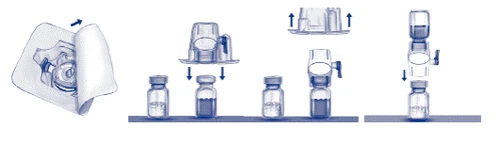
- Open the BAXJECT II device package by removing the paper lid, taking care not to touch the device inside (Fig. a). Do not remove the device from the package. Do not use if the BAXJECT II device, its sterile barrier system, or packaging is damaged or shows signs of deterioration.
- Turn the package over and insert the clear plastic spike into the diluent vial stopper. Hold the package by the edge and remove it from the BAXJECT II device (Fig. b). Do not remove the blue cap from the BAXJECT II device.
- For reconstitution, use only the sterile water for injection and transfer device provided in the package. Turn the system (BAXJECT II device attached to the diluent vial) upside down so that the diluent vial is above the device. Insert the white plastic spike into the stopper of the ADYNOVATE vial. The vacuum will draw the diluent into the ADYNOVATE vial (Fig. c).
- Gently swirl until the product is completely dissolved. Ensure that ADYNOVATE is fully dissolved; otherwise, not all of the reconstituted solution will pass through the device filter. The product dissolves rapidly (usually within less than 1 minute). After reconstitution, the solution should be clear, colourless, and free of particulate matter.
Fig. a Fig. b Fig. c
Administration
Follow aseptic techniques.
Parenteral medicinal products should be inspected visually for particulate matter immediately before use, whenever solution and container permit. Only clear, colourless solutions should be used.
- Remove the blue cap from the BAXJECT II device. Do not draw air into the syringe. Attach the syringe to the BAXJECT II device.
- Invert the system (the vial with reconstituted solution should be on top). Slowly draw the reconstituted solution into the syringe by pulling back the plunger.
- Detach the syringe.
- Attach a butterfly needle to the syringe. Administer intravenously. The solution should be infused slowly at a rate comfortable for the patient, not exceeding 10 ml per minute. Pulse rate should be monitored before and during administration of ADYNOVATE. If a significant increase in pulse rate occurs, reduce the infusion rate or temporarily interrupt the infusion, which is usually sufficient to rapidly resolve symptoms (see sections “Special precautions” and “Adverse reactions”).
From a microbiological standpoint, the product should be used immediately after reconstitution. However, chemical and physical stability of the medicinal product after reconstitution has been demonstrated for up to 3 hours at 25 °C.
During its shelf life, the product may be stored at room temperature (not above 25 °C) for one period not exceeding 6 months. The expiry date after 6 months of storage at room temperature must be indicated on the medicinal product packaging. The product must not be returned to the refrigerator for further storage.
Children
For on-demand treatment, dosing in paediatric patients (aged 0 to 18 years) does not differ from that in adults. For prophylactic therapy in patients under 6 years of age, 20–50 IU of factor VIII per kg body weight should be administered 3–4 times per week.
Overdose.
There are no reports of symptoms related to overdosage with this product.
Adverse Reactions
Clinical trials of the medicinal product ADYNOVATE included 418 studies with single-dose administration of ADYNOVATE, reporting 93 adverse reactions. The most common adverse reactions included development of neutralizing antibodies to factor VIII (inhibitors), headache, and fever.
Hypersensitivity or allergic reactions (which may include angioedema, burning and stinging at the infusion site, chills, flushing, generalized urticaria, headache, urticaria, hypotension, lethargy, nausea, restlessness, tachycardia, chest tightness, pruritus, vomiting, wheezing) were observed rarely, and in some cases progressed to acute anaphylaxis (including shock).
In patients developing antibodies to mouse and/or hamster proteins, associated hypersensitivity reactions may occur.
In patients with haemophilia A receiving factor VIII, including ADYNOVATE, neutralizing antibodies (inhibitors) may develop. If such inhibitors occur, the expected clinical response may not be achieved. In such cases, it is recommended to consult a specialized haemophilia treatment centre.
List of adverse reactions in tabular form
Table 3 below lists adverse reactions reported during clinical trials and spontaneous reporting, categorized by frequency of occurrence. The table follows the MedDRA system organ classification (SOC) and preferred terms.
Frequency categories are defined as follows: very common (≥ 1/10), common (≥ 1/100 to < 1/10), uncommon (≥ 1/1,000 to < 1/100), rare (≥ 1/10,000 to < 1/1,000), very rare (< 1/10,000), and not known (cannot be estimated from available data). Within each frequency category, adverse reactions are listed in order of decreasing severity.
Table 3
Frequency of adverse reactions reported in clinical trials and spontaneous reports
| Standard MedDRA System Organ Class |
Adverse Reactions |
Frequencya |
| Infections and infestations |
Influenza |
Uncommon |
| Laryngitis |
Uncommon |
|
| Blood and lymphatic system disorders |
Inhibition of factor VIII |
Uncommon (POP)d Very common (PBP)d |
| Lymphangitis |
Uncommon |
|
| Immune system disorders |
Anaphylactic reaction |
Not known |
| Increased sensitivityc |
Not known |
|
| Nervous system disorders |
Headache |
Common |
| Dizziness |
Uncommon |
|
| Memory impairment |
Uncommon |
|
| Syncope |
Uncommon |
|
| Tremor |
Uncommon |
|
| Migraine |
Uncommon |
|
| Dysgeusia |
Uncommon |
|
| Eye disorders |
Eye inflammation |
Uncommon |
| Cardiac disorders |
Palpitations |
Uncommon |
| Vascular disorders |
Haematoma |
Uncommon |
| Facial flushing |
Uncommon |
|
| Pallor |
Uncommon |
|
| Respiratory, thoracic and mediastinal disorders |
Dyspnoea |
Uncommon |
| Gastrointestinal disorders |
Diarrhoea |
Uncommon |
| Upper abdominal pain |
Uncommon |
|
| Nausea |
Uncommon |
|
| Vomiting |
Uncommon |
|
| Skin and subcutaneous tissue disorders |
Pruritus |
Uncommon |
| Rash |
Uncommon |
|
| Hyperhidrosis |
Uncommon |
|
| Urticaria |
Uncommon |
|
| General disorders and administration site conditions |
Hypothermia |
Common |
| Peripheral oedema |
Uncommon |
|
| Chest pain |
Uncommon |
|
| Chest discomfort |
Uncommon |
|
| Chills |
Uncommon |
|
| Malaise |
Uncommon |
|
| Vessel puncture site haematoma |
Uncommon |
|
| Fatigue |
Not known |
|
| Injection site reaction |
Not known |
|
| Indisposition |
Not known |
|
| Investigations |
Increased monocyte level |
Uncommon |
| Decreased level of blood coagulation factor VIIIb |
Uncommon |
|
| Decreased haematocrit level |
Uncommon |
|
| Investigation abnormal |
Uncommon |
|
| Injury, poisoning and procedural complications |
Post-procedural complication |
Uncommon |
| Post-procedural haemorrhage |
Uncommon |
|
| Procedure site reaction |
Uncommon |
a Based on the total number of patients who received ADYVIT (418).
b In one patient, an unexpected decrease in factor VIII coagulation levels occurred during continuous infusion of ADYVIT following surgery (10–14 days post-operatively). Hemostasis was maintained throughout this period, and factor VIII plasma levels and clearance rate returned to appropriate levels by day 15 after surgery. Quantitative assays for factor VIII inhibitors performed after completion of the continuous infusion and after study completion were negative.
c An explanation regarding this adverse reaction is provided in the section below.
d Frequency is based on data from studies with all factor VIII coagulation factor products that included patients with severe haemophilia A. PUP – previously treated patients; PTP – previously untreated patients.
Description of selected adverse reactions
Reactions to process residuals
Among 229 patients receiving treatment, testing for antibodies to Chinese hamster ovary (CHO) cell proteins was performed: 3 patients showed statistically significant trends in titres, 4 patients had sustained peaks or transient peak potentials, and 1 patient had both findings, but no clinical symptoms were observed. Among the 229 patients tested for antibodies to mouse IgG, 10 showed statistically significant increasing trends, 2 demonstrated sustained peaks or transient peak potentials, and 1 patient had both findings. Four patients reported isolated events of urticaria, pruritus, rash, and slightly elevated eosinophil counts upon repeated administration of the medicinal product.
Hypersensitivity
Allergic-type reactions include anaphylaxis and may present as dizziness, paresthesia, rash, flushing, facial swelling, urticaria, and pruritus.
Children
Apart from the development of neutralizing antibodies (inhibitors) in previously untreated children and complications related to catheterization, no differences in adverse reactions were observed in clinical studies.
Reporting of suspected adverse reactions
Reporting suspected adverse reactions after medicinal product authorization is important. It allows ongoing monitoring of the benefit-risk balance of the medicinal product. Healthcare and pharmaceutical professionals, as well as patients or their legal representatives, should report all suspected adverse reactions and lack of efficacy through the automated pharmacovigilance information system at the following link: https://aisf.dec.gov.ua.
Shelf life.
2 years.
Diluent (water for injections) – 5 years.
Storage conditions.
Store at 2 to 8 °C. Do not freeze! Store in the original packaging to protect from light.
Keep out of reach and sight of children.
Incompatibilities
Since compatibility studies have not been conducted, this medicinal product must not be mixed with other medicinal products or solvents.
Packaging.
One vial containing powder for solution for injection (250 IU, 500 IU, 1000 IU, 1500 IU, 2000 IU, or 3000 IU) with one vial of diluent (5 ml water for injections) and one BAXJECT II reconstitution device in a carton.
Prescription status.
Prescription only.
Manufacturer.
Baxalta Belgium Manufacturing SA, Belgium / Baxalta Belgium Manufacturing SA, Belgium.
Manufacturer's address.
Boulevard Rene Branquart 80, Lessines, 7860, Belgium / Boulevard Rene Branquart 80, Lessines, 7860, Belgium.