Adempas®
Ukraine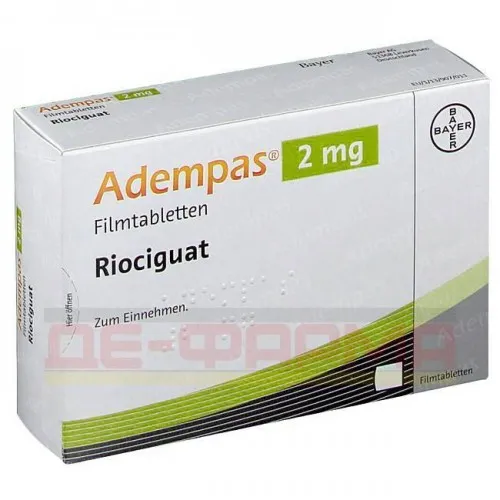
Table of Contents
INSTRUCTIONS for medical use of the medicinal product ADEMPAS® (ADEMPAS®)
Composition:
Active substance: riociguat;
One film-coated tablet contains 0.5 mg riociguat;
One film-coated tablet contains 1.0 mg riociguat;
One film-coated tablet contains 1.5 mg riociguat;
One film-coated tablet contains 2.0 mg riociguat;
One film-coated tablet contains 2.5 mg riociguat;
Excipients: microcrystalline cellulose, crospovidone, hypromellose, lactose monohydrate, magnesium stearate, sodium lauryl sulfate, hydroxypropylcellulose, propylene glycol, titanium dioxide (E 171) or iron oxide red (E 172) or iron oxide yellow (E 172).
Pharmaceutical form. Film-coated tablets.
Main physicochemical properties:
film-coated tablets, 0.5 mg: white, round, biconvex tablets, embossed with the "Bayer cross" on one side and with "R" and "0.5" on the other side;
film-coated tablets, 1 mg: pale yellow, round, biconvex tablets, embossed with the "Bayer cross" on one side and with "R" and "1" on the other side;
film-coated tablets, 1.5 mg: yellow-orange, round, biconvex tablets, embossed with the "Bayer cross" on one side and with "R" and "1.5" on the other side;
film-coated tablets, 2 mg: pale orange, round, biconvex tablets, embossed with the "Bayer cross" on one side and with "R" and "2" on the other side;
film-coated tablets, 2.5 mg: red-orange, round, biconvex tablets, embossed with the "Bayer cross" on one side and with "R" and "2.5" on the other side.
Pharmacotherapeutic group. Antihypertensive agents for the treatment of pulmonary arterial hypertension.
ATC code C02KX05
Pharmacological properties.
Pharmacodynamics.
Mechanism of action. Riociguat is a stimulator of soluble guanylate cyclase (sGC) – an enzyme present in the heart and lungs and serving as a receptor for nitric oxide (NO).
When NO binds to sGC, the enzyme enhances the synthesis of the signaling molecule cyclic guanosine monophosphate (cGMP). Intracellular cGMP plays an important role in regulating vascular tone, as well as processes of proliferation, fibrosis, and inflammation.
Pulmonary hypertension is associated with endothelial dysfunction, impaired nitric oxide synthesis, and insufficient activation of the NO–sGC–cGMP pathway.
Riociguat has a dual mechanism of action: it increases the sensitivity of sGC to endogenous NO by stabilizing its binding to sGC, and also directly stimulates sGC via a different active site independently of NO.
Riociguat stimulates the NO–sGC–cGMP pathway, resulting in increased cGMP production.
Pharmacodynamic effect. Riociguat stimulates the NO–sGC–cGMP pathway, leading to significant improvement in pulmonary vascular hemodynamics and increased exercise tolerance in patients.
There is a direct relationship between plasma concentrations of riociguat and hemodynamic parameters such as systemic vascular resistance, systolic blood pressure, pulmonary vascular resistance, and cardiac output.
Clinical efficacy and safety.
Patients with chronic thromboembolic pulmonary hypertension. A randomized, international, placebo-controlled, double-blind phase III study (CHEST-1) was conducted involving 261 adult patients with inoperable chronic thromboembolic pulmonary hypertension (CTEPH) (72%) or persistent/recurrent CTEPH after pulmonary endarterectomy (28%). During the first 8 weeks, riociguat was titrated every 2 weeks from 0.5 mg to a maximum of 2.5 mg three times daily, based on systolic blood pressure and symptoms of hypotension, to reach the optimal individual dose, which was then maintained for the following 8 weeks. The primary endpoint was change in the 6-minute walk distance (6MWD) from baseline to the final visit (week 16), compared to placebo.
At the final visit, the increase in 6MWD with riociguat compared to placebo was 46 m (95% confidence interval (CI): 25 m to 67 m; p<0.0001).
Results in key subgroups are presented below (statistical analysis of all randomized patients (ITT analysis), see Table 1).
Table 1. Effect of riociguat on 6MWD in the CHEST-1 study at final visit
| General patient population |
Riociguat (n=173) |
Placebo (n=88) |
|
| Baseline (m) (standard deviation (SD)) |
342 (82) |
356 (75) |
|
| Mean change from baseline (m) (SD) |
39 (79) |
-6 (84) |
|
| Placebo-corrected mean difference (m) 95% CI (p-value) |
46 25 to 67 (<0.0001) |
||
| Patients in WHO FC III |
Riociguat (n=107) |
Placebo (n=60) |
|
| Baseline (m) (SD) |
326 (81) |
345 (73) |
|
| Mean change from baseline (m) (SD) |
38 (75) |
-17 (95) |
|
| Placebo-corrected mean difference (m) 95% CI |
56 29 to 83 |
||
| Patients in WHO FC II |
Riociguat (n=55) |
Placebo (n=25) |
|
| Baseline (m) (SD) |
387 (59) |
386 (64) |
|
| Mean change from baseline (m) (SD) |
45 (82) |
20 (51) |
|
| Placebo-corrected mean difference (m) 95% CI |
25 -10 to 61 |
||
| Inoperable patients |
Riociguat (n=121) |
Placebo (n=68) |
|
| Baseline (m) (SD) |
335 (83) |
351 (75) |
|
| Mean change from baseline (m) (SD) |
44 (84) |
-8 (88) |
|
| Placebo-corrected mean difference (m) 95% CI |
54 29 to 79 |
||
| CTEPH patients after pulmonary endarterectomy |
Riociguat (n=52) |
Placebo (n=20) |
|
| Baseline (m) (SD) |
360 (78) |
374 (72) |
|
| Mean change from baseline (m) (SD) |
27 (68) |
(73) |
|
| Placebo-corrected mean difference (m) 95% CI |
27 -10 to 63 |
||
An increase in exercise tolerance was accompanied by improvement in a significant number of clinically relevant secondary endpoints. These results corresponded to the predefined improvement in additional hemodynamic parameters observed in the study.
Table 2. Effect of riociguat on PVR, NT-proBNP, and WHO functional class observed at the last visit in the CHEST-1 study
PVR |
Riociguat (n=151) |
Placebo (n=82) |
| Baseline level (dyn·s·cm-5) (SD) |
790.7 (431.6) |
779.3 (400.9) |
| Mean change from baseline (dyn·s·cm-5) (SD) |
-225.7 (247.5) |
23.1 (273.5) |
| Placebo-corrected difference (dyn·s·cm-5) 95% CI, (p-value) |
-246.4 from –303.3 to –189.5 (<0.0001) |
|
| NT‑proBNP |
Riociguat (n=150) |
Placebo (n=73) |
| Baseline level (ng/L) (SD) |
1508.3 (2337.8) |
1705.8 (2567.2) |
| Mean change from baseline (ng/L) (SD) |
-290.7 (1716.9) |
76.4 (1446.6) |
| Placebo-corrected difference (ng/L) 95% CI, (p-value) |
-444.0 from -843.0 to -45.0 (<0.0001) |
|
| Changes in WHO functional class |
Riociguat (n=173) |
Placebo (n=87) |
| Improvement |
57 (32.9%) |
13 (14.9%) |
| Stable |
107 (61.8%) |
68 (78.2%) |
| Worsening |
9 (5.2%) |
6 (6.9%) |
| p |
0.0026 |
|
PVR – pulmonary vascular resistance.
NT-proBNP – N-terminal prohormone of brain natriuretic peptide.
The frequency of adverse reactions leading to patient withdrawal from the study was similar in both subgroups (riociguat, individualized dose titration (IDT) 1.0–2.5 mg – 2.9 %; placebo – 2.3 %).
Long-term therapy for CTEPH. The open-label extension study CHEST-2 included 237 patients who had completed participation in the CHEST-1 study. At the end of the study, the mean duration of treatment in the overall group was 1285 (709) days, with a median of 1174 days (ranging from 15 to 3512 days). Overall, 221 patients (93.2 %) had a treatment duration of approximately 1 year (at least 48 weeks), 205 patients (86.5 %) – approximately 2 years (at least 96 weeks), and 142 patients (59.9 %) – approximately 3 years (at least 144 weeks). The total treatment exposure amounted to 834 patient-years.
The safety profile of riociguat in the CHEST-2 study was consistent with that observed in the core studies. In the overall population, after treatment with riociguat, the mean 6MWD improved by 53 m at 12 months (n = 208), by 48 m at 24 months (n = 182), and by 49 m at 36 months (n = 117) compared to baseline. Improvement in 6MWD was maintained until the end of the study.
Table 3 shows the proportion of patients* with changes in WHO functional class during treatment with riociguat compared to baseline.
Table 3. CHEST-2: Changes in WHO functional class
| Duration of treatment in the CHEST-2 study |
Changes in WHO functional class (n (%) of patients) |
||
| Improved |
Stable |
Worsened |
|
| 1 year (n = 217) |
100 (46 %) |
109 (50 %) |
6 (3 %) |
| 2 years (n = 193) |
76 (39 %) |
111 (58 %) |
5 (3 %) |
| 3 years (n = 128) |
48 (38 %) |
65 (51 %) |
14 (11 %) |
* Patients participated in the study until the drug was approved and commercially available in their respective countries.
The probability of survival was 97% at 1 year, 93% at 2 years, and 89% after 3 years of treatment with riociguat.
Efficacy in patients with PAH. A randomized, international, placebo-controlled, double-blind Phase III study (PATENT-1) was conducted involving 443 adult patients with PAH, randomized as follows: individualized dose titration of riociguat up to 2.5 mg three times daily (n=254), placebo group (n=126), and a group with dose titration limited to a maximum riociguat dose of 1.5 mg (investigational dose group, no full statistical analysis performed (CT)) (n=63). Of all patients enrolled in the study, 50% had not received prior treatment, 43% had previously received endothelin receptor antagonists, and 7% had received prostacyclin analogues (inhaled (iloprost), oral (beraprost), or subcutaneous (treprostinil)). Additionally, 63.4% of the enrolled patients had idiopathic or hereditary forms of PAH, 25.1% had PAH associated with connective tissue disease, and 7.9% had congenital heart defects. During the first 8 weeks, riociguat was titrated every 2 weeks based on the patient's systolic blood pressure and symptoms of hypotension to determine the optimal individual dose (range: from 0.5 mg to 2.5 mg three times daily), which was then maintained for the subsequent 4 weeks. The primary endpoint of the study was placebo-corrected changes in the 6-minute walk distance (6MWD) observed at the final visit (Week 12).
At the final visit, the increase in 6MWD with individualized dose titration (IDT) was 36 m (95% CI: 20 m to 52 m; p<0.0001) compared to the placebo group. In patients who had not received prior treatment (n=189), the distance increased by 38 m, and in those who had received prior therapy (n=191), by 36 m (ITT analysis; see Table 4). Further exploratory subgroup analyses revealed a treatment effect characterized by an increase in distance of 26 m (95% CI: 5 m to 46 m) in patients previously treated with endothelin receptor antagonists (n=167), and 101 m (95% CI: 27 m to 176 m) in patients who had previously received prostacyclin analogues (n=27).
Table 4. Effect of riociguat on 6MWD in the PATENT-1 study at the final visit
| General patient population |
Verquvo IDT (n=254) |
Placebo (n=126) |
Verquvo CT (n=63) |
| Baseline (m) (SD) |
361 (68) |
368 (75) |
363 (67) |
| Mean change from baseline (m) (SD) |
30 (66) |
-6 (86) |
31 (79) |
| Placebo-corrected difference (m) 95% CI, (p-value) |
36 from 20 to 52 (<0.0001) |
||
| Patients in WHO FC III |
Verquvo IDT (n=140) |
Placebo (n=58) |
Verquvo CT (n=39) |
| Baseline (m) (SD) |
338 (70) |
347 (78) |
351 (968) |
| Mean change from baseline (m) (SD) |
31 (64) |
-27 (98) |
29 (94) |
| Placebo-corrected difference (m) 95% CI |
58 from 35 to 81 |
||
| Patients in WHO FC II |
Verquvo IDT (n=108) |
Placebo (n=60) |
Verquvo CT (n=19) |
| Baseline (m) (SD) |
392 (51) |
393 (61) |
378 (64) |
| Mean change from baseline (m) (SD) |
29 (69) |
19 (63) |
43 (50) |
| Placebo-corrected difference (m) 95% CI |
10 from -11 to 31 |
||
| Patients who were treatment-naïve |
Verquvo IDT (n=123) |
Placebo (n=66) |
Verquvo CT (n=32) |
| Baseline (m) (SD) |
370 (66) |
360 (80) |
347 (72) |
| Mean change from baseline (m) (SD) |
32 (74) |
-6 (88) |
49 (47) |
| Placebo-corrected difference (m) 95% CI |
38 from 14 to 62 |
||
| Patients who were previously treated |
Verquvo IDT (n=131) |
Placebo (n=60) |
Verquvo CT (n=31) |
| Baseline (m) (SD) |
353 (69) |
376 (68) |
380 (57) |
| Mean change from baseline (m) (SD) |
27 (58) |
-5 (83) |
12 (100) |
| Placebo-corrected difference (m) 95% CI |
36 from 15 to 56 |
||
Improvement in exercise tolerance was accompanied by improvement in a significant number of clinically relevant secondary endpoints. These results corresponded to the predefined improvement in additional hemodynamic parameters observed in the study (see Table 5).
Table 5. Effect of riociguat on PVR and NT-proBNP observed at the last visit in the PATENT-1 study
PVR |
Riociguat IDT (n=232) |
Placebo (n=107) |
Riociguat CT (n=58) |
| Baseline level (dyn·s·cm⁻⁵) (SD) |
791 (452.6) |
834.1 (476.7) |
84.8 (548.2) |
| Mean change in PVR from baseline (dyn·s·cm⁻⁵) (SD) |
-223 (260.1) |
-8.9 (316.6) |
-167.8 (320.2) |
| Placebo-corrected difference (dyn·s·cm⁻⁵) 95% CI, (p-value) |
-225.7 -281.4 to -170.1 (<0.0001) |
||
| NT-proBNP |
Riociguat IDT (n = 228) |
Placebo (n = 106) |
Riociguat CT (n=54) |
| Baseline level (ng/L) (SD) |
1026.7 (1799.2) |
1228.1 (1774.9) |
1189.7 (1404.7) |
| Mean change from baseline (ng/L) (SD) |
-197.9 (1721.3) |
232.4 (1011.1) |
-471.5 (913.0) |
| Placebo-corrected difference (ng/L) 95% CI, (p-value) |
-431.8 (-781.5 to -82.1) (<0.0001) |
||
| Changes in WHO functional class |
Riociguat IDT (n = 254) |
Placebo (n = 125) |
Riociguat CT (n=63) |
| Improvement |
53 (20.9%) |
18 (14.4%) |
15 (23.8%) |
| Stable |
192 (75.6%) |
89 (71.2%) |
43 (68.3%) |
| Worsening |
9 (3.6%) |
18 (14.4%) |
5 (7.9%) |
| p-value |
0.0033 |
||
In patients receiving riociguat, a significantly later onset of clinical worsening was observed compared to patients in the placebo group (p=0.0046; stratified log-rank test) (see Table 6).
Table 6. Effect of riociguat on clinical worsening events during the PATENT-1 study
| Clinical worsening events |
Riociguat IDT (n=254) |
Placebo (n=126) |
Riociguat CT (n=63) |
| Patients experiencing any clinical worsening |
3 (1.2%) |
8 (6.3%) |
2 (3.2%) |
| Deaths |
2 (0.8%) |
3 (2.4%) |
1 (1.6%) |
| Hospitalizations due to pulmonary hypertension (PH) |
1 (0.4%) |
4 (3.2%) |
0 |
| Decrease in 6MWD due to PH |
1 (0.4%) |
2 (1.6%) |
1 (1.6%) |
| Sustained deterioration in functional class due to PH |
0 |
1 (0.8%) |
0 |
| Initiation of new PH therapy |
1 (0.4%) |
5 (4.0%) |
1 (1.6%) |
In patients treated with riociguat, a significant improvement was observed in the Borg CR 10 dyspnea scale scores (mean change from baseline (SD): riociguat – 0.4 (2), placebo – 0.1 (2); p = 0.0022).
Adverse reactions leading to study discontinuation occurred less frequently in both riociguat treatment groups compared to the placebo group (riociguat IDT 1.0–2.5 mg, 3.1%; riociguat CT, 1.6%; placebo, 7.1%).
Long-term treatment of PAH. A total of 396 patients who completed the PATENT-1 study were enrolled in the open-label extension study PATENT-2. During PATENT-2, the mean duration of treatment in the overall group (excluding exposure from PATENT-1) was 1375 (772) days, with a median duration of 1331 days (range: 1 to 3565 days). Overall, 90% of patients received treatment for at least 1 year (≥48 weeks), 85% for at least 2 years (≥96 weeks), and 70% for at least 3 years (≥144 weeks). The total treatment exposure amounted to 1491 patient-years.
The safety profile of riociguat in PATENT-2 was consistent with that observed in the core studies. In the overall population, after treatment with riociguat, the mean 6MWD improved by 50 m at 12 months (n = 347), by 46 m at 24 months (n = 311), and by 46 m at 36 months (n = 238) compared to baseline. Improvement in 6MWD was maintained throughout the study period.
Table 7 shows the proportion of patients* with changes in WHO functional class during treatment with riociguat compared to baseline.
Table 7. PATENT-2: Changes in WHO Functional Class
| Duration of treatment in the PATENT-2 study |
Changes in WHO functional class (n (%) of patients) |
||
| Improvement |
Stable |
Worsening |
|
| 1 year (n = 358) |
116 (32 %) |
222 (62 %) |
20 (6 %) |
| 2 years (n = 321) |
106 (33 %) |
189 (59 %) |
26 (8 %) |
| 3 years (n = 257) |
88 (34 %) |
147 (57 %) |
22 (9 %) |
* Patients participated in the study until the drug was approved and commercially available in their countries.
The probability of survival was 97% after 1 year, 93% after 2 years, and 88% after 3 years of treatment with riociguat.
Patients with pulmonary arterial hypertension associated with idiopathic interstitial pneumonia (PAH-IIP). Phase II randomized, double-blind, placebo-controlled study (RISE-IIP) evaluating the efficacy and safety of riociguat in patients with symptomatic PAH-IIP was terminated early due to an increased risk of mortality and serious adverse reactions in individuals receiving riociguat, as well as lack of efficacy. During the main study phase, more patients receiving riociguat experienced death (11% vs. 4%) and serious adverse reactions (37% vs. 23%). With long-term treatment, more patients who switched from the placebo group to the riociguat group (21%) died compared to those who continued receiving riociguat (3%).
Therefore, riociguat is contraindicated in patients with PAH-IIP (see section "Contraindications").
Pharmacokinetics.
Absorption. Riociguat has high absolute bioavailability (94%). Absorption of riociguat is rapid, with maximum concentration (Cmax) reached within 1–1.5 hours after tablet intake. Administration of the drug with food slightly reduces the AUC of riociguat and decreases Cmax by 35%.
The bioavailability (AUC and Cmax) of Adempas® tablets administered orally as crushed tablets mixed with apple puree or water is comparable to that of intact tablets (see section "Dosage and Administration").
Distribution. Plasma protein binding in humans is high, approximately 95%, with serum albumin and alpha-1 acid glycoprotein being the main binding components. The volume of distribution is moderate, reaching about 30 L at steady state.
Metabolism. The primary metabolic pathway of riociguat is N-demethylation, catalyzed by CYP1A1, CYP3A4, CYP3A5, and CYP2J2 isoenzymes, resulting in the formation of the main circulating active metabolite M1 (pharmacological activity of 1/10 to 1/3 that of riociguat), which is subsequently metabolized into a pharmacologically inactive N-glucuronide.
The CYP1A1 isoenzyme catalyzes the formation of the main metabolite of riociguat in the liver and lungs and is known to be induced by polycyclic aromatic hydrocarbons present, for example, in tobacco smoke.
Elimination. Elimination of riociguat (parent compound and metabolites) occurs both renally (33–45%) and via bile/feces (48–59%). Approximately 4–19% of the administered dose is excreted unchanged in urine, and 9–44% is found unchanged in feces.
In vitro, riociguat and its main metabolite are substrates of the transport proteins P-gp (P-glycoprotein) and BCRP (breast cancer resistance protein). Given a systemic clearance of approximately 3–6 L/h, riociguat can be classified as a low-clearance drug. The elimination half-life is approximately 7 hours in healthy individuals and about 12 hours in patients.
Linearity. Riociguat exhibits linear pharmacokinetics in doses ranging from 0.5 to 2.5 mg. The coefficient of variation (CV) of riociguat exposure (AUC) across all doses is approximately 60%.
Special Populations
Gender. Based on pharmacokinetic data, there are no significant differences in riociguat exposure attributable to patient gender.
Children. Pharmacokinetic studies of riociguat in children have not been conducted.
Elderly Patients. In elderly patients (aged 65 years and older), higher plasma concentrations were observed compared to younger patients, with an increase in mean AUC values by approximately 40%, primarily due to reduced total and renal clearance.
Ethnic Differences. Based on pharmacokinetic data, no significant ethnic differences have been identified.
Body Weight Differences. Based on pharmacokinetic data, there are no significant differences in riociguat exposure attributable to body weight.
Hepatic Impairment. In patients with liver cirrhosis (non-smokers) and mild hepatic impairment (Child-Pugh class A), the mean AUC of riociguat was increased by 35% compared to healthy control volunteers, which remains within the range of normal inter-individual variability. The mean AUC of riociguat in patients with liver cirrhosis (non-smokers) and moderate hepatic impairment (Child-Pugh class B) was 51% higher than in healthy control volunteers. Data in patients with severe hepatic impairment (Child-Pugh class C) are lacking.
The use of riociguat in patients with elevated ALT levels (more than 3 times the upper limit of normal) or elevated bilirubin levels (more than 2 times the upper limit of normal) has not been studied (see section "Special Warnings and Precautions for Use").
Renal Impairment. Overall, dose- and weight-normalized mean exposure values of riociguat were higher in patients with renal impairment compared to those with normal renal function. Exposure values of the main metabolite were also higher in patients with renal impairment compared to healthy volunteers. In non-smoking patients with mild (creatinine clearance 80–50 mL/min), moderate (creatinine clearance <50–30 mL/min), or severe (creatinine clearance <30 mL/min) renal impairment, plasma concentrations of riociguat (AUC) were increased by 53%, 139%, and 54%, respectively. Information in patients with creatinine clearance <30 mL/min is limited, and data in dialysis patients are lacking.
Due to the high plasma protein binding of riociguat, elimination during dialysis is unlikely.
Preclinical Data.
Preclinical data from conventional safety pharmacology, single-dose toxicity, phototoxicity, genotoxicity, and carcinogenic potential studies indicate no specific risks to humans.
Adverse reactions observed during repeated-dose toxicity studies were primarily related to the excessive pharmacological activity of riociguat (effects on hemodynamic parameters and myorelaxant effects on smooth muscle).
In young, growing, and immature animals, effects on osteogenesis were observed. In young animals, changes included thickening of trabecular bone, hyperostosis, and remodeling of the metaphyseal and diaphyseal regions of bones; in immature animals, a general increase in bone mass was observed. Such effects were not observed in adult animals.
In reproductive toxicity studies in animals, a decrease in testicular weight was observed at systemic exposure approximately 7 times higher than in humans, with no observed effect on male or female fertility. Moderate placental transfer of the drug was demonstrated. Animal studies on adverse effects on embryofetal development demonstrated reproductive toxicity of riociguat. In animals, at systemic exposure in the maternal organism approximately 7 times higher than in humans (2.5 mg three times daily), increased incidence of developmental abnormalities and shortened gestation due to early resorption were observed. At systemic exposure approximately 3 times higher than in humans, miscarriage and fetal toxicity were observed in animals.
Clinical characteristics.
Indications.
Chronic thromboembolic pulmonary hypertension (CTEPH)
For the treatment of adult patients belonging to WHO functional class II–III and who have
- inoperable CTEPH,
- persistent or recurrent CTEPH after surgery, to improve exercise capacity (see section "Pharmacological properties").
Pulmonary arterial hypertension (PAH)
As monotherapy or in combination with endothelin receptor antagonists for the treatment of adult patients with pulmonary arterial hypertension (PAH) WHO functional class II–III to improve exercise capacity.
The efficacy of the medicinal product was established in patients with idiopathic or hereditary PAH or PAH associated with connective tissue diseases (see section "Pharmacological properties").
Contraindications.
- Concomitant use with phosphodiesterase-5 (PDE5) inhibitors (e.g. sildenafil, tadalafil or vardenafil) (see sections "Dosage and administration" and "Interaction with other medicinal products and other forms of interaction").
- Severe hepatic impairment (Child–Pugh class C).
- Hypersensitivity to the active substance or to any of the excipients.
- Pregnancy (see sections "Special warnings and precautions for use", "Interaction with other medicinal products and other forms of interaction" and "Use during pregnancy or breastfeeding").
- Concomitant use with nitrates or nitric oxide donors (e.g. amyl nitrite) in any form, including recreational drugs, so-called "poppers" (see section "Interaction with other medicinal products and other forms of interaction").
- Concomitant use with other stimulators of soluble guanylate cyclase.
- Systolic blood pressure < 95 mmHg at initiation of treatment.
- Pulmonary arterial hypertension associated with idiopathic interstitial pneumonia (PAH-IIP) (see section "Pharmacological properties").
Interaction with other medicinal products and other forms of interaction.
Pharmacodynamic interactions
Nitrates
In a clinical study, administration of the highest dose of Adempas® (2.5 mg tablets three times daily) enhanced the hypotensive effect of sublingual nitroglycerin (0.4 mg) administered 4 and 8 hours after Adempas®. Therefore, concomitant use of Adempas® with nitrates or nitric oxide donors (e.g. amyl nitrite) in any form, including recreational drugs, so-called "poppers", is contraindicated (see section "Contraindications").
Phosphodiesterase-5 (PDE5) inhibitors
Preclinical studies in animals have shown additive effects on blood pressure reduction when riociguat is used in combination with sildenafil or vardenafil. In some cases, excessive additive effects on blood pressure reduction were observed with increasing doses.
In an exploratory drug interaction study involving 7 PAH patients receiving stable-dose sildenafil (20 mg three times daily), single doses of riociguat (0.5 mg and 1 mg sequentially) caused additional haemodynamic effects. Doses of riociguat higher than 1 mg were not studied in this trial.
In a 12-week combination therapy study, 18 PAH patients receiving a combination of stable-dose sildenafil (20 mg three times daily) and riociguat (1.0–2.5 mg three times daily) were compared with monotherapy with sildenafil. During the long-term extension phase (uncontrolled phase) of this study, a high rate of discontinuations was observed with concomitant use of sildenafil and riociguat, mainly due to hypotension. There was no evidence of a beneficial clinical effect of the combination in the study group. Concomitant use of riociguat with PDE5 inhibitors (such as sildenafil, tadalafil, vardenafil) is contraindicated (see sections "Dosage and administration" and "Contraindications").
A 24-week uncontrolled study, RESPITE, involving 61 PAH patients, was conducted to evaluate the transition from PDE-5 inhibitors to riociguat.
All patients were in WHO functional class III and 82 % were receiving standard therapy with endothelin receptor antagonists (ERAs). The median washout period when switching from PDE-5 inhibitors to riociguat was 1 day for sildenafil and 3 days for tadalafil. Overall, the safety profile observed during the study was comparable to that in the main studies; no serious adverse reactions were reported during the transition period. Six patients (10 %) experienced at least one clinical worsening event, including 2 fatal cases not related to the investigational medicinal product. Changes from baseline indicate a positive effect in individual patients, e.g. improvement in 6-minute walk test distance (+31 m), levels of N-terminal pro-brain natriuretic peptide (NT-proBNP) (–347 pg/mL), WHO functional class I/II/III/IV (2/52/46/0), and cardiac index (+0.3 L/min/m²).
Stimulators of soluble guanylate cyclase
Concomitant use of riociguat with other stimulators of soluble guanylate cyclase is contraindicated (see section "Contraindications").
Warfarin/phenprocoumon
When riociguat was used concomitantly with warfarin, changes in prothrombin time were typical of those caused by warfarin. Similarly, atypical changes in prothrombin time are not expected when riociguat is used concomitantly with other coumarin derivatives (e.g. phenprocoumon).
In vivo studies also showed no pharmacokinetic interactions between riociguat and warfarin, a CYP2C9 substrate.
Acetylsalicylic acid
When riociguat was used concomitantly with acetylsalicylic acid, changes in bleeding time were typical of those caused by acetylsalicylic acid. Riociguat does not affect platelet aggregation in humans.
Effect of other substances on riociguat
Riociguat clearance is primarily mediated by oxidative metabolism via cytochrome P450 (CYP1A1, CYP3A4, CYP3A5, CYP2J2), direct biliary/faecal excretion of unchanged riociguat, and renal excretion of unchanged riociguat via glomerular filtration.
Concomitant use with strong inhibitors of CYP and P-glycoprotein (P-gp)/breast cancer resistance protein (BCRP)
In vitro, abacavir, rilpivirine, efavirenz, ritonavir, cobicistat and elvitegravir inhibit CYP1A1 and riociguat metabolism (listed in decreasing order of inhibitory potency, with abacavir being the most potent inhibitor). Cobicistat, ritonavir, atazanavir and darunavir are also classified as CYP3A inhibitors. Ritonavir also showed P-gp inhibition.
The effect of highly active antiretroviral therapy (HAART) (including various combinations of abacavir, atazanavir, cobicistat, darunavir, dolutegravir, efavirenz, elvitegravir, emtricitabine, lamivudine, rilpivirine, ritonavir and tenofovir) on riociguat exposure was studied in a dedicated trial in HIV patients. Concomitant use of HAART combinations resulted in an increase in mean area under the pharmacokinetic curve (AUC) of riociguat by up to approximately 160 % and an increase in mean Cmax by about 30 %. The safety profile observed in HIV patients receiving a single 0.5 mg dose of riociguat concomitantly with various HAART combination regimens was generally comparable to that in other patient groups.
To reduce the risk of arterial hypotension at the start of Adempas® therapy in patients receiving stable doses of strong CYP (particularly CYP1A1 and CYP3A4) and P-gp/BCRP inhibitors, such as those included in highly active antiretroviral therapy, a lower starting dose should be considered. Monitoring for symptoms of arterial hypotension is recommended in these patients (see sections "Dosage and administration" and "Special warnings and precautions for use").
Antifungal agents
In vitro, ketoconazole, considered a potent inhibitor of CYP3A4 and P-gp, also showed inhibitory effects on CYP and P-gp/BCRP metabolic pathways involved in riociguat metabolism and elimination (see section "Pharmacological properties"). After concomitant administration of 400 mg ketoconazole once daily, an increase in mean AUC of riociguat by 150 % (range up to 370 %) and a 46 % increase in mean Cmax were observed. The terminal half-life increased from 7.3 to 9.2 hours, and total clearance decreased from 6.1 to 2.4 L/h.
To reduce the risk of arterial hypotension at the start of Adempas® therapy in patients receiving stable doses of strong CYP (particularly CYP1A1 and CYP3A4) and P-gp/BCRP inhibitors, such as ketoconazole, posaconazole or itraconazole, a lower starting dose should be considered. Monitoring for symptoms of arterial hypotension is recommended in these patients (see sections "Dosage and administration" and "Special warnings and precautions for use").
Concomitant use with other inhibitors of CYP and P-glycoprotein (P-gp)/breast cancer resistance protein (BCRP)
Medicinal products that strongly inhibit P-gp/BCRP, such as the immunosuppressant cyclosporine A, should be used with caution (see sections "Special warnings and precautions for use", "Pharmacological properties").
Inhibitors of UDP-glucuronosyltransferase (UGT) 1A1 and 1A9 may increase exposure to the pharmacologically active metabolite M-1 of riociguat (pharmacological activity of M-1 is 1/10 to 1/3 that of riociguat). For concomitant use with these substances, dose titration recommendations should be followed (see section "Dosage and administration").
Among the recombinant CYP isoforms tested in vitro, CYP1A1 most effectively catalyses the formation of the main metabolite of riociguat. Tyrosine kinase inhibitors include potent inhibitors of CYP1A1, with erlotinib and gefitinib showing the highest inhibitory activity in vitro. Therefore, due to drug interactions via inhibition of CYP1A1, increased exposure to riociguat is possible, especially in smokers (see section "Pharmacological properties"). Strong inhibitors of CYP1A1 should be used with caution (see section "Special warnings and precautions for use").
Concomitant use with medicinal products that increase gastric pH
Riociguat has lower solubility at neutral pH than in acidic environments. Concomitant use of agents that increase gastrointestinal pH may reduce oral bioavailability.
Concomitant use of antacids such as aluminium hydroxide/magnesium hydroxide reduces the mean AUC of riociguat by 34 % and mean Cmax by 56 % (see section "Dosage and administration"). Antacids should be taken at least 2 hours before or 1 hour after administration of riociguat.
Concomitant use with inducers of CYP3A4
Bosentan, a moderate inducer of CYP3A4, reduces steady-state plasma concentrations of riociguat by 27 % in PAH patients (see sections "Indications", "Pharmacological properties"). When used concomitantly with bosentan, dose titration recommendations should be followed (see section "Dosage and administration").
Concomitant use of riociguat with strong inducers of CYP3A4 (e.g. phenytoin, carbamazepine, phenobarbital or St. John's wort) may also reduce plasma concentrations of riociguat.
Smoking
In smokers, riociguat exposure is reduced by 50–60 % (see section "Pharmacological properties"). Therefore, patients are advised to stop smoking (see section "Dosage and administration").
Effect of riociguat on other substances
In vitro, riociguat and its main metabolite at therapeutic plasma concentrations do not exhibit inhibitory or inductive effects on major CYP isoforms (including CYP3A4) or transporters (e.g. P-gp/BCRP).
Female patients should not plan pregnancy during treatment with Adempas® (see section "Contraindications"). Riociguat (2.5 mg three times daily) had no clinically relevant effect on plasma levels of combined oral contraceptives containing levonorgestrel and ethinylestradiol when co-administered to healthy women. Based on this study and considering that riociguat is not an inducer of relevant metabolic enzymes, pharmacokinetic interactions with other hormonal contraceptives are not expected.
Riociguat and its main metabolite are potent inhibitors of CYP1A1 in vitro. Therefore, clinically relevant drug interactions cannot be excluded when co-administered with medicinal products whose clearance is significantly mediated by CYP1A1 biotransformation, such as erlotinib or granisetron.
Special precautions for use.
Studies on the use of riociguat in pulmonary arterial hypertension (PAH) were predominantly conducted in patients with idiopathic or hereditary forms of PAH or PAH associated with connective tissue diseases. Riociguat is not recommended for other forms of PAH that have not been studied (see section "Pharmacological properties").
For chronic thromboembolic pulmonary hypertension (CTEPH), pulmonary endarterectomy is the treatment of choice. According to standard medical practice, expert assessment of operability should be performed before initiating riociguat therapy.
Pulmonary veno-occlusive disease
Pulmonary vasodilators may significantly worsen cardiovascular status in patients with pulmonary veno-occlusive disease. Therefore, riociguat is not recommended for use in such patients. If signs of pulmonary edema occur, the possibility of associated pulmonary veno-occlusive disease should be considered, and riociguat treatment should be discontinued if the diagnosis is confirmed.
Respiratory tract bleeding
Patients with pulmonary hypertension have an increased risk of respiratory tract bleeding, particularly in those receiving anticoagulant therapy. Careful monitoring of patients on anticoagulants is recommended according to standard medical practice.
The risk of serious and fatal respiratory tract bleeding may be increased with riociguat treatment, especially in the presence of risk factors such as recent episodes of hemoptysis (including cases requiring bronchial artery embolization). Riociguat should be avoided in patients with a history of hemoptysis or those who have previously undergone bronchial artery embolization. In the event of respiratory tract bleeding, the physician should continuously assess the benefit-risk ratio regarding continuation of treatment.
Serious bleeding was observed in 2.4% (12/490) of patients receiving riociguat, compared to 0/214 patients in the placebo group. Significant hemoptysis occurred in 1% (5/490) of patients on riociguat therapy, including one fatal case, compared to 0/214 patients on placebo. Serious hemorrhagic events also included vaginal bleeding in 2 patients, catheter site hemorrhage in 2 patients, and one case each of subdural hematoma, hematemesis, and intra-abdominal bleeding.
Hypotension
Riociguat has vasodilatory properties, which may lead to a reduction in arterial blood pressure. Before prescribing riociguat, the physician should carefully consider all concomitant conditions that may be adversely affected by vasodilation (e.g., concomitant antihypertensive therapy, baseline hypotension, hypovolemia, severe left ventricular outflow tract obstruction, or autonomic dysfunction).
Riociguat must not be used in patients with systolic blood pressure below 95 mm Hg (see section "Contraindications"). Patients aged 65 years and older have an increased risk of developing hypotension. Therefore, riociguat should be used with caution in these patients.
Renal impairment
Data in patients with severe renal impairment (creatinine clearance < 30 mL/min) are limited, and data in patients receiving dialysis are lacking. Therefore, riociguat is not recommended for use in these patients. In the core studies, patients with mild to moderate renal impairment were included. In such patients, increased exposure to riociguat was observed (see section "Pharmacological properties"). Patients with renal impairment have a higher risk of developing hypotension; therefore, individual dose titration should be performed with particular caution.
Hepatic impairment
Patients with severe hepatic impairment (Child-Pugh class C) have not been studied, and therefore riociguat is contraindicated in these patients (see section "Contraindications"). In patients with moderate hepatic impairment (Child-Pugh class B), pharmacokinetic data indicate increased exposure to riociguat (see section "Pharmacological properties"). Individual dose titration should be performed with particular caution.
There is no clinical experience with riociguat in patients who had elevated liver transaminases (more than 3 times the upper limit of normal) or elevated direct bilirubin (more than 2 times the upper limit of normal) prior to starting treatment; riociguat is not recommended for use in such patients.
Pregnancy/contraception
Adempas® is contraindicated during pregnancy (see section "Contraindications"). Therefore, women of childbearing potential must use effective contraception during treatment with Adempas®. Monthly pregnancy testing is recommended.
Smoking
Plasma concentrations of riociguat in smokers are lower than in non-smokers. In patients who start or stop smoking during riociguat treatment, dose adjustment may be required (see sections "Dosage and administration" and "Pharmacological properties").
Concomitant use with other medicinal products
- Concomitant use of riociguat with strong inhibitors of cytochrome P450 (CYP) and inhibitors of P-glycoprotein (P-gp)/breast cancer resistance protein (BCRP), such as azole antifungals (e.g., ketoconazole, posaconazole, itraconazole) or HIV protease inhibitors (e.g., ritonavir), leads to a substantial increase in riociguat exposure (see sections "Interaction with other medicinal products and other forms of interaction" and "Pharmacological properties").
- The benefit-risk ratio should be individually assessed for each patient before prescribing Adempas® concomitantly with stable doses of strong CYP/P-gp/BCRP inhibitors. To reduce the risk of arterial hypotension, dose reduction should be considered, and patients should be monitored for symptoms of hypotension (see sections "Dosage and administration" and "Interaction with other medicinal products and other forms of interaction").
- Patients receiving stable doses of Adempas® should not initiate therapy with strong CYP and P-gp/BCRP inhibitors, as limited data are available and no dosing recommendations can be provided. Alternative therapeutic options should be considered.
- Concomitant use of riociguat with strong CYP1A1 inhibitors, such as the tyrosine kinase inhibitor erlotinib, and strong P-gp/BCRP inhibitors, such as the immunosuppressant cyclosporine A, may increase riociguat exposure (see sections "Interaction with other medicinal products and other forms of interaction" and "Pharmacological properties"). These medicinal products should be used with caution. Blood pressure should be monitored, and dose reduction of riociguat should be considered.
Adempas® contains lactose
Patients with rare hereditary conditions of galactose intolerance, Lapp lactase deficiency, or glucose-galactose malabsorption should not take this medicinal product.
Sodium content in Adempas®
This medicinal product contains less than 1 mmol sodium (23 mg) per dose, i.e., essentially "sodium-free".
Use during pregnancy or breastfeeding.
Pregnancy
There are no data on the use of riociguat in pregnant women. Animal studies have shown evidence of reproductive toxicity and placental transfer (see section "Pharmacological properties"). Therefore, Adempas® is contraindicated during pregnancy (see section "Contraindications"). Monthly pregnancy testing is recommended.
Women of childbearing potential
Women of childbearing potential must use effective contraception during treatment with Adempas®.
Breastfeeding
There are no data on the use of riociguat in women who are breastfeeding. Animal studies indicate that riociguat is excreted in breast milk. Due to the potential for serious adverse reactions in breastfed infants, Adempas® must not be used in women who are breastfeeding. The risk to the infant cannot be excluded. Breastfeeding must be discontinued during treatment with this medicinal product.
Effect on fertility
No specific studies have been conducted in humans to evaluate the effect of riociguat on fertility. In reproductive toxicity studies in animals, reduced testicular weight was observed, but without any effect on fertility (see section "Pharmacological properties"). The relevance of these findings to humans is unknown.
Ability to influence reaction speed when driving or operating machinery.
Adempas® has a moderate influence on the ability to drive or operate machinery. Cases of dizziness have been reported, which may affect the ability to drive or operate machinery (see section "Adverse reactions"). Patients should assess their response to Adempas® before driving or operating machinery.
Method of Administration and Dosage
Treatment must be initiated and monitored only by a physician experienced in the treatment of CTEPH or PAH.
Dosing
Dose Titration
The recommended initial dose is 1 mg three times daily for 2 weeks. Tablets should be taken three times daily, with approximately 6–8 hours between doses (see section "Pharmacological Properties").
If systolic blood pressure is ≥ 95 mm Hg and the patient has no symptoms of hypotension, the dose should be increased by 0.5 mg three times daily every 2 weeks until the maximum dose of 2.5 mg three times daily is reached. In some patients with PAH, an adequate response to riociguat may be achieved at a dose of 0.5 mg three times daily (see section "Pharmacological Properties"). If systolic blood pressure decreases to below 95 mm Hg, the dose should remain at the previous level provided the patient has no symptoms of hypotension. If at any time during the dose escalation phase systolic blood pressure drops below 95 mm Hg and the patient experiences symptoms of hypotension, the dose should be reduced by 0.5 mg three times daily.
Maintenance Dose
The individually determined dose should be continued, except in cases of hypotension symptoms. The maximum total daily dose is 7.5 mg, i.e., 2.5 mg three times daily. If a dose is missed, the next dose should be taken at the usual time.
If intolerance occurs, dose reduction may be considered at any time.
Effect of Food
Tablets can generally be taken independently of food intake. However, as a precaution, patients prone to hypotension are advised to maintain a consistent dosing regimen (either always before or always after meals) due to increased maximum plasma concentration of riociguat when administered on an empty stomach compared to administration with food (see section "Pharmacological Properties").
Interruption of Treatment
If treatment is interrupted for 3 days or more, therapy should be resumed starting at a dose of 1 mg three times daily for 2 weeks, followed by continued treatment according to the dose titration schedule described above.
Transition from PDE-5 Inhibitors to Riociguat
Discontinue sildenafil at least 24 hours or tadalafil at least 48 hours before initiating riociguat. Discontinue riociguat at least 24 hours before administering PDE-5 inhibitors. Monitoring for symptoms of arterial hypotension is recommended following any transition (see sections "Contraindications", "Interaction with Other Medicinal Products and Other Forms of Interaction", and "Pharmacological Properties").
Use in Special Patient Populations
Individual dose titration at the beginning of treatment allows adjustment according to patient needs.
Use in Elderly Patients
In elderly patients (aged 65 years and older), the risk of hypotension is increased; therefore, individual dose titration should be performed with particular caution (see section "Pharmacological Properties").
Patients with Hepatic Impairment
Patients with severe hepatic impairment (Child–Pugh class C) were not included in clinical studies; therefore, use of Adempas® in these patients is contraindicated (see section "Contraindications"). In patients with moderate hepatic impairment (Child–Pugh class B), increased exposure to riociguat has been observed (see section "Pharmacological Properties"). Individual dose titration should be performed with particular caution.
Patients with Renal Impairment
Data in patients with severe renal impairment (creatinine clearance < 30 mL/min) are limited, and data in patients undergoing dialysis are lacking. Therefore, riociguat is not recommended in these patients (see section "Special Warnings and Precautions for Use").
In patients with moderate renal impairment (creatinine clearance 80–30 mL/min), increased exposure to riociguat has been observed (see section "Pharmacological Properties"). Patients with renal impairment have an increased risk of hypotension; therefore, individual dose titration should be performed with particular caution.
Patients Receiving Stable Doses of Strong CYP/P-glycoprotein (P-gp) and Breast Cancer Resistance Protein (BCRP) Inhibitors
At the start of Adempas® therapy in patients receiving stable doses of strong CYP/P-gp and BCRP inhibitors, such as azole antifungals (e.g., ketoconazole, posaconazole, itraconazole) or HIV protease inhibitors (e.g., ritonavir), consideration should be given to initiating treatment with a dose of 0.5 mg three times daily to reduce the risk of arterial hypotension. Patients should be monitored for symptoms of hypotension at the beginning and throughout treatment.
For patients receiving Adempas® at doses higher than or equivalent to 1.0 mg, dose reduction should be considered if symptoms of arterial hypotension occur (see sections "Special Warnings and Precautions for Use" and "Interaction with Other Medicinal Products and Other Forms of Interaction").
Use in Children
The safety and efficacy of riociguat in children (under 18 years of age) have not been established. Clinical data are lacking. Preclinical data indicate a negative effect of the drug on bone tissue in growing animals (see section "Pharmacological Properties"). Until more detailed information on the significance of these findings is available, riociguat should be avoided in children (see section "Use in Children").
The European Medicines Agency has deferred the obligation to submit the results of paediatric studies with Adempas® for the treatment of pulmonary hypertension in one or more paediatric subgroups.
Use in Smokers
Smoking patients are advised to stop smoking during treatment due to the risk of reduced efficacy. Plasma concentrations of riociguat are lower in smokers than in non-smokers. In patients who smoke or start smoking during treatment, dose escalation up to the maximum allowed dose (up to 2.5 mg three times daily) may be required (see sections "Interaction with Other Medicinal Products and Other Forms of Interaction" and "Pharmacological Properties").
Patients who stop smoking may require dose reduction.
Method of Administration
For oral use.
For patients unable to swallow Adempas® tablets whole, the tablet may be crushed and mixed with water or soft food such as apple puree immediately before administration (see section "Pharmacological Properties").
Children
The safety and efficacy of riociguat in children (under 18 years of age) have not been established. Clinical data are lacking. Preclinical data indicate a negative effect of the drug on bone tissue in growing animals (see section "Pharmacological Properties"). Until more detailed information on the significance of these findings is available, riociguat should be avoided in children (see section "Method of Administration and Dosage").
Overdose
Cases of unintentional overdose with total daily doses of riociguat ranging from 9 to 25 mg over 2–32 days have been reported. The adverse reactions observed were consistent with those seen at lower doses (see section "Adverse Reactions").
In case of overdose, standard supportive measures should be implemented as needed.
In cases of pronounced hypotension, active correction of haemodynamic parameters may be required. Due to the high degree of plasma protein binding, elimination of riociguat by dialysis is unlikely.
Adverse reactions
The safety of Adempas® was evaluated in phase III studies involving 681 patients with CTEPH and PAH who received at least one dose of riociguat (see section "Pharmacological properties"). With longer-term follow-up in uncontrolled, long-term extension studies, the safety profile of riociguat was similar to that observed in placebo-controlled phase III trials.
The majority of adverse reactions were related to relaxation of vascular or gastrointestinal smooth muscle. The most commonly reported adverse reactions (occurring in ≥10% of patients receiving Adempas® at doses up to 2.5 mg three times daily) were headache, dizziness, dyspepsia, peripheral edema, nausea, diarrhea, and vomiting. In patients with CTEPH or PAH treated with Adempas®, cases of serious hemoptysis and pulmonary hemorrhage, sometimes fatal, have been reported (see section "Special precautions"). The safety profile of Adempas® in patients with CTEPH and those with PAH was similar; therefore, adverse reactions observed during placebo-controlled 12-week and 16-week clinical trials are presented below with combined frequencies (see Table 8).
Adverse reactions reported during treatment with Adempas® are listed below by MedDRA system organ class and frequency.
Frequency categories are defined as follows: very common (≥1/10), common (≥1/100 to <1/10), uncommon (≥1/1,000 to <1/100), rare (<1/10,000), and not known (cannot be estimated from available data).
Table 8. Adverse reactions observed during treatment with Adempas® in phase III studies
MedDRA Organ System Classes |
Very common |
Common |
Uncommon |
| Infections and infestations |
Gastroenteritis |
||
| Blood and lymphatic system disorders |
Anaemia (including laboratory findings) |
||
| Nervous system disorders |
Dizziness, headache |
||
| Cardiac disorders |
Palpitations |
||
| Vascular disorders |
Hypotension |
||
| Respiratory, thoracic and mediastinal disorders |
Haemoptysis, epistaxis, nasal congestion |
Pulmonary haemorrhage* |
|
| Gastrointestinal disorders |
Dyspepsia, diarrhoea, nausea, vomiting |
Gastritis, gastroesophageal reflux disease, dysphagia, gastrointestinal pain and abdominal pain, constipation, abdominal distension |
|
| General disorders |
Peripheral oedema |
*Fatal pulmonary hemorrhage has been reported in uncontrolled, long-term extension studies.
Reporting of suspected adverse reactions
Reporting of suspected adverse reactions during the post-marketing period is very important. It allows ongoing monitoring of the benefit-risk balance of the medicinal product. Healthcare professionals should report any suspected adverse reactions.
Shelf life.
3 years.
Storage conditions.
Store at temperatures not exceeding 25 °C. Keep out of reach and sight of children.
Packaging.
Film-coated tablets containing 0.5 mg, 1.0 mg, 1.5 mg, 2.0 mg, or 2.5 mg; 42 (21×2) or 84 (21×4) tablets in blisters, packed in a cardboard carton.
Prescription status.
Prescription only.
Manufacturer.
Bayer AG.
Manufacturer's address.
Kaiser-Wilhelm-Allee, 51368 Leverkusen, Germany.