Xorimax 250
Poland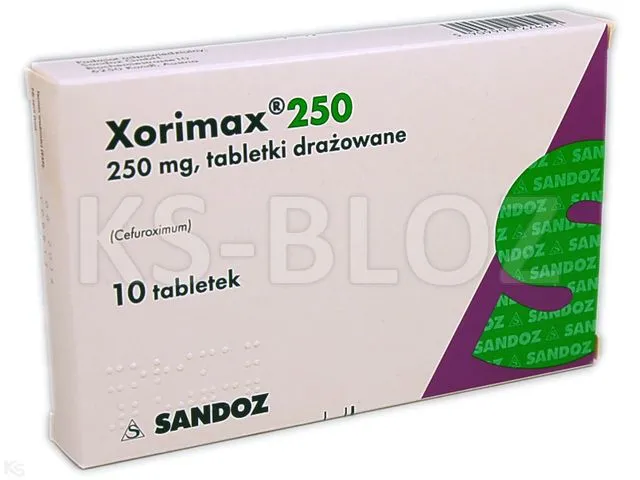
Table of Contents
Package leaflet: Information for the patient
Xorimax 250, 250 mg, film-coated tablets
Xorimax 500, 500 mg, film-coated tablets
Cefuroximum
Please read all of this leaflet carefully before taking this medicine, because it contains
important information for you.
Keep this leaflet, as you may need to read it again.
If you have any further questions, please consult your doctor or pharmacist.
This medicine has been prescribed for a specific individual. Do not pass it on to others.
It may harm someone else, even if their symptoms are the same as yours.
If you experience any adverse reactions, including any not listed in this leaflet, inform your doctor or pharmacist. See section 4.
Contents of the leaflet:
- What Xorimax is and what it is used for
- What you need to know before taking Xorimax
- How to take Xorimax
- Possible side effects
- How to store Xorimax
- Contents of the pack and other information
1. What Xorimax is and what it is used for
Xorimax is an antibiotic used in adults and children. It acts against microorganisms causing infections by exerting a bactericidal effect. It belongs to the group of so-called cephalosporins.
Xorimax is used to treat the following infections:
throat
sinuses
middle ear
lungs or chest infections
urinary tract
skin and soft tissues.
Xorimax may also be used:
in the treatment of Lyme disease (borreliosis – an infection transmitted by ticks).
2. Information before using Xorimax
When not to use Xorimax
if the patient is allergic to cefuroxime, to any antibiotic from the cephalosporin group, or to
any of the other ingredients of this medicine (listed in section 6).
if the patient has ever previously experienced a severe allergic reaction (hypersensitivity)
to any other type of beta-lactam antibiotic (penicillins, monobactams,
carbapenems).
if the patient has ever previously developed severe skin rash or skin peeling, blisters and
(and/or) mouth ulcers after treatment with cefuroxime or other antibiotics from the
cephalosporin group.
➔ If any of the above situations may apply to the patient, the patient should not take Xorimax
without first consulting a doctor.
Warnings and precautions
Talk to your doctor, pharmacist, or nurse before taking Xorimax.
Xorimax is not recommended for use in children under 3 months of age, as the safety and efficacy
of Xorimax have not been established in this age group.
While taking Xorimax, be alert for certain symptoms such as allergic reactions, fungal infections (e.g.
candidiasis), and severe diarrhoea ( pseudomembranous colitis ). Monitoring for these symptoms may
help reduce the risk of potential problems. Please refer to the section “ What to be aware of” in section 4.
Exercise special caution when using Xorimax
Severe skin adverse reactions have occurred during treatment with cefuroxime, such as:
Stevens-Johnson syndrome, toxic epidermal necrolysis, and drug reaction with eosinophilia and
systemic symptoms (DRESS).
If any of the symptoms associated with severe skin reactions described in section 4 occur, seek
immediate medical advice.
If the patient is scheduled for blood tests
Xorimax may interfere with blood glucose tests and with a blood test known as the Coombs test.
If the patient is scheduled for such tests:
➔ the patient should inform the person taking the sample that they are taking Xorimax.
Xorimax and other medicines
Tell your doctor or pharmacist about all medicines the patient is currently taking or has recently
taken, including medicines the patient plans to use, even those available without a prescription.
Medicines used to reduce the amount of hydrochloric acid in the stomach (i.e. antacids
used in the treatment of heartburn) may affect the action of Xorimax.
Probenecid
Oral anticoagulants
➔ If the patient is taking any of these medicines, they should inform their doctor or
pharmacist.
Pregnancy, breastfeeding and fertility
If the patient is pregnant or breastfeeding, suspects she may be pregnant, or is planning to have a
child, she should consult her doctor or pharmacist before using this medicine.
The doctor will weigh the benefits of treating the patient with Xorimax against the potential risks to
her unborn or breastfed child.
Driving and operating machinery
Xorimax may cause dizziness and other adverse effects that impair the patient's attention.
➔ If feeling unwell, the patient should not drive or operate machinery.
Xorimax film-coated tablets contain sodium
This medicine contains less than 1 mmol (23 mg) of sodium per film-coated tablet, meaning this
medicine is considered “sodium-free”.
3. How to use Xorimax
This medicine should always be used exactly as directed by a doctor or pharmacist. If in
doubt, consult a doctor or pharmacist.
Xorimax tablets should be taken after meals, as this will help increase the effectiveness
of treatment.
Xorimax tablets should be swallowed with water.
The tablets must not be chewed, crushed, or split, as this may make them harder to swallow and could reduce
the effectiveness of treatment.
Recommended dose:
Adults and children with body weight of 40 kg or more
The recommended dose of Xorimax is 250 mg to 500 mg twice daily, depending on the
severity and type of infection.
Children with body weight less than 40 kg
Children with body weight less than 40 kg should be treated with the oral suspension formulation of the medicine.
The recommended dose of Xorimax is 10 mg/kg to 15 mg/kg body weight (maximum 250 mg) twice daily, depending on the
severity and type of infection.
Xorimax is not recommended for use in children under 3 months of age, as safety and efficacy have not been established in this age group.
Depending on the type of illness or the patient's response to treatment, the doctor may adjust the
initial dose or consider more than one treatment cycle necessary.
Patients with renal impairment
If the patient has kidney problems, the doctor may prescribe a different dose of the medicine.
➔ If this applies to the patient, the patient should inform the doctor.
Taking more than the recommended dose of Xorimax
Taking an excessive dose of Xorimax may cause neurological disturbances, particularly increasing
the risk of seizures.
➔ Seek immediate medical advice from a doctor or go to the nearest hospital emergency department.
If possible, bring the medicine packaging with you.
Missing a dose of Xorimax
Do not take a double dose to make up for a missed dose. Take the next dose at the usual time.
Stopping treatment with Xorimax
Do not stop taking Xorimax without consulting your doctor.
It is important to continue taking the medicine for the full duration of the prescribed treatment course. Do not stop treatment early without medical advice, even if the patient feels better. Premature discontinuation
of the medicine may result in recurrence of infection.
If you have any further questions about the use of this medicine, consult your doctor or pharmacist.
4. Possible adverse reactions
Like all medicines, this medicine can cause adverse reactions, although not everyone will experience them.
If the patient experiences any of the following symptoms, cefuroxime treatment must be stopped immediately and medical help must be sought:
Red, flat spots on the trunk, resembling a target or circular rash, often with blisters in the center, peeling skin, and ulceration of the mouth, throat, nose, genital organs, and eyes. These severe skin rashes (Stevens-Johnson syndrome, toxic epidermal necrolysis) may be preceded by fever and flu-like symptoms.
Red, scaly widespread rash with subcutaneous nodules and blisters, accompanied by fever. These symptoms usually occur at the beginning of treatment (acute generalized exanthematous pustulosis).
Adverse reactions requiring attention
In a small number of patients receiving Xorimax, an allergic reaction or skin reaction, which may be severe, may occur. Symptoms may include:
Severe allergic reaction. Symptoms include raised, itchy rash (urticaria), swelling, sometimes affecting the face or mouth, causing difficulty breathing.
Widespread rash, high body temperature, and swollen lymph nodes (DRESS syndrome or drug hypersensitivity syndrome).
Chest pain associated with an allergic reaction, which may be a symptom of an allergy-induced heart attack (Kounis syndrome).
Other adverse reactions requiring attention during treatment with Xorimax include:
Fungal infections. Medicines such as Xorimax may cause overgrowth of yeasts (Candida) in the body, leading to fungal infections (such as thrush). This adverse reaction is more likely if the patient is taking Xorimax for a prolonged period.
Severe diarrhoea ( pseudomembranous colitis ). Medicines such as Xorimax may cause inflammation of the large intestine resulting in severe diarrhoea (usually with blood and mucus), abdominal pain, and fever.
Jarisch-Herxheimer reaction. In some patients taking Xorimax for Lyme disease, fever, chills, headache, muscle pain, and rash may occur. This phenomenon is known as the Jarisch-Herxheimer reaction. These symptoms usually last from several hours to one day.
➔ If the patient experiences any of these symptoms, they should contact their doctor or nurse immediately.
Common adverse reactions
May occur in less than 1 in 10 people:
Fungal infections (e.g. candidiasis)
Headache
Dizziness
Diarrhoea
Nausea
Abdominal pain
Common adverse reactions detectable in blood tests:
Increase in a certain type of white blood cells (eosinophilia)
Increased activity of liver enzymes
Uncommon adverse reactions
May occur in less than 1 in 100 people:
Vomiting
Skin rashes
Uncommon adverse reactions detectable in blood tests:
Decreased number of platelets (cells involved in blood clotting)
Decreased number of white blood cells
Positive Coombs test
Other adverse reactions
Other adverse reactions occurred in very few individuals, but their exact frequency is unknown:
- Severe diarrhoea (pseudomembranous colitis)
- Allergic reactions
- Skin reactions (including severe)
- High body temperature (fever)
- Yellowing of the whites of the eyes or skin
- Hepatitis
Adverse reactions detectable in blood tests:
Rapid breakdown of red blood cells (hemolytic anemia)
Reporting of adverse reactions
If any adverse reactions occur, including any not listed in this leaflet, inform your doctor, pharmacist, or nurse. Adverse reactions can be reported directly to the Department of Monitoring Adverse Drug Reactions of the Office for Registration of Medicinal Products, Medical Devices and Biocidal Products:
Al. Jerozolimskie 181C, 02-222 Warsaw:
tel.: +48 22 49 21 301
fax: +48 22 49 21 309
website: https://smz.ezdrowie.gov.pl
Adverse reactions can also be reported to the marketing authorization holder.
Reporting adverse reactions helps provide more information on the safety of the medicine.
5. How to store Xorimax
Keep this medicine out of the sight and reach of children.
Do not use this medicine after the expiry date stated on the packaging after EXP.
The expiry date refers to the last day of the stated month.
Store in the original packaging to protect from moisture.
No special temperature storage requirements.
Medicines must not be disposed of via wastewater or household waste. Ask your pharmacist how to properly dispose of medicines no longer in use. This will help protect the environment.
6. Contents of the pack and other information
What Xorimax contains
The active substance is cefuroxime.
One Xorimax 250 film-coated tablet contains 300.72 mg of cefuroxime axetil, equivalent to
250 mg of cefuroxime.
One Xorimax 500 film-coated tablet contains 601.44 mg of cefuroxime axetil, equivalent to
500 mg of cefuroxime.
The other ingredients (excipients) are:
sodium lauryl sulfate, copovidone, sodium croscarmellose, magnesium stearate, anhydrous colloidal silica, granulated mannitol, microcrystalline cellulose, crospovidone, talc,
hypromellose, polyethylene glycol, polysorbate 80 and titanium dioxide (E 171).
What Xorimax looks like and contents of the pack
Xorimax tablets are film-coated.
Xorimax 250: white to slightly yellowish, biconvex, elongated film-coated tablets with a score line on both sides.
Xorimax 500: white to slightly yellowish, biconvex, elongated film-coated tablets.
The tablets are available in blister packs or soft blisters, packed in cardboard boxes.
Pack sizes contain:
Xorimax 250: 10, 14, 16 or 20 tablets.
Xorimax 500: 10, 14 or 16 tablets.
Marketing Authorisation Holder and Manufacturer
Sandoz GmbH
Biochemiestrasse 10
6250 Kundl, Austria
This medicinal product is authorised in the Member States of the European Economic Area and in the United Kingdom (Northern Ireland) under the following names:
Austria Cefuroxim Sandoz 250 mg – Filmtabletten
Cefuroxim Sandoz 500 mg – Filmtabletten
Belgium Cefuroxim Sandoz 250 mg omhulde tabletten
Cefuroxim Sandoz 500 mg omhulde tabletten
Czech Republic Xorimax 250 mg potahované tablety
Xorimax 500 mg potahované tablety
Hungary Xorimax 250 mg bevont tabletta
Xorimax 500 mg bevont tabletta
Lithuania Xorimax 500 mg dengtos tabletės
Latvia Xorimax 500 mg apvalkotās tabletes
Netherlands Cefuroximaxetil 250, omhulde tabletten 250 mg
Cefuroximaxetil 500, omhulde tabletten 500 mg
Poland Xorimax 250
Xorimax 500
Slovakia Xorimax 250 mg
Xorimax 500 mg
Spain Cefuroxima Sandoz 500 mg comprimidos recubiertos EFG
United Kingdom Cefuroxime 250mg Tablets
(Northern Ireland)
(marketing authorisation holder's logo)