Vitamin e 400 mg hasco
Poland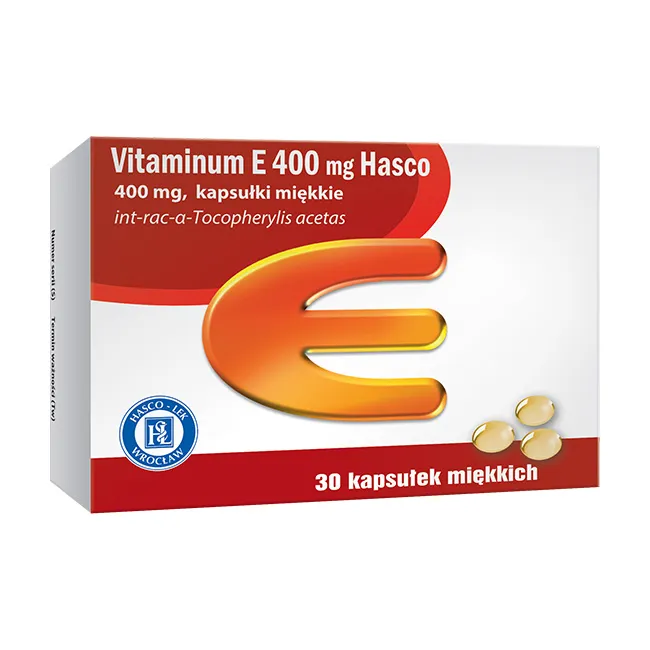
Table of Contents
- Package leaflet: Information for the patient
- 1. What is Vitaminum E 400 mg Hasco and what is it used for
- 2. Important information before using the medicine Vitaminum E 400 mg Hasco
- 3. How to use Vitaminum E 400 mg Hasco
- 4. Possible adverse effects
- 5. How to store the medicine Vitaminum E 400 mg Hasco
- 6. Contents of the package and other information
Package leaflet: Information for the patient
VITAMINUM E 400 mg HASCO
400 mg, soft capsules
int-rac- α- Tocopherylis acetas
Please read carefully the entire leaflet before taking this medicine, as it contains
important information for the patient.
- Keep this leaflet, so that you may read it again if necessary.
- If you have any doubts, please consult your doctor, pharmacist, or nurse.
- This medicine has been prescribed for a specific individual. Do not pass it on to others. The medicine may harm someone else, even if their symptoms are the same as yours.
- If you experience any adverse reactions, including any not listed in this leaflet, inform your doctor, pharmacist, or nurse. See section 4.
Table of contents
- What is Vitaminum E 400 mg Hasco and what is it used for
- Important information before taking Vitaminum E 400 mg Hasco
- How to take Vitaminum E 400 mg Hasco
- Possible side effects
- How to store Vitaminum E 400 mg Hasco
- Contents of the pack and other information
1. What is Vitaminum E 400 mg Hasco and what is it used for
Vitamin E is one of the essential nutrients, although its role has not yet been fully understood. Together with catalase, superoxide dismutase, glutathione peroxidase, and selenium, it forms part of the cellular defense system against oxygen free radicals. It protects polyunsaturated fatty acids in cell membranes and other cellular structures, stabilizes membranes of cells and cellular organelles, and prevents hemolysis of red blood cells. Protection against oxidative damage appears to be important in the development and function of the nervous and muscular systems.
Vitamin E may also act as a cofactor in certain enzymatic systems. It participates in glucose oxidation and glycogenolysis. It is involved in lipid metabolism, including prostaglandins and cholesterol.
Epidemiological studies suggest an association between daily intake of vitamin E and the risk of ischemic heart disease, atherosclerosis, and other diseases whose pathogenesis is linked to oxidative stress. Vitamin E reduces platelet aggregatory activity.
Indications:
- Treatment of vitamin E deficiency caused by impaired bile secretion, chronic intestinal inflammation, prolonged improper nutrition, and metabolic disorders;
- As supportive therapy in atherosclerosis, ischemic heart disease, and for cholesterol and infarction prophylaxis (especially in individuals exposed to polluted environments, stress, or tobacco smoking), in thrombophlebitis, intermittent claudication, and ophthalmological conditions (atherosclerotic and hypertensive retinopathy);
- In the prevention of diseases whose etiology is associated with oxidative stress.
2. Important information before using the medicine Vitaminum E 400 mg Hasco
When not to use Vitaminum E 400 mg Hasco
- if the patient is allergic to the active substance (vitamin E) or to any of the other ingredients of this medicine (listed in section 6);
- if the patient is allergic to peanuts or soy;
- in case of vitamin K deficiency.
Warnings and precautions
Before starting to use Vitaminum E 400 mg Hasco, discuss it with your doctor,
pharmacist, or nurse.
Exercise particular caution when using Vitaminum E 400 mg Hasco in patients concurrently taking oral anticoagulant medicines (e.g. dicoumarol, warfarin) or estrogens (e.g. oral contraceptives).
Vitaminum E 400 mg Hasco and other medicines
Tell your doctor or pharmacist about all medicines the patient is currently taking or has recently taken, as well as any medicines the patient plans to use.
Vitamin E may act antagonistically to vitamin K, especially in patients treated with oral anticoagulants or estrogens. The concomitant use of other antioxidant agents (vitamin C, selenium, ubiquinone, sulfur-containing amino acids) may alleviate some symptoms of vitamin E deficiency. Concurrent use of iron preparations may reduce the effect of vitamin E; therefore, a several-hour interval should be maintained between taking these medicines.
Vitamin E may reduce the need for insulin and cardiac glycosides, and may increase the absorption, utilization, and storage of vitamin A.
Pregnancy and breastfeeding
If the patient is pregnant or breastfeeding, suspects she may be pregnant, or is planning to have a child, she should consult a doctor or pharmacist before using this medicine.
This medicine should be used during pregnancy or breastfeeding only on a doctor's prescription.
Driving and operating machinery
Taking Vitaminum E 400 mg Hasco has no effect or has a negligible effect on the ability to drive and operate machinery.
Vitaminum E 400 mg Hasco contains purified arachis oil (from peanuts).
This medicine should not be used in patients with a known allergy to peanuts or soy.
3. How to use Vitaminum E 400 mg Hasco
This medicine should always be used according to the instructions given by your doctor or pharmacist. If in doubt,
you should consult your doctor or pharmacist.
The medicine is taken orally.
The recommended dose is usually 1 capsule per day.
Use of a higher than recommended dose of Vitaminum E 400 mg Hasco
If a significantly higher than recommended dose of the medicine is taken, consult your doctor or
pharmacist.
Large doses of vitamin E used over a prolonged period may cause diarrhoea, abdominal pain and
other gastrointestinal disturbances, as well as fatigue, weakness, blurred vision, headache, rash,
disturbances in sexual gland function, and decreased concentration of thyroid hormones in plasma.
Missed use of Vitaminum E 400 mg Hasco
Do not take a double dose to make up for a missed dose.
4. Possible adverse effects
Like all medicines, this medicine can cause adverse effects, although not everyone will experience them.
Vitamin E is generally well tolerated. After high doses (above 800 mg/day), fatigue, weakness, headache, gastrointestinal disturbances, and rash may occur.
Reporting of adverse effects
If any adverse symptoms occur, including any adverse effects not listed in this leaflet, inform your doctor, pharmacist, or nurse. Adverse effects can be reported directly to the Department of Monitoring Adverse Drug Reactions at the Office for Registration of Medicinal Products, Medical Devices and Biocidal Products: Al. Jerozolimskie 181C, 02-222 Warsaw, phone: +48 22 49 21 301, fax: +48 22 49 21 309, e-mail: [email protected]
Adverse effects can also be reported to the marketing authorization holder.
Reporting adverse effects helps to provide more information on the safety of the medicine.
5. How to store the medicine Vitaminum E 400 mg Hasco
Keep the medicine out of the sight and reach of children.
Store below 25°C.
Store in the original packaging to protect from light.
Do not use this medicine after the expiry date stated on the packaging. The expiry date refers to the last day of the stated month.
Medicines must not be disposed of via wastewater or household waste. Ask your pharmacist what to do with medicines no longer required. This will help protect the environment.
6. Contents of the package and other information
What Vitaminum E 400 mg Hasco contains
- The active substance is all-rac-α-tocopheryl acetate (vitamin E). Each soft capsule contains 400 mg of vitamin E.
- The other ingredients (excipients) are: purified arachis oil, gelatin, glycerol.
What Vitaminum E 400 mg Hasco looks like and contents of the pack
Vitaminum E 400 mg Hasco is oval, transparent, light yellow soft capsules with a smooth,
glossy surface.
One pack contains 30 soft capsules.
Marketing Authorisation Holder and Manufacturer
"PRZEDSIĘBIORSTWO PRODUKCJI FARMACEUTYCZNEJ HASCO-LEK" S.A.
51-131 Wrocław, ul. Żmigrodzka 242 E
Medicinal Product Information
tel.: 22 742 00 22
email: [email protected]