Vestibo
Poland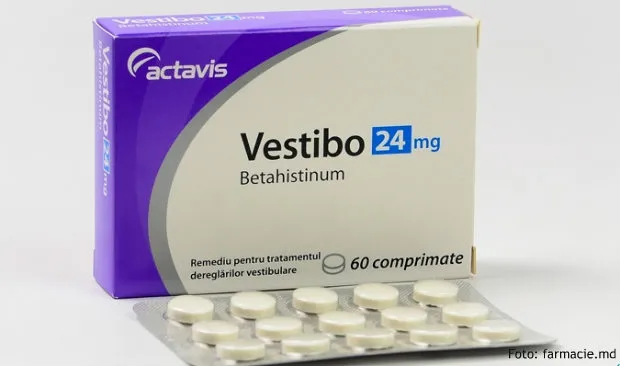
Table of Contents
Package leaflet: Information for the patient
Vestibo, 8 mg, tablets
Vestibo, 16 mg, tablets
Betahistini dihydrochloridum
Please read this leaflet carefully before taking this medicine, as it contains
important information for you.
- Keep this leaflet, as you may need to read it again.
- If you have any further questions, please ask your doctor or pharmacist.
- This medicine has been prescribed for a specific individual. Do not pass it on to others. It may harm someone else, even if their symptoms are the same.
- If you experience any adverse reactions, including any not listed in this leaflet, tell your doctor or pharmacist. See section 4.
Contents of the leaflet
- What Vestibo is and what it is used for
- Important information before taking Vestibo
- How to take Vestibo
- Possible side effects
- How to store Vestibo
- Contents of the pack and other information
1. What Vestibo is and what it is used for
Vestibo contains betahistine, a type of medicine known as a "histamine analogue".
Betahistine is used to treat symptoms of Ménière’s disease, such as dizziness and nausea or vomiting, tinnitus (ringing in the ears), and hearing loss or difficulty hearing.
Betahistine may also be used for symptomatic treatment of dizziness caused by improper functioning of the inner ear responsible for balance (vestibular origin dizziness).
Betahistine works by improving blood flow in the inner ear. The inner ear is one of the organs responsible for the sense of balance.
2. Important information before taking Vestibo
When not to take Vestibo
- if you are allergic to betahistine or any of the other ingredients of this medicine (listed in section 6)
- if you have a phaeochromocytoma, a rare tumour of the adrenal gland.
Warnings and precautions
Before starting Vestibo, consult your doctor or pharmacist if:
- you have or have had a peptic ulcer (peptic ulcer disease) in the past
- you suffer from bronchial asthma
- you have urticaria, rash, or allergic rhinitis, as these symptoms may worsen
- you have low blood pressure.
If you have any of the above conditions, you should consult your doctor to determine whether you can take betahistine. Your doctor may wish to monitor your condition more closely during treatment with Vestibo.
Children and adolescents
Vestibo is not recommended for use in children and adolescents under 18 years of age due to lack of information on safety and efficacy in these age groups.
Vestibo with other medicines
Tell your doctor or pharmacist if you are taking, have recently taken, or might take any other medicines.
In particular, inform your doctor or pharmacist if you are taking any of the following medicines:
- antihistamines (medicines used especially to treat allergies, such as hay fever and motion sickness). These may (theoretically) reduce the effect of betahistine. Conversely, betahistine may reduce the effectiveness of antihistamines.
- monoamine oxidase inhibitors (MAOIs) (medicines used to treat depression or Parkinson’s disease). These may increase the concentration of betahistine in the body.
Pregnancy and breastfeeding
If you are pregnant or breastfeeding, think you may be pregnant, or are planning to have a baby, consult your doctor or pharmacist before taking this medicine.
It is not known whether betahistine affects the unborn child. Do not take Vestibo if you are pregnant unless your doctor has decided it is absolutely necessary.
It is not known whether betahistine passes into breast milk. Do not breastfeed while taking Vestibo unless your doctor has advised it.
Driving and using machines
Studies have shown that betahistine does not affect the ability to drive or operate machinery.
However, bear in mind that the conditions for which this medicine is prescribed (Ménière’s disease or dizziness) may cause sensations of spinning or nausea and may affect your ability to drive or operate machinery.
Vestibo contains lactose
If you have been previously diagnosed with an intolerance to certain sugars, consult your doctor before taking this medicine.
3. How to use Vestibo
This medicine should always be taken as directed by a doctor or pharmacist. If in doubt,
consult a doctor or pharmacist.
Recommended dosage:
8 mg tablets:
The recommended initial dose is one to two 8 mg tablets three times daily. The usual maintenance dose is between 24 mg and 48 mg daily.
16 mg tablets:
The recommended initial dose is half to one 16 mg tablet three times daily. The usual maintenance dose is between 24 mg and 48 mg daily.
It may take several weeks before improvement occurs.
How to take the medicine
Tablets should be swallowed whole with sufficient liquid, during or after a meal.
Taking more Vestibo than recommended
If a patient takes more than the prescribed dose, they should consult a doctor.
Symptoms of betahistine overdose include nausea, fatigue, abdominal pain, vomiting, indigestion, and, after large doses, seizures and disturbances affecting the lungs or heart.
Missing a dose of Vestibo
Wait until the next scheduled dose.
Do not take a double dose to make up for a missed dose.
Stopping Vestibo treatment
Do not stop taking Vestibo without consulting your doctor, even if symptoms improve.
If you have any further questions about the use of this medicine, consult your doctor or pharmacist.
4. Possible adverse reactions
Like all medicines, this medicine can cause adverse reactions, although not everyone experiences them.
Severe adverse reactions may occur:
Allergic reactions (frequency unknown), such as:
- swelling of the face, lips, tongue or throat.
- This may cause difficulty in breathing.
- red skin rash or inflammatory skin condition with itching
- sudden drop in blood pressure
- loss of consciousness. You should stop taking Vestibo and contact your doctor immediately if any of the above symptoms occur.
Other adverse reactions include:
Common (may affect less than 1 in 10 people):
- nausea
- indigestion (digestive disturbances)
- headache
Rare (may affect less than 1 in 1,000 people):
- palpitations
Frequency not known (frequency cannot be estimated from available data):
- mild gastrointestinal discomfort such as vomiting, stomach pain and flatulence. These adverse reactions may be reduced by taking the dose with food or by reducing the dose.
- drowsiness
Reporting of adverse reactions
If any adverse symptoms occur, including any adverse effects not listed
in this leaflet, inform your doctor or pharmacist. Adverse reactions can
be reported directly to the Department of Monitoring Adverse Drug Reactions of the Office for Registration of Medicinal Products, Medical Devices and Biocidal Products, Al. Jerozolimskie 181C, 02-222 Warsaw,
Tel.: +48 22 49 21 301,
Fax: +48 22 49 21 309,
Website: https://smz.ezdrowie.gov.pl
Adverse reactions may also be reported to the marketing authorization holder.
Reporting adverse reactions helps to provide more information on the safety of this medicine.
5. How to store Vestibo
Keep this medicine out of the sight and reach of children.
Do not use this medicine after the expiry date stated on the carton or blister pack following EXP.
The expiry date refers to the last day of the stated month.
Store below 25°C and keep in the original packaging.
Medicines should not be disposed of via wastewater or household waste. Ask your pharmacist how to dispose of medicines no longer required. This will help protect the environment.
6. Contents of the pack and other information
What Vestibo contains
The active substance is betahistine dihydrochloride.
One tablet contains 8 mg of betahistine dihydrochloride.
One tablet contains 16 mg of betahistine dihydrochloride.
The other ingredients are: povidone K90, microcrystalline cellulose, monohydrate lactose,
anhydrous colloidal silicon dioxide, crospovidone, stearic acid.
What Vestibo looks like and contents of the pack
8 mg tablets:
White or almost white, round tablets, embossed with "B8" on one side.
PVDC/PVC/Aluminium blisters. Available pack sizes: 30, 50, 100 or 120 tablets.
16 mg tablets:
White or almost white, round tablets, embossed with "B16" on one side and a score line on the other side, allowing the tablet to be divided into equal doses.
PVDC/PVC/Aluminium blisters. Available pack sizes: 20, 30, 42, 50, 60 or 84 tablets.
Not all pack sizes may be marketed.
Marketing Authorisation Holder and Manufacturer:
Marketing Authorisation Holder
Actavis Group PTC ehf.
Dalshraun 1
220 Hafnarfjörður
Iceland
Manufacturers
Catalent Germany Schorndorf GmbH, Steinbeisstrasse 1-2, D-73614 Schorndorf, Germany
Balkanpharma – Dupnitsa AD, 3 Samokovsko Shosse Str., Dupnitsa 2600, Bulgaria
This medicinal product is authorised in the European Economic Area under the following names:
Member country Name of the medicinal product
Czech Republic Betahistin Actavis
Estonia Betahistine Actavis
Lithuania Betahistine Actavis 16 mg tabletės
Latvia Betahistin Actavis 16 mg tablets
Poland Vestibo
Slovakia Betahistin Actavis 8 mg
Betahistin Actavis 16 mg
Hungary Elven 16 mg tabletta
For further information about this medicinal product, please contact the local representative of the Marketing Authorisation Holder:
Teva Pharmaceuticals Polska Sp. z o.o., ul. Emilii Plater 53, 00-113 Warsaw, Poland,
tel. (22) 345 93 00.