Treprostinil tillomed
Poland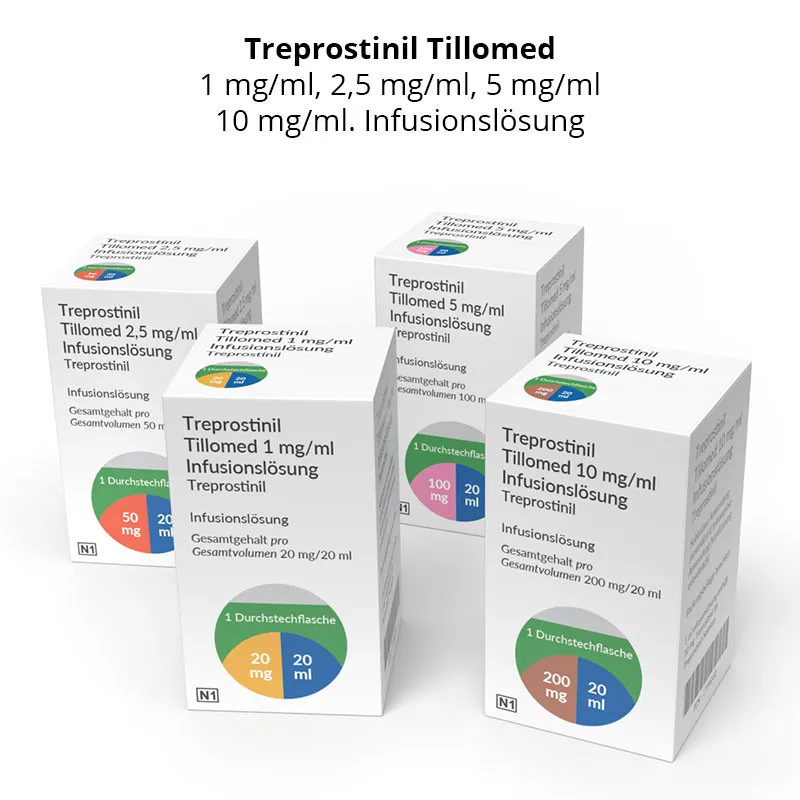
Table of Contents
Package leaflet: Information for the user
Treprostinil Tillomed
1 mg/mL, 2.5 mg/mL, 5 mg/mL, 10 mg/mL, solution for infusion
Treprostinilum
Please read all of this leaflet carefully before using this medicine, because it contains
important information for you.
- Keep this leaflet, as you may need to read it again.
- If you have any further questions, please ask your doctor.
- This medicine has been prescribed for a specific individual. Do not pass it on to others. It may harm other people, even if their symptoms are the same.
- If you experience any side effects, including any not listed in this leaflet, tell your doctor or pharmacist. See section 4.
Contents of the leaflet
- What Treprostinil Tillomed is and what it is used for
- What you need to know before you use Treprostinil Tillomed
- How to use Treprostinil Tillomed
- Possible side effects
- How to store Treprostinil Tillomed
- Contents of the pack and other information
1. What Treprostinil Tillomed is and what it is used for
What Treprostinil Tillomed is
The active substance in Treprostinil Tillomed is treprostinil.
Treprostinil belongs to a group of medicines that act similarly to naturally occurring prostacyclins in the body. Prostacyclins are hormone-like substances. They lower blood pressure by relaxing blood vessels, causing them to widen, thereby improving blood flow. In addition, prostacyclins may also help prevent blood clotting.
For what conditions is Treprostinil Tillomed used
Treprostinil Tillomed is used in the treatment of idiopathic or heritable pulmonary arterial hypertension (PAH) in patients with moderate symptom severity. Pulmonary arterial hypertension is a condition in which blood pressure is too high in the blood vessels between the heart and lungs, causing shortness of breath, dizziness, fatigue, fainting, palpitations or irregular heartbeat, dry cough, chest pain, and swelling of the ankles or legs.
Treprostinil Tillomed is initially administered as a continuous subcutaneous infusion. Some patients may not tolerate this route of administration due to local pain and swelling. Your doctor will decide whether Treprostinil Tillomed can be given as a continuous intravenous infusion. This will require placement of a central venous catheter in the neck, chest, or groin.
How Treprostinil Tillomed works
Treprostinil Tillomed lowers blood pressure in the pulmonary artery, improving blood flow and reducing the workload of the heart. Improved blood flow leads to better oxygen delivery to the body and reduced strain on the heart muscle, thereby improving cardiac efficiency.
Treprostinil Tillomed alleviates symptoms associated with PAH and improves exercise tolerance in patients who must limit their physical activity.
2. Important information before using Treprostinil Tillomed
When not to use Treprostinil Tillomed:
- if the patient is allergic to treprostinil or any of the other ingredients of this medicine (listed in section 6);
- if the patient has been diagnosed with pulmonary veno-occlusive disease. This is a condition in which blood vessels in the lungs become swollen and blocked, causing increased blood pressure in the vessels between the heart and lungs;
- if the patient has severe liver disease;
- if the patient has heart diseases, e.g.:
- myocardial infarction (heart attack) within the last six months,
- severe disturbances in heart rate,
- severe ischemic heart disease or unstable angina pectoris,
- diagnosed heart defect such as valvular heart disease causing worsening heart function,
- heart disease that is untreated or not under close medical supervision;
- if the patient is at significant risk of bleeding – e.g. active peptic ulcer, wounds, or other types of bleeding;
- if the patient has had a stroke within the last 3 months or other cerebral ischemic events.
Warnings and precautions
Before starting treatment with Treprostinil Tillomed, inform your doctor if:
- the patient has liver disease;
- the patient has kidney disease;
- the patient has been medically diagnosed with obesity (BMI over 30 kg/m^2);
- the patient has human immunodeficiency virus (HIV) infection;
- the patient has high blood pressure in the liver's portal vein (portal hypertension);
- the patient has a congenital heart defect affecting blood flow direction through the heart;
- the patient is on a low-sodium diet.
During treatment with Treprostinil Tillomed, inform your doctor if:
- low blood pressure (hypotension) occurs;
- sudden worsening of breathing difficulties or persistent cough occurs (this may be related to pulmonary congestion, asthma, or another condition); contact your doctor immediately;
- excessive bleeding occurs, as treprostinil may increase this risk due to its anticoagulant effect;
- fever, redness, swelling, and/or tenderness at the infusion site occurs during intravenous administration of Treprostinil Tillomed, as this may indicate infection.
Treprostinil Tillomed and other medicines
Tell your doctor about all medicines the patient is currently taking or has recently taken, as well as any medicines the patient plans to take.
Inform your doctor if the patient is taking:
- medicines used to treat high blood pressure (antihypertensives or other vasodilators);
- medicines used to increase urine output (diuretics), including furosemide;
- medicines that prevent blood clotting (anticoagulants), such as warfarin-containing medicines, heparin, or nitric oxide;
- any non-steroidal anti-inflammatory drugs ( NSAIDs ) (e.g. acetylsalicylic acid, ibuprofen);
- medicines that may increase or decrease the effect of Treprostinil Tillomed (e.g. gemfibrozil, rifampicin, trimethoprim, deferasirox, phenytoin, carbamazepine, phenobarbital, St John's wort), as dose adjustment of Treprostinil Tillomed may be necessary.
Pregnancy, breastfeeding, and effects on fertility
If the patient is pregnant, breastfeeding, suspects she may be pregnant, or is planning to become pregnant, she should consult her doctor before using this medicine.
Treprostinil Tillomed is not recommended for pregnant women, women planning pregnancy, or women suspecting pregnancy unless the doctor considers its use necessary.
The safety of Treprostinil Tillomed during pregnancy has not been established.
Treprostinil Tillomed is not recommended for breastfeeding women unless the doctor considers its use necessary. If Treprostinil Tillomed is prescribed, breastfeeding should be discontinued, as it is unknown whether the medicine passes into human breast milk.
The effect of treprostinil on human fertility is currently unknown; therefore, effective contraception is strongly recommended during treatment with treprostinil.
Driving and operating machinery
Treprostinil Tillomed may cause low blood pressure with dizziness and fainting. In such cases, do not drive or operate machinery and consult your doctor for advice.
Treprostinil Tillomed contains sodium
Inform your doctor if the patient is on a sodium-controlled diet.
Your doctor will consider that one vial of Treprostinil Tillomed contains the amount of sodium stated below.
Treprostinil Tillomed 1 mg/ml, solution for infusion
This medicine contains 74.16 mg of sodium (the main component of table salt) per vial. This corresponds to 3.71% of the recommended maximum daily dietary sodium intake for an adult.
Treprostinil Tillomed 2.5 mg/ml, solution for infusion
This medicine contains 75.08 mg of sodium (the main component of table salt) per vial. This corresponds to 3.75% of the recommended maximum daily dietary sodium intake for an adult.
Treprostinil Tillomed 5 mg/ml, solution for infusion
This medicine contains 78.16 mg of sodium (the main component of table salt) per vial. This corresponds to 3.91% of the recommended maximum daily dietary sodium intake for an adult.
Treprostinil Tillomed 10 mg/ml, solution for infusion
This medicine contains 75 mg of sodium (the main component of table salt) per vial. This corresponds to 3.75% of the recommended maximum daily dietary sodium intake for an adult.
3. How to use Treprostinil Tillomed
Always use this medicine exactly as prescribed by your doctor. If in doubt, consult your doctor.
Treprostinil Tillomed is administered as a continuous infusion:
- subcutaneously via a small tube (cannula) inserted under the skin of the patient's abdomen or thigh, or
- intravenously via a venous catheter in the neck, chest, or groin.
In both cases, Treprostinil Tillomed is delivered through tubing by a portable pump.
Before discharge from hospital, your doctor will inform you how to prepare Treprostinil Tillomed and at which rate the pump should deliver the medicine. You will also receive instructions on how to properly use the pump and what to do if the pump stops working. These instructions should also include information on whom to contact in an emergency.
Filling the connected infusion line may lead to accidental overdose.
Treprostinil Tillomed is diluted only when administered intravenously:
Intravenous administration only: You must dilute the Treprostinil Tillomed solution with sterile water for injection or 0.9% sodium chloride for injection (according to your doctor's instructions), but only if the medicine is given as a continuous intravenous infusion.
Adults
Treprostinil Tillomed is available as a 1 mg/ml, 2.5 mg/ml, 5 mg/ml, or 10 mg/ml infusion solution. Your doctor will determine the infusion rate and dose appropriate for your clinical condition.
Patients with obesity
If you have obesity (body weight exceeding ideal body weight by 30% or more), your doctor will determine the initial and subsequent doses based on ideal body weight. See also section 2, "Warnings and precautions."
Elderly patients
Your doctor will determine the infusion rate and dose appropriate for your clinical condition.
Children and adolescents
Limited data are available on the use of this medicine in children and adolescents.
Dose adjustments
The infusion rate may be individually increased or decreased only under the supervision of a doctor.
The aim of adjusting the infusion rate is to establish an effective maintenance dose that alleviates symptoms of PAH while minimizing adverse effects.
Do not increase the dose without contacting your doctor if symptoms worsen, or if you require complete rest, are confined to bed or a chair, or if any physical exertion causes discomfort and symptoms occur at rest.
Treprostinil Tillomed may not be sufficient to treat your condition, and additional medications may be necessary.
The maximum administered dose depends on the patient's clinical condition and coexisting diseases.
How to prevent bloodstream infections during intravenous treatment with Treprostinil Tillomed?
As with any long-term intravenous therapy, there is a risk of bloodstream infection. Your doctor will train you in how to prevent such infections.
Accidental overdose of Treprostinil Tillomed
If you accidentally overdose on Treprostinil Tillomed, symptoms such as nausea, vomiting, diarrhea, low blood pressure (dizziness, feeling faint, or fainting), skin flushing, and/or headache may occur.
If any of these symptoms are severe, contact your doctor or go to hospital immediately.
Your doctor may reduce the dose or temporarily stop the infusion until symptoms resolve. The Treprostinil Tillomed infusion solution will then be restarted at the dose prescribed by your doctor.
Stopping treatment with Treprostinil Tillomed
Always use Treprostinil Tillomed exactly as prescribed by your doctor or hospital specialist. Do not stop using Treprostinil Tillomed without your doctor's instruction.
Sudden discontinuation or reduction of Treprostinil Tillomed may lead to recurrence of pulmonary arterial hypertension, possibly resulting in a rapid and severe deterioration in your condition.
If you have any doubts about how to use this medicine, consult your doctor.
4. Possible adverse reactions
Like all medicines, this medicine can cause adverse reactions, although not everyone experiences them.
Very common adverse reactions (may occur in more than 1 in 10 people)
- Vasodilation with skin flushing
- Pain or irritation at the infusion site
- Skin depigmentation or pallor around the infusion site
- Headache
- Skin rash
- Nausea
- Diarrhoea
- Jaw pain
Common adverse reactions (may occur in up to 1 in 10 people)
- Dizziness
- Vomiting
- Feeling faint or fainting due to low blood pressure
- Tingling or skin redness
- Swelling of the feet, ankles, legs or fluid retention
- Bleeding, e.g. nosebleeds, coughing up blood, blood in urine, bleeding from gums, blood in stool
- Joint pain
- Muscle pain
- Pain in legs and (or) arms
Other possible adverse reactions (frequency unknown (frequency cannot be determined from available data))
- Infection at the infusion site
- Abscess at the infusion site
- Decreased platelet count (thrombocytopenia)
- Bleeding at the infusion site
- Bone pain
- Skin rashes with depigmentation or nodularity
- Skin and subcutaneous tissue infection (cellulitis)
- Excessive blood volume pumped by the heart leading to breathlessness, fatigue, swelling of legs and abdomen due to fluid accumulation, and persistent cough
Additional adverse reactions associated with intravenous administration
- Inflammation of veins (thrombophlebitis)
- Bacterial infection of the blood (bacteraemia)* (see section 3)
- Sepsis (severe blood infection)
* Life-threatening or fatal bacterial blood infections have been reported
Reporting of adverse reactions
If any adverse reactions occur, including any not listed in this leaflet, inform your doctor. Adverse reactions can be reported directly to the Department of Monitoring Adverse Drug Reactions, Office for Registration of Medicinal Products, Medical Devices and Biocidal Products, Al. Jerozolimskie 181C, 02-222 Warsaw, Tel.: +48 22 49 21 301; Fax: +48 22 49 21 309
Website: https://smz.ezdrowie.gov.pl
Reporting adverse reactions helps to provide more information on the safety of the medicine.
Adverse reactions can also be reported to the marketing authorization holder.
5. How to store Treprostinil Tillomed
Keep the medicine out of the sight and reach of children.
Do not use this medicine after the expiry date stated on the carton and on the vial. The expiry date refers to the last day of the stated month.
Do not use Treprostinil Tillomed if the vial is damaged, discoloured, or shows any other signs of deterioration.
No special precautions for storage of the medicinal product are required.
Shelf life of treprostinil after first opening: 30 days.
During continuous subcutaneous infusion, one reservoir (syringe) of undiluted Treprostinil Tillomed must be used within 72 hours.
Shelf life for continuous subcutaneous administration
Physical and chemical stability has been demonstrated under use conditions for 72 hours when stored at 37°C. From a microbiological standpoint, the product should be used immediately unless the method of opening precludes the risk of microbiological contamination. If not used immediately, responsibility for observing storage conditions and duration after preparation lies with the user.
During continuous intravenous infusion, to minimize the risk of blood infection, the maximum duration of use for one reservoir (syringe) of diluted treprostinil should not exceed 24 hours.
Shelf life for continuous intravenous administration
After dilution:
Physical and chemical stability of diluted treprostinil has been demonstrated under use conditions for 48 hours when stored at 2–8°C, 20–25°C, and 40°C. From a microbiological standpoint, the product should be used immediately unless the method of dilution precludes the risk of microbiological contamination. If not used immediately, responsibility for observing storage conditions and duration after preparation lies with the user. The storage period should generally not exceed 24 hours at 2–8°C, unless dilution was performed under controlled and validated aseptic conditions.
Any unused diluted solution should be discarded.
Information on use is provided in section 3, "How to use Treprostinil Tillomed".
Medicines must not be disposed of via wastewater or household waste. Ask your pharmacist how to dispose of medicines no longer required. These measures will help protect the environment.
- Contents of the pack and other information
What Treprostinil Tillomed contains
The active substance is treprostinil 1 mg/mL; 2.5 mg/mL; 5 mg/mL; 10 mg/mL.
Other ingredients: sodium chloride, metacresol, sodium citrate, sodium hydroxide (for pH adjustment), concentrated hydrochloric acid (for pH adjustment), water for injections (to 1 mL).
What Treprostinil Tillomed looks like and contents of the pack
Treprostinil Tillomed, 1 mg/mL, solution for infusion
A clear, colourless to slightly yellow solution, free from visible particles, contained in a 20 mL vial made of colourless type I glass, closed with a bromobutyl rubber stopper with a seal and a flip-off cap, packed in a cardboard carton.
Treprostinil Tillomed, 2.5 mg/mL, solution for infusion
A clear, colourless to slightly yellow solution, free from visible particles, contained in a 20 mL vial made of colourless type I glass, closed with a bromobutyl rubber stopper with a seal and a flip-off cap, packed in a cardboard carton.
Treprostinil Tillomed, 5 mg/mL, solution for infusion
A clear, colourless to slightly yellow solution, free from visible particles, contained in a 20 mL vial made of colourless type I glass, closed with a bromobutyl rubber stopper with a seal and a flip-off cap, packed in a cardboard carton.
Treprostinil Tillomed, 10 mg/mL, solution for infusion
A clear, colourless to slightly yellow solution, free from visible particles, contained in a 20 mL vial made of colourless type I glass, closed with a bromobutyl rubber stopper with a seal and a flip-off cap, packed in a cardboard carton.
Pack size: 1 vial/pack
Marketing Authorisation Holder
Tillomed Malta Ltd
Tower Business Centre,
2nd floor Tower Street,
Swatar, Birkirkara
BKR4013,
Malta
Tel: +48 509 368 531
Email: [email protected]
Importer
SGS Pharma Magyarorszag Kft.
Derkovits Gyula Utca 53
Budapest XIX, 1193
Hungary
Tillomed Malta Limited,
Malta Life Sciences Park,
LS2.01.06 Industrial Estate,
San Gwann, SGN 3000, Malta
This medicinal product is authorised for marketing in the European Economic Area countries under the following names:
Austria Treprostinil Tillomed 1 mg / ml, 2.5 mg / ml, 5 mg / ml and 10 mg / ml Infusionslösung
Croatia Treprostinil Tillomed 1 mg / ml otopina za infuziju
Treprostinil Tillomed 2.5 mg / ml otopina za infuziju
Treprostinil Tillomed 5 mg / ml otopina za infuziju
Treprostinil Tillomed 10 mg / ml otopina za infuziju
Czech Republic Treprostinil Tillomed
Finland Treprostinil Tillomed 1 mg / ml, 2.5 mg / ml, 5 mg / ml ja 10 mg / ml infuusioneste
France TREPROSTINIL TILLOMED 1 mg/ml, solution pour perfusion
TREPROSTINIL TILLOMED 2.5 mg/ml, solution pour perfusion
TREPROSTINIL TILLOMED 5 mg/ml, solution pour perfusion
TREPROSTINIL TILLOMED 10 mg/ml, solution pour perfusion
Germany Treprostinil Tillomed 1 mg / ml, 2.5 mg / ml, 5 mg / ml und 10 mg / ml Infusionslösung
Hungary Treprostinil Tillomed 1 mg / ml, 2.5 mg / ml, 5 mg / ml és 10 mg / ml infúziós oldat
Italy Treprostinil Tillomed
Lithuania Treprostinil Tillomed 1 mg / ml, 2.5 mg / ml, 5 mg / ml ir 10 mg / ml infuzinis tirpalas
Norway Treprostinil Tillomed
Poland Treprostinil Tillomed
Portugal Treprostinil Tillomed
Slovakia Treprostinil Tillomed 1 mg / ml, 2.5 mg / ml, 5 mg / ml a 10 mg / ml infúzny roztok
Slovenia Treprostinil Tillomed Pharma 1 mg / ml, 2.5 mg / ml, 5 mg / ml in 10 mg / ml raztopina za infundiranje
Sweden Treprostinil Tillomed 1 mg / ml, 2.5 mg / ml, 5 mg / ml och 10 mg / ml infusionsvätska, lösning
United Kingdom Treprostinil Tillomed 1 mg/ml, 2.5 mg/ml, 5 mg/ml & 10 mg/ml solution for infusion
(Northern Ireland)