Rutinoscorbin
Poland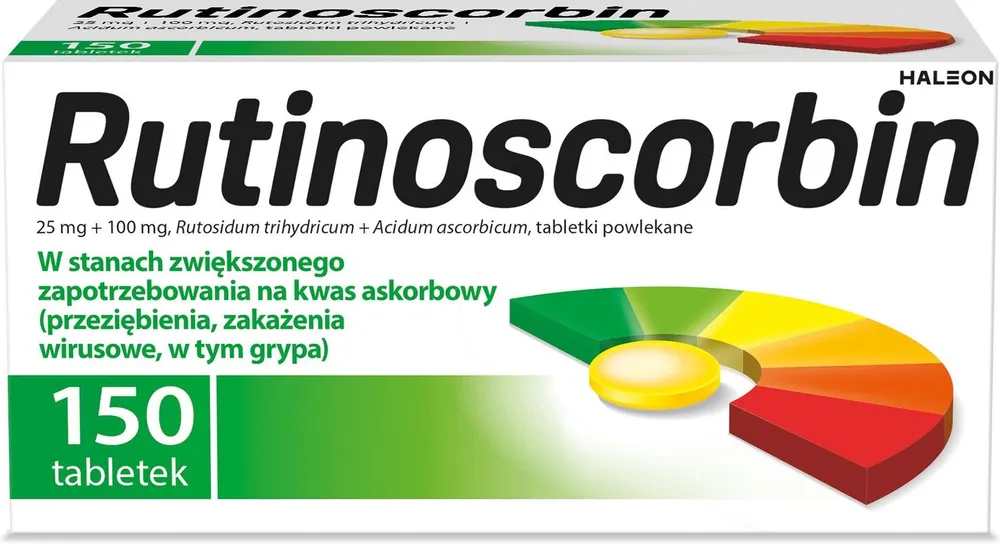
Table of Contents
Package leaflet: Information for the patient
Rutinoscorbin
25 mg + 100 mg coated tablets
Rutosidum trihydricum + Acidum ascorbicum
Please read the entire leaflet carefully before using this medicine, as it contains
important information for the patient.
This medicine should always be used exactly as described in the patient leaflet or
according to the instructions provided by the doctor or pharmacist.
- Keep this leaflet, as you may need to read it again.
- If you need advice or further information, please consult your pharmacist.
- If you experience any adverse reactions, including any possible side effects not listed in this leaflet, inform your doctor or pharmacist. See section 4.
- If there is no improvement or if you feel worse, consult your doctor.
Table of contents of the leaflet
- What Rutinoscorbin is and what it is used for
- Important information before taking Rutinoscorbin
- How to take Rutinoscorbin
- Possible side effects
- How to store Rutinoscorbin
- Contents of the pack and other information
1. What Rutinoscorbin is and what it is used for
Rutinoscorbin is a combined preparation containing rutoside and vitamin C (ascorbic acid).
Rutoside strengthens blood vessels and reduces their permeability. It also protects vitamin C
from oxidation, thereby prolonging its activity.
Vitamin C acts as an antioxidant. It is essential for many metabolic processes, including collagen and hemoglobin synthesis, and facilitates iron absorption.
Indications:
- In conditions of deficiency or increased demand for vitamin C (colds, viral infections including influenza);
- As an adjunctive treatment in excessive capillary permeability.
2. Important information before using Rutinoscorbin
When not to use Rutinoscorbin
Do not use Rutinoscorbin if the patient has:
- hypersensitivity (allergy) to rutin and ascorbic acid (vitamin C), or to any of the other ingredients of this medicine (listed in section 6);
- oxalate kidney stones (a condition characterized by formation of deposits, so-called "stones", in the kidneys) or a history of oxalate kidney stones;
- diseases associated with excessive iron accumulation (thalassemia, hemochromatosis, sideroblastic anemia) or other conditions that may cause excess iron in the body.
Warnings and precautions
Do not exceed the recommended doses.
Before starting to use Rutinoscorbin, consult a doctor or pharmacist if the patient:
- has a rare metabolic disorder (glucose-6-phosphate dehydrogenase deficiency) which may lead to breakdown of red blood cells and anemia;
- has impaired kidney function. Do not take more than 5 tablets (corresponding to 500 mg of vitamin C) per day;
- is taking sulfonamides (antibacterial drugs).
High doses of vitamin C (above 1 g) are not recommended if the patient has:
- excessive excretion of oxalic acid;
- uric acid stones (a condition involving formation of deposits, so-called "stones", in the urinary tract);
- gout (a chronic disease associated with disturbed uric acid metabolism);
- cystinuria (a metabolic disorder);
- hypokalemia (low potassium levels in blood);
- hypercalcemia (high calcium levels in blood).
Children
Rutinoscorbin should be used in children under 6 years of age only under medical supervision.
Effect on laboratory test results
Vitamin C may interfere with urine glucose tests and fecal occult blood tests.
If such tests are required, inform the doctor about the use of Rutinoscorbin and follow the doctor's instructions.
Rutinoscorbin with other medicines
Inform the doctor or pharmacist about all medicines currently taken or recently taken, as well as any medicines planned for use. This includes medicines obtained without a prescription.
Vitamin C contained in this medicine:
- enhances absorption of metal compounds (especially iron);
- increases absorption of aluminium (a component of antacids used, for example, in treatment of indigestion and heartburn). If the patient is taking vitamin C, antacids should not be used, especially in case of kidney disease;
- when used concomitantly with deferoxamine (a drug used in iron overdose to help remove excess iron from the body), may adversely affect the heart in the early stages of treatment;
- may intensify the adverse effects of acetylsalicylic acid (aspirin) on the stomach. Conversely, acetylsalicylic acid may impair absorption of ascorbic acid;
- enhances the effect of paracetamol and coumarin anticoagulants (e.g. acenocoumarol);
- reduces the effectiveness of disulfiram (a drug used in the treatment of alcoholism);
- when used with sulfonamides (antibacterial drugs), may cause crystallization of these drugs in urine;
- long-term use in high doses may affect the excretion of certain drugs (e.g. tricyclic antidepressants such as imipramine, amitriptyline).
Pregnancy and breastfeeding
If the patient is pregnant or breastfeeding, suspects she may be pregnant, or is planning to have a child, she should consult a doctor or pharmacist before using this medicine.
Vitamin C passes into breast milk and crosses the placental barrier.
The safety of use during pregnancy and breastfeeding has not been established.
Driving and operating machinery
This medicine does not affect the ability to drive or operate machinery.
Rutinoscorbin contains monohydrate lactose and sucrose. If the patient has previously been diagnosed with intolerance to certain sugars, he or she should consult a doctor before taking this medicine.
Rutinoscorbin contains quinoline yellow, and therefore may cause allergic reactions.
3. How to take Rutinoscorbin
This medicine should always be taken exactly as described in the patient leaflet or as directed by a doctor or pharmacist.
If in doubt, consult a doctor or pharmacist.
Do not take more than the recommended dose.
This medicine is for oral use. The recommended dose is:
- for prophylaxis: 1 to 2 tablets per day;
- in cases of vitamin C deficiency: 1 to 2 tablets 2 to 4 times per day.
Use in children
Rutinoscorbin should be used in children under 6 years of age only as directed by a physician.
Patients with kidney disease should not take more than 5 tablets per day (corresponding to 500 mg of vitamin C; see Warnings and precautions in section 2).
Taking more Rutinoscorbin than recommended
If you take more than the recommended dose, consult a doctor or pharmacist immediately.
After taking very high doses, diarrhoea may occur. There is a risk of haemolysis (breakdown of red blood cells), nephrolithiasis (kidney stones), fluid and electrolyte imbalances, and significant reduction in the activity of cobalamin (vitamin B12).
If you miss a dose of Rutinoscorbin
Do not take a double dose to make up for a missed dose.
4. Possible adverse reactions
Like all medicines, this medicine can cause adverse reactions, although not everyone experiences them.
Adverse reactions may occur when doses of vitamin C exceeding 600 mg per day are used:
Very rare adverse reactions (occurring in no more than 1 in 10,000 patients):
- allergic reactions, including hypersensitivity reactions (shortness of breath, swelling of the face, lips, tongue or throat, skin rash, itching);
- headache, dizziness;
- vomiting, nausea, diarrhoea, indigestion, abdominal pain;
- fatigue.
Other adverse reactions
Other adverse reactions may occur in a small number of patients, but their frequency is unknown:
- skin redness;
- increased urination, kidney stones.
Very high doses of vitamin C (greater than 10 g per day) may cause water-electrolyte imbalances, haemolysis (breakdown of red blood cells), and significant reduction in the activity of cobalamin (vitamin B12).
If any of the following symptoms occur: nausea, vomiting, diarrhoea, headache, skin redness, or increased urination, use of Rutinoscorbin should be stopped immediately and medical advice should be sought.
Reporting of adverse reactions
If any adverse reactions occur, including any adverse reactions not listed in this leaflet, inform a doctor, pharmacist, or nurse. Adverse reactions can be reported directly to the Department of Monitoring Adverse Drug Reactions, Office for Registration of Medicinal Products, Medical Devices and Biocidal Products, Al. Jerozolimskie 181C, 02-222 Warsaw, Tel.: + 48 22 49 21 301, Fax: + 48 22 49 21 309. Website: https://smz.ezdrowie.gov.pl
Adverse reactions can also be reported to the marketing authorization holder.
Reporting adverse reactions helps to provide more information on the safety of the medicine.
5. How to store Rutinoscorbin
Keep the medicine out of the sight and reach of children.
Store below 25°C.
Keep in the original packaging to protect from light and moisture.
Do not use this medicine after the expiry date stated on the container. The expiry date refers to the last day of the stated month.
Medicines should not be disposed of via wastewater or household waste. Ask your pharmacist how to dispose of medicines no longer in use. This will help protect the environment.
6. Contents of the packaging and other information
What Rutinoscorbin contains
- The active substances in this medicine are: rutoside and ascorbic acid (vitamin C). Each tablet contains 25 mg of rutoside and 100 mg of ascorbic acid.
- Other components of the medicine are: monohydrate lactose, potato starch, sucrose, polyvinyl alcohol, talc, magnesium stearate. The tablet coating contains: Opadry II 85F32876 Yellow (polyvinyl alcohol, macrogol 4000, titanium dioxide (E171), talc, quinoline yellow aluminium lake).
What Rutinoscorbin looks like and contents of the pack
Rutinoscorbin is a yellow, round, biconvex tablet.
Pack sizes containing 20, 30, 60, 90, 120, 150, 180 or 210 tablets are available.
Marketing Authorisation Holder
Haleon Poland Sp. z o.o.
ul. Rzymowskiego 53
02-697 Warsaw
tel. 800 702 849
Manufacturer
Delpharm Poznań S.A.
ul. Grunwaldzka 189
60-322 Poznań
For further information, please contact the representative of the Marketing Authorisation Holder.