Rozaprost mono
Poland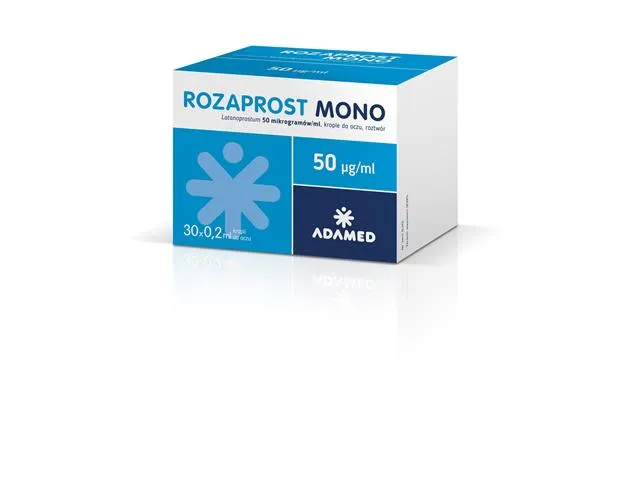
Table of Contents
Package leaflet: Information for the user
Rozaprost Mono, 50 micrograms/mL, eye drops, solution
Latanoprost
Please read all of this leaflet carefully before using this medicine, because it contains
important information for you.
- Keep this leaflet as you may need to read it again.
- If you have any further questions, please consult your doctor or pharmacist.
- This medicine has been prescribed for a specific individual. Do not pass it on to others. It may harm them even if their symptoms are the same as yours.
- If you experience any adverse reactions, including any not listed in this leaflet, tell your doctor or pharmacist. See section 4.
Leaflet contents:
- What Rozaprost Mono is and what it is used for
- Important information before using Rozaprost Mono
- How to use Rozaprost Mono
- Possible side effects
- How to store Rozaprost Mono
- Contents of the pack and other information
1. What Rozaprost Mono is and what it is used for
Rozaprost Mono contains latanoprost and belongs to a group of medicines called prostaglandin analogues.
It works by increasing the natural outflow of fluid from inside the eye into the bloodstream.
Rozaprost Mono is used to treat conditions known as open-angle glaucoma and ocular hypertension in adults. Both of these conditions are associated with increased pressure within the eyeball, which may eventually adversely affect vision.
Rozaprost Mono is also used to treat elevated intraocular pressure and glaucoma in adolescents, children, and infants.
2. Important information before using Rozaprost Mono
Rozaprost Mono can be used in adult men and women (including elderly patients) and in children from birth up to 18 years of age. Its use has not been studied in preterm infants (born before week 36 of pregnancy).
When not to use Rozaprost Mono:
- if the patient is allergic to latanoprost or any of the other ingredients of this medicine (listed in section 6),
- if the patient is pregnant or planning to become pregnant,
- if the patient is breastfeeding.
Warnings and precautions
Before starting treatment with Rozaprost Mono, discuss this with your doctor or pharmacist.
- If the adult or child has undergone eye surgery (including cataract surgery), or such surgery is planned,
- If the adult or child has eye problems (such as eye pain, irritation or eye inflammation, blurred vision),
- if the patient complains of dry eyes,
- if the patient suffers from severe or uncontrolled asthma,
- if the patient wears contact lenses; in such a case, Rozaprost Mono may be used, but instructions for contact lens wearers described in section 3 must be followed,
- if the patient has had or currently has a viral eye infection caused by herpes simplex virus (HSV).
Rozaprost Mono and other medicines
Tell your doctor or pharmacist about all medicines (including eye drops) currently used or recently used, even those obtained without a prescription, as well as any medicines you plan to take.
Rozaprost Mono may interact with other medicines; therefore, concomitant use of two or more prostaglandins, prostaglandin analogues, or prostaglandin derivatives is not recommended.
Pregnancy and breastfeeding
If the patient is pregnant or breastfeeding, suspects she may be pregnant, or is planning to have a child, she should consult her doctor or pharmacist before using this medicine. Rozaprost Mono must not be used in pregnant or breastfeeding women.
Driving and operating machinery
While using Rozaprost Mono, blurred vision may occur, which is a transient symptom. In such a case, do not drive or operate any tools or machinery until normal visual acuity returns.
3. How to use Rozaprost Mono
This medicine should always be used as directed by the doctor. If in doubt, consult
your doctor or pharmacist.
The recommended dose for adults (including elderly patients) and children is one drop once daily
into the affected eye or eyes. It is best to administer the drops in the evening.
The contents of a single-dose container should be used immediately after opening; any
remaining medicine should be discarded.
Do not use Rozaprost Mono more than once a day, as more frequent use may
reduce the effectiveness of treatment.
Use Rozaprost Mono as directed by your doctor until he or she advises you to stop
using the medicine.
Contact lens wearers
Patients wearing contact lenses should remove them before using Rozaprost Mono. After instilling the medicine, wait 15 minutes before reinserting the lenses.
Instructions for use:
- Wash your hands and sit or stand comfortably.
- Twist and remove the closure cap of the single-dose container.
- Gently pull down the lower eyelid of the affected eye with your finger.
- Hold the tip of the single-dose container near the eye, but ensure it does not touch the eye surface.
- Gently squeeze the single-dose container to release one drop into the eye, then release the lower eyelid.
- Press with your finger on the inner corner of the affected eye near the nose. Keep pressing for 1 minute without opening the eye.
- Repeat these steps for the other eye if your doctor has advised treatment of both eyes.
- Discard the single-dose container.
Using Rozaprost Mono with other eye drops
Wait at least 5 minutes between using Rozaprost Mono and applying other
eye drops.
Use of a higher than recommended dose of Rozaprost Mono
Using more drops than recommended may cause mild eye irritation with
redness and tearing. These symptoms should resolve, but if the patient is concerned,
they should contact their doctor for advice.
If Rozaprost Mono is accidentally ingested by an adult or child,
seek immediate medical advice from a doctor.
Missing a dose of Rozaprost Mono
Continue with the usual dosing schedule at the prescribed times. Do not use a double
dose to make up for a missed dose. If in doubt, consult your
doctor or pharmacist.
Stopping treatment with Rozaprost Mono
Before stopping treatment with Rozaprost Mono, consult the doctor managing the
patient's treatment or a pharmacist.
If you have any further questions about the use of this medicine, consult your
doctor or pharmacist.
4. Possible adverse reactions
Like all medicines, this medicine can cause adverse reactions, although not everyone experiences them.
Very common adverse reactions (occurring in more than 1 in 10 people)
-
Gradual change in eye colour due to increased amount of brown pigment in the coloured part of the eye, called the iris. Patients with mixed eye colour (blue-brown, grey-brown, yellow-brown or green-brown) have a higher probability of such a change compared to patients with uniform eye colour (blue, grey, green or brown). Any changes in eye colour may develop over years, although they usually appear within 8 months of treatment. The colour change may be permanent and may be more noticeable in people using Rozaprost Mono in only one eye. Such changes in eye colour do not appear to be associated with any problems. These types of changes do not progress further after discontinuation of Rozaprost Mono.
-
Eye redness.
-
Eye irritation (a burning, gritty, itchy, stinging sensation or a feeling of a foreign body in the eye). If eye irritation becomes so severe that it causes excessive tearing or a desire to discontinue the medicine, consult a doctor, pharmacist or nurse immediately (within one week). Re-evaluation of treatment may be necessary to ensure appropriate management for the patient.
-
Gradual change in the appearance of eyelashes and surrounding hairs in the treated eye, particularly in individuals of Japanese origin. These changes include darkening, lengthening, thickening and increased number of eyelashes.
Common adverse reactions (occurring in more than 1 in 100 but less than 1 in 10 people)
- Eye surface irritation or defects, eyelid margin inflammation, eye pain, light sensitivity (photophobia), conjunctivitis.
Uncommon adverse reactions (occurring in more than 1 in 1,000 but less than 1 in 100 people)
- Eyelid swelling, dry eye, inflammation or irritation of the eye surface (keratitis), blurred vision, inflammation of the coloured part of the eye (uveitis), retinal swelling (macular oedema).
- Rash.
- Chest pain (angina), palpitations.
- Asthma, shortness of breath (dyspnoea).
- Chest pain.
- Headache, dizziness.
- Muscle pain, joint pain.
Rare adverse reactions (occurring in more than 1 in 10,000 but less than 1 in 1,000 people)
- Iritis, symptomatic swelling or defects/damage on the eye surface, periorbital oedema (swelling around the eye), changes in the direction of eyelash growth or development of an additional row of eyelashes, scarring on the eye surface, formation of fluid-filled cysts in the coloured part of the eye (iris cysts). Local skin reactions on the eyelids, darkening of eyelid skin.
- Worsening of asthma.
- Acute skin itching.
- Viral eye infections caused by herpes simplex virus (HSV).
Very rare adverse reactions (occurring in less than 1 in 10,000 people)
- Worsening of angina in patients with heart disease.
- Sunken eye appearance.
In very rare cases, in some patients with significantly damaged transparent membrane covering the front part of the eyeball (cornea), corneal calcific deposits (calcium deposits) occurred during treatment.
Adverse reactions observed more frequently in children and adolescents than in adults were cold (catarrh) and fever.
Reporting of adverse reactions
If any adverse reactions occur, including any not listed in this leaflet, inform a doctor, pharmacist or nurse. Adverse reactions can be reported directly to the Department of Monitoring Adverse Drug Reactions at the Office for Registration of Medicinal Products, Medical Devices and Biocidal Products:
Al. Jerozolimskie 181C
02-222 Warsaw
Tel: +48 22 49 21 301
Fax: +48 22 49 21 309
Website: https://smz.ezdrowie.gov.pl
Adverse reactions can also be reported to the representative of the marketing authorisation holder.
Reporting adverse reactions helps provide more information on the safety of this medicine.
5. How to store Rozaprost Mono
Keep this medicine out of sight and reach of children.
Do not use this medicine after the expiry date stated on the label after: EXP. The expiry date refers to the last day of the stated month.
The code Lot on the cardboard box and sachet stands for batch number.
Store in a refrigerator (2°C – 8°C).
After first opening the sachet: Store below 25°C.
Medicines should not be disposed of via wastewater or household waste. Ask your pharmacist how to dispose of medicines no longer in use. Such measures help protect the environment.
6. Contents of the packaging and other information
What Rozaprost Mono contains
- The active substance is latanoprost. 1 mL of the medicinal product contains 50 micrograms of latanoprost.
- The other components are: monosodium dihydrogen phosphate monohydrate, disodium phosphate anhydrous, sodium chloride, water for injections.
What Rozaprost Mono looks like and contents of the pack
Rozaprost Mono is a clear, colourless solution in single-dose containers. Each
single-dose container contains 0.2 mL of eye drops.
Rozaprost Mono is available in packs containing 30 or 90 single-dose containers with a volume of 0.2 mL.
Not all pack sizes may be marketed.
Marketing Authorisation Holder
Adamed Pharma S.A.
Pieńków, ul. M. Adamkiewicza 6A
05-152 Czosnów
Manufacturer
Genetic S.p.A.
Nucleo Industriale
Contrada Canfora
84084 Fisciano (SA)
Italy
Adamed Pharma S.A.
Pieńków, ul. M. Adamkiewicza 6A
05-152 Czosnów
This medicinal product has been authorised in EEA Member States under the following names:
Poland Rozaprost Mono