Posterisan
Poland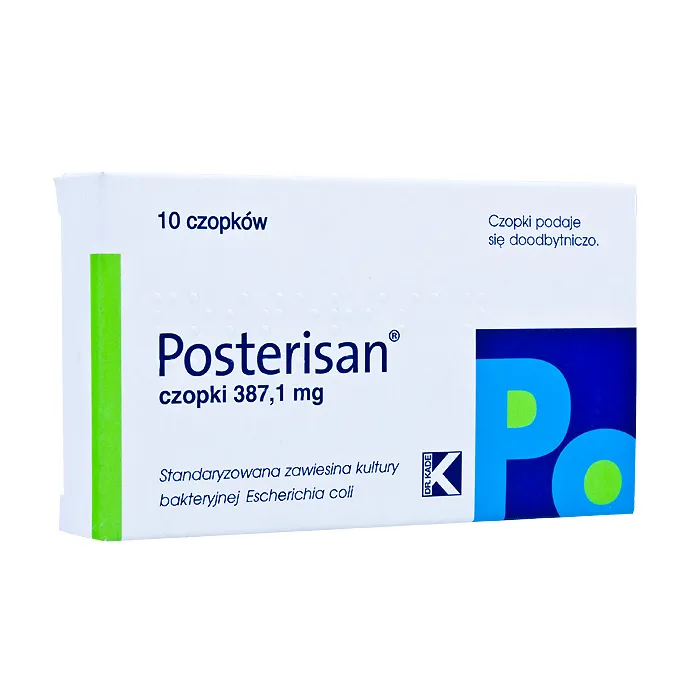
Table of Contents
Package leaflet: Information for the user
Posterisan, 387.1 mg, suppositories
Standardized suspension of Escherichia coli bacterial culture
Please read carefully all the information in this leaflet before using the medicine, as it contains
important information for the patient.
This medicine should always be used exactly as described in this patient information leaflet or as
directed by the doctor or pharmacist.
- Keep this leaflet, as you may need to read it again.
- If you need advice or further information, consult your pharmacist.
- If you experience any adverse reactions, including any possible adverse reactions not listed in this leaflet, inform your doctor or pharmacist. See section 4.
- If there is no improvement or if you feel worse, contact your doctor.
Table of contents
- What Posterisan is and what it is used for
- Important information before using Posterisan
- How to use Posterisan
- Possible side effects
- How to store Posterisan
- Contents of the pack and other information
1. What Posterisan is and what it is used for
Posterisan stimulates the body's immune system and supports the natural defense response against infections. This action leads to relief from itching and burning.
Posterisan suppositories are used for itching, oozing, and burning in the anal area caused by haemorrhoidal nodules.
2. Important information before using Posterisan
When not to use Posterisan:
- if the patient is allergic to the standardized bacterial culture suspension or to any of the other ingredients of this medicine (listed in section 6).
Warnings and precautions
Before starting to use Posterisan, discuss it with your doctor or pharmacist.
In case of fungal infections, concomitant use of topical antifungal medications is required.
Children and adolescents
There is no justified indication for the use of Posterisan in children and adolescents.
Posterisan and other medicines
You must tell your doctor or pharmacist about all medicines the patient is currently taking or has recently taken, as well as any medicines the patient plans to take.
Pregnancy and breastfeeding
If the patient is pregnant or breastfeeding, suspects she may be pregnant, or is planning to have a baby, she should consult her doctor or pharmacist before using this medicine.
There are no data available on the use of Posterisan in pregnant or breastfeeding women.
Driving and operating machinery
Posterisan has no effect on the ability to drive or operate machinery.
Posterisan contains macrogolglycerol hydroxystearate
The medicine may cause skin reactions.
Important information for patients with hemorrhoidal nodules
What are hemorrhoidal nodules?
The terminal part of the rectum above the anal sphincter, beneath the mucous membrane, contains soft, widely distributed, and richly vascularized vascular cushions. These cushions ensure tight closure of the anus.
Symptoms occur when these cushions become enlarged due to blood congestion, forming nodular thickenings. This condition is known as hemorrhoidal nodules (anal varices, hemorrhoids). Contributing factors include improper diet low in dietary fiber, chronic constipation, excessive straining during defecation, frequent use of laxatives, sedentary work, and sometimes connective tissue weakness.
Patients typically experience a sensation of pressure or bleeding during or after defecation. Bleeding results from abrasions of the mucosa around the hemorrhoids or rupture of a hemorrhoidal nodule. As the condition progresses, persistent or painful pricking, itching, burning, and discharge in the anal area may occur, associated with inflammation and skin rash.
In advanced stages, hemorrhoidal nodules may intermittently or permanently prolapse from the anus.
Course of treatment
After thorough examination, the doctor will provide treatment recommendations. Ointments and suppositories help relieve acute symptoms such as itching, pricking, burning, discharge, and pain at the onset of the disease, as well as before and after surgical procedures. Continued treatment is very important, even if symptoms improve, because otherwise symptoms may recur within a few days. However, this treatment does not eliminate enlarged hemorrhoidal nodules. In advanced stages, enlarged hemorrhoidal nodules require surgical treatment.
Prevention
Prevention primarily involves regulating bowel movements and maintaining anal hygiene.
Hard stools promote the development of hemorrhoids, so it is important to ensure regular passage (not necessarily daily) of soft stools.
However, this does not mean forcing overly soft stools with the use of laxatives, which may irritate and weaken the anal region. Stool consistency should be regulated through an appropriate diet rich in dietary fiber (fruits, vegetables that do not cause bloating, wholemeal bread, and porridge), dairy products, and adequate fluid intake. Spicy foods, alcohol, and constipating foods should be avoided. Body weight should be monitored and excess weight reduced.
Additionally, especially with sedentary work, regular physical activity such as walking, cycling, or swimming should be maintained. Avoid sitting on cold surfaces.
Regular and thorough hygiene of the anal area is also important. After each bowel movement, soft toilet paper should be used, followed by washing the anal area with lukewarm water and a soft cloth, without soap or disinfectants. Do not rub! Commercially available moist hygiene wipes are effective. The anal area should be thoroughly cleaned at least every evening. Careful and gentle drying with soft toilet paper or cotton wool can help prevent infection (by bacteria, fungi, or yeasts).
To prevent blood congestion in hemorrhoidal nodules, daily exercises improving circulation should be performed—tightening and relaxing the sphincter every 2 seconds for a total of 3 minutes. Sitz baths or rinsing the anus with cool water under the shower also improve circulation and provide relief from itching and burning.
What must be strictly observed?
In case of bloody stools or frequent or prolonged symptoms, a doctor must be consulted immediately, as these symptoms may indicate serious diseases.
The enclosed leaflet should be read carefully and the doctor's instructions followed.
Additionally, regular proctological examinations should be performed routinely—even in the absence of acute symptoms.
3. How to use Posterisan
This medicine should always be used exactly as described in the patient leaflet or as directed by a doctor or pharmacist.
If in doubt, consult your doctor or pharmacist.
Recommended dose
The usual dose is to use the suppositories twice daily, in the morning and evening, preferably after a bowel movement,
inserting the suppository deeply into the rectum.
The recommended duration of treatment with Posterisan ointment or Posterisan suppositories is 2 to 3 weeks.
To remove the suppository, tear or cut the aluminium foil along the package.
Previous experience indicates that, if necessary, Posterisan may be administered for a longer period,
especially to prevent recurrences. Even after the acute itching, oozing, and burning have subsided,
treatment with Posterisan should be continued for several more days.
Use of a higher than recommended dose of Posterisan
Cases of overdose or poisoning are unknown.
In the event of accidental oral ingestion of the suppositories, gastrointestinal symptoms such as abdominal pain and nausea may occur.
Missed dose of Posterisan
Do not use a double dose to make up for a missed dose.
If you have any further doubts concerning the use of this medicine, consult your doctor or pharmacist.
4. Possible adverse reactions
Like all medicines, this medicine can cause adverse reactions, although not everyone will experience them.
Common adverse reactions (may affect up to 1 in 10 people):
local skin reaction (e.g. itching, burning sensation).
Uncommon adverse reactions (may affect up to 1 in 100 people):
allergic dermatitis (e.g. due to hypersensitivity to phenol).
Reporting of adverse reactions
If any adverse reactions occur, including any adverse reactions not listed in this leaflet, inform a doctor or pharmacist. Adverse reactions can be reported directly to the Department of Monitoring of Adverse Drug Reactions of the Office for Registration of Medicinal Products, Medical Devices and Biocidal Products, Al. Jerozolimskie 181C, 02-222 Warsaw, phone: +48 22 49-21-301, fax: +48 22 49-21-309, website: https://smz.ezdrowie.gov.pl.
Adverse reactions can also be reported to the marketing authorization holder.
Reporting adverse reactions helps to provide more information on the safety of the medicine.
5. How to store Posterisan
Keep this medicine out of sight and reach of children.
Do not use this medicine after the expiry date stated on the blister and carton after:
"Expiry date". The expiry date refers to the last day of the stated month.
Do not store above 25°C.
Medicines should not be disposed of via wastewater or household waste. Ask your pharmacist
how to dispose of medicines no longer in use. This will help protect the environment.
6. Contents of the package and other information
What Posterisan contains
- The active substance is a standardized bacterial culture suspension of Escherichia coli. Each suppository contains 387.1 mg of standardized bacterial culture suspension of Escherichia coli (killed with 6.6 mg of liquid phenol). The suspension contains cellular components and metabolic products derived from 660 million Escherichia coli bacteria, killed and preserved with phenol.
- Other ingredients: hard fat, macrogol glycerol hydroxystearate.
What Posterisan looks like and contents of the pack
Posterisan is white or almost white, homogeneous suppositories.
Aluminum foil blisters in a cardboard box containing 10 suppositories.
Marketing Authorisation Holder and Manufacturer
DR. KADE Pharmazeutische Fabrik GmbH
Rigistrasse 2
12277 Berlin
Germany
For further information, please contact the representative of the
Marketing Authorisation Holder:
Kadefarm Sp. z o.o.
Sierosław, Gipsowa 18 Street
62-080 Tarnowo Podgórne, Poland
Tel.: +48 61 862 99 43
e-mail: [email protected]