Oxalin baby
Poland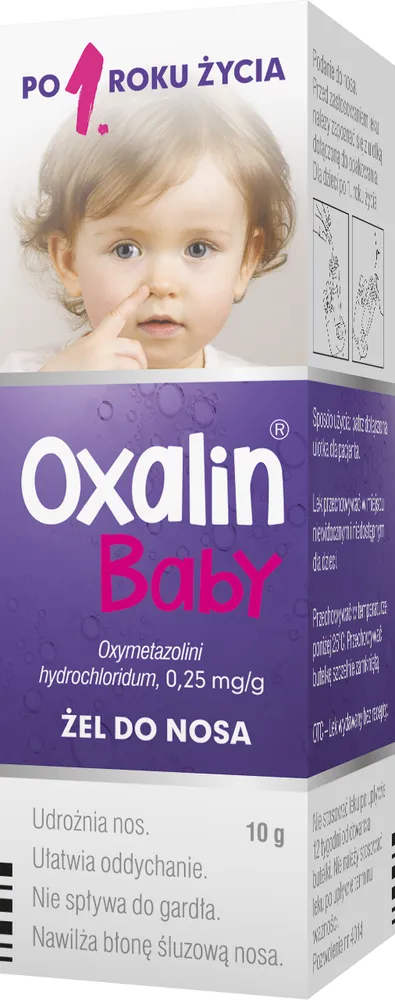
Table of Contents
Package leaflet: Information for the user
Oxalin Baby, 0.25 mg/g, nasal gel
Oxymetazolini hydrochloridum
Please read the entire leaflet carefully before using this medicine, as it contains important information for the patient.
This medicine should always be used exactly as described in this patient leaflet or as directed by a doctor, pharmacist, or nurse.
- Keep this leaflet for future reference.
- If you need advice or further information, consult your pharmacist.
- If you experience any adverse reactions, including any possible side effects not listed in this leaflet, inform your doctor, pharmacist, or nurse. See section 4.
- If there is no improvement after 3–5 days, or if your condition worsens, consult a doctor.
Table of contents
- What Oxalin Baby is and what it is used for
- Important information before using Oxalin Baby
- How to use Oxalin Baby
- Possible side effects
- How to store Oxalin Baby
- Contents of the pack and other information
1. What Oxalin Baby is and what it is used for
Oxalin Baby is a nasal gel containing oxymetazoline hydrochloride as the active substance, belonging to a group of medicines called sympathomimetics.
When applied locally to the nasal mucosa, Oxalin Baby constricts blood vessels, reduces swelling of the nasal mucosa, and suppresses excessive secretion, thereby facilitating free breathing through the nose. It clears the nasal passages and promotes drainage of secretions from the paranasal sinuses.
Oxalin Baby is formulated as a gel, which moisturizes the nasal mucosa and prevents the medicine from running down the back of the nasal cavity and into the throat.
Oxalin Baby nasal gel is intended for use in children aged over 1 year up to 6 years.
Oxalin Baby is used:
- in acute rhinitis;
- in vasomotor rhinitis;
- in allergic rhinitis;
- in sinusitis;
- in otitis media with Eustachian tube inflammation;
- in otitis media.
2. Important information before using Oxalin Baby
When not to use Oxalin Baby
- If the patient is allergic to xylometazoline hydrochloride or to any of the other ingredients of this medicine (listed in section 6).
- If the patient has dry nasal inflammation (atrophic rhinitis with formation of crusts).
Warnings and precautions
Before starting to use Oxalin Baby, discuss it with a doctor, pharmacist, or nurse.
Oxalin Baby should be used with particular caution and only after medical advice in the following cases:
- Treatment with monoamine oxidase inhibitors (MAOIs) and other medicines that increase blood pressure;
- Increased intraocular pressure, particularly in the case of so-called closed-angle glaucoma;
- Severe cardiovascular diseases, e.g. ischemic heart disease, arterial hypertension;
- Pheochromocytoma (a tumor located in the glands above the kidneys);
- Metabolic disorders, e.g. hyperthyroidism, diabetes.
Oxalin Baby should not be used for longer than 3–5 days or in doses higher than recommended, as this may lead to reduced effectiveness of the medicine and may cause difficult-to-treat changes in the nasal mucosa.
Children
Do not use this medicine in children under 1 year of age.
Follow the dosage and duration of use recommendations provided in section 3 of the leaflet.
Oxalin Baby and other medicines
Tell your doctor or pharmacist about all medicines the patient is currently taking or has recently taken, as well as any medicines the patient plans to use.
Overdose or accidental ingestion of the medicine, as well as concomitant use of tricyclic antidepressants or monoamine oxidase inhibitors (medicines used, among others, in depression) either simultaneously or immediately before administration of xylometazoline, may lead to increased blood pressure.
Pregnancy and breastfeeding
If the patient is pregnant or breastfeeding, suspects she may be pregnant, or is planning to have a child, she should consult a doctor or pharmacist before using this medicine.
Driving and operating machinery
During prolonged use of the medicine or use in doses higher than recommended, systemic cardiovascular effects cannot be ruled out. In such cases, psycho-physical performance, ability to drive vehicles, and operate machinery may be impaired.
Oxalin Baby contains benzalkonium chloride
The medicine contains 0.1 mg of benzalkonium chloride per g of gel. Benzalkonium chloride may cause irritation or swelling inside the nose, especially if used for a prolonged period.
3. How to use Oxalin Baby
This medicine should always be used exactly as described in this patient leaflet or as directed by a doctor. If in doubt, consult a doctor or pharmacist.
- This medicine should be used for nasal use only.
- For hygienic reasons, the medicine container should be used by only one person.
- Do not use for longer than 3 to 5 days.
- Do not use more than 3 times per day.
- Do not use doses larger than those stated below.
One 45 µl (microliter) dose of gel contains 11.48 µg (micrograms) of oxymetazoline hydrochloride.
Oxalin Baby nasal gel is intended for children after completion of 1 year of age.
Children aged above 1 year up to 6 years:
1 dose into each nostril 2 to 3 times per day.
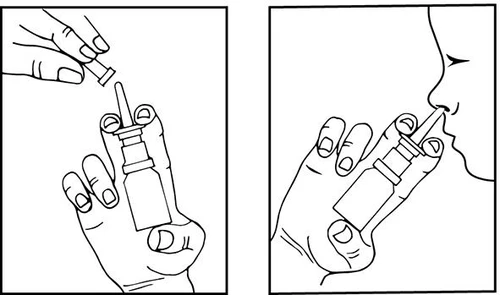
Instructions for use
Before each use, remove the protective cap.
Before first use of a new bottle, due to the gel formulation, after removing the cap, press the pump several times until the medicine appears. Insert the pump tip into the nostril.
Holding the bottle vertically, press the pump to deliver a dose of the medicine into the nose.
After use, replace the protective cap.
Use of a higher than recommended dose of Oxalin Baby
If a patient has used a higher than recommended dose (overdose) or accidentally swallowed the medicine, especially if this occurred in a child, contact a doctor immediately.
Seek immediate medical attention if any of the following symptoms occur:
- Dilated pupils;
- Nausea, vomiting;
- Cyanosis (bluish discoloration of the skin and mucous membranes);
- Fever;
- Muscle spasms;
- Cardiac dysfunction (e.g. rapid heartbeat, cardiac arrhythmia);
- Circulatory collapse (acute heart failure with sudden drop in blood pressure, manifested by severe weakness, often with loss of consciousness);
- Cardiac arrest (causing cessation of blood circulation and life-threatening condition);
- Pulmonary edema (characterized by increasing shortness of breath, labored breathing with wheezing, pallor and cyanosis, decreased or elevated blood pressure);
- Psychiatric disturbances;
- Drowsiness;
- Hypothermia;
- Bradycardia;
- Sudden drop in arterial blood pressure;
- Apnea;
- Coma.
If you have any further doubts regarding the use of this medicine, consult your doctor or pharmacist.
4. Possible adverse reactions
Like all medicines, this medicine can cause adverse reactions, although not everyone will experience them.
The following adverse reactions may occur:
Common (in more than 1 in 100 patients, but less than 1 in 10 patients):
- burning sensation at the application site, dryness of the nasal mucosa, sneezing.
Uncommon (in more than 1 in 1,000 patients, but less than 1 in 100 patients):
- palpitations, increased heart rate;
- increased blood pressure.
Rare (in more than 1 in 10,000 patients, but less than 1 in 1,000 patients):
- motor restlessness, insomnia, headache;
- fatigue;
- strong sensation of "nasal congestion" due to worsening of nasal mucosal swelling (occurs after the medicine wears off, as a symptom of so-called reactive hyperaemia).
Prolonged use of the medicine beyond the recommended duration and/or in doses higher than recommended may lead to difficult-to-treat or even irreversible changes in the nasal mucosa.
Reporting of adverse reactions
If any adverse reactions occur, including any not listed in this leaflet, inform your doctor, pharmacist, or nurse. Adverse reactions can be reported directly to the Department of Monitoring Adverse Drug Reactions of the Office for Registration of Medicinal Products, Medical Devices and Biocidal Products
Al. Jerozolimskie 181C
02-222 Warsaw
Phone: +48 22 49 21 301
Fax: +48 22 49 21 309
Website: https://smz.ezdrowie.gov.pl
Adverse reactions can also be reported to the marketing authorisation holder.
Reporting adverse reactions helps provide more information on the safety of this medicine.
5. How to store Oxalin Baby
Store below 25°C.
Keep the bottle tightly closed.
Keep the medicine out of the sight and reach of children.
Do not use this medicine after the expiry date stated on the box and bottle after EXP.
The expiry date refers to the last day of the stated month.
Do not use the medicine after 12 weeks from first opening of the bottle.
Medicines should not be disposed of via wastewater or household waste. Ask your pharmacist how to dispose of medicines no longer in use. This will help protect the environment.
6. Contents of the package and other information
What Oxalin Baby contains
- The active substance is oxymetazoline hydrochloride. 1 g of gel contains 0.25 mg of oxymetazoline hydrochloride.
- The other ingredients are: sodium chloride; disodium phosphate dodecahydrate; sodium dihydrogen phosphate monohydrate; disodium edetate; hydroxyethylcellulose; glycerol; benzalkonium chloride, solution; purified water.
What Oxalin Baby looks like and contents of the pack
Oxalin Baby is a colourless or slightly yellow, transparent or slightly opalescent viscous liquid.
The medicine is available:
- in glass bottles with an atomizer containing 10 g of gel, in a cardboard box,
- in 15 ml polyethylene bottles closed with a dosing pump and an applicator with a protective cap containing 10 g of gel, in a cardboard box.
Marketing Authorisation Holder
Zakłady Farmaceutyczne POLPHARMA S.A.
ul. Pelplińska 19, 83-200 Starogard Gdański
tel. + 48 22 364 61 01
Manufacturer
Zakłady Farmaceutyczne POLPHARMA S.A.
Medana Branch in Sieradz
ul. Władysława Łokietka 10, 98-200 Sieradz