Octenigin
Poland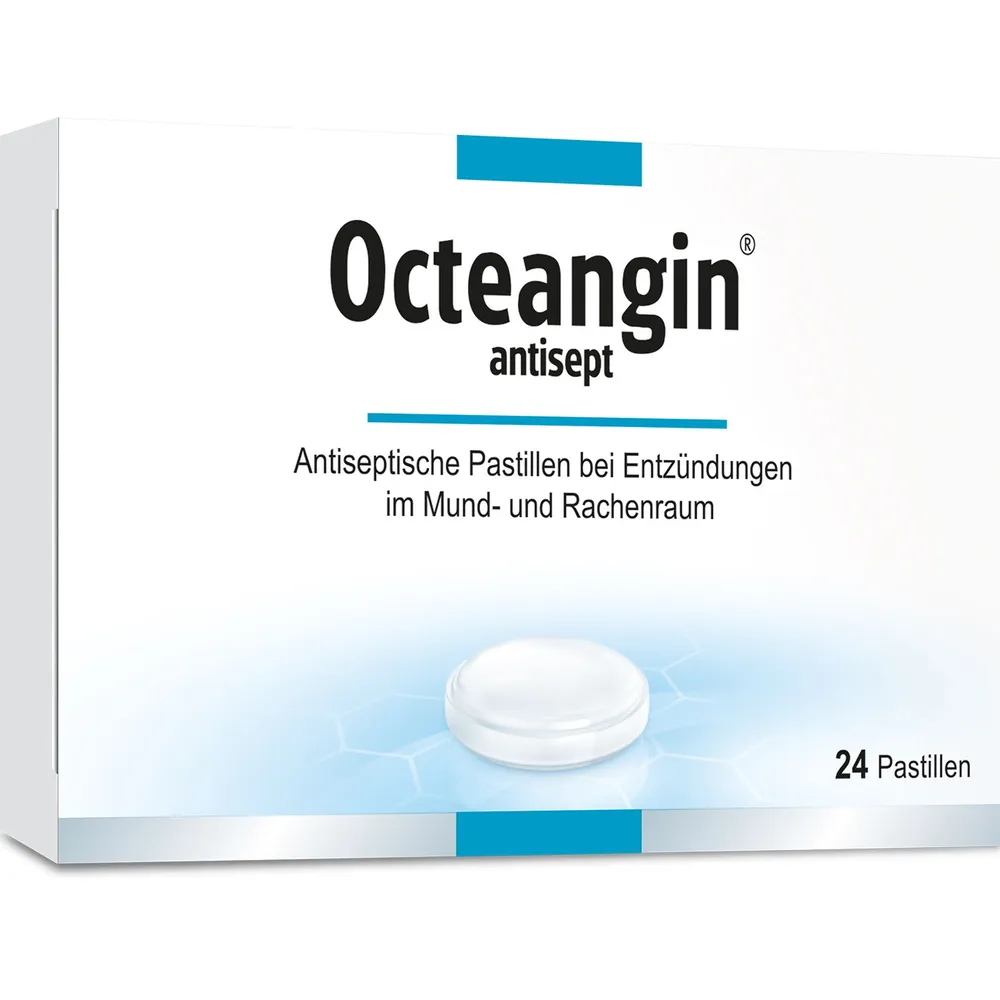
Table of Contents
Package leaflet: Information for the patient
Warning! Keep this leaflet! Information on the immediate packaging in a foreign language.
Octeangin
2.6 mg, hard pastilles
Octenidini dihydrochloridum
Please read this leaflet carefully before using the medicine, as it contains
important information for the patient.
- Keep this leaflet, so that you can read it again if necessary.
- If you have any questions, consult your doctor or pharmacist.
- This medicine has been prescribed for a specific individual. Do not pass it on to others. It may harm other people, even if their symptoms are the same.
- If you experience any adverse effects, including any not listed in this leaflet, inform your doctor or pharmacist. See section 4.
Table of contents
- What Octeangin is and what it is used for
- Important information before using Octeangin
- How to use Octeangin
- Possible side effects
- How to store Octeangin
- Contents of the pack and other information
1. What Octeangin is and what it is used for
Octeangin contains the active substance octenidine dihydrochloride. This is an antiseptic agent that effectively combats pathogenic microorganisms by disrupting their cellular functions.
Octeangin is used for short-term supplementary treatment of inflammation of the mucous membranes of the mouth and throat, associated with typical symptoms such as pain, redness, and swelling.
Octeangin is indicated for use in adults and adolescents aged 12 years and older.
If there is no improvement after 4 days of treatment, or if symptoms worsen, consult a doctor.
2. Information before using Octeangin
When not to use Octeangin
Do not use this medicine if the patient is allergic to octenidine dihydrochloride or any of the other ingredients
of this medicine (listed in section 6).
Warnings and precautions
Talk to your doctor or pharmacist before starting to use Octeangin.
For short-term use only.
Do not use this medicine for longer than 4 days.
Children
The safety and efficacy of Octeangin in children aged 0 to 11 years have not been established.
Octeangin and other medicines
Tell your doctor or pharmacist about all medicines the patient is currently taking or has recently taken, as well as any medicines the patient plans to use.
No interaction studies have been conducted.
Pregnancy, breastfeeding and fertility
If the patient is pregnant or breastfeeding, suspects she may be pregnant, or is planning to have a child, she should consult her doctor or pharmacist before using this medicine.
Pregnancy
Pregnant women should consult their doctor before using Octeangin.
Breastfeeding
There is insufficient information regarding the passage of octenidine dihydrochloride into human breast milk.
A risk to the breastfed infant cannot be completely ruled out. Therefore, Octeangin should not be used during breastfeeding.
Fertility
No studies have been conducted.
Driving and operating machinery
No studies have been conducted on the effect on the ability to drive and operate machinery.
Octeangin contains isomalt (E 953).
One hard tablet contains 2.57 g of isomalt (a sugar substitute), corresponding to approximately 6 kcal (26 kJ).
This should be taken into account in patients with diabetes. Isomalt may have a mild laxative effect.
If the patient has previously been diagnosed with intolerance to certain sugars, the patient should consult a doctor before taking this medicine.
3. How to use Octeangin
This medicine should always be used according to the instructions given by your doctor or pharmacist. If you have any doubts,
consult your doctor or pharmacist.
Recommended dose:
Adults and adolescents aged 12 years and older should take one hard lozenge every 2–3 hours, unless otherwise advised.
Maximum dose: 6 hard lozenges per day.
Route of administration:
The hard lozenge should be actively and continuously sucked, moving it around the mouth until it dissolves completely.
Do not use Octeangin for longer than 4 days.
The risk of adverse effects can be reduced by using the lowest effective dose for the shortest duration necessary to relieve symptoms.
Use of a higher than recommended dose of Octeangin
In the unlikely event of overdose, the adverse effects described may become more severe. In such a case, consult a doctor immediately for symptomatic treatment.
Missed dose of Octeangin
Do not take a double dose to make up for a missed lozenge.
If you have any further doubts about the use of this medicine, consult your doctor or pharmacist.
4. Possible adverse effects
Like all medicines, this medicine can cause adverse effects, although not everyone will experience them.
Frequency unknown (frequency cannot be determined from available data):
- Irritation of the oral and gastric mucosa, such as taste disturbances, dry mouth, indigestion, nausea, or abdominal pain.
- Discoloration of the tongue.
- Allergic reactions.
Reporting of adverse effects
If any adverse effects occur, including any adverse effects not listed in this leaflet, inform a doctor or pharmacist. Adverse effects can be reported directly to the Department of Monitoring Adverse Drug Reactions of the Office for Registration of Medicinal Products, Medical Devices and Biocidal Products, Al. Jerozolimskie 181C, 02-222 Warsaw, tel.: +48 22 49 21 301, fax: +48 22 49 21 309, website: https://smz.ezdrowie.gov.pl.
Reporting adverse effects allows the collection of additional information on the safety of the medicine.
5. How to store the medicine Octeangin
Keep the medicine out of the sight and reach of children.
Do not use this medicine after the expiry date stated on the packaging. The expiry date refers to the last day of the stated month.
There are no special storage temperature requirements.
Store in the original packaging to protect from light.
Medicines must not be disposed of via wastewater or household waste. Ask your pharmacist how to dispose of medicines no longer required. Such measures will help protect the environment.
6. Contents of the pack and other information
What Octeangin contains
- The active substance is octenidine dihydrochloride. Each hard pastille contains 2.6 mg of octenidine dihydrochloride.
- The other ingredients are: isomalt (E 953), tartaric acid, flavour (Masking Flavour PHL-121355) (containing propylene glycol, coffee extract and 4-(2,2,3-trimethylcyclopentyl) butanoic acid), star anise essential oil, peppermint essential oil, sucralose (E 955).
What Octeangin looks like and contents of the pack
The hard pastilles are creamy white, round and slightly transparent.
Octeangin is available in cardboard boxes containing 12 or 24 hard pastilles,
packaged in PVC-PVDC/Aluminium blisters.
For more detailed information, please contact the responsible party or parallel importer.
Responsible party in Romania, country of export:
M.C.M. Klosterfrau Vertriebsgesellschaft mbH
Gereonsmühlengasse 1-11
D-50670 Cologne
Germany
Manufacturer:
Klosterfrau Berlin GmbH
Motzener Strasse 41
Marienfelde
12277 Berlin
Germany
Parallel importer:
InPharm Sp. z o.o.
ul. Strumykowa 28/11
03-138 Warsaw
Repackaged in:
InPharm Sp. z o.o. Services sp. k.
ul. Chełmżyńska 249
04-458 Warsaw
Marketing authorisation number in Romania, country of export: 14990/2023/01
14990/2023/04
Parallel import authorisation number: 293/25
This medicinal product is authorised for sale in the European Economic Area countries under the following names:
Germany, Luxembourg: Laryngomedin Octenidin Antisept
Austria: Octeangin antisept 2.6 mg Pastillen
Bulgaria, Hungary, Poland, Romania: Octeangin
Czech Republic, Slovakia: Octenidine Klosterfrau