Nodisen
Poland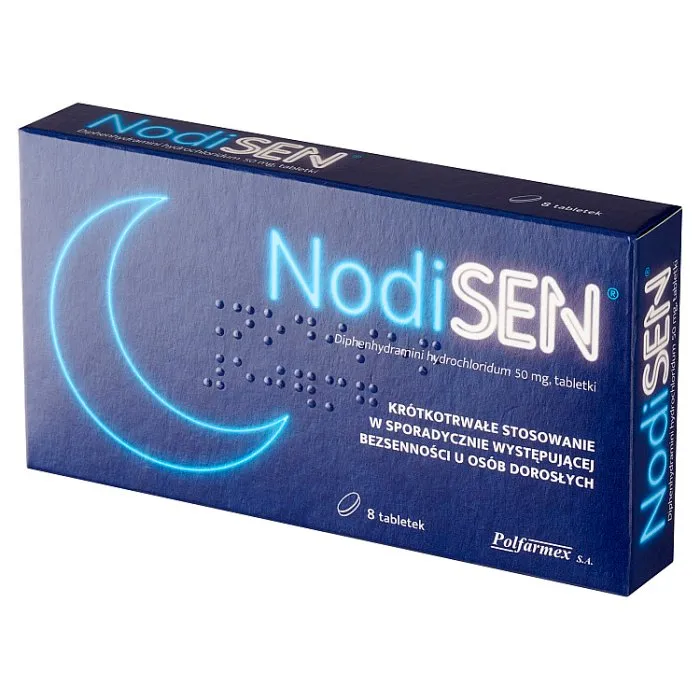
Table of Contents
Before using Nodisen medicine, carefully read the package leaflet
and complete the Patient Information Leaflet.
The medicine is intended only for adult patients.
Package leaflet: information for the patient
NODISEN, 50 mg, tablets
Diphenhydramini hydrochloridum
Please read this leaflet carefully before taking the medicine, as it contains
important information for the patient.
This medicine should always be taken exactly as described in this patient leaflet or as directed by
your doctor or pharmacist.
- Keep this leaflet, as you may need to read it again.
- If you need advice or further information, please consult your pharmacist.
- If you experience any adverse reactions, including any not listed in this leaflet, inform your doctor or pharmacist. See section 4.
- If there is no improvement after 7 days, or if your condition worsens, consult your doctor.
Table of contents of the leaflet
- What Nodisen is and what it is used for
- Important information before taking Nodisen
- How to take Nodisen
- Possible side effects
- How to store Nodisen
- Contents of the pack and other information
1. What Nodisen is and what it is used for
The active substance in Nodisen is diphenhydramine hydrochloride. Diphenhydramine belongs to a group of antihistamines that cause drowsiness.
Nodisen is indicated for short-term use in occasional insomnia in adults.
Occasional insomnia may occur especially when there are difficulties in falling asleep, frequent awakenings during the night, or early morning awakening related to stress or changes in time zones.
Transient sleep disturbances usually last for several days and may be caused by various factors such as stress, fatigue due to time zone changes, personal problems, or work-related issues. Treatment with Nodisen shortens the time required to fall asleep and increases the depth and quality of sleep.
Sleep disturbances may negatively affect physiological processes and lead to reduced psycho-physical performance. Insomnia is considered present, among other cases, when: the time to fall asleep exceeds half an hour, total nighttime awakenings last longer than half an hour, such disturbances occur at least three nights per week, and poor sleep quality causes fatigue or reduced daytime psycho-physical performance.
Medication should not be the primary method of treating sleep disorders and should be limited to short-term use only.
Persistent poor sleep quality may be a symptom of psychological or physical disorders requiring different treatment approaches, which should be evaluated by a doctor. Consultation with a doctor is also necessary if symptoms other than insomnia are present. Failure to properly diagnose the underlying cause of sleep disturbances and to treat it appropriately may pose a health risk. Treating the underlying condition causing sleep disturbances is essential for achieving lasting improvement in sleep quality.
Nodisen should not be used to treat chronic sleep disorders.
The treatment period should be as short as possible. Do not use the medicine for longer than 7 days without consulting a doctor. If there is no improvement after 7 days, or if your condition worsens, consult your doctor.
2. Important information before using Nodisen
When not to use Nodisen:
- if the patient is allergic to the active substance or to any of the other ingredients of this medicine (listed in section 6);
- if the patient has gastric ulcer with scarring;
- if the patient has gastric or intestinal obstruction (e.g. due to existing ulcers);
- if the patient has a phaeochromocytoma;
- if the patient has a cardiac condition known as QT prolongation;
- if the patient has cardiovascular disease or very slow heart rate;
- if the patient has low levels of electrolytes in the blood (e.g. decreased potassium or magnesium levels);
- if the patient is taking medicines used to treat heart rhythm disorders or medicines affecting heart rhythm (see section: "Nodisen with other medicines");
- if there have been cases of sudden cardiac death in the patient's immediate family.
Warnings and precautions
Before starting Nodisen, discuss this with a doctor or pharmacist:
- if the patient suffers from asthma, bronchitis or chronic obstructive pulmonary disease (COPD);
- if the patient has narrow-angle glaucoma (increased pressure in the eye);
- if the patient has an enlarged prostate or difficulty urinating (urinary retention);
- if the patient has myasthenia gravis (excessive muscle weakness);
- if the patient has epilepsy or seizure disorders;
- if the patient has moderate or severe liver or kidney disease;
- if the patient is elderly (over 65 years), as there is a higher risk of adverse effects.
Treatment with Nodisen should be discontinued if any symptoms or signs of heart rhythm disturbances occur. In such case, contact a doctor immediately.
If sleep problems persist despite treatment with the medicine, contact a doctor, as symptoms may indicate another serious underlying condition.
In young adults and patients with psychiatric disorders or episodes related to such disorders, cases of dependence or misuse of the medicine have been reported.
Any signs of dependence or misuse should be reported to a doctor immediately.
Diphenhydramine should be used for the shortest possible duration.
Prolonged use of the medicine may lead to the development of tolerance and/or dependence.
If the patient does not feel better or feels worse after 7 days of treatment, medical advice must be sought immediately.
Allergy testing
The medicine should be discontinued at least 72 hours before allergy testing.
Diphenhydramine may affect the test results.
Children and adolescents
The medicine is not indicated for use in children and adolescents under 18 years of age and should not be used in this patient group.
Nodisen with other medicines
Inform the doctor or pharmacist about all medicines currently used, recently taken, or planned to be used.
The medicine may enhance the effect of certain drugs.
Do not take Nodisen if the patient is taking medicines used for heart rhythm disorders or medicines that may affect the occurrence of heart rhythm disturbances.
Do not take Nodisen together with other medicines containing antihistamines, including those used on the skin, or in the treatment of cough or colds.
The patient should inform the doctor or pharmacist before taking Nodisen if they are using any of the following medicines:
medicines causing drowsiness, e.g. certain sedatives, hypnotics, analgesics, antidepressants, anxiolytics (e.g. opioid-containing sedatives, venlafaxine, tricyclic antidepressants, monoamine oxidase inhibitors MAOIs taken within the last 2 weeks);
atropine (used to dilate the pupil of the eye);
metoprolol (a medicine used to treat hypertension, heart problems, and prevention of migraine).
Nodisen and alcohol
Do not consume alcohol while taking Nodisen.
Pregnancy and breastfeeding
If the patient is pregnant, breastfeeding, suspects she may be pregnant, or plans to become pregnant, she should consult a doctor or pharmacist before using this medicine.
Do not use Nodisen during pregnancy or while breastfeeding.
Driving and operating machinery
Nodisen affects the ability to drive and operate machinery. Do not drive or operate machinery for at least 8 hours after taking Nodisen.
Nodisen is used to induce drowsiness, which occurs shortly after taking the dose. It may also cause dizziness, blurred vision, attention disturbances, and psychomotor disturbances. If such symptoms occur, the patient should not drive or operate machinery.
Nodisen contains lactose
If the patient has been previously diagnosed with intolerance to certain sugars, the patient should consult a doctor before taking this medicine.
3. How to take Nodisen
This medicine should always be taken exactly as described in this patient information leaflet, or as
advised by your doctor or pharmacist. If in doubt, consult your doctor or pharmacist.
This is an oral medicine.
Recommended dose for adults
If needed, 1 tablet 20 minutes before bedtime.
Do not exceed the recommended dose or frequency of dosing.
Do not take an additional tablet if you wake up during the night.
Do not take more than 1 tablet in any 24-hour period.
Duration of treatment
Treatment should be as short as possible. Do not use this medicine for longer than 7 days without
consulting a doctor. Contact your doctor if there is no improvement after 7 days of use, or if you feel worse.
Use in children and adolescents
Nodisen must not be used in children and adolescents under 18 years of age.
Taking more than the recommended dose of Nodisen
If you take more than the recommended dose, contact your doctor or the nearest emergency department immediately.
Overdose may cause: dilated pupils, fever, facial flushing, agitation, muscle tremors, involuntary movements, hallucinations (perceiving objects or people that are not present), and changes in the ECG recording. Significant overdose may lead to rhabdomyolysis (muscle breakdown), seizures, delirium, toxic psychosis, disturbances in heart function, coma, and cardiovascular collapse.
Missed dose of Nodisen
Do not take a double dose to make up for a missed dose.
Take the next dose the following day, as instructed in this leaflet.
If you have any further doubts about the use of this medicine, consult your doctor or pharmacist.
4. Possible adverse reactions
Like all medicines, this medicine can cause adverse reactions, although not everybody will experience them.
You should contact your doctor or pharmacist immediately if any of the following
adverse reactions occur:
Frequency unknown (frequency cannot be estimated from available data):
Allergic reactions (skin rash, itching, hives, breathing difficulties,
wheezing, swelling of lips, tongue, throat, or face).
Other adverse reactions:
Common (occur in less than 1 in 10 people):
fatigue, sedation, drowsiness,
attention disturbances,
loss of coordination, dizziness,
dry mouth.
Frequency unknown (frequency cannot be estimated from available data):
- disorientation*, paradoxical excitation* (e.g. increased energy*, motor restlessness*, nervousness*),
- convulsions, headache,
- skin tingling (pins and needles sensation), dyskinesia (difficulty performing movements),
- blurred vision,
- palpitations or rapid heartbeat,
- thickening and accumulation of mucus,
- indigestion, stomach upset,
- nausea, vomiting,
- muscle tremors,
- difficulty urinating, urinary retention.
* Elderly patients are more likely to experience the adverse reactions indicated above.
Reporting of adverse reactions
If any adverse reactions occur, including any not listed in this leaflet, inform your doctor or pharmacist. Adverse reactions can be reported directly to the Department of Monitoring Adverse Drug Reactions at the Office for Registration of Medicinal Products, Medical Devices and Biocidal Products
Al. Jerozolimskie 181C
02-222 Warsaw
Tel.: (22) 49 21 301
Fax: (22) 49 21 309
Website: https://smz.ezdrowie.gov.pl
Adverse reactions can also be reported to the marketing authorization holder.
Reporting adverse reactions helps to provide more information on the safety of the medicine.
5. How to store the medicine Nodisen
Keep the medicine out of sight and reach of children.
Store in the original packaging to protect from light and moisture.
There are no special requirements regarding storage temperature.
Do not use this medicine after the expiry date stated on the carton and blister pack following "EXP".
The expiry date refers to the last day of the stated month.
Medicines must not be disposed of via wastewater or household waste. Ask your pharmacist how to dispose of medicines no longer required. Such measures will help protect the environment.
6. Contents of the pack and other information
What Nodisen contains
- The active substance is diphenhydramine hydrochloride. Each tablet contains 50 mg of diphenhydramine hydrochloride.
- The other ingredients are: anhydrous lactose, microcrystalline cellulose, maize starch, crospovidone, magnesium stearate.
What Nodisen looks like and contents of the pack
Nodisen is a white to light cream-coloured, elongated, biconvex tablet.
The pack contains 8 tablets in an OPA/Aluminium/PVC/Aluminium blister pack in a cardboard box.
Marketing Authorisation Holder and Manufacturer:
Polfarmex S.A.
ul. Józefów 9
99-300 Kutno
Poland
Tel.: 24 357 44 44
Fax: 24 357 45 45
e-mail: [email protected]