Mivacurium kalceks
PolandTable of Contents
- Patient Information Leaflet
- 1. What Mivacurium Kalceks is and what it is used for
- 2. Important information before using Mivacurium Kalceks
- 3. How to use Mivacurium Kalceks
- 4. Possible adverse reactions
- 5. How to store Mivacurium Kalceks
- 6. Contents of the package and other information
- Information intended exclusively for medical professionals:
Patient Information Leaflet
Mivacurium Kalceks, 2 mg/mL, solution for injection/infusion
Mivacurium
Please read all of this leaflet carefully before this medicine is administered, as it contains
important information for you.
- Keep this leaflet, as you may need to read it again.
- If you have any further questions, please ask your doctor or nurse.
- If you experience any side effects, including any not listed in this leaflet, tell your doctor or nurse. See section 4.
Leaflet Contents
- What Mivacurium Kalceks is and what it is used for
- What you need to know before Mivacurium Kalceks is given
- How Mivacurium Kalceks is given
- Possible side effects
- How to store Mivacurium Kalceks
- Contents of the pack and other information
1. What Mivacurium Kalceks is and what it is used for
Mivacurium Kalceks contains a medicine called mivacurium. This medicine belongs to a group of medicines known as muscle relaxants.
This medicine is used:
- to relax muscles during surgery in adults, adolescents and children aged 2 months and above, including heart surgery;
- to help insert a breathing tube into the windpipe (endotracheal intubation), if the patient requires assistance with breathing.
For further information about this medicine, please consult your doctor.
2. Important information before using Mivacurium Kalceks
When not to use Mivacurium Kalceks
- if the patient is allergic to mivacurium or any of the other ingredients of this medicine (listed in section 6);
- if the patient has genetically abnormal cholinesterase activity;
- if the patient or their family has previously had a bad reaction to a muscle relaxant used during anaesthesia.
If the patient is unsure whether any of the above apply, talk to a doctor or nurse before receiving this medicine.
Warnings and precautions
Talk to a doctor or nurse before using this medicine if:
- the patient has muscle weakness, fatigue or difficulty with coordination (myasthenia gravis) or another neuromuscular disease;
- the patient has a burn requiring medical treatment;
- the patient has ever had an allergic reaction to any muscle relaxant used during surgery;
- the patient is sensitive to drops in blood pressure;
- the patient has undergone a blood-cleansing procedure called plasmapheresis;
- the patient has received donor plasma substitutes (plasma exchange);
- the patient has undergone cardiopulmonary bypass (a procedure that temporarily takes over the function of the heart and lungs during surgery);
- the patient has lower than normal blood volume (hypovolemia);
- the patient has an acid-base imbalance in the body;
- the patient has abnormal levels of sodium, potassium or calcium in the body;
- the patient has been pregnant or has given birth within the last 6 weeks;
- the patient has a genetically abnormal cholinesterase enzyme;
- the patient is particularly sensitive to histamine or has asthma.
Consult a doctor before administering this medicine if the patient currently has or has ever had any of the following conditions:
- tetanus;
- severe or long-lasting infections such as tuberculosis;
- any chronic illness resulting in general weakness;
- tumour;
- anaemia (reduced number of red blood cells);
- malnutrition;
- hypothyroidism;
- heart disease;
- gastric ulcers;
- burns;
- liver or kidney disease;
- collagen diseases (collagenoses or connective tissue diseases).
If the patient is unsure whether any of the above apply, talk to a doctor or nurse before using this medicine.
Children
This medicine should not be given to children under 2 months of age.
Mivacurium Kalceks and other medicines
Tell the doctor or nurse about all medicines the patient is currently taking, has recently taken, or plans to take, including over-the-counter and herbal medicines. These medicines may affect how Mivacurium Kalceks works or may cause unwanted effects.
In particular, tell the doctor or nurse if the patient is taking any of the following medicines:
- anaesthetics such as ketamine, enflurane, isoflurane, sevoflurane and halothane (used to reduce sensation and pain during surgery);
- muscle relaxants such as suxamethonium chloride and pancuronium;
- antibiotics such as aminoglycosides, polymyxins, spectinomycin, tetracyclines, lincomycin and clindamycin (used to treat infections);
- medicines for irregular heartbeat, such as propranolol (also used to treat high blood pressure), lidocaine, procainamide, quinidine and calcium channel blockers (antiarrhythmics);
- diuretics (water tablets), such as furosemide, thiazides, mannitol and acetazolamide;
- medicines for arthritis, such as chloroquine or D-penicillamine;
- steroids;
- medicines for seizures (epilepsy), such as phenytoin;
- medicines used in psychiatric disorders, such as lithium, monoamine oxidase inhibitors (MAOIs), selective serotonin reuptake inhibitors or chlorpromazine (which may also be used for nausea);
- medicines containing magnesium, such as those used to treat indigestion and heartburn;
- ganglion-blocking agents, such as trimethaphan and hexamethonium;
- medicines for chest pain (angina), such as oxprenolol (also used to treat high blood pressure);
- bambuterol (used to treat asthma);
- medicines that may reduce plasma cholinesterase levels, such as antimitotic agents, echothiophate iodide, organophosphorus compounds, cholinesterase inhibitors, and certain hormones.
Pregnancy and breastfeeding
If the patient is pregnant or breastfeeding, suspects she may be pregnant, or is planning to have a baby, she should consult a doctor before using this medicine.
Driving and using machines
Driving or operating machinery too soon after surgery may be dangerous. The doctor will inform the patient how long to wait before driving or operating machinery.
3. How to use Mivacurium Kalceks
Patients will never be expected to administer this medicine themselves. The patient will always receive it
from a qualified healthcare professional.
This medicine may be administered:
- as a single injection into a vein (intravenous bolus injection);
- as a continuous intravenous infusion. In this case, the medicine is given slowly over a prolonged period.
The doctor will decide the route of administration and the dose of the medicine to be given to the patient. This will depend on:
- the patient's body weight;
- the required degree and duration of muscle relaxation;
- the expected response of the patient to the medicine.
This medicine is not used in children under 2 months of age.
Use of a higher than recommended dose of Mivacurium Kalceks
This medicine should always be administered under strictly controlled conditions. However, if the patient
believes that a higher than recommended dose has been administered, they should immediately inform
the doctor or nurse.
4. Possible adverse reactions
Like all medicines, this medicine can cause adverse reactions, although not everyone will experience them.
Allergic reactions (may occur in up to 1 in 10,000 patients)
If the patient experiences an allergic reaction, you must inform the doctor or nurse immediately. Symptoms may include:
- sudden wheezing, chest pain or chest tightness
- swelling of the eyelids, face, lips, mouth or tongue
- hives or skin rash anywhere on the body
- collapse (sudden circulatory failure)
Inform the doctor or nurse if the patient notices any of the following:
Very common (may affect more than 1 in 10 patients)
- skin flushing
Not very common (may affect up to 1 in 100 patients)
- increased heart rate
- low blood pressure
- wheezing or cough
- rash or hives (hives or skin rash anywhere on the body)
Reporting of adverse reactions
If any adverse symptoms occur, including any adverse reactions not listed in this leaflet, inform the doctor or pharmacist. Adverse reactions can be reported directly to the Department of Monitoring Adverse Drug Reactions of the Office for Registration of Medicinal Products, Medical Devices and Biocidal Products
Al. Jerozolimskie 181C
PL-02-222 Warsaw
Tel.: + 48 22 49 21 301
Fax: + 48 22 49 21 309
Website: https://smz.ezdrowie.gov.pl
Adverse reactions can also be reported to the marketing authorization holder.
Reporting adverse reactions helps provide more information on the safety of this medicine.
5. How to store Mivacurium Kalceks
Keep this medicine out of the sight and reach of children.
Do not use this medicine after the expiry date stated on the outer carton and on the ampoule after "Expiry date (EXP)". The expiry date refers to the last day of the stated month.
Store in a refrigerator (2°C – 8°C).
Stability after dilution
Chemical and physical stability has been demonstrated for 48 hours at 30°C and for 2 to 8°C after dilution with infusion solutions (listed below) at a concentration of 0.5 mg/mL.
From a microbiological standpoint, the diluted solution should be used immediately. If not used immediately, the responsibility for storage conditions and duration prior to use lies with the user. The storage time of the solution should generally not exceed 24 hours at a temperature of 2 to 8°C, unless dilution was carried out under controlled and validated aseptic conditions.
Medicines must not be disposed of via wastewater or household waste. Ask your pharmacist how to dispose of medicines no longer required. Such measures will help protect the environment.
6. Contents of the package and other information
What Mivacurium Kalceks contains
- The active substance is mivacurium. 1 mL of solution contains 2 mg of mivacurium (Mivacurium) as mivacurium chloride. Each 5 mL ampoule contains 10 mg of mivacurium (as mivacurium chloride). Each 10 mL ampoule contains 20 mg of mivacurium (as mivacurium chloride).
- The other ingredient is water for injections.
What Mivacurium Kalceks looks like and contents of the pack
A clear, colourless or slightly yellow solution free from visible particles.
5 mL or 10 mL of solution in ampoules made of colourless type I glass, with a single break point.
The ampoules are packed in a protective sleeve. The sleeves are packed in a cardboard box.
Pack sizes:
5 or 10 ampoules of 5 mL
5 or 10 ampoules of 10 mL
Not all pack sizes may be marketed.
Marketing Authorisation Holder and Manufacturer
AS KALCEKS
Krustpils iela 71E
LV-1057 Rīga
Latvia
Tel.: +371 67083320
E-mail: [email protected]
This medicinal product is authorised in the European Economic Area countries under the following names:
Latvia Mivacurium Kalceks 2 mg/ml solution for injection/infusion
Germany Mivacurium Kalceks 2 mg/ml solution for injection/infusion
Poland Mivacurium Kalceks
Information intended exclusively for medical professionals:
Dosage
- Intravenous injection in adults
Mivacurium Kalceks is administered by intravenous injection. The average dose required to achieve 95% inhibition of the single twitch response of the adductor pollicis muscle to ulnar nerve stimulation (ED ) is 0.07 mg/kg body weight (range 0.06 to 0.09 mg/kg body weight) in adults anaesthetized with opioid analgesics.
For endotracheal intubation, the following dosing regimens are recommended:
a) A dose of 0.2 mg/kg body weight administered over 30 seconds provides good or excellent conditions for endotracheal intubation within 2 to 2.5 minutes.
b) A dose of 0.25 mg/kg body weight given as a divided dose (0.15 mg/kg body weight, followed 30 seconds later by 0.1 mg/kg body weight) provides good or excellent conditions for endotracheal intubation within 1.5 to 2.0 minutes after completion of the first dose.
In healthy adults, the recommended bolus dose range is 0.07 to 0.25 mg/kg body weight. The duration of neuromuscular blockade depends on the dose administered. Doses of 0.07 mg/kg, 0.15 mg/kg, 0.20 mg/kg, and 0.25 mg/kg produce clinically effective blockade lasting approximately 13, 16, 20, and 23 minutes, respectively.
Doses up to 0.15 mg/kg body weight may be administered over 5 to 15 seconds. Larger doses should be given over 30 seconds or as divided doses to minimize the risk of cardiovascular adverse effects.
Complete neuromuscular blockade may be maintained by administering supplemental doses of mivacurium. Each 0.1 mg/kg body weight dose, given during opioid analgesic anaesthesia, prolongs clinically effective blockade by approximately 15 minutes. Repeated supplemental doses do not result in cumulative neuromuscular blocking effects.
The neuromuscular blocking effect of mivacurium is potentiated when isoflurane or enflurane are used for anaesthesia. During stabilized anaesthesia with isoflurane or enflurane, the initial dose of mivacurium should be reduced by up to 25%. Halothane appears to potentiate the effect of mivacurium only slightly, and dose reduction is probably not necessary.
From the onset of spontaneous recovery of neuromuscular transmission to complete recovery, approximately 15 minutes elapse, regardless of the dose of mivacurium administered.
Neuromuscular blockade induced by mivacurium can be reversed by administering standard doses of cholinesterase inhibitors. However, since spontaneous recovery after mivacurium is rapid, routine reversal may not be necessary, as it shortens the time to recovery by only 5–6 minutes.
- Infusion in adults
To maintain neuromuscular blockade, mivacurium may be administered as a continuous infusion. After early signs of spontaneous recovery appear following the initial dose of mivacurium, an infusion rate of 8 to 10 micrograms/kg body weight/minute (0.5 to 0.6 mg/kg body weight/hour) is recommended.
The initial infusion rate should be determined based on the patient's response to peripheral nerve stimulation and clinical criteria.
The infusion rate should be adjusted by stepwise changes of approximately 1 microgram/kg body weight/minute (0.06 mg/kg body weight/hour). Generally, a given infusion rate should be maintained for at least 3 minutes before any adjustment.
In adults anaesthetized with opioid analgesics, an average infusion rate of 6 to 7 micrograms/kg/minute allows prolonged maintenance of 89 to 99% neuromuscular blockade. During stabilized anaesthesia with isoflurane or enflurane, the mivacurium infusion rate should be reduced by up to 40%. Clinical studies have shown that when sevoflurane is used concomitantly, the mivacurium infusion rate should be reduced by up to 50%. With halothane, a smaller reduction in infusion rate may be required.
Spontaneous recovery from neuromuscular blockade after mivacurium infusion is independent of infusion duration and is comparable to recovery after single doses.
Continuous infusion of mivacurium has not been associated with tachyphylaxis or cumulative neuromuscular blocking effects.
Special patient groups
Paediatric population
Infants and children aged 7 months to 12 years
Mivacurium has a higher ED (approximately 0.1 mg/kg body weight), a faster onset, a shorter duration of clinically effective blockade, and faster spontaneous recovery in infants and children aged 7 months to 12 years compared to adults.
The recommended dose range for intravenous injection in children aged 7 months to 12 years is 0.1 to 0.2 mg/kg body weight, administered over 5 to 15 seconds. A dose of 0.2 mg/kg body weight, given during stabilized anaesthesia with opioid analgesics or halothane, produces clinically effective neuromuscular blockade for an average of 9 minutes.
For endotracheal intubation in infants and children aged 7 months to 12 years, a dose of 0.2 mg/kg body weight of mivacurium is recommended. Maximum neuromuscular blockade usually occurs within 2 minutes after administration, allowing intubation at that time.
Supplemental doses are generally required more frequently in infants and children than in adults. Available data indicate that a supplemental dose of 0.1 mg/kg body weight prolongs clinically effective blockade by an average of 6 to 9 minutes during anaesthesia with opioid analgesics or halothane.
Infants and children generally require higher infusion rates than adults.
During halothane anaesthesia, the average infusion rate required to maintain 89 to 99% neuromuscular blockade in patients aged 7 to 23 months is approximately 11 micrograms/kg body weight/minute (about 0.7 mg/kg body weight/hour) [range: 3 to 26 micrograms/kg body weight/minute (about 0.2 to 1.6 mg/kg body weight/hour)].
In children aged 2 to 12 years, the equivalent average infusion rate is approximately 13 to 14 micrograms/kg body weight/minute (about 0.8 mg/kg body weight/hour) [range: 5 to 31 micrograms/kg body weight/minute (about 0.3 to 1.9 mg/kg body weight/hour)] during halothane or opioid analgesic anaesthesia.
Neuromuscular blockade induced by mivacurium is potentiated by concomitant administration of inhalational agents. Clinical studies have shown that in children aged 2 to 12 years, when sevoflurane is used, the mivacurium infusion rate should be reduced by up to 70%.
From the onset of spontaneous recovery to complete recovery, approximately 10 minutes elapse.
Infants aged 2 to 6 months
Mivacurium has a similar ED compared to adults (0.07 mg/kg body weight), but a faster onset, shorter duration of clinically effective blockade, and faster spontaneous recovery in infants aged 2 to 6 months.
The recommended dose range for intravenous injection in infants aged 2 to 6 months is 0.1 to 0.15 mg/kg body weight, administered over 5 to 15 seconds. A dose of 0.15 mg/kg body weight, given during stabilized halothane anaesthesia, produces clinically effective neuromuscular blockade lasting on average 9 minutes.
A mivacurium dose of 0.15 mg/kg body weight is recommended for endotracheal intubation in infants aged 2 to 6 months. Maximum neuromuscular blockade occurs approximately 1.4 minutes after administration, allowing intubation at that time.
Supplemental doses are generally required more frequently in infants aged 2 to 6 months than in adults. Available data indicate that a supplemental dose of 0.1 mg/kg body weight prolongs clinically effective blockade by approximately 7 minutes during halothane anaesthesia.
Infants aged 2 to 6 months generally require higher infusion rates than adults. The average infusion rate required to maintain 89 to 99% neuromuscular blockade during halothane anaesthesia is approximately 11 micrograms/kg/minute (about 0.7 mg/kg body weight/hour) [range: 4 to 24 micrograms/kg body weight/minute (about 0.2 to 1.5 mg/kg body weight/hour)].
From the onset of spontaneous recovery to complete recovery, approximately 10 minutes elapse.
Newborns and infants below 2 months
The safety and efficacy of mivacurium chloride in newborns and infants below 2 months of age have not been established. No dosage recommendations can be made.
Elderly patients
In elderly patients receiving a single dose of mivacurium as a rapid intravenous injection, the time from administration to onset of action, as well as the duration and rate of recovery from blockade, may be prolonged by 20 to 30% compared to younger patients. Elderly patients may require slower infusion rates or less frequent administration, or reduced supplemental doses given as rapid intravenous injections.
Patients with cardiovascular disorders
In patients with clinically significant cardiovascular disease, the initial dose of mivacurium should be administered over at least 60 seconds. When administered this way, mivacurium caused minimal hemodynamic changes in patients undergoing cardiac surgery.
Patients with renal impairment
In patients with end-stage renal failure, clinically effective blockade induced by a 0.15 mg/kg body weight dose of mivacurium lasts about 1.5 times longer than in patients with normal renal function. Therefore, the dose should be adjusted according to the individual patient's clinical response.
Prolonged and intensified neuromuscular blockade may also occur in patients with acute or chronic renal failure due to reduced plasma cholinesterase activity.
Patients with hepatic impairment
In patients with end-stage liver failure, clinically effective blockade induced by a 0.15 mg/kg body weight dose of mivacurium lasts about three times longer than in patients with normal liver function. This prolonged duration is associated with markedly reduced plasma cholinesterase activity observed in these patients. Therefore, the dose should be adjusted according to the individual patient's clinical response.
Patients with reduced plasma cholinesterase activity
Mivacurium is metabolized by plasma cholinesterase. Plasma cholinesterase activity may be reduced in the presence of genetic anomalies of plasma cholinesterase (e.g., patients who are heterozygous or homozygous for atypical plasma cholinesterase gene) and in various pathological conditions or after administration of certain drugs. In patients with reduced plasma cholinesterase activity, prolonged duration of neuromuscular blockade after mivacurium administration should be anticipated. A slight reduction in enzyme activity (i.e., up to 20% compared to the lower limit of normal values) does not have a clinically significant effect on the duration of blockade.
Patients with obesity
In obese patients (body weight exceeding ideal body weight for height by 30% or more), the initial dose of mivacurium should be calculated based on ideal body weight, not actual body weight.
Patient monitoring
As with all neuromuscular blocking agents, monitoring of neuromuscular function is recommended during mivacurium administration to individualize dosing requirements.
With mivacurium, there is no significant fade in the muscle response measured by the train-of-four method. Endotracheal intubation may often be performed before complete suppression of the adductor pollicis response to train-of-four stimulation.
Administration method
For intravenous use.
This product does not contain antibacterial preservatives and is intended for use in a single patient.
Mivacurium Kalceks (2 mg/mL) may be used for infusion in undiluted form.
Overdose
Symptoms and signs
Excessively prolonged muscle paralysis and its consequences are the main symptoms of overdose with neuromuscular blocking agents. There is also an increased risk of hemodynamic adverse effects, especially a drop in blood pressure.
Treatment
Until spontaneous adequate respiratory function returns, airway patency must be maintained and positive pressure ventilation applied.
Agents to ensure full unconsciousness should be administered, as consciousness is not impaired after mivacurium administration.
Administration of acetylcholinesterase inhibitors together with atropine or glycopyrrolate, when signs of spontaneous recovery of neuromuscular transmission appear, may accelerate recovery.
Appropriate patient positioning and administration of fluids or vasoconstrictor agents as needed may support cardiovascular function.
Incompatibilities
Mivacurium solution is acidic (pH approximately 4.5) and should not be mixed with strongly alkaline solutions, e.g., barbiturates.
Do not mix this medicinal product with other medicinal products except those listed below.
Instructions for use and disposal
For single use only.
The ampoule should be visually inspected before use. Only clear, particle-free solutions should be used.
After opening, the medicinal product should be used immediately.
Since the product does not contain antibacterial preservatives, the mivacurium solution should be used under completely aseptic conditions, and any dilution should be performed immediately before use. Any unused portions in opened ampoules must be discarded.
Mivacurium has been shown to be compatible with certain drugs commonly used in the perioperative period, which are available as acidic solutions. When mivacurium and other anaesthetic drugs are administered through the same indwelling needle or cannula and compatibility has not been established, the line should be flushed with isotonic saline solution after each injection.
Mivacurium Kalceks is compatible with the following infusion solutions:
- 9 mg/mL (0.9%) sodium chloride solution
- 50 mg/mL (5%) glucose intravenous solution
- 1.8 mg/mL (0.18%) sodium chloride and 40 mg/mL (4%) glucose solution
- Ringer's lactate solution
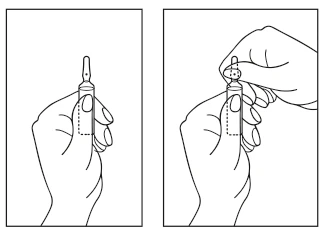
Instructions for opening the ampoule
- Turn the ampoule with the coloured dot upwards. If solution is present in the upper part of the ampoule, gently tap with a finger to move all solution to the lower part.
- Use both hands to open the ampoule; hold the lower part of the ampoule in one hand and snap off the top part in the direction away from the coloured dot (see image below).