Miostat
Poland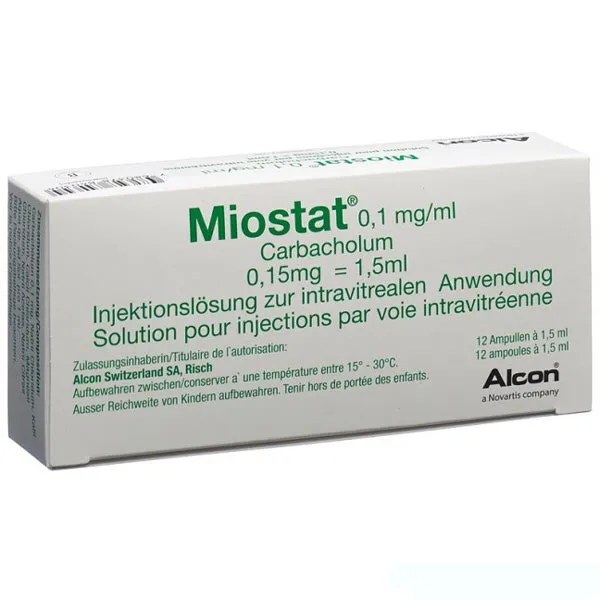
Table of Contents
Package leaflet: Information for the user
Miostat
0.1 mg/ml, solution for intracameral use
Carbacholi chloridum
Read this leaflet carefully before using this medicine because it contains important information for you.
- Keep this leaflet so that you can read it again if necessary.
- If you have any further questions, please consult your doctor or pharmacist.
- This medicine has been prescribed for a specific individual. Do not pass it on to others. The medicine may harm other people, even if their symptoms are the same.
- If you experience any adverse reactions, including any not listed in this leaflet, inform your doctor or pharmacist. See section 4.
Leaflet contents
- What Miostat is and what it is used for
- Important information before using Miostat
- How to use Miostat
- Possible side effects
- How to store Miostat
- Contents of the pack and other information
1. What Miostat is and what it is used for
Miostat is a medicine used by a doctor during intraocular surgery when immediate and complete constriction of the pupil is desired. Maximum pupillary constriction usually occurs within a few minutes after administration of the drug. Miostat is used only during eye surgical procedures.
2. Important information before using Miostat
When not to use Miostat
- if the patient is allergic to the active substance or to any of the other ingredients of this medicine (listed in section 6).
Warnings and precautions
Before starting treatment with Miostat, discuss this with your doctor. Exercise
special caution and inform your doctor if the patient has any of the following
conditions:
- Heart diseases
- Bronchial asthma
- Inability to pass urine or difficulties in passing urine
- Peptic ulcer (stomach ulcers)
- Thyroid dysfunction
- Excessive gastrointestinal motility
- Parkinson's disease
- Recent eye surgery. Use of Miostat may exacerbate inflammation.
- Iritis (acute or chronic inflammation of the coloured part of the eye).
Miostat and other medicines
Tell your doctor or pharmacist about all medicines the patient is currently taking or has recently taken, as well as any medicines the patient plans to take.
High doses of drugs such as Miostat (potent cholinergic agonists) may enhance
the effects of cardiac glycosides (such as digoxin) or alter the effects of certain muscle relaxants used during anaesthesia.
Pregnancy, breastfeeding and fertility
If the patient is pregnant or breastfeeding, suspects she may be pregnant, or is planning to have a
child, she should consult her doctor or pharmacist before using this medicine.
Driving and operating machinery
Miostat may cause blurred vision and light sensitivity. Do not drive or operate machinery until these symptoms have subsided.
The stopper of the vial contains natural rubber (latex)
The vial stopper contains natural rubber (latex). This may cause severe allergic reactions.
Miostat contains sodium and potassium
The medicine contains less than 1 mmol (23 mg) of sodium per 1.5 ml vial, meaning the medicine is considered "sodium-free".
The medicine contains less than 1 mmol (39 mg) of potassium per dose, meaning the medicine is considered "potassium-free".
3. How to use Miostat
Miostat must be administered before surgery only by a physician.
Approximately 0.5 ml of Miostat is injected into the anterior chamber of the eye during the surgical procedure.
The effect of Miostat may last up to 24 hours after the ophthalmic surgery.
Use of a higher than recommended dose of Miostat
If a higher than recommended dose of Miostat has been administered, it may be necessary for the physician to administer an anticholinergic drug to counteract the symptoms of overdose.
Such symptoms may include: headache, increased salivation, fainting, slow heartbeat, decreased blood pressure, abdominal cramps, vomiting, asthma, and diarrhea.
If you have any further questions about the use of this medicine, consult your doctor or pharmacist.
4. Possible adverse reactions
Like all medicines, this medicine can cause adverse reactions, although they do not occur in all patients.
The following adverse reactions have been observed with the use of Miostat:
Uncommon adverse reactions (may occur in 1 out of 100 patients)
- Nervous system disorders: headache
- Eye disorders: increased intraocular pressure.
Additionally, the following adverse reactions have been observed after the medicine was placed on the market,
for which the frequency cannot be estimated from available data:
- Eye disorders: visual disturbances, corneal disorders, corneal opacity, eye inflammation, corneal edema, decreased pupil size, blurred vision, eye pain, eye redness
- Gastrointestinal disorders: vomiting.
Additionally, the following adverse reactions may occur:
Eye disorders:
Rare: retinal detachment
Skin and subcutaneous tissue disorders:
Uncommon: excessive sweating
Renal and urinary disorders:
Uncommon: urinary urgency
Reporting of adverse reactions
If any adverse reactions occur, including any adverse reactions not listed
in this leaflet, inform your doctor, pharmacist, or nurse. Adverse reactions
can be reported directly to the Department of Monitoring Adverse Drug Reactions of the Office for Registration of Medicinal Products, Medical Devices and Biocidal Products: Al. Jerozolimskie 181C, 02-222 Warsaw, phone: +48 22 49-21-301, fax: +48 22 49-21-309,
website: https://smz.ezdrowie.gov.pl
Reporting adverse reactions helps to provide more information on the safety of the medicine.
5. How to store Miostat medication
Keep this medicine out of sight and reach of children.
Store below 30 °C.
Do not use this medicine after the expiry date stated on the carton and vial after: EXP.
The expiry date refers to the last day of the stated month.
Medicines must not be disposed of via wastewater or household waste. Ask your pharmacist how to dispose of medicines no longer required. Such measures help protect the environment.
6. Package contents and other information
What Miostat contains
The active substance is carbachol. 1 ml of solution contains 0.1 mg of carbachol (in the form of
carbachol chloride).
The other ingredients are: sodium chloride, potassium chloride, calcium chloride dihydrate, magnesium
chloride hexahydrate, sodium acetate trihydrate, sodium citrate dihydrate, sodium hydroxide
and (or) hydrochloric acid to adjust the appropriate pH, water for injections.
What Miostat looks like and contents of the pack
Miostat is available as 1.5 ml of colourless, clear solution for intracameral use, contained in glass vials with a rubber stopper and aluminium seal, packed in PVC blisters.
Marketing Authorisation Holder and Manufacturer
Marketing Authorisation Holder:
Alcon Polska Sp. z o.o.
ul. Marynarska 15
02-674 Warsaw
Poland
Importer responsible for batch release:
Alcon Laboratories Belgium
Lichterveld 3
2870 Puurs-Sint-Amands
Belgium
For further information, please contact the local representative of the Marketing Authorisation Holder:
Alcon Polska Sp. z o.o.
ul. Marynarska 15
02-674 Warsaw
Poland
Tel.: +48 22 820 34 50