Memotropil
Poland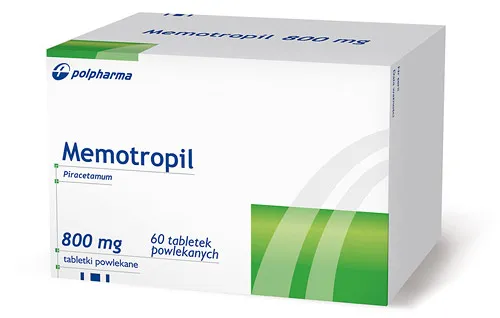
Table of Contents
Package leaflet: Information for the patient
Memotropil, 800 mg, coated tablets
Memotropil, 1200 mg, coated tablets
Piracetamum
Please read this leaflet carefully before taking this medicine, as it contains
important information for the patient.
- Keep this leaflet so that you can read it again if necessary.
- If you have any further questions, please consult your doctor or pharmacist.
- This medicine has been prescribed for a specific individual. Do not pass it on to others. It may harm other people, even if their symptoms are the same.
- If you experience any adverse reactions, including any not listed in this leaflet, inform your doctor or pharmacist. See section 4.
Leaflet contents
- What Memotropil is and what it is used for
- Important information before taking Memotropil
- How to take Memotropil
- Possible side effects
- How to store Memotropil
- Contents of the pack and other information
1. What Memotropil is and what it is used for
Memotropil contains the active substance piracetam, which belongs to a group of medicines known as psychostimulants.
Piracetam acts by influencing energy metabolism in the cells of the central nervous system (CNS), increasing oxygen and glucose utilization.
Memotropil is indicated for the treatment of:
- Dyslexic disorders in children, in combination with speech therapy;
- Cortical myoclonus (brief, sudden muscle jerks affecting one or more limbs or the trunk);
- Vertigo (sensation of spinning, loss of balance, feeling of collapsing, and fear of falling).
2. Important information before using Memotropil
When not to use Memotropil:
- if the patient is allergic to piracetam or any of the other ingredients of this medicine (listed in section 6);
- if the patient is allergic to peanuts or soy, because the medicine contains soy-derived lecithin;
- if the patient has severe renal insufficiency;
- in case of intracranial hemorrhage. The most common symptoms include severe headache, partial paralysis (e.g. facial muscles with speech disturbances), and vomiting;
- if the patient has Huntington's chorea – a progressive and incurable genetic neurological disorder characterized by irritability, depression, memory disturbances, and involuntary movements.
Warnings and precautions
Special caution is required when using Memotropil:
- in patients with impaired kidney function (the doctor may recommend lower doses of the medicine);
- in patients with severe bleeding, patients at risk of bleeding (such as those with gastrointestinal ulcers), patients with coagulation disorders, patients after cerebrovascular hemorrhage, patients undergoing major surgical procedures (including dental procedures), and patients taking anticoagulant medicines or platelet aggregation inhibitors (including acetylsalicylic acid used in low doses);
- in elderly patients.
Memotropil and other medicines
You should inform your doctor about all medicines currently used or recently used,
as well as any medicines you plan to use, especially:
- thyroid hormones;
- anticoagulant medicines such as acenocoumarol.
Pregnancy and breastfeeding
If the patient is pregnant or breastfeeding, suspects she may be pregnant, or is planning to become
pregnant, she should consult a doctor before using this medicine.
Pregnancy
Piracetam crosses the placental barrier.
Therefore, Memotropil should not be used during pregnancy unless there are clear medical indications and when the benefits of treatment outweigh the potential risks to the fetus, and the clinical condition of the pregnant patient requires therapy with piracetam.
Breastfeeding
Piracetam passes into breast milk.
Due to the risk of adverse effects in breastfed infants, breastfeeding should be discontinued during treatment with Memotropil.
Driving and operating machinery
Memotropil may cause drowsiness and tremor. If these occur, patients should not drive or operate any machinery.
Memotropil 800 mg, film-coated tablets contain sunset yellow (E 110) and quinoline yellow (E 104), and Memotropil 1200 mg, film-coated tablets contain sunset yellow (E 110)
The medicine may cause allergic reactions.
Sodium
Memotropil 800 mg, film-coated tablets
The medicine contains 1.68 mg of sodium (main component of table salt) in each film-coated tablet.
This corresponds to 0.084% of the maximum recommended daily dietary intake of sodium for adults.
In the maximum single dose of 12 g of piracetam (15 film-coated tablets), there is 25.2 mg of sodium. This corresponds to 1.26% of the maximum recommended daily dietary intake of sodium for adults.
Memotropil 1200 mg, film-coated tablets
The medicine contains 2.35 mg of sodium (main component of table salt) in each film-coated tablet.
This corresponds to 0.118% of the maximum recommended daily dietary intake of sodium for adults.
In the maximum single dose of 12 g of piracetam (10 film-coated tablets), there is 23.5 mg of sodium. This corresponds to 1.175% of the maximum recommended daily dietary intake of sodium for adults.
Memotropil 800 mg, film-coated tablets and Memotropil 1200 mg, film-coated tablets contain lecithin (soy-derived)
The medicine contains soy-derived lecithin. Do not use if hypersensitivity to peanuts or soy has been diagnosed.
3. How to use Memotropil
This medicine should always be used exactly as directed by your doctor or pharmacist. If in doubt,
consult your doctor or pharmacist.
Usual dosage:
Treatment of dyslexic disorders in combination with speech therapy
In combination with speech therapy in children from the age of 8 and adolescents, the usual dose is 3.2 g
of piracetam per day, administered in two divided doses.
Treatment of cortical myoclonus
Initially, 7.2 g of piracetam per day (in three divided doses) is administered.
If necessary, the dose may be increased every 3-4 days by 4.8 g of piracetam per day, up to a maximum
dose of 24 g per day. The daily dose should be given in 2 or 3 divided doses.
When used in combination with other anti-myoclonic medications, the doses of other drugs should be
maintained within their recommended therapeutic ranges. If clinical improvement is achieved and it is
feasible, the doses of other medications should be gradually reduced.
Piracetam treatment should be continued as long as the underlying brain disorder persists.
In patients experiencing acute episodes every 6 months, the doctor may attempt to reduce or discontinue
the medication. However, to prevent sudden recurrence of the disease or withdrawal-induced seizures,
the doctor may reduce the piracetam dose by 1.2 g every two to four days.
Treatment of dizziness
The recommended dose is 2.4 g to 4.8 g of piracetam per day, given in 2 or 3 divided doses.
Use in elderly patients
In elderly patients undergoing long-term treatment with piracetam, the doctor will individually adjust
the dosage.
Use in patients with impaired renal function
The daily dose will be individually determined by the doctor according to kidney function.
Use in patients with impaired liver function
Dosage adjustment is not necessary in patients with liver function impairment alone.
Use of a higher than recommended dose of Memotropil
If a higher than recommended dose of this medicine is taken, contact your doctor immediately or go
to the nearest hospital.
Piracetam has low toxicity. When very high doses are taken, adverse effects may become more pronounced.
Drug accumulation may occur in patients with renal insufficiency.
Missed dose of Memotropil
If a dose is missed, take it as soon as possible. If it is almost time for the next dose, do not take the
missed dose. Do not take a double dose to make up for a missed dose.
Stopping treatment with Memotropil
Do not stop taking this medicine without consulting your doctor. In patients with myoclonus, stopping
treatment may lead to recurrence of the disease or seizures.
If you have any further questions about the use of this medicine, consult your doctor or pharmacist.
4. Possible adverse reactions
Like all medicines, this medicine can cause adverse reactions, although not everyone will experience them.
Common adverse reactions (in less than 1 in 10 patients)
- Increased motor activity (hyperkinesia)
- Weight gain
- Nervousness
Uncommon adverse reactions (in less than 1 in 100 patients)
- Drowsiness
- Depression
- Weakness (asthenia)
Adverse reactions with unknown frequency (cannot be estimated from available data)
- Dizziness
- Bleeding disorders
- Nausea, vomiting, diarrhoea, abdominal pain, epigastric pain
- Anaphylactoid (allergic) reactions, hypersensitivity. Immediately inform your doctor if symptoms such as skin redness, swelling, urticaria, shortness of breath, laryngeal oedema, or breathing difficulties occur.
- Impaired body movement coordination (ataxia), balance disorders, exacerbation of epilepsy, headache, insomnia
- Stimulation, anxiety, confusion (disorientation), hallucinations
- Angioedema, dermatitis, pruritus, urticaria
Reporting of adverse reactions
If any adverse reactions occur, including any adverse reactions not listed in this leaflet, inform your doctor or pharmacist. Adverse reactions can be reported directly to the Department of Monitoring of Adverse Drug Reactions at the Office for Registration of Medicinal Products, Medical Devices and Biocidal Products
Al. Jerozolimskie 181C
02-222 Warsaw
Tel.: + 48 22 49 21 301
Fax: + 48 22 49 21 309
Website: https://smz.ezdrowie.gov.pl
Adverse reactions may also be reported to the marketing authorisation holder.
Reporting adverse reactions helps provide more information on the safety of the medicine.
5. How to store Memotropil
Do not store above 25°C. Keep in the original packaging to protect from light and moisture.
Keep the medicine out of the sight and reach of children.
Do not use this medicine after the expiry date stated on the carton and blister. The expiry date refers to the last day of the stated month. The marking on the packaging following "EXP" indicates the expiry date, and following "Lot/LOT" indicates the batch number.
Medicines must not be disposed of via wastewater or household waste. Ask your pharmacist how to dispose of medicines no longer required. This will help protect the environment.
6. Contents of the pack and other information
What Memotropil contains
- The active substance is piracetam. Each coated tablet contains either 800 mg or 1200 mg of piracetam.
- The other ingredients are: tablet core: potato starch, microcrystalline cellulose, sodium carboxymethyl starch (type C), colloidal anhydrous silica, magnesium stearate; tablet coating: Memotropil 800 mg: (Opadry II Yellow 85G38109) containing: polyvinyl alcohol, talc, titanium dioxide (E 171), macrogol 4000, lecithin (soy-derived), carmoisine lake (E 110), quinoline yellow lake (E 104). Memotropil 1200 mg: (Opadry II Orange 85G33228) containing: polyvinyl alcohol, talc, titanium dioxide (E 171), macrogol 4000, lecithin (soy-derived), carmoisine lake (E 110), indigo carmine lake (E 132).
What Memotropil looks like and contents of the pack
The tablets are bean-shaped, biconvex, with a dividing line and slightly rough surface. The tablet can be divided into equal doses.
The 800 mg tablets are yellow in colour, and the 1200 mg tablets are orange in colour.
Pack contents:
20 or 60 coated tablets in a cardboard box.
Not all pack sizes may be marketed.
Marketing Authorisation Holder and Manufacturer
Zakłady Farmaceutyczne POLPHARMA S.A.
ul. Pelplińska 19, 83-200 Starogard Gdański
tel. + 48 22 364 61 01