Leuprostin
PolandTable of Contents
Package leaflet: Information for the patient
Leuprostin, 5 mg, implant
Leuprorelinum
Please read all of this leaflet carefully before using this medicine, because it contains
important information for the patient.
Keep this leaflet, as you may need to read it again.
If you have any further questions, please ask your doctor, pharmacist, or nurse.
This medicine has been prescribed for a specific individual. Do not pass it on to others.
It may harm someone else, even if their symptoms are the same.
If you experience any adverse reactions, including any not listed in this leaflet, inform your doctor,
pharmacist, or nurse. See section 4.
Leaflet contents:
- What Leuprostin is and what it is used for
- Important information before using Leuprostin
- How to use Leuprostin
- Possible side effects
- How to store Leuprostin
- Contents of the pack and other information
1. What Leuprostin is and what it is used for
The active substance in Leuprostin (leuprorelin acetate) belongs to a group of drugs known as inhibitors of certain sex hormones.
Leuprostin acts on the pituitary gland, initially stimulating and then suppressing the production of hormones that regulate the formation of male sex hormones in the testes.
This results in a reduction of sex hormone levels, which remain at a low level during treatment. After discontinuation of Leuprostin, hormone levels secreted by the pituitary gland and sex hormone levels return to normal.
Leuprostin is used for symptomatic treatment of advanced hormone-dependent prostate cancer.
Leuprostin is also used in the treatment of locally advanced prostate cancer and cancer confined to the prostate gland, both hormone-dependent, during or after radiotherapy.
2. Information before using Leuprostin
When not to use Leuprostin
if the patient is allergic to leuprorelin or to any of the other ingredients of this medicine
(listed in section 6);
if the patient is allergic to substances similar to leuprorelin, such as goserelin or
buserelin;
if the patient has been diagnosed with cancer that is not hormone-dependent;
in women and children.
Warnings and precautions
Before starting treatment with Leuprostin, discuss the following with your doctor or nurse:
if the patient has high blood pressure. In such a case, the doctor will carefully monitor the patient's condition.
if the patient has undergone surgical removal of both testicles. In this case, Leuprostin will not further reduce the level of male sex hormone in the blood.
if the patient already has neurological symptoms (spinal cord compression, spinal metastases) or experiences discomfort during urination due to urinary tract changes before starting treatment. The patient should immediately inform the doctor, who will closely monitor the patient's condition during the first weeks of treatment, preferably in a hospital setting.
if disease symptoms recur (i.e. pain, difficulty urinating, or leg muscle weakness) during long-term treatment with Leuprostin. In such a case, the doctor will regularly assess treatment effectiveness by performing appropriate tests (digital rectal examination of the prostate gland, imaging tests) and monitoring blood markers (phosphatase activity, prostate-specific antigen (PSA) levels, and male sex hormone (testosterone) concentration).
if the patient is at risk of developing osteoporosis. If possible, the doctor may recommend additional treatment to prevent bone mass loss.
if the patient has diabetes. In such a case, the doctor will monitor the patient's condition very carefully.
if the patient has fatty liver disease (a condition in which excess fat accumulates in the liver).
If the patient experiences severe or recurring headaches, vision problems, or ringing or buzzing in the ears, medical advice should be sought immediately.
Cases of depression (which may be severe) have been reported in patients receiving Leuprostin. If depressive mood occurs during treatment with Leuprostin, the patient should inform the doctor.
Inform the doctor about any heart or blood vessel disorders, including heart rhythm disturbances (arrhythmias), or if the patient is taking medications for such conditions. The use of Leuprostin may increase the risk of heart rhythm disturbances.
Serious skin reactions, including Stevens-Johnson syndrome and toxic epidermal necrolysis (SJS/TEN), have been reported with the use of leuprorelin. If any symptoms of severe skin reactions described in section 4 occur, treatment with leuprorelin should be discontinued immediately and the patient should contact a doctor without delay.
Leuprostin and other medicines
Tell your doctor, pharmacist, or nurse about all medicines the patient is currently taking or has recently taken, as well as any medicines the patient plans to take.
Leuprostin may interact with certain medicines used to treat heart rhythm disorders (such as quinidine, procainamide, amiodarone, and sotalol) or may increase the risk of heart rhythm disturbances when used concomitantly with certain other medicines [e.g. methadone (used as a painkiller and in drug detoxification programs), moxifloxacin (an antibiotic), antipsychotic medicines (used to treat severe psychiatric disorders)].
Children and adolescents
Leuprostin is intended only for adult patients.
Pregnancy and breastfeeding
Leuprostin is intended only for use in men.
Driving and operating machinery
Both the medicine and the underlying tumour disease may cause tiredness. This is more likely if alcohol is consumed at the same time. If this applies to the patient, he should not drive or operate machinery without the doctor's approval.
3. How to use Leuprostin
Administration of Leuprostin
The injection site should be cleaned.
A local anaesthetic may be used to reduce pain during implant injection.
Leuprostin is administered as a subcutaneous injection into the patient's abdominal area.
Leuprostin must be administered only by a physician or nurse, who will also prepare the medication.
Dosage
The recommended dose is 1 implant containing 5 mg of leuprorelin, administered every 3 months.
You must strictly follow your doctor's instructions regarding the timing of doses and intervals between consecutive implant injections.
Leuprostin is administered every 3 months. If, in exceptional cases, the next injection is delayed by up to 4 weeks, treatment efficacy usually remains unchanged.
The implant is delivered via a single pre-filled syringe-cartridge.
Each syringe-cartridge contains one implant with 5 mg of leuprorelin.
Blood tests
Your doctor will order regular blood tests to monitor the effectiveness of the treatment.
After 3 months of therapy, your doctor will usually assess whether Leuprostin is effective in treating prostate cancer. For this purpose, the levels of prostate-specific antigen (PSA) and testosterone must be measured.
Duration of treatment
The duration of treatment is determined by the doctor. Treatment should be continued even if symptoms have improved or the disease has regressed.
Prostate cancer may be treated with Leuprostin for several years. Therefore, continuous administration is possible if the drug remains effective and is well tolerated by the patient. The doctor will periodically order tests to evaluate treatment efficacy, especially in case of recurrence, such as:
- pain
- difficulty urinating
- leg muscle weakness.
More frequent administration of Leuprostin than recommended
It is unlikely that a physician or nurse would administer an excessive dose.
In case of accidental overdose, the doctor will monitor the patient and, if necessary, initiate appropriate treatment.
Missed dose of Leuprostin
If the patient suspects that the dose has not been administered after 3 months, they should consult their doctor.
Discontinuation of Leuprostin treatment
If treatment is stopped without medical advice, disease-related symptoms may worsen.
Therefore, treatment should not be discontinued prematurely without the doctor's consent.
If you have any further questions about the use of this medicine, consult your doctor, pharmacist, or nurse.
4. Possible adverse reactions
Like all medicines, this medicine can cause adverse reactions, although they do not occur in everyone.
If the patient experiences any of the following serious adverse reactions, immediate medical attention
should be sought from a doctor or at the nearest hospital emergency department:
Allergic reactions (anaphylactic reactions) with sudden onset of symptoms such as:
- hot flushes, rash, itching or hives on the skin and/or mucous membranes
- swelling of the face, lips, tongue or other parts of the body
- shortness of breath, wheezing or difficulty breathing
- decreased blood pressure, rapid heartbeat, seizures, and in the most severe cases, life-threatening circulatory failure.
Swelling and pain in certain parts of the body caused by the formation of a blood clot in a vein.
Difficulty breathing, chest pain, fainting, rapid heartbeat, bluish skin tone and skin discoloration due to the presence of a blood clot in the lungs.
These are rare adverse reactions (may occur in fewer than 1 in 1,000 people).
It is common for there to be an initial, transient increase in the blood concentration of the male sex hormone (testosterone). This may cause a temporary worsening of symptoms related to the disease, such as:
onset or worsening of bone pain
difficulty urinating due to narrowing of the urinary tract
pressure on the spinal cord
leg muscle weakness
tissue swelling due to fluid retention (lymphatic), so-called lymphoedema
Worsening of these symptoms usually resolves spontaneously without the need to discontinue Leuprostin treatment.
At the beginning of treatment, the doctor may prescribe an appropriate sex hormone antagonist (so-called antiandrogen) to alleviate possible disturbances associated with the initial rise in testosterone levels.
During treatment, testosterone levels decrease to very low values. As a result, the following adverse reactions may occur in some patients:
Very common (may affect more than 1 in 10 people):
hot flushes
increased sweating
bone pain
decreased or loss of libido and potency
reduction in testicle size
increased body weight
injection site reactions such as redness or induration, pain, swelling and itching, which usually resolve even if treatment continues; in isolated cases, ulceration
Common (may affect fewer than 1 in 10 people):
breast enlargement in men
decreased appetite
increased appetite
depression, mood changes
sleep disturbances
headache
abnormal sensations, e.g. tingling and/or numbness
nausea and/or vomiting
joint or back pain
reduced muscle strength
increased need to urinate at night
frequent need to urinate during the day
difficult or painful urination
feeling of fatigue
swelling of ankles, feet or fingers (peripheral oedema)
decreased body weight
increased activity of liver enzymes (AlAT, AspAT, gamma-GT) and other enzymes (LDH, alkaline phosphatase)
Uncommon (may affect fewer than 1 in 100 people):
generalized allergic reactions such as fever, itching, increased number of eosinophilic granulocytes, skin rash
diarrhoea
dryness of the skin or mucous membranes
testicular pain
inability to completely empty the bladder
excessive night sweating
Rare (may affect fewer than 1 in 1,000 people):
decreased or increased blood glucose levels
dizziness
transient taste disturbances
decreased or increased blood pressure
hair loss
Very rare (may affect fewer than 1 in 10,000 people):
pituitary apoplexy after the first dose in patients with pituitary adenoma (as with other drugs in this group)
Frequency not known (frequency cannot be estimated from available data):
non-inflammatory lung disease (interstitial lung disease), reported mainly in Japan
pneumonia, lung disease
isolated cases of ulceration at the injection site
changes in ECG (prolongation of QT interval)
seizures
idiopathic intracranial hypertension (increased intracranial pressure around the brain, characterized by headache, double vision and other visual disturbances, and ringing or buzzing in one or both ears)
red, flat, target-shaped or round spots on the trunk, often with blisters in the center, skin peeling, oral, pharyngeal, nasal, genital or ocular mucosal ulceration.
These severe skin rashes may be preceded by fever and influenza-like symptoms (Stevens-Johnson syndrome, toxic epidermal necrolysis).
redness of the skin and itchy rash (toxic skin eruptions)
skin reaction causing red spots or patches on the skin, which may resemble a bull's-eye with a dark red center surrounded by lighter red rings (erythema multiforme).
Special information
The effectiveness of Leuprostin can be monitored by measuring blood levels of testosterone and prostate-specific antigen (PSA), as well as acid phosphatase activity. Testosterone levels increase at the beginning of treatment and decrease within the next 2 weeks. Within 2 to 4 weeks, testosterone levels reach values observed in patients after bilateral orchidectomy and remain at this level throughout the treatment period.
Transient increase in blood acid phosphatase activity may occur at the beginning of treatment. After several weeks, activity returns to normal or near-normal values.
Reduced testosterone levels, whether after orchidectomy or due to treatment with sex hormone inhibitors (such as Leuprostin), may lead to decreased bone density with an increased risk of fractures (see "Warnings and precautions").
Bone density reduction is more pronounced after orchidectomy than after Leuprostin administration. The doctor may recommend taking an additional drug that regulates calcium metabolism (from the group of so-called bisphosphonates).
Reporting of adverse reactions
If any adverse effects occur, including any not listed in this leaflet, inform your doctor, pharmacist or nurse. Adverse reactions can be reported directly to the Department of Monitoring Adverse Drug Reactions, Office for Registration of Medicinal Products, Medical Devices and Biocidal Products: Al. Jerozolimskie 181C, 02-222 Warsaw
tel.: + 48 22 49 21 301, fax: + 48 22 49 21 309, website: https://smz.ezdrowie.gov.pl
Adverse reactions can also be reported to the marketing authorization holder.
Reporting adverse reactions helps to provide more information on the safety of the medicine.
5. How to store Leuprostin
This medicine should be stored out of sight and reach of children.
Do not use this medicine after the expiry date stated on the carton, sterile pouch and syringe label after EXP. The expiry date refers to the last day of the stated month.
Do not store above 30°C.
Medicines must not be disposed of via wastewater or household waste. Ask your pharmacist how to dispose of medicines no longer required. These measures will help protect the environment.
6. Contents of the pack and other information
What Leuprostin contains
The active substance is leuprorelin (in the form of leuprorelin acetate).
Each implant contains 5 mg of leuprorelin (in the form of leuprorelin acetate).
The other ingredient is: polylactic acid.
What Leuprostin looks like and contents of the pack
A pre-filled syringe made of polycarbonate (PC) with a plunger made of acrylonitrile-butadiene-styrene (ABS) copolymer, and a needle, placed in a pouch made of PET/Aluminium/PE film, packed in a cardboard box.
Pack sizes contain:
1 pre-filled syringe with 1 implant
2 pre-filled syringes, each with 1 implant
3 pre-filled syringes, each with 1 implant
Marketing Authorisation Holder and Manufacturer
Marketing Authorisation Holder
Sandoz GmbH
Biochemiestrasse 10
6250 Kundl, Austria
Manufacturers
EVER Pharma Jena GmbH
Otto-Schott-Strasse 15
07745 Jena, Germany
Sandoz GmbH
Biochemiestrasse 10
6250 Kundl, Austria
EVER Pharma Jena GmbH
Brüsseler Strasse 18
07747 Jena, Germany
Lek Pharmaceuticals d.d.
Verovškova ulica 57
Ljubljana 1526
Slovenia
This medicinal product is authorised in the Member States of the European Economic Area under the following names:
Austria: Leuprorelin Sandoz 5 mg - Implantat für 3 Monate
Denmark: Leuprorelin „Sandoz“
Germany: Leuprorelin HEXAL 5 mg
Greece: PROSTAPLANT 5 mg εμφύτευμα
Hungary: Leuprorelin -Sandoz 5mg implantátum
Ireland: Leuprex 3, 5 mg Implant
Italy: LEPTOPROL
Norway: Leuprorelin Sandoz 5 mg implantat
Poland: Leuprostin
Sweden: Leuprorelin Sandoz 5 mg implantat
Slovakia: Leuprorelin Sandoz 5 mg implantát
To obtain further information about this medicinal product, please contact:
Sandoz Polska Sp. z o.o.
ul. Domaniewska 50 C
02-672 Warszawa
tel. 22 209 70 00
Information intended exclusively for medical professionals
Please read the instructions carefully, as the applicator of this medicinal product may differ from
those previously used.
Instructions for use
- Disinfect the injection site located on the anterior abdominal wall below the umbilical line.
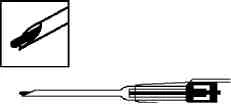
- Remove the applicator from its sterile packaging and check whether the implant is visible inside (see figure in the box). To confirm, hold the applicator up to the light or gently shake it.
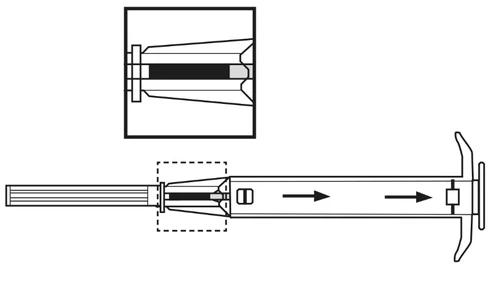
- Pull the plunger of the applicator fully backward until the complete line appears in the second window.
Warning: The plunger can be moved forward to inject the implant only if it has previously been fully pulled back!
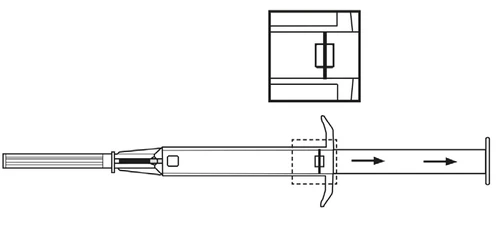
- Remove the protective needle cap.
- Hold the applicator body in one hand. With the other hand, pinch the skin of the patient's anterior abdominal wall below the umbilical line. See figure. While holding the bevel of the needle angled upward, insert the entire needle subcutaneously at a slight angle, almost parallel to the skin surface.
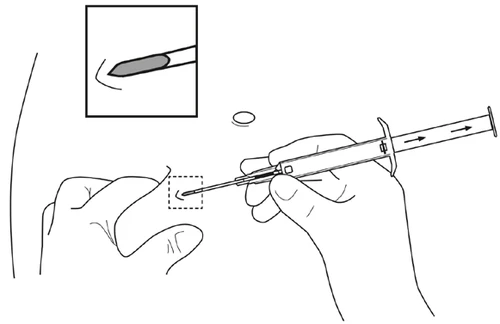
- Carefully withdraw the applicator approximately 1 cm backward to create a puncture channel for the implant.
- Inject the implant into the puncture channel by completely pressing the plunger until it clicks audibly into place.
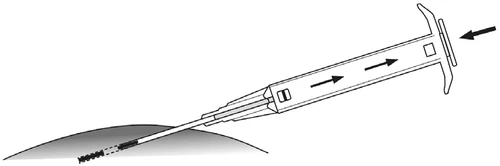
- Remove the needle. To confirm that the implant has been correctly administered, check whether the light-blue plunger tip is visible at the needle's end.
Dosage instructions are provided in section 3 „How to use Leuprostin”.