Lacipil
Poland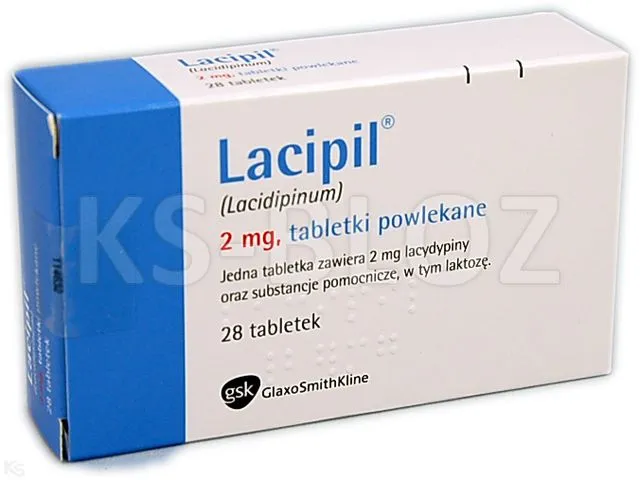
Table of Contents
Package leaflet: information for the patient
Lacipil, 2 mg, film-coated tablets
Lacipil, 4 mg, film-coated tablets
Lacipil, 6 mg, film-coated tablets
Lacidipine
Please read carefully all the information in this leaflet before taking the medicine, as it contains
important information for the patient.
- Keep this leaflet, as you may need to read it again.
- If you have any doubts, please consult your doctor or pharmacist.
- This medicine has been prescribed for a specific individual. Do not share it with others. The medicine may harm another person, even if their symptoms are similar.
- If you experience any adverse reactions, including those not listed in this leaflet, inform your doctor or pharmacist. See section 4.
Leaflet contents:
- What Lacipil is and what it is used for
- Important information before taking Lacipil
- How to take Lacipil
- Possible side effects
- How to store Lacipil
- Contents of the pack and other information
1. What Lacipil is and what it is used for
Lacipil contains lacidipine, which is a specific, potent calcium antagonist from the dihydropyridine derivative group. Lacidipine acts almost exclusively on vascular smooth muscle. By dilating peripheral arterioles, it reduces peripheral resistance and consequently lowers arterial blood pressure.
Lacipil is indicated for the treatment of hypertension. It may be used as monotherapy (as the only antihypertensive agent) or in combination with other antihypertensive drugs such as beta-blockers, diuretics, or angiotensin-converting enzyme (ACE) inhibitors.
2. Important information before taking Lacipil
When not to use Lacipil:
- if you are allergic to lacidipine or to any of the other ingredients of this medicine (listed in section 6).
- like other dihydropyridine derivatives, lacidipine is contraindicated in patients with severe aortic stenosis.
Warnings and precautions:
Specialist studies have not demonstrated any effect of Lacipil on sinus node function or on prolongation of atrioventricular nodal conduction. However, as with other calcium antagonists, there is a theoretical possibility of an effect on sinus node and atrioventricular node function. Therefore, caution should be exercised when using Lacipil in patients with previously diagnosed disorders of automaticity or conduction.
As with other dihydropyridine-derived calcium antagonists, caution should be exercised when using lacidipine in patients with congenital or documented acquired QT interval prolongation. Caution is also advised when using lacidipine in patients concurrently treated with drugs that prolong the QT interval, such as class I and III antiarrhythmic agents, tricyclic antidepressants, certain antipsychotics, antibacterial agents (e.g. erythromycin), and certain antihistamines (e.g. terfenadine).
As with other calcium antagonists, Lacipil should be used cautiously in patients with borderline cardiac function.
Similarly, as with other dihydropyridine-derived calcium antagonists, Lacipil should be used cautiously in patients with previously diagnosed unstable angina, as well as in patients who develop unstable angina during treatment.
Caution should be exercised when using Lacipil in patients after recent myocardial infarction.
There is no evidence that Lacipil is effective in preventing recurrent myocardial infarction.
The efficacy and safety of Lacipil in the treatment of the most severe form of hypertension (so-called malignant hypertension) have not been established.
The medicine should be used with caution in patients with impaired liver function due to the possibility of enhanced blood pressure-lowering effect.
Children and adolescents
There is no experience with the use of Lacipil in children.
Lacipil and other medicines
Inform your doctor or pharmacist about all medicines you are currently taking or have recently taken, as well as any medicines you plan to take. This includes medicines available without a prescription.
Concomitant use of Lacipil with other antihypertensive drugs, including those used in the treatment of hypertension (e.g. beta-blockers, diuretics, or ACE inhibitors), may enhance the hypotensive effect. No specific interactions have been observed with commonly used antihypertensive agents (e.g. beta-blockers, diuretics), digoxin, tolbutamide, or warfarin.
Plasma concentrations of lacidipine may be increased when cimetidine is administered concomitantly.
Lacidipine is highly bound to plasma proteins (over 95%)—mainly to albumin and alpha-1-glycoprotein.
In clinical studies involving kidney transplant patients treated with cyclosporine, lacidipine was found to normalize the reduced glomerular filtration rate and decreased renal blood flow caused by cyclosporine administration.
Lacidipine is metabolized by CYP3A4, and therefore drugs that are strong inhibitors (e.g. itraconazole) or inducers (e.g. rifampicin) of CYP3A4, when used concomitantly with lacidipine, may affect its metabolism and elimination.
Concomitant use of lacidipine with corticosteroids or tetracosactide may reduce its hypotensive effect.
Lacipil with food and drink
The medicine can be taken independently of meals.
Do not drink grapefruit juice during treatment with Lacipil.
Pregnancy, breastfeeding, and fertility
There are no adequate studies on the safety of Lacipil use during pregnancy in humans. Animal studies have not shown teratogenic effects or harmful effects on fetal development.
Lacipil may be used during pregnancy only if, in the opinion of the physician, the expected benefit to the mother outweighs the potential risk to the fetus or child.
Lacipil may reduce uterine contractility during labor.
Lacipil may be used during breastfeeding only if, in the opinion of the physician, the expected benefit to the mother outweighs the potential risk to the infant.
If you are pregnant, breastfeeding, think you may be pregnant, or are planning to have a child, consult your doctor or pharmacist before taking this medicine.
There are no data on the effect of Lacipil on fertility in humans.
Driving and operating machinery
Due to lack of adequate data, it is unknown whether the medicine affects the ability to drive or operate machinery.
If adverse reactions such as dizziness occur, consult your doctor.
Lacipil contains lactose.
If you have been previously diagnosed with intolerance to certain sugars, consult your doctor before taking this medicine.
3. How to use Lacipil
This medicine should always be used as directed by the physician. In case of doubt, consult
your doctor or pharmacist.
The initial dose is 2 mg once daily, taken at the same time each day, preferably in the morning,
and it does not need to be taken in relation to meals.
Depending on the severity of the disease and the individual patient's response to treatment, the doctor
may increase the dose to 4 mg, and if necessary, up to 6 mg daily.
Dose escalation may occur after an interval sufficient to achieve the full pharmacological effect.
In practice, this period should not be shorter than 3–4 weeks, unless the patient's clinical condition
requires a more rapid dose increase.
There are no limitations regarding the duration of treatment with this medicine.
Use of Lacipil in patients with renal and/or hepatic impairment:
Dosage adjustment is not required in patients with impaired renal and/or hepatic function.
Use of Lacipil in elderly patients (over 65 years of age):
Dosage adjustment is not required in elderly patients.
Taking more than the recommended dose of Lacipil
Cases of overdose with Lacipil have not been reported to date.
Symptoms:
The most likely consequence of overdose is prolonged peripheral vasodilation, leading to sustained
arterial hypotension and tachycardia.
Atrioventricular block or prolonged atrioventricular conduction time may also occur.
Management:
In case of ingestion of more than the recommended dose, seek immediate medical advice from a
doctor or go to the emergency department of the nearest hospital.
There is no specific antidote. In the event of overdose, symptomatic treatment and close monitoring
of cardiac function are recommended.
4. Possible adverse reactions
Like all medicines, this medicine can cause adverse reactions, although not everyone will experience them.
The frequencies of adverse reactions reported as common, uncommon, and rare were determined
based on data from large clinical trials (both internal and published).
Lacipil is generally well tolerated. Some individuals may experience certain mild symptoms related to peripheral vasodilation. These symptoms, marked with the symbol #, are usually transient and diminish during continued treatment with the same dose of Lacipil.
Common adverse reactions (may occur in 1 to 10 out of 100 patients):
- headache, dizziness,
- palpitations, very rapid heart rate (tachycardia),
- sudden flushing (especially of the face),
- nausea, dyspeptic symptoms,
- rash (including erythema and skin itching),
- polyuria,
- weakness, edema,
- transient increase in alkaline phosphatase activity (clinically significant increase occurs uncommonly).
Uncommon adverse reactions (may occur in 1 to 10 out of 1,000 patients):
- worsening of existing angina pectoris – as with other dihydropyridine derivatives, worsening of pre-existing angina has been observed in isolated cases, particularly at the beginning of treatment. The likelihood of this reaction is higher in patients with symptomatic ischemic heart disease,
- syncope, hypotension,
- gingival hyperplasia.
Rare adverse reactions (may occur in 1 to 10 out of 10,000 patients):
- angioedema, urticaria.
Very rare adverse reactions (may occur in fewer than 1 out of 10,000 patients):
- tremor,
- depression.
Reporting of adverse reactions
If any adverse reactions occur, including any not listed in this leaflet, inform your doctor or pharmacist. Adverse reactions can be reported directly to the Department of Monitoring Adverse Drug Reactions of the Office for Registration of Medicinal Products, Medical Devices and Biocidal Products, Al. Jerozolimskie 181C, 02-222 Warsaw, tel.: +48 22 49-21-301, fax: +48 22 49-21-309, e-mail: [email protected]
Reporting adverse reactions helps to provide more information on the safety of the medicine.
5. How to store Lacipil
Keep this medicine out of sight and reach of children.
Store below 30°C.
Protect tablets from light and remove them from the blister pack immediately before use. If
the recommended dose is 2 mg of Lacipil, i.e. half a 4 mg tablet, the unused half must be left in the blister pack and taken within 48 hours.
Do not use this medicine after the expiry date stated on the packaging.
Medicines must not be disposed of via wastewater or household waste. Ask your pharmacist how to dispose of medicines no longer required. These measures help protect the environment.
6. Contents of the package and other information
What Lacipil contains
The active substance is lacidipine.
Each coated tablet contains 2 mg, 4 mg or 6 mg of lacidipine.
The other ingredients are: monohydrate lactose, povidone K30, magnesium stearate.
Film-coating composition:
Lacipil 2 mg and 4 mg: Opadry White YS-1-18043 (hypromellose, titanium dioxide (E171), PEG 400, polysorbate 80) or Opadry White OY-S-7335 (hypromellose, titanium dioxide (E171)).
Lacipil 6 mg: Opadry White YS-1-18043 (hypromellose, titanium dioxide (E171), PEG 400, polysorbate 80).
What Lacipil looks like and contents of the pack
Lacipil 2 mg: round, white coated tablets, embossed with the number "2".
Lacipil 4 mg: white, oval coated tablets. The tablet may be embossed with the code "GS" on one side and "3MS" on the other. The tablets can be divided into two equal doses.
Lacipil 6 mg: white, oval, biconvex coated tablets, embossed with the code "GX CX3".
Pack contents:
Lacipil 2 mg – 28 coated tablets in blisters, in a cardboard box.
Lacipil 4 mg – 28 coated tablets in blisters, in a cardboard box.
Lacipil 6 mg – 14 or 28 coated tablets in blisters, in a cardboard box.
Marketing Authorisation Holder and Manufacturer
Marketing Authorisation Holder: Manufacturer:
GlaxoSmithKline Trading Services Limited Delpharm Spółka Akcyjna
12 Riverwalk Grunwaldzka 189
Citywest Business Campus 60-322 Poznań
Dublin 24 {tablets 2 mg, 4 mg}
D24 YK11
Ireland or
Glaxo Wellcome S.A.
Avenida de Extremadura 3
09400 Aranda de Duero
Burgos, Spain
{tablets 2 mg, 4 mg, 6 mg}
For further information, please contact the representative of the Marketing Authorisation Holder.
GSK Services Sp. z o.o.
Warsaw Office
Rzymowskiego 53
02-697 Warsaw
Tel: +48 22 576 9000
(GSK logo)