Ibuprom zatoki
Poland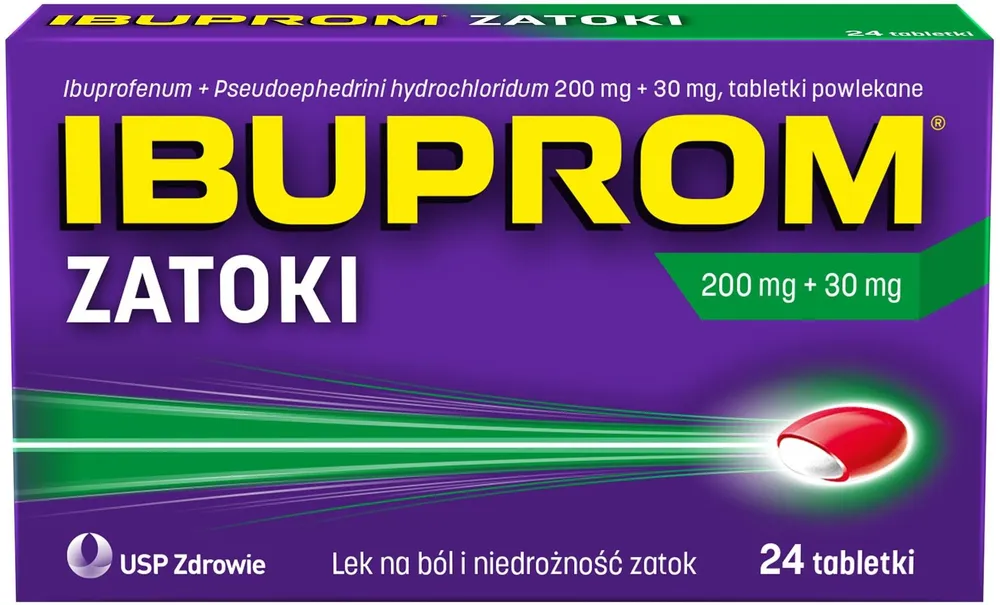
Table of Contents
Package leaflet: Information for the user
IBUPROM ZATOKI
200 mg + 30 mg, film-coated tablets
(Ibuprofenum + Pseudoephedrini hydrochloridum)
Please read all of this leaflet carefully before taking this medicine, because it contains
important information for you.
This medicine should always be used exactly as described in this patient leaflet or as directed
by your doctor or pharmacist.
- Keep this leaflet, so that you can read it again if necessary.
- If you need advice or further information, please consult your pharmacist.
- If you experience any adverse reactions, including any possible adverse reactions not listed in this leaflet, tell your doctor or pharmacist. See section 4.
- If there is no improvement or if you feel worse after 3 days, you should contact your doctor.
Contents of the leaflet
- What Ibuprom Zatoki is and what it is used for
- Important information before taking Ibuprom Zatoki
- How to take Ibuprom Zatoki
- Possible side effects
- How to store Ibuprom Zatoki
- Contents of the package and other information
1. What Ibuprom Zatoki is and what it is used for
Ibuprom Zatoki is a medicine intended for short-term use to relieve symptoms associated with
the common cold and influenza, such as: headache, pain and nasal congestion due to sinusitis,
runny nose, fever, sore throat, and muscle aches.
Short-term treatment of symptoms of sinusitis, such as headache, nasal and sinus congestion
with pain, resulting from complications of the common cold, influenza, or allergic rhinitis.
2. Important information before using Ibuprom Zatoki
When not to use Ibuprom Zatoki:
- if the patient is allergic to the active substances or any of the other ingredients of this medicine (listed in section 6) or to other non-steroidal anti-inflammatory drugs (NSAIDs);
- if, after taking acetylsalicylic acid or other NSAIDs, the patient has ever previously experienced allergic reactions such as rhinitis, urticaria or bronchial asthma;
- in patients with active or past history of gastric or duodenal ulcer, perforation or bleeding, including cases occurring after use of NSAIDs;
- in patients with severe liver failure or severe heart failure;
- in patients taking other non-steroidal anti-inflammatory drugs simultaneously, including COX-2 inhibitors (increased risk of adverse effects);
- during pregnancy and breastfeeding;
- in patients with bleeding disorders;
- in patients with severe cardiovascular disorders, tachycardia, or angina pectoris;
- if the patient has very high blood pressure (severe hypertension) or uncontrolled hypertension despite medication;
- if the patient has severe acute (sudden) or chronic (long-term) kidney disease or renal failure;
- in patients with hyperthyroidism;
- in patients with diabetes;
- in patients with closed-angle glaucoma;
- in patients with benign prostatic hyperplasia;
- in patients with pheochromocytoma.
Warnings and precautions
Exercise special caution when using the medicine:
- if the patient has systemic lupus erythematosus or mixed connective tissue disease;
- if allergic reactions occurred after taking acetylsalicylic acid;
- if the patient has gastrointestinal disorders or chronic inflammatory bowel diseases (ulcerative colitis, Leśniowski-Crohn disease);
- if the patient has hypertension and/or heart function disorders;
- if the patient has kidney function disorders;
- if the patient has liver function disorders;
- if the patient has blood coagulation disorders;
- if the patient has a history of bronchial asthma or allergic reactions; bronchospasm may occur after taking the medicine;
- if the patient is taking other medicines (especially anticoagulants, diuretics, cardiac drugs, corticosteroids).
There is a risk of gastrointestinal bleeding, ulceration or perforation, which may be fatal and which may occur without warning symptoms or in patients who have previously experienced such warning signs. If gastrointestinal bleeding or ulceration occurs, discontinue the medicine immediately.
Patients with a history of gastrointestinal disorders, especially elderly individuals, should inform their doctor of any unusual gastrointestinal symptoms (particularly bleeding), especially during the initial period of therapy.
If fever with generalized skin redness and blistering rash develops, stop taking Ibuprom Zatoki immediately and contact a doctor or seek immediate medical help. See section 4.
Long-term, simultaneous use of various painkillers may lead to kidney damage with risk of renal failure (analgesic nephropathy).
Exercise caution in dehydrated patients (children and adolescents) due to increased risk of kidney function impairment.
Use of anti-inflammatory/pain-relieving medicines such as ibuprofen may be associated with a small increased risk of myocardial infarction or stroke, particularly when used at high doses. Do not exceed the recommended dose or duration of treatment.
During treatment with Ibuprom Zatoki, sudden abdominal pain or rectal bleeding due to inflammation of the large intestine (ischemic colitis) may occur. If such gastrointestinal symptoms occur, discontinue use of Ibuprom Zatoki and seek immediate medical advice or help. See section 4.
During treatment with Ibuprom Zatoki, reduced blood flow in the optic nerve may occur. In case of sudden vision loss, discontinue use of Ibuprom Zatoki and contact a doctor or seek immediate medical help. See section 4.
Before using Ibuprom Zatoki, the patient should discuss treatment with a doctor or pharmacist if:
- the patient has heart diseases such as heart failure, angina pectoris (chest pain), history of heart attack, coronary artery bypass surgery, peripheral arterial disease (poor circulation in legs due to narrowed or blocked arteries), or history of stroke (including mini-stroke or transient ischemic attack - TIA);
- the patient has hypertension, diabetes, elevated cholesterol levels, family history of heart disease or stroke, or if the patient smokes.
After using medicines containing pseudoephedrine, cases of posterior reversible encephalopathy syndrome (PRES) and reversible cerebral vasoconstriction syndrome (RCVS) have been reported.
PRES and RCVS are rare conditions that may be associated with reduced blood flow to the brain.
If symptoms suggestive of PRES or RCVS occur, discontinue Ibuprom Zatoki immediately and seek immediate medical help (symptoms, see section 4 "Possible adverse effects").
Do not use higher doses or longer treatment duration than recommended.
If symptoms persist, worsen or do not resolve after 3 days, or if new symptoms appear,
contact a doctor.
In case of heart problems, history of stroke, or suspected risk of such conditions (e.g. high blood pressure, diabetes, elevated cholesterol, smoking), discuss treatment approach with a doctor or pharmacist.
During use of ibuprofen, allergic reactions to this medicine have been reported, including breathing difficulties, facial and neck swelling (angioedema), chest pain. If these symptoms occur, discontinue Ibuprom Zatoki immediately and consult a doctor or go to an emergency department.
Skin reactions
Severe skin reactions associated with use of Ibuprom Zatoki have been reported.
If any skin rash, mucosal lesions, blisters or other signs of allergy appear, discontinue taking Ibuprom Zatoki and seek immediate medical help, as these may be early signs of a very serious skin reaction. See section 4.
Infections
Ibuprom Zatoki may mask symptoms of infection such as fever and pain. Therefore, Ibuprom Zatoki may delay appropriate treatment of infection and consequently increase the risk of complications. This has been observed in bacterial pneumonia and bacterial skin infections associated with chickenpox. If the patient takes this medicine during an existing infection and symptoms persist or worsen, consult a doctor immediately.
This medicine belongs to a group of medicines (non-steroidal anti-inflammatory drugs) that may adversely affect fertility in women. This effect is reversible and resolves after discontinuation of therapy. In case of difficulty conceiving, contact a doctor before taking ibuprofen.
This medicine should be used cautiously in patients taking tricyclic antidepressants and other sympathomimetic drugs (vasoconstricting agents acting on mucous membranes), appetite suppressants, amphetamine-like drugs, or psychotropic medicines.
Children
The medicine is not indicated for children under 12 years of age.
Ibuprom Zatoki and other medicines
Inform your doctor or pharmacist about all medicines currently used, recently used, or planned for use.
Do not take Ibuprom Zatoki simultaneously with other non-steroidal anti-inflammatory drugs (including cyclooxygenase-2 inhibitors such as celecoxib or etoricoxib), other painkillers, or acetylsalicylic acid (at analgesic doses). Concurrent use of Ibuprom Zatoki with these medicines increases the risk of adverse effects.
Ibuprom Zatoki may affect the action of other medicines or other medicines may affect the action of Ibuprom Zatoki, for example:
- anticoagulant medicines (i.e. blood thinners/preventing clot formation, such as aspirin/acetylsalicylic acid, warfarin, ticlopidine);
- blood pressure-lowering medicines (ACE inhibitors, such as captopril, beta-blockers such as atenolol-containing medicines, angiotensin II receptor antagonists such as losartan);
- diuretics;
- corticosteroids (such as prednisolone or dexamethasone);
- methotrexate (anticancer medicine);
- lithium (antidepressant medicine);
- zidovudine (antiviral medicine);
- MAO inhibitors (e.g. selegiline), including within 14 days after stopping their use;
- dopamine receptor agonists, ergot alkaloid derivatives – bromocriptine, cabergoline, lisuride, pergolide;
- vasoconstricting dopaminergic medicines – dihydroergotamine, ergotamine, methylergonovine;
- linezolid;
- quinidine;
- tricyclic antidepressants;
- sympathomimetic nasal decongestants and appetite suppressants;
- amphetamine-type sympathomimetic drugs.
Some other medicines may also interact with or influence treatment with Ibuprom Zatoki.
Therefore, always consult a doctor or pharmacist before using Ibuprom Zatoki with other medicines.
Pregnancy, breastfeeding and effect on fertility
Consult a doctor before using the medicine.
Do not use the medicine during pregnancy or breastfeeding.
Effect of the medicinal product on fertility – see section Warnings and precautions.
Driving and operating machinery
Exercise caution while driving or operating machinery during treatment with this medicine.
Ibuprom Zatoki contains sucrose, sunset yellow (E110), sodium benzoate and sodium.
If the patient has previously been diagnosed with intolerance to certain sugars, contact a doctor before taking the medicine.
Sunset yellow (E110) and allura red (E129) may cause allergic reactions.
The medicine contains 0.005 mg of sodium benzoate per tablet.
The medicine contains less than 1 mmol (23 mg) of sodium per single dose (1 tablet), meaning the medicine is considered sodium-free.
3. How to use Ibuprom Zatoki
Adults and children over 12 years of age: for short-term treatment, 1 to 2 tablets orally every 4 hours
(do not exceed 6 tablets per day).
Use the lowest effective dose for the shortest duration necessary to relieve symptoms.
If symptoms of infection (such as fever and pain) persist or worsen, consult a doctor immediately (see section 2).
Do not use in children under 12 years of age.
Elderly patients: dosage adjustment is not required unless renal or hepatic function is impaired.
Do not exceed the recommended dose.
If you feel the effect of the medicine is too strong or too weak, consult your doctor.
This medicine is intended for short-term use only. If symptoms persist or worsen, or if new symptoms occur, contact your doctor.
Do not take this medicine for more than 3 days without consulting a doctor.
Use of a higher than recommended dose of Ibuprom Zatoki
If a patient has taken more than the recommended dose of Ibuprom Zatoki, or if a child has accidentally taken the medicine, always contact a doctor or go to the nearest hospital to assess possible health risks and receive advice on necessary actions.
Symptoms may include nausea, stomach pain, vomiting (possibly with blood), headache, tinnitus, disorientation, and nystagmus.
After a large overdose, drowsiness, chest pain, palpitations, loss of consciousness, seizures (especially in children), weakness, dizziness, blood in urine, feeling cold, and breathing difficulties may occur.
Significant increase in heart rate and elevated blood pressure may also occur.
If less than 1 hour has passed since the overdose, induce vomiting or perform gastric lavage or administer activated charcoal.
Based on numerous studies on the effects of pseudoephedrine overdose in combination products used for colds and allergies, gastric lavage is recommended if the ingested amount exceeds 3–4 times the maximum daily dose (i.e. 720–960 mg).
Missed dose of Ibuprom Zatoki
Do not take a double dose to make up for a missed dose.
4. Possible adverse reactions
Like all medicines, this medicine can cause adverse reactions, although not everyone will experience them.
The frequency of possible adverse reactions listed below is defined as follows:
- very common: affects more than 1 in 10 patients;
- common: affects 1 to 10 in 100 patients;
- uncommon: affects 1 to 10 in 1,000 patients;
- rare: affects 1 to 10 in 10,000 patients;
- very rare: affects fewer than 1 in 10,000 patients;
- not known: frequency cannot be estimated from available data.
You must immediately stop taking Ibuprom Zatoki and seek immediate medical help if symptoms indicating posterior reversible encephalopathy syndrome (PRES) or reversible cerebral vasoconstriction syndrome (RCVS) occur. These include:
- sudden, severe headache,
- nausea,
- vomiting,
- confusion,
- seizures,
- visual disturbances.
Adverse reactions occurring commonly (in 1 to 10 out of 100 patients taking the medicine):
- heartburn, abdominal pain, nausea, vomiting, flatulence with gas release, diarrhoea, constipation, and minor gastrointestinal bleeding, which may exceptionally lead to anaemia.
Adverse reactions occurring uncommonly (in 1 to 10 out of 1,000 patients taking the medicine):
- hypersensitivity reactions with skin rash and itching, as well as asthma attacks (possible occurrence together with a drop in blood pressure);
- headache, dizziness, insomnia, restlessness, irritability, and fatigue;
- visual disturbances;
- gastrointestinal ulcers, potentially with bleeding and perforation, ulcerative stomatitis, exacerbation of colitis and Crohn's disease, gastritis.
Adverse reactions occurring rarely (in 1 to 10 out of 10,000 patients taking the medicine):
- tinnitus;
- renal papillary necrosis, increased blood uric acid levels.
Adverse reactions occurring very rarely (less than 1 in 10,000 patients taking the medicine):
- worsening of inflammatory conditions associated with infection (e.g. necrotizing fasciitis) related to the use of non-steroidal anti-inflammatory drugs. If symptoms of infection occur or worsen during treatment with Ibuprom Zatoki, consult a doctor immediately to determine whether antimicrobial/antibiotic treatment is necessary.
- symptoms of aseptic meningitis such as neck stiffness, headache, nausea, vomiting, fever, or altered consciousness, mainly in patients with autoimmune disorders (systemic lupus erythematosus, mixed connective tissue disease). In case of such symptoms, contact a doctor immediately.
- blood cell production disorders: initial symptoms include fever, sore throat, superficial oral mucosal ulcers, flu-like symptoms, fatigue, bleeding (e.g. bruising, petechiae, purpura, nosebleeds). In such cases, treatment must be discontinued and medical advice sought immediately. Do not treat these symptoms with analgesics or antipyretics.
- severe generalized hypersensitivity reactions. These may present as facial swelling, tongue swelling, internal laryngeal swelling with impaired airway patency, respiratory failure, rapid heartbeat, drop in blood pressure, up to life-threatening shock. If any of the above symptoms occur, stop taking the medicine immediately and contact a doctor without delay.
- psychotic reactions, depression;
- palpitations, heart failure, myocardial infarction;
- hypertension;
- oesophagitis, pancreatitis, development of diaphragm-like intestinal strictures; If acute upper abdominal pain, tarry stools, or bloody vomiting occur, stop taking the medicine and contact a doctor immediately.
- liver function disorders, particularly during long-term use, liver failure, acute hepatitis;
- erythema multiforme, Stevens-Johnson syndrome, toxic epidermal necrolysis, and in exceptional cases, during varicella virus infection, severe skin infections and soft tissue complications may occur;
- reduced urine output and development of oedema, particularly in patients with hypertension or renal insufficiency, nephrotic syndrome, interstitial nephritis, which may be accompanied by acute renal failure. In such cases, stop taking the medicine and contact a doctor immediately, as these may be the first signs of kidney damage or kidney failure.
Adverse reactions with unknown frequency (frequency cannot be estimated from available data):
- red scaly rash with subcutaneous nodules and blisters, mainly located in skin folds, trunk, and upper limbs, accompanied by fever at the beginning of treatment (acute generalized exanthematous pustulosis). If such symptoms occur, stop taking Ibuprom Zatoki and seek medical help immediately. See also section 2.
- photosensitivity reactions;
- chest pain, which may indicate a severe allergic reaction known as Kounis syndrome.
Treatment with NSAIDs has been associated with the occurrence of oedema, hypertension, and heart failure.
Taking medicines such as Ibuprom Zatoki may be associated with a small increased risk of heart attack (myocardial infarction) or stroke.
Severe skin reactions known as DRESS syndrome may occur. Symptoms of DRESS syndrome include: skin rash, fever, lymph node swelling, and increased eosinophil count (a type of white blood cell).
Due to the limited number of reports on adverse reactions related to pseudoephedrine hydrochloride, the exact frequency of these reactions cannot be determined, but they appear to occur:
- rarely or very rarely: increased thirst, hallucinations (especially in children), insomnia, restlessness, anxiety, dizziness, muscle weakness, tremors, cardiac arrhythmias, tachycardia, dyspepsia, gastrointestinal disturbances, nausea, vomiting, dry mouth, redness, rash, excessive sweating, urinary retention (mainly in men);
- frequency not known: severe conditions affecting cerebral blood vessels, known as posterior reversible encephalopathy syndrome (PRES) and reversible cerebral vasoconstriction syndrome (RCVS); colitis due to insufficient blood supply (ischaemic colitis); sudden fever, skin redness, or numerous small pustules (possible symptoms of acute generalized exanthematous pustulosis - AGEP) may occur within the first 2 days of taking Ibuprom Zatoki. See section 2; decreased blood flow in the optic nerve (ischaemic optic neuropathy).
If such symptoms occur, stop taking Ibuprom Zatoki and contact a doctor or seek immediate medical help.
When the medicine is used occasionally, adverse reactions occur rarely.
In elderly patients, the risk of adverse reactions associated with ibuprofen use is increased compared to younger patients.
The frequency and severity of adverse reactions can be reduced by using the lowest therapeutic dose for the shortest possible duration.
If any adverse reactions occur, including any possible adverse reactions not listed in this leaflet, consult a doctor or pharmacist.
Reporting of adverse reactions
If any adverse reactions occur, including any not listed in this leaflet, inform your doctor or pharmacist. Adverse reactions can be reported directly to the Department of Monitoring of Adverse Drug Reactions, Office for Registration of Medicinal Products, Medical Devices and Biocidal Products
Al. Jerozolimskie 181 C
02-222 Warsaw
Phone: +48 22 49-21-301
Fax: +48 22 49-21-309
Website: https://smz.ezdrowie.gov.pl
Adverse reactions can also be reported to the marketing authorization holder.
Reporting adverse reactions helps to provide more information on the safety of the medicine.
5. How to store Ibuprom Zatoki
Store below 25°C.
Keep the medicine out of the sight and reach of children.
Do not use after the expiry date stated on the outer carton and immediate packaging (month/year).
The labelling on the blister uses the following abbreviations: EXP - expiry date, Lot - batch number.
6. Contents of the packaging and other information
What Ibuprom Zatoki contains
- The active substances in the medicine are ibuprofen and pseudoephedrine hydrochloride.
- The other excipients are: cellulose powder (Elcema P-100), cellulose powder (Elcema F-150), corn starch, pregelatinized starch, guar gum, talc, sodium croscarmellose, crospovidone, colloidal anhydrous silica, hydrogenated vegetable oil.
- Coating composition: hydroxypropylcellulose, macrogol 400, talc, gelatin, sucrose, kaolin, confectioner's sugar (a mixture of sucrose and corn starch), calcium carbonate, Opaglos Clear GS-2-0750 (a mixture of carnauba wax, white wax and methanol-denatured ethanol), dried arabic gum dispersion, corn starch, Opalux Brown AS-16518 (a mixture of sucrose, titanium dioxide (E171), sunset yellow lake (E110), allura red lake (E129), indigo carmine lake (E132), povidone, sodium benzoate (E211)).
- Printing ink composition: Opacode Black S-1-17823 (a mixture of shellac, black iron oxide (E172), n-butyl alcohol, isopropyl alcohol, ammonium hydroxide 28%, propylene glycol, ethanol).
What Ibuprom Zatoki looks like and contents of the pack
Elliptical, brick-red tablets with "IB Z" printed on one side.
Pack sizes available:
6 tablets – 1 blister of 6 tablets;
10 tablets – 1 blister of 10 tablets;
12 tablets – 1 blister of 12 tablets;
20 tablets – 2 blisters of 10 tablets each;
24 tablets – 2 blisters of 12 tablets each;
24 tablets in a bottle.
Marketing authorization holder and manufacturer:
US Pharmacia Sp. z o.o.
Ziębicka 40
50-507 Wrocław, Poland
For further information, please contact:
USP Zdrowie Sp. z o.o.
Poleczki 35
02-822 Warsaw, Poland
Tel.: +48 (22) 543 60 00