Diohespan max
Poland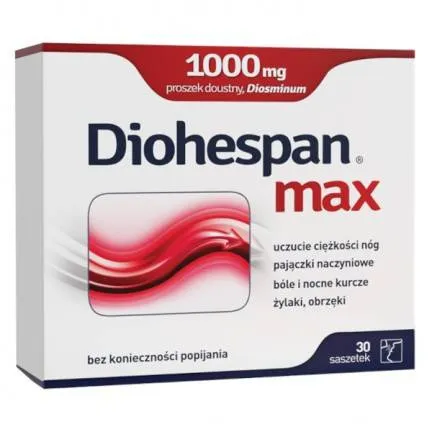
Table of Contents
Package leaflet: Information for the patient
Diohespan max, 1000 mg, oral powder
Diosminum
Please read the entire leaflet carefully before taking this medicine, as it contains
important information for the patient.
This medicine should always be taken exactly as described in this patient leaflet or as directed by
your doctor or pharmacist.
- Keep this leaflet so that you can read it again if necessary.
- If you need advice or further information, please consult your pharmacist.
- If you experience any adverse reactions, including any not listed in this leaflet, inform your doctor or pharmacist. See section 4.
- If there is no improvement after 7 days or if your condition worsens, contact your doctor.
Table of contents
- What Diohespan max is and what it is used for
- Important information before taking Diohespan max
- How to take Diohespan max
- Possible side effects
- How to store Diohespan max
- Contents of the pack and other information
1. What Diohespan max is and what it is used for
Diohespan max increases venous vessel tone and exerts a protective effect on blood vessels. It enhances lymphatic drainage by stimulating peristalsis (motility) of lymphatic vessels and lymph flow. The drug acts on the microcirculation, reducing permeability of small blood vessels, perivascular inflammatory conditions, and stasis in the microcirculation. It also reduces the susceptibility of small blood vessels to rupture.
Indications
Symptoms of chronic venous insufficiency of the lower limbs:
- Leg pain and nocturnal leg cramps;
- Sensation of heavy legs;
- Varicose veins of the lower limbs;
- Leg swelling (edema / puffiness of legs);
- Dilatation of very small veins, so-called capillary veins (telangiectasias).
Symptomatic treatment of hemorrhoidal disease (hemorrhoids).
If there is no improvement after 7 days or if your condition worsens, consult your doctor.
2. Important information before taking Diohespan max
When not to take Diohespan max
- if the patient is allergic to diosmin or any of the other ingredients of this medicine (listed in section 6).
Warnings and precautions
If symptoms related to haemorrhoids persist or worsen despite treatment with the medicine,
consult a doctor. Treatment of symptoms associated with haemorrhoids should be short-term.
Diohespan max and other medicines
Inform your doctor or pharmacist about all medicines currently used, recently taken, or planned to be taken.
Do not take Diohespan max together with the following medicines:
- diclofenac (a non-steroidal anti-inflammatory drug);
- metronidazole (a medicine used to treat infections caused by certain bacteria and protozoa);
- fexofenadine (a medicine used to treat allergies);
- carbamazepine (a medicine used to treat epilepsy).
Diohespan max with food and drink
Take the medicine during meals.
Pregnancy and breastfeeding
If the patient is pregnant or breastfeeding, suspects she might be pregnant, or is planning to have a child, she should consult a doctor or pharmacist before using this medicine.
Pregnancy
If necessary, the medicine may be used during pregnancy, but only on a doctor's prescription.
If the patient becomes pregnant during treatment, she should consult a doctor, as only a doctor can decide whether treatment should be continued.
Breastfeeding
This medicine should not be used during breastfeeding due to lack of data on the passage of diosmin into human breast milk.
Driving and operating machinery
This medicine has no effect or has negligible effect on the ability to drive and operate machinery.
Diohespan max contains benzyl alcohol, fructose, glucose, and sucrose
Benzyl alcohol
The medicine contains 0.157 mg of benzyl alcohol per sachet.
Benzyl alcohol may cause allergic reactions.
Fructose
The medicine contains 0.407 mg of fructose per sachet. Fructose contained in medicinal products may have harmful effects on teeth.
Glucose
The medicine contains 657.60 mg of glucose per sachet.
If the patient has previously been diagnosed with intolerance to certain sugars, he or she should consult a doctor before taking the medicine.
Sucrose
The medicine contains 445.69 mg of sucrose per sachet.
If the patient has previously been diagnosed with intolerance to certain sugars, he or she should consult a doctor before taking the medicine.
3. How to take Diohespan max
This medicine should always be taken exactly as described in this patient leaflet or as directed by your doctor or pharmacist. If in doubt, consult your doctor or pharmacist.
Recommended dose
1 sachet per day.
Acute flare-up of haemorrhoidal symptoms: 3 sachets per day for 4 days, followed by
2 sachets per day for the next 3 days.
Do not take more than the recommended dose.
This medicine should be taken during meals.
The medicine is for oral use.
The powder should be poured directly onto the tongue and swallowed. If necessary, it may be taken with water or suspended in a small amount of water and then drunk.
Taking more Diohespan max than recommended
There have been no reported cases of poisoning due to overdose of this medicine.
Taking more than the recommended dose may cause gastrointestinal disturbances, vomiting and nausea.
If more than the recommended dose has been taken, seek immediate advice from your doctor or pharmacist.
If you miss a dose of Diohespan max
Do not take a double dose to make up for the missed dose.
Stopping Diohespan max treatment
There is no data available on the consequences of stopping treatment.
If you have any further questions about the use of this medicine, consult your doctor or pharmacist.
4. Possible adverse reactions
Like any medicine, this medicine may cause adverse reactions, although not everybody will experience them.
The following adverse reactions may occur:
Rare (occur in 1 to 10 people in 10,000):
- diarrhoea;
- indigestion;
- nausea;
- vomiting;
- dizziness;
- headache;
- malaise;
- rash (itchy, red bumps on the skin);
- itching;
- urticaria (pinkish, itchy blisters on the skin).
Observed adverse reactions do not necessitate discontinuation of the medicine.
Reporting of adverse reactions
If any adverse symptoms occur, including any adverse symptoms not listed in this leaflet, inform a doctor or pharmacist.
Adverse reactions can be reported directly to the Department of Monitoring Adverse Drug Reactions of the Office for Registration of Medicinal Products, Medical Devices and Biocidal Products:
Al. Jerozolimskie 181C, 02-222 Warsaw
Tel.: + 48 22 49 21 301
Fax: + 48 22 49 21 309
Website: https://smz.ezdrowie.gov.pl
Adverse reactions can also be reported to the marketing authorization holder.
By reporting adverse reactions, additional information on the safety of the medicine can be collected.
5. How to store Diohespan max
Keep this medicine out of the sight and reach of children.
No special storage conditions are required for this medicine.
Do not use this medicine after the expiry date stated on the sachet and the outer packaging.
The expiry date refers to the last day of the stated month.
Markings on the sachet:
Lot - batch number
EXP - expiry date
Medicines must not be disposed of via wastewater or household waste. Ask your pharmacist how to dispose of medicines you no longer use. This will help protect the environment.
6. Contents of the pack and other information
What Diohespan max contains
- The active substance is diosmin. One sachet contains 1000 mg of micronized diosmin.
- The other ingredients are: sucrose, polyvinyl alcohol, polysorbate 80, glucose, citric acid, xanthan gum, colloidal anhydrous silica, orange flavour SD1918 (containing: fructose), cherry flavour SD0559 (containing: benzyl alcohol), sucralose.
What Diohespan max looks like and contents of the pack
Diohespan max is an orange-cherry-scented oral powder, greyish-yellow to light brown in colour, with lighter specks.
The pack contains 10, 20, 30 or 60 sachets of 2.2 g of medicinal product in a cardboard box.
Marketing Authorisation Holder and Manufacturer
Aflofarm Farmacja Polska Sp. z o.o.
ul. Partyzancka 133/151
95-200 Pabianice
Tel. (42) 22-53-100