Difadol 0.1%
Poland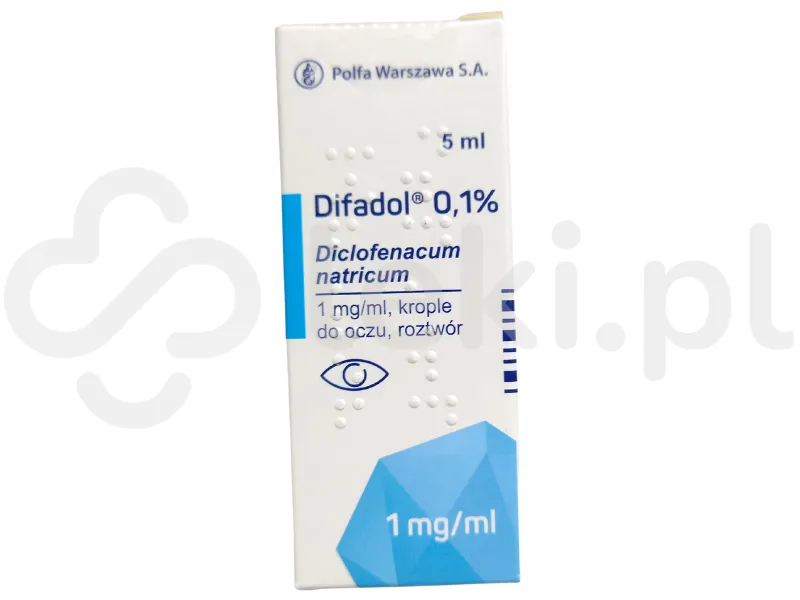
Table of Contents
Package leaflet: Information for the patient
Difadol 0,1%, 1 mg/ml, eye drops, solution
Diclofenacum natricum
Please read carefully the entire leaflet before using the medicine, as it contains
important information for the patient.
- Keep this leaflet, as you may need to read it again.
- If you have any questions, ask your doctor or pharmacist.
- This medicine has been prescribed for a specific individual. Do not pass it on to others. The medicine may harm another person, even if their symptoms are the same.
- If you experience any adverse reactions, including any not listed in this leaflet, tell your doctor or pharmacist. See section 4.
Table of contents
- What Difadol 0,1% is and what it is used for
- Important information before using Difadol 0,1%
- How to use Difadol 0,1%
- Possible side effects
- How to store Difadol 0,1%
- Contents of the pack and other information
1. What Difadol 0,1% is and what it is used for
Difadol 0,1% contains diclofenac sodium, which is a derivative of aminophenylacetic acid and belongs to the group of non-steroidal anti-inflammatory drugs; it also has analgesic properties.
Difadol 0,1% is indicated:
- for postoperative inflammatory conditions following cataract surgery and other surgical procedures;
- to prevent ocular pain and photophobia;
- to prevent intraoperative miosis during cataract surgery;
- for prophylaxis of cystoid macular edema following cataract surgery with intraocular lens implantation.
2. Information before using Difadol 0.1%
When not to use Difadol 0.1%
- if the patient is allergic to sodium diclofenac or to any of the other components of this medicine (listed in section 6);
- if the patient has hypersensitivity to salicylic acid derivatives or other non-steroidal anti-inflammatory drugs (symptoms of allergy - asthma attacks, skin reactions, inflammation of the nasal mucosa).
Warnings and precautions
Before starting treatment with Difadol 0.1%, discuss this with your doctor.
- In patients taking medications that prolong bleeding time or with bleeding disorders (hemostasis), because there is a potential risk of worsening blood clotting disorders.
- As with other medicines in the group of non-steroidal anti-inflammatory drugs, Difadol 0.1% may mask symptoms of eye infection – in such cases, the doctor may recommend additional use of an appropriate antibacterial agent.
Difadol 0.1% and other medicines
Inform your doctor or pharmacist about all medicines currently used or recently used, as well as any medicines the patient intends to use.
No interactions are known with eye drops containing diclofenac.
Difadol 0.1% can be safely used concomitantly with antibiotics, steroids, and β-adrenergic receptor blockers.
If the patient is using another eye medication, an interval of at least 5 minutes should be maintained between successive instillations.
Pregnancy and breastfeeding
If the patient is pregnant or breastfeeding, suspects she may be pregnant, or is planning to become pregnant, she should consult a doctor or pharmacist before using this medicine.
Pregnancy
This medicine should not be used during the last three months of pregnancy unless the doctor decides it is absolutely necessary.
Breastfeeding
Diclofenac passes into breast milk in such small amounts that it is unlikely to cause adverse effects in the breastfed infant.
Driving and operating machinery
Generally, this medicine does not affect the ability to drive or operate machinery.
However, transient visual disturbances may occur after instillation. Patients experiencing visual disturbances should not drive or operate machinery.
Difadol 0.1% contains benzalkonium chloride
This medicine contains 0.05 mg of benzalkonium chloride per millilitre.
Benzalkonium chloride may be absorbed by soft contact lenses and may change their colour. Soft contact lenses should be removed before instillation and at least 15 minutes should be waited before reinsertion.
Benzalkonium chloride may also cause eye irritation, especially in individuals with dry eye syndrome or corneal disorders (the transparent layer at the front of the eye). If abnormal sensations in the eye, stinging, or eye pain occur after using the medicine, contact a doctor.
3. How to use Difadol 0.1%
This medicine should always be used exactly as directed by your doctor or pharmacist. If in doubt,
please consult your doctor or pharmacist.
Adults
Ophthalmic surgery and its complications
Before surgery: administer 1 drop 5 times within 3 hours.
After surgery: 1 drop 3 times during the day of surgery, then 1 drop 3 to 5 times daily over the
following days, for as long as necessary.
Management of symptoms of pain and photophobia
1 drop every 4 to 6 hours.
If pain is related to surgical procedure, administer 1 to 2 drops within the hour preceding surgery,
1 to 2 drops within 15 minutes after surgery, and 1 drop every 4 to 6 hours for 3 days after surgery.
Elderly patients
No dose adjustment is required.
Use in children
The efficacy and safety of this medicine in children have not been established.
Note: if the patient is using another eye medication, an interval of at least 5 minutes should be
maintained between successive instillations. Ocular ointments should be administered last.
Method of administration
This medicine is intended for external use only – locally into the conjunctival sac.
Do not touch the dropper tip, as this may contaminate the contents of the bottle.
- Wash your hands thoroughly before instilling the drops.
- Unscrew the cap on the bottle.
- Tilt your head backward and gently pull down the lower eyelid to create a pocket between the eyelid and the eyeball.
- Invert the bottle and gently press with your thumb or index finger on the side until one drop of medicine is dispensed into the eye. Do not touch the dropper tip to the eye or eyelids. If the drop missed the eye, instill another drop.
- After instilling Difadol 0.1%, gently press on the inner corner of the eye for about 2 minutes. This helps prevent the medicine from being absorbed into the body.
- If your doctor has instructed you to instill the drops into the other eye as well, repeat steps 3, 4, and 5.
- The dropper is designed to accurately dispense drops; therefore, do not enlarge the opening of the dropper.
- After instillation, replace the cap on the bottle. Do not overtighten.
Use of more than the recommended dose of Difadol 0.1%
Overdose following instillation into the conjunctival sac, as well as after accidental oral ingestion,
is unlikely due to the low content of active substance.
If too much medicine has been instilled, the excess can be removed by rinsing the eye with
physiological saline or cooled boiled water at room temperature.
Missed dose of Difadol 0.1%
Do not use a double dose to make up for a missed dose.
If you have any further questions about the use of this medicine, consult your doctor or pharmacist.
4. Possible adverse reactions
Like any medicine, this medicine can cause adverse reactions, although not everyone experiences them.
The most commonly reported reaction is a transient sensation of burning, mild to moderate in intensity.
Rarely, itching, eye redness, and blurred vision occurring immediately after instillation of the medicine have been observed.
With prolonged use of the medicine, cases of punctate keratitis and corneal epithelial damage have been reported.
In patients treated with anti-inflammatory corticosteroid medicines, particularly those with infection or rheumatoid arthritis, there is a risk of corneal ulceration or decreased corneal thickness, which diclofenac may rarely exacerbate.
Rarely, dyspnea and exacerbation of asthma symptoms have been reported.
Reporting of adverse reactions
If any adverse reactions occur, including any adverse reactions not listed in this leaflet, inform your doctor or pharmacist. Adverse reactions can be reported directly to the Department of Monitoring Adverse Drug Reactions, Office for Registration of Medicinal Products, Medical Devices and Biocidal Products
Al. Jerozolimskie 181C
02-222 Warsaw
Tel.: + 48 22 49 21 301
Fax: + 48 22 49 21 309
e-mail: [email protected]
Adverse reactions can also be reported to the marketing authorization holder.
Reporting adverse reactions enables better assessment of the benefit-risk balance of the medicine.
5. How to store Difadol 0.1%
Store below 25°C.
Keep the bottle tightly closed and in the outer packaging to protect from light.
Keep the medicine out of the sight and reach of children.
Do not use this medicine after the expiry date stated on the carton and bottle. The expiry date refers to the last day of the stated month.
The labelling abbreviation "EXP" refers to the expiry date, and "Lot" refers to the batch number.
After first opening the bottle, do not use the medicine for longer than 4 weeks.
Medicines must not be disposed of via wastewater or household waste. Ask your pharmacist how to dispose of medicines no longer required. This will help protect the environment.
6. Contents of the packaging and other information
What Difadol 0.1% contains
- The active substance is diclofenac sodium. Each ml of solution contains 1 mg of diclofenac sodium.
- The other ingredients are: polysorbate 80; boric acid; borax; sodium chloride; benzalkonium chloride, solution; disodium edetate; purified water.
What Difadol 0.1% looks like and contents of the pack
Difadol 0.1% is a sterile eye drop solution, as a colourless or pale yellow, clear liquid.
The medicine is available in polyethylene bottles containing 5 ml of solution, packed in a cardboard box.
Marketing Authorisation Holder
Zakłady Farmaceutyczne POLPHARMA S.A.
ul. Pelplińska 19, 83-200 Starogard Gdański
tel. + 48 22 364 61 01
Manufacturer
Warszawskie Zakłady Farmaceutyczne Polfa S.A.
ul. Karolkowa 22/24, 01-207 Warszawa