Diclotica
Poland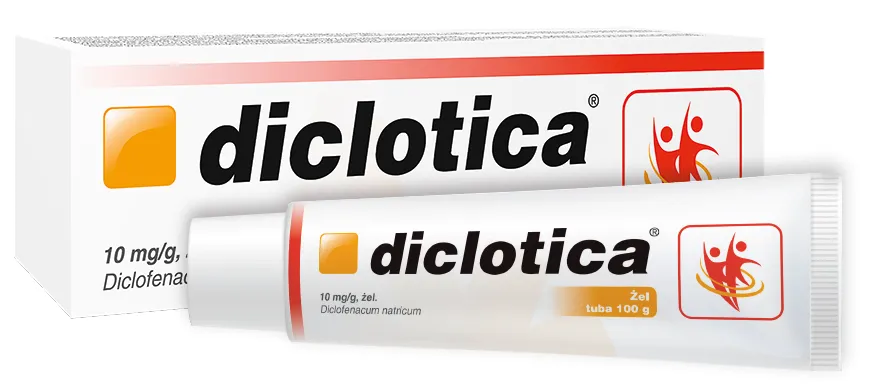
Table of Contents
Package leaflet: Information for the patient
Diclotica, 10 mg/g, gel
Diclofenacum natricum
Please read all of this leaflet carefully before using this medicine, as it contains
important information for you.
This medicine should always be used exactly as described in this patient leaflet or as directed by your
doctor, pharmacist, or nurse.
- Keep this leaflet so that you can read it again if necessary.
- If you need advice or further information, please consult your pharmacist.
- If you experience any adverse reactions, including any not listed in this leaflet, inform your doctor, pharmacist, or nurse. See section 4.
- If there is no improvement or if you feel worse after 7 days, consult your doctor.
Contents of the leaflet
- What Diclotica is and what it is used for
- Important information before using Diclotica
- How to use Diclotica
- Possible side effects
- How to store Diclotica
- Contents of the pack and other information
1. What Diclotica is and what it is used for
Diclotica contains the active substance sodium diclofenac, which has anti-inflammatory and analgesic properties.
Indications:
Diclotica is used locally for the treatment of:
Adults and adolescents over 14 years of age:
- inflammatory traumatic conditions of tendons, ligaments, muscles, and joints (e.g. resulting from sprains, strains or contusions);
- back pain;
- localized inflammatory conditions of soft tissues, such as: tendinitis, tennis elbow, bursitis, periarthritis.
Adults (over 18 years of age)
- localized and mild forms of osteoarthritis.
2. Important information before using Diclotica
When not to use Diclotica
-
- If the patient is allergic to the active substance or any of the other ingredients of this medicine (listed in section 6).
- If the patient has ever had an allergic reaction (e.g. rash, difficulty breathing or coughing attack) after taking medicines containing acetylsalicylic acid (also used as an anticoagulant), ibuprofen, or other medicines used to treat joint and muscle pain, fever and inflammatory conditions.
- During the third trimester of pregnancy.
- In children under 14 years of age.
Warnings and precautions
Before starting to use Diclotica, discuss it with your doctor or pharmacist.
Do not apply the medicine to damaged skin, open wounds or rashes. The area to which Diclotica gel is applied must not be exposed to sunlight.
Discontinue use if a rash or other symptoms of hypersensitivity occur after application.
- Avoid applying the medicine to large areas of skin and for prolonged periods unless directed by a doctor. The medicine may cause severe skin reactions.
- Diclotica is intended for topical use on the skin only. Do not apply to mucous membranes or inside the mouth. Do not swallow. Wash hands after use. Avoid contact of the gel with eyes. If the medicine gets into the eyes, rinse thoroughly with clean water and contact your doctor or pharmacist.
- Use with caution in patients with asthma or a history of peptic ulcer disease.
- Diclotica may be used under bandages or dressings commonly used for sprains; however, it should not be used under occlusive dressings that prevent air access.
Children and adolescents
There is insufficient data on the efficacy and safety of using this product in children and adolescents under 14 years of age.
In adolescents aged over 14 years, if treatment needs to continue for longer than 7 days for pain relief or if symptoms worsen, the patient should consult a doctor.
Diclotica with other medicines
Tell your doctor or pharmacist about all medicines you are currently taking or have recently taken, as well as any medicines you plan to take.
Be aware of potential interactions when using diclofenac, especially if the product is applied to large skin areas and for prolonged periods, in combination with ACE inhibitors (ACEIs) or ARBs (angiotensin receptor blockers).
Pregnancy and breastfeeding
If you are pregnant or breastfeeding, suspect you may be pregnant, or are planning to have a baby, consult your doctor or pharmacist before using this medicine.
Pregnancy
Do not use Diclotica during the last three months of pregnancy, as it may harm the unborn child or cause complications during delivery.
During the first six months of pregnancy, Diclotica should only be used on the advice of a doctor, using the lowest possible dose for the shortest possible duration.
Breastfeeding
Diclofenac passes into breast milk. Use of Diclotica is not recommended during breastfeeding.
If you have any further doubts regarding the use of Diclotica in pregnancy or breastfeeding, consult your doctor or pharmacist.
Driving and operating machinery
Diclotica has no influence on the ability to drive or operate machinery.
Diclotica contains propyl parahydroxybenzoate (E 216) and methyl parahydroxybenzoate (E 218).
These may cause allergic reactions (including delayed-type reactions).
Diclotica contains propylene glycol.
Propylene glycol may cause skin irritation.
3. How to use Diclotica
This medicine should always be used exactly as described in this patient leaflet or as directed by your doctor or pharmacist. If in doubt, consult your doctor or pharmacist.
Adults and adolescents over 14 years of age
Apply thin layers of Diclotica gel to the affected area 3 to 4 times daily, as needed, using 2 g to 4 g of the medicine, which approximately corresponds to 2.0–2.5 cm of gel and is sufficient to cover an area of about 400 cm^2 to 800 cm^2.
The duration of treatment depends on the indication and response to therapy. If used without prior consultation with a doctor, the medicine should not be used for longer than 14 days in cases of post-traumatic inflammatory conditions and soft tissue rheumatism, and not longer than 4 weeks in cases of degenerative joint disease. Consult a doctor after 7 days of treatment if there is no improvement, or immediately if symptoms worsen.
Use in children under 14 years of age
There is insufficient data on the efficacy and safety of using this medicine in children and adolescents under 14 years of age.
Use in elderly patients (over 65 years of age)
Should be used as in other adult patients.
After applying the medicine, wash your hands unless the hands themselves are the area being treated.
Diclotica may be used as an adjunctive treatment alongside oral non-steroidal anti-inflammatory drugs.
Use of a higher than recommended dose of Diclotica
Diclofenac is absorbed into the systemic circulation in very small amounts; therefore, overdose following topical application is unlikely.
Missed dose of Diclotica
Do not apply a double dose to make up for a missed dose.
If you have any doubts regarding the use of this medicine, contact your doctor or pharmacist.
4. Possible adverse reactions
Like any medicine, Diclotica may cause adverse reactions, although not everyone experiences them.
If any of the symptoms listed below occur, which may be signs of hypersensitivity, discontinue use of the medicine immediately, contact a doctor or go to the nearest hospital emergency department:
Rare (occur in no more than 1 in 1,000 people taking the medicine):
- Bullous dermatitis. Very rare (occur in no more than 1 in 10,000 people taking the medicine):
- Wheezing, shortness of breath or feeling of tightness in the chest (asthma), swelling of the face, lips, tongue or throat, blistering reactions such as Stevens-Johnson syndrome and toxic epidermal necrolysis.
Other adverse reactions
Other adverse reactions that may occur during treatment with Diclotica are usually mild, harmless and transient:
Very rare (occur in no more than 1 in 10,000 people taking the medicine):
- Nodular rash, itching, erythematous rash or localized or generalized skin eruptions. Photosensitivity reactions, increased sensitivity of the skin to sunlight. Symptoms of photosensitivity include sunburn with itching, swelling and blisters.
Common (occur in no more than 1 in 10 people taking the medicine): - Skin rash with vesicles, urticaria, itching, redness or burning sensation of the skin, dermatitis (including contact dermatitis).
If any of the adverse symptoms worsen or if any adverse symptoms not listed in this leaflet occur, inform your doctor or pharmacist.
Reporting of adverse reactions
If any adverse reactions occur, including any adverse reactions not listed in this leaflet, inform your doctor or pharmacist. Adverse reactions can be reported directly to:
Department of Monitoring of Adverse Drug Reactions
Office for Registration of Medicinal Products, Medical Devices and Biocidal Products
Al. Jerozolimskie 181C, 02-222 Warsaw, Poland
Tel.: +48 22 49 21 301
Fax: +48 22 49 21 309
Website: https://smz.ezdrowie.gov.pl
Adverse reactions can also be reported to the marketing authorization holder.
Reporting adverse reactions helps to provide more information on the safety of the medicine.
5. How to store Diclotica
Keep out of sight and reach of children
Store in the original packaging to protect from light. Store at a temperature below 25°C.
Do not store in the refrigerator or freeze
The shelf life after first opening the immediate packaging is 6 months.
Do not use this medicine if the patient notices any signs of deterioration.
Do not use this medicine after the expiry date stated on the cardboard box after:
EXP. The expiry date refers to the last day of the month indicated.
Medicines must not be disposed of via wastewater or household waste. Ask your pharmacist what to do with medicines no longer in use. This will help protect the environment.
6. Contents of the packaging and other information
What Diclotica contains
The active substance is sodium diclofenac. One gram of gel contains 10 mg of sodium diclofenac.
Other ingredients are: propylene glycol, sodium hydroxide, medium-chain triglycerides, carbomer, hydroxyethylcellulose, propyl parahydroxybenzoate (E 216), methyl parahydroxybenzoate (E 218), and purified water.
What Diclotica looks like and contents of the pack
White or almost white, smooth, homogeneous gel with a creamy consistency.
Aluminium tube with an internal epoxy-phenolic lacquer coating, fitted with a polyethylene cap with a piercing device, in a cardboard box, containing 100 g of gel.
Marketing Authorisation Holder and Manufacturer
Marketing Authorisation Holder
Tactica Pharmaceuticals Sp. z o.o.
Bankowa 4
44-100 Gliwice
Poland
Tel.: +48 889 388 53
{logo of the marketing authorisation holder}
Manufacturer
Laboratórios Basi – Indústria Farmacêutica, S.A.
Parque Industrial Manuel Lourenço Ferreira, Lotes 8, 15 e 16
3450-232 Mortágua
Portugal