Casaro
Poland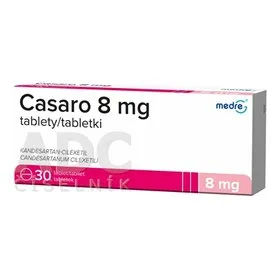
Table of Contents
Package leaflet: Information for the patient
Casaro, 8 mg, tablets
Casaro, 16 mg, tablets
Casaro, 32 mg, tablets
Candesartan cilexetil
Please read this leaflet carefully before taking the medicine, as it contains important information for you.
- Keep this leaflet so that you can read it again if necessary.
- If you have any questions, please consult your doctor or pharmacist.
- This medicine has been prescribed for a specific individual. Do not pass it on to others. The medicine may harm others, even if their symptoms are similar.
- If you experience any adverse reactions, including any not listed in this leaflet, tell your doctor or pharmacist. See section 4.
Leaflet contents:
- What Casaro is and what it is used for
- Important information before taking Casaro
- How to take Casaro
- Possible side effects
- How to store Casaro
- Contents of the pack and other information
1. What Casaro is and what it is used for
The active substance in Casaro is candesartan cilexetil. It belongs to a group of medicines called angiotensin II receptor antagonists. It works by relaxing and widening blood vessels. This helps lower blood pressure. It also helps the heart pump blood to all parts of the body.
Casaro may be used:
- for the treatment of high blood pressure (hypertension) in adults and in children and adolescents aged 6 to 18 years,
- for the treatment of adult patients with heart failure and impaired heart muscle function, if angiotensin-converting enzyme (ACE) inhibitors cannot be used, or as an add-on to ACE inhibitor therapy if heart failure symptoms persist despite treatment, and mineralocorticoid receptor antagonists (MRA) cannot be used (ACE inhibitors and MRAs are medicines used in the treatment of heart failure).
2. Important information before taking Casaro
When not to take Casaro
- if the patient is allergic to candesartan cilexetil or any of the other ingredients of this medicine (listed in section 6),
- if the patient is more than 3 months pregnant (Casaro is also best avoided during early pregnancy - see section "Pregnancy and breastfeeding"),
- if the patient has severe liver disease or biliary obstruction (a condition causing impaired bile flow from the gallbladder),
- if the patient is a child under 1 year of age,
- if the patient has diabetes or kidney problems and is being treated with a blood pressure-lowering medicine containing aliskiren.
If in doubt whether any of the above situations apply to the patient, consult a doctor or pharmacist before taking Casaro.
Warnings and precautions
Before starting Casaro, discuss with your doctor or pharmacist if:
- the patient has heart, liver or kidney problems, or is undergoing dialysis,
- the patient has recently had a kidney transplant,
- the patient is experiencing vomiting or has recently had severe vomiting, or has diarrhoea,
- the patient has a disorder of the adrenal glands called Conn's syndrome (primary hyperaldosteronism),
- the patient has low blood pressure,
- the patient has ever had a stroke,
- the patient should inform the doctor if she is (or may become) pregnant. Use of Casaro is not recommended during early pregnancy and must not be used after the third month of pregnancy, as it may seriously harm the unborn child (see section "Pregnacy and breastfeeding"),
- if the patient is taking any of the following medicines used to treat high blood pressure:
- an ACE inhibitor (e.g. enalapril, lisinopril, ramipril), particularly if the patient has kidney problems related to diabetes,
- aliskiren,
- if the patient is taking an ACE inhibitor together with a medicine belonging to a group of medicines called mineralocorticoid receptor antagonists (MRAs). These medicines are used in the treatment of heart failure (see "Casaro with other medicines").
If any of the above conditions apply, the doctor may recommend more frequent monitoring and tests.
If the patient experiences abdominal pain, nausea, vomiting or diarrhoea after taking Casaro, discuss this with the doctor. The doctor will decide on further treatment. Do not stop taking Casaro without medical advice.
The doctor may recommend regular monitoring of kidney function, blood pressure and blood electrolyte levels (e.g. potassium).
If the patient is scheduled for surgery, inform the doctor or dentist about taking Casaro. This is because Casaro, in combination with certain anaesthetics, may cause excessive lowering of blood pressure.
Children and adolescents
Casaro has been studied in children. For further information, please speak with your doctor. Casaro must not be given to children under 1 year of age due to potential risk to kidney development.
Casaro with other medicines
Tell your doctor or pharmacist about all medicines the patient is currently taking or has recently taken, as well as any medicines the patient plans to take.
Casaro may affect the action of certain other medicines, and some medicines may affect the action of Casaro.
If the patient is taking certain medicines, the doctor may periodically recommend blood tests.
In particular, inform the doctor if the patient is taking any of the following medicines, as the doctor may need to adjust the dose and/or recommend additional precautions:
- other blood pressure-lowering medicines, including beta-blockers, diazoxide and ACE inhibitors such as enalapril, captopril, lisinopril or ramipril,
- non-steroidal anti-inflammatory drugs (NSAIDs), such as ibuprofen, naproxen, diclofenac, celecoxib or etoricoxib (medicines that relieve pain and inflammation),
- acetylsalicylic acid (if taken at doses exceeding 3 g per day) (a medicine that relieves pain and inflammation),
- potassium supplements, salt substitutes containing potassium (medicines that increase blood potassium levels),
- heparin (a medicine that reduces blood clotting),
- co-trimoxazole (an antibiotic), also known as trimethoprim with sulfamethoxazole,
- diuretics (water pills),
- lithium (a medicine used to treat psychiatric disorders),
- if the patient is taking an ACE inhibitor or aliskiren (see also sections "When not to take Casaro" and "Warnings and precautions"),
- if the patient is taking an ACE inhibitor together with certain medicines used in the treatment of heart failure called mineralocorticoid receptor antagonists (MRAs) (e.g. spironolactone, eplerenone).
Casaro with food, drink and alcohol
Casaro may be taken with or without food.
During treatment with Casaro, consult your doctor before consuming alcohol. Alcohol may cause dizziness or fainting.
Pregnancy and breastfeeding
Pregnancy
If the patient suspects she is (or might be) pregnant, she must inform her doctor. The doctor will usually advise stopping Casaro before becoming pregnant or as soon as pregnancy is confirmed, and will recommend an alternative medicine.
Use of Casaro during early pregnancy is not recommended, and it must not be used after the third month of pregnancy, as it may seriously harm the unborn child.
Breastfeeding
Inform the doctor if the patient is breastfeeding or planning to breastfeed. Use of Casaro is not recommended during breastfeeding. For patients planning to breastfeed, especially a newborn or premature infant, the doctor may choose a different suitable medicine.
Driving and operating machinery
While taking Casaro, some patients may experience fatigue or dizziness. If these symptoms occur, do not drive, use tools or operate machinery.
Casaro contains lactose
If the patient has been previously diagnosed with an intolerance to certain sugars, the patient should consult their doctor before taking this medicine.
Casaro contains sodium
This medicine contains less than 1 mmol (23 mg) of sodium per tablet, meaning the medicine is considered "sodium-free".
3. How to take Casaro
This medicine should always be taken as prescribed by your doctor. If you have any doubts,
consult your doctor or pharmacist.
It is important to take Casaro every day. You should take the tablet at the same time each day.
This will help you remember to take your medicine.
Casaro may be taken with or without food.
Swallow the tablet with water. The tablet may be divided into equal doses.
High blood pressure
The recommended dose of Casaro is 8 mg once daily. Your doctor may increase the dose to 16 mg
once daily, and then to 32 mg once daily, depending on your blood pressure response to treatment.
Some patients, for example those with impaired liver or kidney function, or those who have recently
lost a large amount of fluid (due to vomiting or diarrhoea, or due to taking diuretics) may be
prescribed a lower starting dose by their doctor.
In some patients of black race, response to this type of medicine may be reduced when used as
monotherapy (single treatment), and such patients may require a higher dose.
Use in children and adolescents
Children aged 6 to 18 years:
The recommended starting dose is 4 mg once daily.
Patients with body weight < 50 kg: In some patients with inadequate blood pressure control,
the doctor may increase the dose of the medicine up to a maximum of 8 mg once daily.
Patients with body weight ≥ 50 kg: In some patients with inadequate blood pressure control,
the doctor may increase the dose of the medicine to 8 mg once daily and then to 16 mg once daily.
Heart failure
The recommended starting dose of Casaro is 4 mg once daily. Your doctor may increase the dose
by doubling it at intervals of at least 2 weeks, up to 32 mg once daily. Casaro may be taken
together with other medicines used in the treatment of heart failure, and your doctor will decide
which therapy is most appropriate for you.
Taking more Casaro than prescribed
If you take more Casaro than prescribed by your doctor, contact your doctor or pharmacist
immediately.
If you miss a dose of Casaro
Do not take a double dose to make up for a missed dose. Take the next dose at the usual time.
Stopping Casaro
If you stop taking Casaro, your blood pressure may rise again. Therefore, do not stop taking
Casaro without first consulting your doctor.
If you have any further doubts about the use of this medicine, consult your doctor or pharmacist.
4. Possible adverse reactions
Like all medicines, this medicine may cause adverse reactions, although not everyone experiences them.
You must stop taking Casaro and seek immediate medical help if the patient experiences any of the following allergic reactions:
- difficulty breathing, with or without swelling of the face, lips, tongue and (or) throat,
- swelling of the face, lips, tongue and (or) throat, which may cause difficulty in swallowing,
- severe skin itching (with raised lumps).
Casaro may cause a reduction in the number of white blood cells. This may reduce resistance to infections, so the patient may experience fatigue, infection and fever. If these symptoms occur, contact a doctor. The doctor may periodically recommend blood tests to check whether Casaro is causing any blood disorders (agranulocytosis).
Other possible adverse reactions include:
Common (may affect up to 1 in 10 patients)
- dizziness/feeling of spinning
- headache
- respiratory tract infection
- low blood pressure – this may cause fainting or dizziness
- changes in blood test results:
- increased potassium levels in the blood, particularly if the patient has kidney function disorders or heart failure. In case of a significant increase in potassium levels, fatigue, weakness, irregular heartbeat or tingling sensations may occur.
- effects on kidney function, particularly in case of pre-existing kidney disorders or heart failure. In very rare cases, kidney failure may occur.
Very rare (may affect up to 1 in 10,000 patients)
- swelling of the face, lips, tongue and (or) throat
- reduction in the number of red or white blood cells. The patient may experience fatigue, infection or fever.
- skin rash, papular rash (urticaria)
- itching
- back pain, joint and muscle pain
- changes in liver function, including hepatitis (jaundice). The patient may notice fatigue, yellowing of the skin and whites of the eyes, and flu-like symptoms.
- intestinal angioedema: swelling in the intestine with symptoms such as abdominal pain, nausea, vomiting and diarrhoea
- nausea
- cough
- changes in blood test results:
- decreased sodium levels in the blood. If this decrease is significant, the patient may experience weakness, lack of energy or muscle cramps.
Frequency not known (frequency cannot be estimated from available data):
- diarrhoea.
Additional adverse reactions in children and adolescents
Adverse reactions in children treated for high blood pressure appear to be similar to those observed in adult patients, but occur more frequently. Sore throat is a very common adverse reaction in children but not reported in adults, while nasal congestion, fever and rapid heartbeat are common in children but not reported in adults.
Reporting of adverse reactions
If any adverse reactions occur, including any adverse reactions not listed in this leaflet, tell your doctor or pharmacist. Adverse reactions can be reported directly to the Department of Monitoring Adverse Drug Reactions, Office for Registration of Medicinal Products, Medical Devices and Biocidal Products, Al. Jerozolimskie 181C, 02-222 Warsaw, Tel: +48 22 49 21 301, Fax: +48 22 49 21 309, website: https://smz.ezdrowie.gov.pl
Reporting adverse reactions helps to provide more information on the safety of the medicine.
Adverse reactions can also be reported to the responsible entity.
5. How to store the medicine Casaro
Keep the medicine out of sight and reach of children.
Do not store above 25°C.
Do not use this medicine after the expiry date stated on the carton or blister after:
EXP. The expiry date refers to the last day of the stated month.
Medicines must not be disposed of via wastewater or household waste. Ask your pharmacist
how to dispose of medicines you no longer use. Such measures help protect the
environment.
6. Contents of the pack and other information
What Casaro contains
- The active substance is candesartan cilexetil. Each tablet contains 8 mg, 16 mg, or 32 mg of candesartan cilexetil.
- Other ingredients are: lactose monohydrate, corn starch, hypromellose 2910, calcium stearate, iron oxide red (E 172), hydroxypropyl cellulose, disodium edetate, microcrystalline cellulose, dried.
What Casaro looks like and contents of the pack
Casaro, 8 mg:
Pink to reddish-brown with a whitish mosaic appearance, round, biconvex, uncoated tablets (with a diameter of 8.00 mm ± 0.20 mm), with a score line on one side and smooth on the other.
Casaro, 16 mg:
Light pink to pale red, round, biconvex, uncoated tablets (with a diameter of 7.14 mm ± 0.20 mm), with a score line on one side and smooth on the other.
Casaro, 32 mg:
Light pink to pale red, round, biconvex, uncoated tablets (with a diameter of 9.52 mm ± 0.20 mm), with a score line on both sides.
The tablet can be divided into equal doses.
Tablets are supplied in blisters made of OPA/Aluminum/PVC/Aluminum or PVC/PVDC/Aluminum, packed in a cardboard box.
Pack sizes: 7, 14, 28, 30, 56, 70, 90, and 98 tablets.
Not all pack sizes may be marketed.
Marketing Authorisation Holder and Manufacturer
Marketing Authorisation Holder:
Medreg s.r.o.
Na Florenci 2116/15
Nové Město
110 00 Prague 1
Czech Republic
Tel.: (+420) 516 770 199
Manufacturer/Importer:
Medis International a.s.
Výrobní závod Bolatice
Průmyslová 961/16
747 23 Bolatice
Czech Republic
Dr. Max Pharma s.r.o.
Na Florenci 2116/15
Nové Město
110 00 Prague 1
Czech Republic
This medicinal product is authorised in the following names in the European Economic Area:
Slovakia: Casaro 8 mg
Casaro 16 mg
Casaro 32 mg
Czech Republic: Casaro
Poland: Casaro
Romania: Candesartan Gemax Pharma 8 mg comprimate
Candesartan Gemax Pharma 16 mg comprimate
Candesartan Gemax Pharma 32 mg comprimate