Calperos 1000
Poland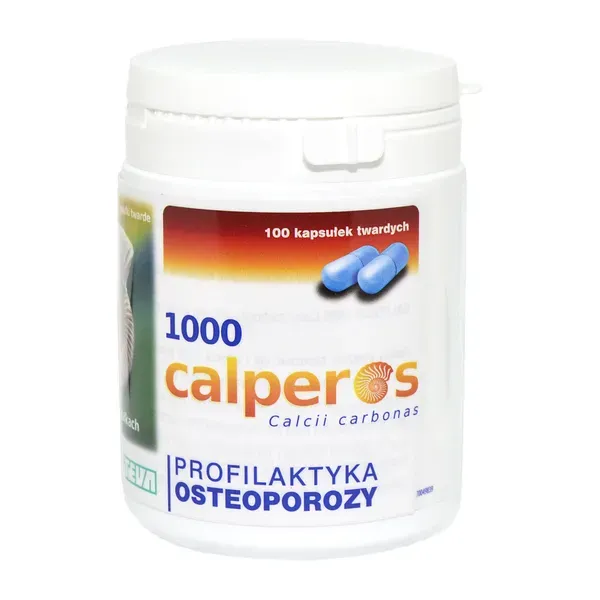
Table of Contents
Package leaflet: Information for the patient
CALPEROS 500
Calcii carbonas
200 mg calcium ions, hard capsules
CALPEROS 1000
Calcii carbonas
400 mg calcium ions, hard capsules
Please read all of this leaflet carefully before taking this medicine, because it contains
important information for the patient.
This medicine should always be taken exactly as described in this patient leaflet or as directed by
the doctor, pharmacist, or nurse.
- Keep this leaflet, so that you can read it again if necessary.
- If you need advice or further information, please contact your pharmacist.
- If you experience any adverse reactions, including any possible adverse reactions not listed in this leaflet, you should inform your doctor, pharmacist, or nurse. See section 4.
- If there is no improvement after 14 days, or if you feel worse, you should contact your doctor.
Contents of the leaflet
- What CALPEROS is and what it is used for
- Important information before taking CALPEROS
- How to take CALPEROS
- Possible side effects
- How to store CALPEROS
- Contents of the pack and other information
1. What CALPEROS is and what it is used for
CALPEROS 500 and CALPEROS 1000 contain calcium carbonate, which serves as a source of ionized calcium for the body.
Calcium is an element involved in the formation and mineralization of bone tissue throughout human life. It ensures proper nerve conduction and contractility of striated muscles. It maintains the body's electrolyte balance and also affects the proper functioning of the heart muscle. It participates in the blood coagulation process. It influences the activity of numerous enzymes and also acts as a mediator, converting chemical, physical, or hormonal stimuli into specific biological effects. Due to its ability to reduce the permeability of blood vessel walls, calcium exerts anti-inflammatory, anti-edematous, and anti-allergic effects.
The calcium carbonate contained in CALPEROS preparations helps meet daily calcium requirements, reduces calcium loss from the skeletal system in women during perimenopausal and postmenopausal periods, as well as in all elderly individuals. It prevents bone changes in chronic renal failure. It has a soothing effect on allergic reactions on the skin surface and mucous membranes.
Indications for use include:
- Conditions of increased calcium demand: periods of rapid growth in children and adolescents, as well as during pregnancy and lactation;
- Inadequate diet low in calcium-containing products;
- Impaired renal tubular reabsorption of calcium;
- Low blood calcium levels with elevated phosphate levels in patients with chronic renal failure undergoing dialysis, and prevention of increased neuromuscular excitability;
- Prophylactically in the prevention and as supplementary treatment in comprehensive management of osteoporosis;
- Following prolonged immobilization and during convalescence after bone fractures;
- Supportively in the treatment of colds and allergic diseases.
2. Important information before using CALPEROS
When not to use Calperos:
- if the patient is allergic to calcium carbonate or any of the other ingredients of this medicine (listed in section 6);
- in case of increased calcium levels in the blood and excessive calcium excretion in urine, e.g. in hyperthyroidism, hyperparathyroidism, vitamin D overdose, decalcifying tumours such as multiple myeloma and tumours metastasizing to bones, in severe renal failure not treated with dialysis;
- in nephrolithiasis (kidney stones);
- during treatment with cardiac glycosides;
- in severe hypercalciuria (urine containing excessive amounts of calcium).
Warnings and precautions
In patients with chronic renal failure, monitoring of blood calcium and phosphorus levels is required during treatment with this medicine.
When high doses are used, especially in combination with vitamin D supplements, the risk of hypercalcemia (excessively high calcium levels in blood) leading to kidney damage cannot be excluded; therefore, serum calcium levels and kidney function should be monitored in such patients.
Patients receiving cardiac glycosides should consult a physician before taking calcium preparations, as concomitant use of both medicines may enhance the effect of cardiac glycosides on the heart and increase the risk of cardiac arrhythmias.
During treatment with high doses, particularly when combined with vitamin D, thiazide diuretics and/or calcium-containing medications or food products (such as milk), there is a risk of developing hypercalcemia (excessively high calcium levels in blood), which may lead to impaired kidney function or milk-alkali syndrome. This risk also applies to pregnant women taking high calcium doses and patients with impaired kidney function. In these patients, serum calcium levels should be monitored and kidney function assessed regularly.
Taking CALPEROS with food and drink
It is recommended to take the medicine during meals.
Pregnancy and breastfeeding
If the patient is pregnant or breastfeeding, suspects she may be pregnant, or is planning to become pregnant, she should consult a doctor or pharmacist before using this medicine.
Pregnancy
Calcium requirements increase during pregnancy. No risk to the fetus has been demonstrated when therapeutic doses are used.
Breastfeeding
Calcium requirements increase during breastfeeding. No risk to the newborn has been demonstrated when therapeutic doses are used.
Driving and operating machinery
This medicine does not affect the ability to drive or operate machinery.
CALPEROS with other medicines
Thiazide diuretics enhance calcium reabsorption, reduce urinary excretion of calcium ions, and may increase the risk of hypercalcemia (excessively high calcium levels in blood). Serum calcium levels should be monitored when these drugs are used concomitantly.
Concomitant systemic corticosteroids reduce calcium absorption and may necessitate an increase in calcium dosage.
Oral calcium salts reduce gastrointestinal absorption of concurrently administered tetracycline antibiotics and fluoride compounds. These medicines should be administered at least 2 hours apart.
Calcium compounds may also reduce the absorption of quinolones, certain cephalosporin antibiotics, and iron-containing preparations.
Calcium preparations may enhance the effects and thus increase the toxicity of cardiac glycosides. Therefore, when these medicines are used together, heart function (electrocardiogram) and blood calcium levels should be monitored.
Bisphosphonates or sodium fluoride should be administered at least 3 hours before taking calcium due to reduced gastrointestinal absorption when used concomitantly.
Concomitant use of vitamin D or its derivatives in doses exceeding 400 IU/day significantly increases gastrointestinal calcium absorption and may lead to hypercalcemia. Serum calcium levels should be systematically monitored during combined treatment with vitamin D and Calperos.
This medicine may reduce the effect of verapamil and other calcium channel blockers.
Oxalic acid (present in high amounts in spinach and rhubarb) and phytic acid (present in whole grains) may reduce calcium absorption by forming insoluble calcium salts. Patients should not take calcium supplements within 2 hours of consuming foods high in oxalic or phytic acid.
Thiazide diuretics may increase the risk of hypercalcemia (excessively high calcium levels in blood).
This medicine contains indigo carmine (E132)
This medicine may cause allergic reactions.
3. How to use CALPEROS
This medicine should always be used exactly as described in this patient information leaflet, or as directed by a doctor or pharmacist. If in doubt, consult a doctor or pharmacist.
The dose is usually determined based on the daily requirement, which is as follows:
| Age group | Amount in mg (elemental calcium) |
| Adolescents and adults Pregnant and breastfeeding women Postmenopausal women not using hormone replacement therapy (HRT) Postmenopausal women using HRT | 800 - 1200 1000 – 1500 1500 1000 |
| All individuals over 65 years of age | 1500 |
The usual dosage is as follows:
CALPEROS 500: 1 to 2 hard capsules (200 mg to 400 mg of calcium) 2 to 3 times daily;
CALPEROS 1000: 1 hard capsule (400 mg of calcium) 1 to 3 times daily.
Do not exceed 1200 mg of calcium ions per day, i.e. no more than 6 hard capsules of CALPEROS 500 or 3 hard capsules of CALPEROS 1000.
Use in children and adolescents
Children over 7 years of age and adolescents:
1 hard capsule of CALPEROS 500 (200 mg calcium) up to 3 times daily.
It is recommended to take the medicine during a meal.
Overdose of CALPEROS
There are no reports of acute poisoning with this medicine.
Overdose, especially in patients taking doses higher than therapeutic of vitamin D or its derivatives, may lead to excessive calcium concentration in blood. Symptoms may include: loss of appetite, excessive thirst, nausea, vomiting, constipation, muscle weakness, fatigue, disturbances of consciousness, polyuria, bone pain, nephrocalcinosis, kidney stones, and in severe cases, cardiac arrhythmias.
Milk-alkali syndrome: metastatic calcification may occur.
Treatment of overdose: Discontinue calcium administration. Do not administer thiazide diuretics, lithium, vitamin A, or cardiac glycosides. Seek medical advice immediately. The physician may perform gastric lavage, rehydrate the patient, and depending on the severity of overdose, initiate treatment with one or more of the following medications (loop diuretics, bisphosphonates, calcitonin, corticosteroids). Electrolyte levels in blood, kidney function, urine output, and in severe cases also cardiac function, will be monitored.
Missed dose of CALPEROS:
Take the next dose at the scheduled time.
Do not take a double dose to make up for a missed dose.
4. Possible adverse reactions
Like all medicines, this medicine can cause adverse reactions, although not everyone experiences them.
The frequency of adverse reactions is defined as follows:
- not frequently: occurring in 1 to 10 out of 1,000 patients;
- rarely: occurring in 1 to 10 out of 10,000 patients.
Metabolism and nutrition disorders
Not frequently: elevated calcium levels in blood, excessive calcium excretion in urine.
Frequency not known: milk-alkali syndrome, usually observed only in cases of overdose
(see section “Taking more CALPEROS than you should”). The milk-alkali syndrome
is usually reversible after discontinuation of the medicine and with specific treatment (diuretic effect
induced by saline solution, pamidronic acid).
Gastrointestinal disorders
Rarely: constipation, bloating with gas release, nausea, abdominal pain, diarrhoea.
Skin and subcutaneous tissue disorders
Rarely: itching, rash, urticaria.
Reporting of adverse reactions
If any adverse symptoms occur, including any adverse symptoms not listed
in this leaflet, you should inform your doctor, pharmacist, or nurse. Adverse reactions
can be reported directly to the Department of Monitoring Adverse Drug Reactions of the Office for Registration of Medicinal Products, Medical Devices and Biocidal Products, Al. Jerozolimskie 181C, 02-222 Warsaw, Tel.: +48 22 49 21 301, Fax: +48 22 49 21 309, Website: https://smz.ezdrowie.gov.pl
Adverse reactions can also be reported to the marketing authorization holder.
By reporting adverse reactions, additional information on the safety of the medicine can be collected.
5. How to store CALPEROS medicine
Keep this medicine out of sight and reach of children.
Do not store above 25 °C and protect from moisture.
Do not use this medicine after the expiry date stated on the packaging after "Expiry date". The expiry date refers to the last day of the stated month.
Medicines must not be disposed of via wastewater or household waste. Ask your pharmacist how to dispose of medicines no longer required. These measures help protect the environment.
6. Contents of the packaging and other information
What CALPEROS contains
One hard capsule of CALPEROS 500 contains 200 mg of calcium ions in the form of 500 mg calcium carbonate.
One hard capsule of CALPEROS 1000 contains 400 mg of calcium ions in the form of 1000 mg calcium carbonate.
Excipients: magnesium stearate, talc.
Composition of the gelatin capsule: titanium dioxide (E 171), indigo carmine (E 132), gelatin.
What CALPEROS looks like and contents of the packaging
Available pack sizes
CALPEROS 500:
- 15 hard capsules or 30 hard capsules (blister packs);
- 200 hard capsules (HDPE bottle with PP cap);
CALPEROS 1000:
- 30 hard capsules or 100 hard capsules (blister packs);
- 100 hard capsules (HDPE bottle with PP cap).
Marketing Authorisation Holder and Manufacturer
Marketing Authorisation Holder
Teva Pharmaceuticals Polska Sp. z o.o.
ul. Emilii Plater 53
00-113 Warsaw
tel.: (22) 345 93 00
Manufacturer
Teva Operations Poland Sp. z o.o.
ul. Mogilska 80
31-546 Kraków