Atussan
Poland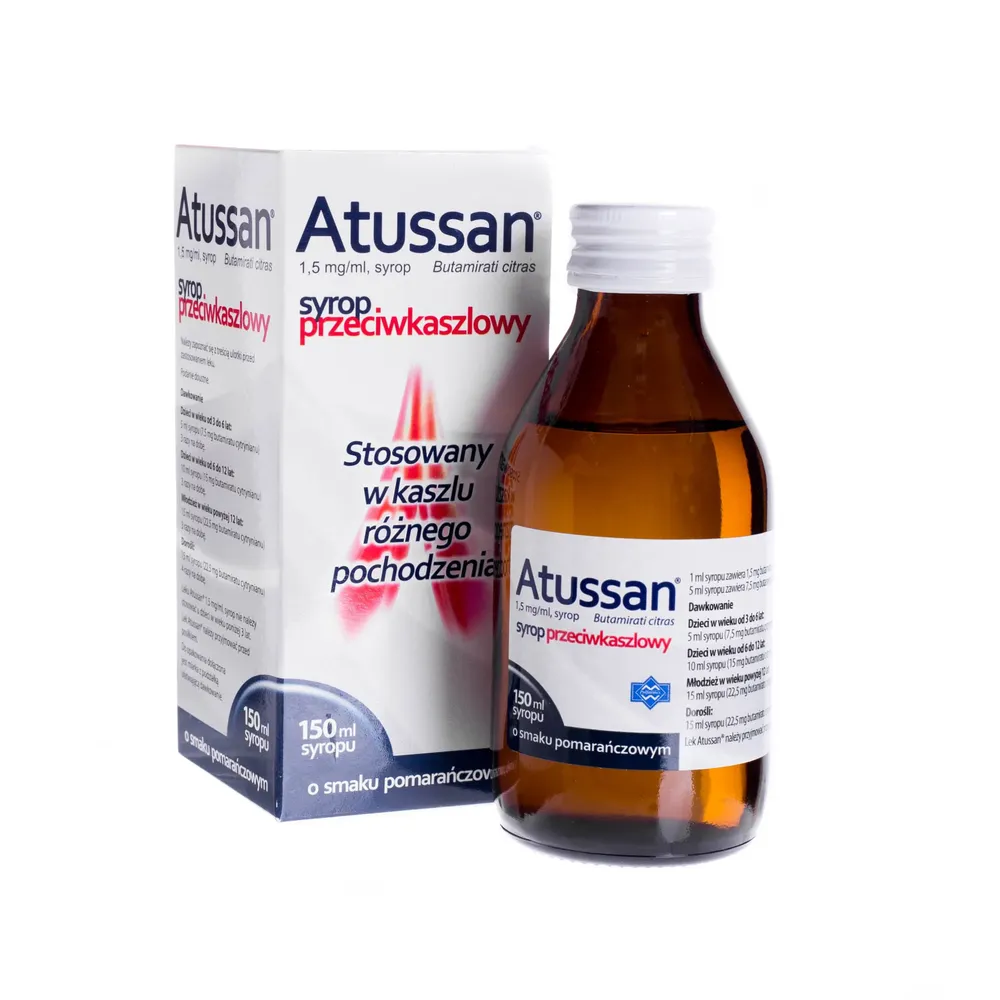
Table of Contents
Patient Information Leaflet
ATUSSAN, 1.5 mg/ml, syrup
Butamirati citras
Please read all of this leaflet carefully before taking this medicine, because it contains
important information for you.
This medicine should always be used exactly as described in this patient leaflet or as directed by
your doctor or pharmacist.
- Keep this leaflet so that you can read it again if necessary.
- If you need advice or further information, please consult your pharmacist.
- If you experience any adverse reactions, including any adverse reactions not listed in this leaflet, inform your doctor or pharmacist. See section 4.
- If there is no improvement or if you feel worse after 7 days, you should contact your doctor.
Table of contents:
- What Atussan is and what it is used for
- Important information before taking Atussan
- How to take Atussan
- Possible side effects
- How to store Atussan
- Contents of the pack and other information
1. What Atussan is and what it is used for
Atussan contains the active substance butamirate citrate. It is a non-opioid antitussive agent.
Indications:
- Symptomatic treatment of cough of various origins.
2. Important information before using Atussan
When not to use Atussan:
- if the patient is allergic to the active substance or to any of the other components of this medicine (listed in section 6).
Warnings and precautions
Before starting to use Atussan, consult a doctor or pharmacist:
- if the patient has serious breathing difficulties (shallow, irregular breathing, worsening shortness of breath, cyanosis, apnea);
- if cough persists for more than 7 days; the doctor will determine the cause of the cough.
Atussan and other medicines
Inform the doctor or pharmacist about all medicines currently or recently taken, as well as any medicines planned for future use.
Concomitant use of expectorants should be avoided (drugs that increase mucus production). This may lead to mucus accumulation in the airways, increasing the risk of bronchospasm and respiratory tract infection.
Atussan with food and drink
Atussan should be taken before meals.
Pregnancy and breastfeeding
If the patient is pregnant, breastfeeding, suspects she may be pregnant, or is planning to become pregnant, she should consult a doctor or pharmacist before using this medicine.
The use of Atussan should be avoided during the first trimester of pregnancy. During the second and third trimesters, the medicine may be used only if the doctor considers it absolutely necessary.
For safety reasons, butamirate citrate should not be used during breastfeeding.
Driving and operating machinery
Atussan may cause dizziness or drowsiness; therefore, caution should be exercised when driving or operating machinery.
Atussan contains sorbitol, glycerol, sodium benzoate, ethanol, and sodium
The medicine contains 450 mg of sorbitol per 1 ml of syrup. Sorbitol is a source of fructose. If intolerance to certain sugars has been previously diagnosed in the patient (or their child), or if hereditary fructose intolerance—a rare genetic disorder in which the patient's body cannot metabolize fructose—has been diagnosed, the patient should consult a doctor before taking the medicine or giving it to a child. Sorbitol may cause gastrointestinal discomfort and may have a mild laxative effect. Calorific value: 2.6 kcal/g of sorbitol.
Atussan also contains glycerol (0.25 g in 1 ml of syrup), which may cause headache, gastric disturbances, and diarrhea.
Atussan also contains sodium benzoate (E 211). The medicine contains 1 mg of benzoic acid salt per 1 ml of syrup.
Atussan contains a small amount of ethanol, which is part of the flavoring component.
This medicine contains 6.96 mg of alcohol (ethanol) in 5 ml of syrup. At the maximum daily dose, the amount of alcohol is equivalent to:
- in children aged 3 to 6 years – less than 1 ml of beer and less than 1 ml of wine,
- in children aged 6 to 12 years – less than 2 ml of beer and less than 1 ml of wine,
- in adolescents over 12 years – less than 2 ml of beer and less than 1 ml of wine,
- in adults – less than 2 ml of beer and 1 ml of wine. The small amount of alcohol in this medicine will not cause noticeable effects.
This medicine contains less than 1 mmol (23 mg) of sodium per 1 ml of syrup, meaning the medicine is considered "sodium-free".
3. How to use Atussan
This medicine should always be taken exactly as described in this patient leaflet or as directed by a doctor or pharmacist.
If in doubt, consult a doctor or pharmacist.
Do not use Atussan for longer than 7 days without consulting a doctor.
The usual dose is:
Children and adolescents
| Age | Dosage |
| Administer 3 times daily: | |
| 3 to 6 years | 5 ml of syrup (7.5 mg citric acid butamirate) |
| 6 to 12 years | 10 ml of syrup (15 mg citric acid butamirate) |
| above 12 years | 15 ml of syrup (22.5 mg citric acid butamirate) |
Adults
15 ml of syrup (22.5 mg citrate of butamirate) 4 times daily.
- Atussan must not be used in children under 3 years of age.
- Atussan should be taken before meals.
A measuring device with graduations is attached to the package to facilitate dosing.
Use of a higher than recommended dose of Atussan
If a higher than recommended dose of Atussan is taken, inform your doctor or pharmacist immediately.
The following symptoms of overdose may occur:
- drowsiness;
- vomiting, diarrhea, nausea;
- dizziness;
- hypotension.
Missed dose of Atussan
If a dose is missed, take it as soon as possible and continue treatment according to the recommendations.
Do not take a double dose to make up for the missed dose.
Discontinuation of Atussan
If you have any further doubts regarding the use of this medicine, consult your doctor or pharmacist.
4. Possible adverse effects
Like all medicines, this medicine can cause adverse effects, although not everybody will experience them.
Rare adverse effects (occurring in more than 1 in 10,000 people and less than 1 in 1,000 people):
- drowsiness;
- nausea, diarrhoea;
- urticaria.
Reporting of adverse effects
If any adverse effects occur, including any adverse effects not listed in this leaflet, inform a doctor, pharmacist, or nurse. Adverse effects can be reported directly to the Department of Monitoring Adverse Drug Reactions of the Office for Registration of Medicinal Products, Medical Devices and Biocidal Products:
Al. Jerozolimskie 181C
02-222 Warsaw
Tel.: 22 49-21-301,
Fax: 22 49-21-309
Website: https://smz.ezdrowie.gov.pl
Adverse effects can also be reported to the marketing authorization holder.
Reporting adverse effects helps to provide more information on the safety of the medicine.
5. How to store Atussan
Keep the medicine out of the sight and reach of children.
Store below 25 °C. Keep in the original packaging.
Do not use this medicine after the expiry date stated on the carton and label after "EXP". The expiry date refers to the last day of the stated month.
Medicines must not be disposed of via the sewage system or in household waste. Ask your pharmacist how to dispose of medicines no longer required. Such measures help protect the environment.
6. Contents of the package and other information
What Atussan contains
- The active substance is citric butamirate. 1 ml of syrup contains 1.5 mg of citric butamirate.
- The other ingredients are: sodium benzoate (E 211), liquid non-crystallizing sorbitol (E 420), glycerol (E 422), sodium saccharin, liquid orange flavour (containing, among others, ethanol), monohydrate citric acid, sodium citrate, purified water.
What Atussan looks like and contents of the pack
Atussan is a clear syrup with an orange taste and odour.
The container is an amber glass bottle or a polyethylene terephthalate (PET) bottle, closed with an aluminium cap or a polyethylene (PE) cap, containing 100 ml, 150 ml or 200 ml of syrup,
packaged in a cardboard box. A dosing cup is supplied with the package.
Marketing Authorisation Holder and Manufacturer
Polfarmex S.A.
ul. Józefów 9
99-300 Kutno
Poland
Tel. (24) 357 44 44
Fax (24) 357 45 45
e-mail: [email protected]