Atosiban accord
Poland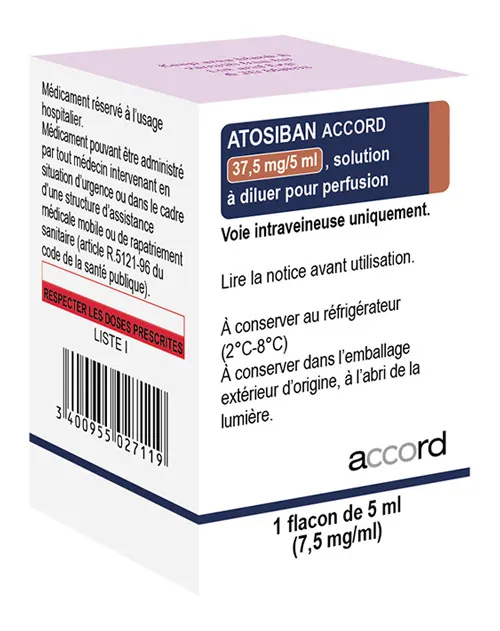
Table of Contents
Package leaflet: Information for the user
Atosiban Accord, 37.5 mg/5 ml, concentrate for solution for infusion
Atosibanum
Please read all of this leaflet carefully before taking this medicine, because it contains important information for you.
- Keep this leaflet, as you may need to read it again.
- If you have any further questions, please ask your doctor, pharmacist or nurse.
- If you experience any side effects, including any not listed in this leaflet, please tell your doctor, pharmacist or nurse. See section 4.
Contents of the leaflet
- What Atosiban Accord is and what it is used for
- What you need to know before using Atosiban Accord
- How to use Atosiban Accord
- Possible side effects
- How to store Atosiban Accord
- Contents of the pack and other information
1. What Atosiban Accord is and what it is used for
The full name of the medicine is Atosiban Accord, 37.5 mg/5 ml, concentrate for solution for infusion, but in the remainder of this leaflet it will be referred to as Atosiban Accord.
Atosiban Accord contains atosiban. This medicine is used to delay premature birth. It is used in adult pregnant women between the 24th and 33rd week of pregnancy.
Atosiban Accord works by reducing the strength of uterine contractions. It also reduces the frequency of uterine contractions. This occurs because the medicine blocks the action of a natural hormone in the woman's body called oxytocin, which causes uterine contractions.
2. What you need to know before using Atosiban Accord
Do not use Atosiban Accord
- if the pregnancy has lasted less than 24 weeks;
- if the pregnancy has lasted more than 33 weeks;
- if the amniotic membranes have ruptured prematurely (premature rupture of membranes) and the pregnancy has reached or exceeded 30 full weeks;
- if the unborn child (fetus) has an abnormal heart rate;
- if you have vaginal bleeding and your doctor considers that immediate delivery of the unborn child is required;
- if you have a condition called severe pre-eclampsia and your doctor considers that immediate delivery of the unborn child is required; severe pre-eclampsia is a condition in which high blood pressure, fluid retention in the body, and (or) protein in the urine are observed;
- if you have a condition called eclampsia, which is similar to severe pre-eclampsia, but you also have seizures; this means that immediate delivery of the unborn child is required;
- if the unborn child has died;
- if you have an infection or suspected infection of the uterus;
- if the placenta covers the birth canal (placenta praevia);
- if the placenta has separated from the uterine wall (placental abruption);
- if you or the unborn child have any other condition in which continuing the pregnancy would be dangerous;
- if you are allergic to atosiban or any of the other ingredients of this medicine (listed in section 6).
Warnings and precautions
Before starting treatment with Atosiban Accord, please consult your doctor, midwife or pharmacist:
- if you suspect that your waters have broken (premature rupture of membranes);
- if you have impaired kidney or liver function;
- if you are pregnant between 24 and 27 weeks;
- if your pregnancy is multiple (more than one child);
- if you have recurrent uterine contractions, treatment with Atosiban Accord may be repeated up to three times;
- if the unborn child is small for gestational age;
- your uterus may have reduced ability to contract after delivery; this may lead to bleeding;
- if you have a multiple pregnancy and (or) are taking medicines that may delay delivery, such as medicines used to treat high blood pressure. This may increase the risk of pulmonary oedema (fluid accumulation in the lungs).
If any of the above conditions apply to you (or if you are unsure), please inform your doctor, midwife or pharmacist before using Atosiban Accord.
Children and adolescents
Atosiban Accord has not been studied in pregnant women under 18 years of age.
Atosiban Accord with other medicines
Tell your doctor or pharmacist about all medicines you are currently taking, have recently taken or plan to take.
Pregnancy and breastfeeding
If you are pregnant and breastfeeding, you should stop breastfeeding while receiving Atosiban Accord.
3. How to use Atosiban Accord
Atosiban Accord is administered to you in hospital by a doctor, nurse or midwife. They will decide what dose is appropriate for you. They will also ensure that the solution is clear and free from insoluble particles.
Atosiban Accord is given intravenously (into a vein) in three stages:
- an initial bolus dose of 6.75 mg in 0.9 ml is administered slowly into a vein over 1 minute;
- followed by a continuous intravenous infusion at a rate of 18 mg per hour for 3 hours;
- then a further continuous intravenous infusion at a rate of 6 mg per hour for up to 45 hours or until uterine contractions cease.
The total duration of treatment should not exceed 48 hours. If uterine contractions recur, treatment with Atosiban Accord may be repeated. Treatment with Atosiban Accord may be repeated up to three times.
During treatment with Atosiban Accord, uterine contractions and the unborn child's heart rate may be monitored.
It is recommended not to repeat treatment more than three times during a single pregnancy.
4. Possible side effects
Like all medicines, this medicine can cause side effects, although not everybody gets them.
Side effects observed in mothers are usually of mild to moderate intensity. There are no known side effects affecting unborn children or newborns.
The following side effects may occur during treatment with this medicine:
Very common (affects more than 1 in 10 people)
- nausea
Common (affects less than 1 in 10 people)
- headache
- dizziness
- hot flushes
- vomiting
- rapid heartbeat
- low blood pressure; symptoms may include dizziness or feeling faint
- injection site reaction
- high blood sugar levels
Uncommon (affects less than 1 in 100 people)
- high temperature (fever)
- difficulty sleeping (insomnia)
- itching
- rash
Rare (affects less than 1 in 1,000 people)
- the uterus may have reduced ability to contract after delivery; this may lead to bleeding
- allergic reactions
You may experience shallow breathing or pulmonary oedema (fluid accumulation in the lungs), particularly if you have a multiple pregnancy and (or) are taking medicines that may delay delivery, such as medicines used to treat high blood pressure.
Reporting of side effects
If you experience any side effects, including any not listed in this leaflet, please tell your doctor or pharmacist. Side effects can be reported directly to the Department for Monitoring Adverse Drug Reactions, Office for Registration of Medicinal Products, Medical Devices and Biocidal Products, Al. Jerozolimskie 181C, 02-222 Warsaw, tel.: +48 22 49 21 301, fax: +48 22 49 21 309, website: https://smz.ezdrowie.gov.pl
Side effects can also be reported to the marketing authorization holder.
Reporting side effects helps provide more information on the safety of this medicine.
5. How to store Atosiban Accord
Keep this medicine out of the sight and reach of children.
Do not use this medicine after the expiry date stated on the vial/fiolin and on the carton after EXP.
The expiry date refers to the last day of the stated month.
Store in a refrigerator (2°C – 8°C).
Keep in the original packaging to protect from light.
Physicochemical stability of the product after dilution has been demonstrated for 72 hours at 23°C – 27°C.
From a microbiological point of view, if the method of opening/reconstitution/dilution does not exclude the risk of microbiological contamination, the product should be used immediately. If not used immediately, the responsibility for storage conditions and duration lies with the user.
Do not use the solution if it changes colour or if insoluble particles are visible.
6. Contents of the pack and other information
What Atosiban Accord contains
The active substance is atosiban.
One vial of Atosiban Accord 37.5 mg/5 ml solution for injection contains atosiban acetate equivalent to 37.5 mg of atosiban in 5 ml.
The other ingredients are: mannitol, hydrochloric acid (concentrated), water for injections.
What Atosiban Accord looks like and contents of the pack
Atosiban Accord is a clear, colourless solution free from visible insoluble particles.
Each pack contains one vial with 5 ml of solution.
Marketing Authorisation Holder
Accord Healthcare Polska Sp. z o.o.
ul. Taśmowa 7
02-677 Warszawa
Tel: +48 22 577 28 00
Manufacturer/Importer
Accord Healthcare B.V.
Winthontlaan 200
3526 KV Utrecht
The Netherlands
Accord Healthcare Polska Sp. z o.o.
ul. Lutomierska 50
95-200 Pabianice
Poland
This medicinal product is authorised in the Member States of the European Economic Area under the following names:
| Member State Name | Medicinal Product Name |
| Austria | Atosiban Accord 37.5 mg/5 ml concentrate for solution for infusion |
| Czech Republic | Atosiban Accord 37.5 mg/5 ml concentrate for infusion solution |
| Denmark | Atosiban Accord 37.5 mg/5 ml |
| Finland | Atosiban Accord 37.5 mg/5 ml concentrate for infusion solution |
| France | Atosiban Accord 37.5 mg/5 ml solution à diluer pour perfusion |
| Spain | Atosiban Accord 37.5 mg/5 ml concentrate for solution for perfusion EFG |
| Netherlands | Atosiban Accord 37.5 mg/5 ml concentrate for solution for infusion |
| Ireland | Atosiban Accord 37.5 mg/5 ml concentrate for solution for infusion |
| Lithuania | Atosiban Accord 37.5 mg/5 ml concentrate for infusion solution |
| Malta | Atosiban Accord 37.5 mg/5 ml concentrate for solution for infusion |
| Germany | Atosiban Accord 37.5 mg/5 ml concentrate for solution for infusion |
| Norway | Atosiban Accord 37.5 mg/5 ml concentrate to infusion solution |
| Poland | Atosiban Accord |
| Portugal | Atosibano Accord |
| Sweden | Atosiban Accord 37.5 mg/5 ml concentrate for infusion solution |
| United Kingdom | Atosiban Accord 37.5 mg/5 ml concentrate for solution for infusion |
| Italy | Atosiban Accord |
Information intended exclusively for healthcare professionals: (See also section 3)
Instructions for proper use
Before using Atosiban Accord, check that the solution is clear and free from insoluble particles.
Atosiban Accord is administered intravenously in three consecutive stages:
- an initial intravenous dose of 6.75 mg in 0.9 ml is injected slowly into a vein over 1 minute;
- a continuous intravenous infusion at a rate of 24 ml/hour is administered for 3 hours;
- a continuous intravenous infusion at a rate of 8 ml/hour is administered for up to 45 hours or until uterine contractions cease. The total duration of treatment should not exceed 48 hours. Repeated treatment cycles with Atosiban may be applied if contractions recur. Re-treatment should not be repeated more than three times during the same pregnancy. Preparation of intravenous infusion
The intravenous infusion is prepared by diluting Atosiban Accord 37.5 mg/5 ml concentrate for solution for infusion in 9 mg/ml (0.9%) sodium chloride injection solution, Ringer's lactate solution, or 5% glucose solution. This is achieved by removing 10 ml of the infusion fluid from a 100 ml infusion bag and replacing it with 10 millilitres of Atosiban Accord 37.5 mg/5 ml concentrate for solution for infusion, drawn from two 5 ml vials, to obtain a concentration of 75 mg of atosiban in 100 ml. If an infusion bag of different volume is used, calculations must be performed and proportions adjusted accordingly to achieve the same concentration. Atosiban Accord must not be mixed with other medicinal products in the infusion bag.