Asamax 250
Poland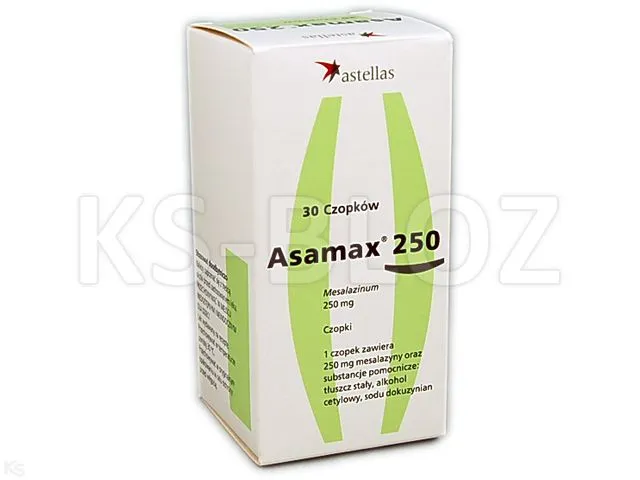
Table of Contents
- Package leaflet: Information for the patient
- 1. What Asamax 250 and Asamax 500 are and what they are used for
- 2. Important information before using Asamax 250 and Asamax 500
- 3. How to use Asamax 250 and Asamax 500
- 4. Possible adverse effects
- 5. How to store Asamax 250 and Asamax 500
- 6. Contents of the packaging and other information
Package leaflet: Information for the patient
Asamax 250 250 mg suppositories
Asamax 500 500 mg suppositories
Mesalazinum
Please read carefully the entire leaflet before using the medicine, as it contains
important information for the patient.
- Keep this leaflet, so that you can read it again if necessary.
- If you have any questions, please consult your doctor or pharmacist.
- This medicine has been prescribed for a specific individual. Do not pass it on to others. The medicine may harm another person, even if their symptoms are the same.
- If the patient experiences any adverse reactions, including any adverse reactions not listed in this leaflet, inform the doctor or pharmacist immediately. See section 4.
Table of contents of the leaflet:
- What Asamax 250 and Asamax 500 are and what they are used for
- Important information before using Asamax 250 and Asamax 500
- How to use Asamax 250 and Asamax 500
- Possible side effects
- How to store Asamax 250 and Asamax 500
- Contents of the pack and other information
1. What Asamax 250 and Asamax 500 are and what they are used for
Asamax 250 and Asamax 500 suppositories contain the active substance mesalazine. Mesalazine exerts a direct anti-inflammatory effect on diseased tissue in the intestine. Regular use of the medicine as directed by the doctor may halt the progression of the disease process in the rectum.
Indications for Asamax 250 and Asamax 500
Ulcerative proctitis.
2. Important information before using Asamax 250 and Asamax 500
When not to use Asamax 250 and Asamax 500
- if the patient is allergic to mesalazine/salicylates or any of the other ingredients of this medicine (listed in section 6).
- if the patient has severe impairment of kidney or liver function.
Warnings and precautions
Before starting treatment with mesalazine, inform the doctor:
- if the patient has ever experienced the following after taking mesalazine: severe skin rash, skin peeling, blisters, or oral ulcers.
When to exercise special caution with mesalazine:
Serious skin reactions have occurred during treatment with mesalazine, including drug reaction with eosinophilia and systemic symptoms (DRESS), Stevens-Johnson syndrome (SJS), toxic epidermal necrolysis (TEN), and other serious symptoms. Treatment with mesalazine must be discontinued immediately and medical help sought if any of these severe skin reactions occur, as listed in section 4.
Please discuss this with your doctor or pharmacist before starting treatment with Asamax 250 and Asamax 500.
- Before starting and during treatment, the doctor will recommend regular blood tests (complete blood count, liver and kidney function parameters). If serious blood abnormalities occur, the doctor will discontinue treatment.
- The doctor will exercise caution in patients with liver function disorders.
- This medicine should not be used in patients with impaired kidney function. In such patients who develop kidney failure during treatment, mesalazine toxicity should be considered.
- The doctor will closely monitor patients with lung diseases, especially bronchial asthma.
- The doctor will closely monitor patients who have previously experienced adverse reactions to sulfasalazine-containing medicines and will immediately discontinue treatment if such reactions occur.
- If signs of heart hypersensitivity reactions (myocarditis or pericarditis) occur, the doctor will discontinue treatment.
- Mesalazine may lead to the formation of kidney stones. Symptoms may include flank pain and blood in the urine. Adequate fluid intake is recommended during mesalazine treatment.
- Mesalazine may cause a reddish-brown discoloration of urine upon contact with sodium hypochlorite bleach commonly found in toilet water. This is a chemical reaction between mesalazine and bleach and is harmless.
Children and adolescents
Data on the use of mesalazine in children and adolescents are limited.
Asamax 250 and Asamax 500 with other medicines
Inform the doctor about all medicines currently or recently taken, as well as any medicines the patient intends to take.
In patients who are concurrently taking azathioprine, 6-mercaptopurine, or thioguanine, there is a possibility of enhanced myelosuppressive effects (reduced bone marrow cell counts) of these drugs.
There is limited evidence that mesalazine may reduce the anticoagulant effect of warfarin (a medicine that reduces blood clotting).
Pregnancy, breastfeeding, and fertility
If the patient is pregnant or breastfeeding, suspects she may be pregnant, or is planning to have a child, she should consult her doctor before using this medicine.
Asamax 250 and Asamax 500 should be used during pregnancy only if the potential benefits outweigh the expected risks.
There are insufficient data on the use of mesalazine in pregnant women. Data from a limited number of pregnant women exposed to mesalazine during pregnancy have not shown adverse effects on pregnancy or the health of the fetus or newborn. Other epidemiological data are currently not available.
In a single case, following high-dose mesalazine (2–4 g orally) during pregnancy, neonatal kidney failure was reported.
Animal studies with orally administered mesalazine have not shown direct or indirect harmful effects on pregnancy, embryonic or fetal development, or neonatal development.
Asamax 250 and Asamax 500 should be used during breastfeeding only if the potential benefits outweigh the expected risks.
N-acetyl-5-salicylic acid, and to a lesser extent mesalazine, pass into breast milk in small amounts. Currently, data from breastfeeding women are limited. Hypersensitivity reactions such as diarrhea in the breastfed infant cannot be excluded. If diarrhea occurs in a breastfed infant, breastfeeding should be discontinued.
The decision to use mesalazine during pregnancy and breastfeeding is always made by the doctor.
Very rarely, transient reduction in sperm count associated with mesalazine use has been reported. There are no data on the effect of mesalazine on female fertility.
Driving and operating machinery
Mesalazine has no known effect on the ability to drive vehicles or operate machinery.
3. How to use Asamax 250 and Asamax 500
These medicines should always be used as prescribed by your doctor. If in doubt, consult your doctor or pharmacist.
The dosage and duration of treatment are always determined by the doctor, depending on the severity of symptoms.
The desired therapeutic effect of mesalazine can only be achieved if dosage instructions are consistently and strictly followed.
Dosage
The recommended dose is 500 mg of mesalazine three times daily, administered rectally. During remission phase, to prevent relapse of the disease, the dosage may be reduced to 250 mg of mesalazine three times daily, administered rectally.
Use in children
The safety and efficacy of this medicine in children have not been established due to limited experience and insufficient data.
Duration of treatment
The duration of treatment is always determined by the doctor depending on the severity of symptoms.
Method of administration
The suppository should be inserted into the rectum via the anus. It is easiest to insert the suppository while lying on your side, with knees slightly bent.
Use of a higher than recommended dose of Asamax 250 or Asamax 500
There is limited data on overdose (e.g. suicide attempts following ingestion), which does not indicate toxic effects of mesalazine on the liver or kidneys. There is no specific antidote; treatment of overdose is symptomatic and supportive.
In case of administration of a higher than recommended dose, seek immediate medical advice from a doctor.
Missed dose of Asamax 250 or Asamax 500
If a patient forgets to take a dose, they should take it as soon as possible, provided that the time until the next scheduled dose is longer than 2–3 hours. Otherwise, only the next dose should be taken. Do not use a double dose to make up for a missed dose.
If you have any further questions about the use of this medicine, consult your doctor or pharmacist.
4. Possible adverse effects
Like all medicines, these medicines may cause adverse effects, although not everyone experiences them.
Treatment with mesalazine should be discontinued and immediate medical attention sought if the
patient develops any of the following symptoms:
- red, flat, disc-shaped or circular patches on the trunk, often with blisters in their centre, skin peeling, oral, throat, nasal, genital and ocular ulcers, extensive rash, fever and enlarged lymph nodes. Such severe skin rashes may be preceded by local inflammatory conditions, skin lesions, fever and influenza-like symptoms (see also section 2).
- such severe skin rashes may also be associated with increased liver enzyme activity and elevated white blood cell count (eosinophilia) shown in blood tests ordered, if necessary, by a physician.
Other possible adverse effects:
Adverse effects occurring rarely (may affect fewer than 1 in 1,000 people):
- headache
- dizziness
- myocarditis, pericarditis
- abdominal pain, diarrhoea, flatulence, nausea, vomiting
- increased skin sensitivity to sunlight and ultraviolet radiation (photosensitivity)
Adverse effects occurring very rarely (may affect fewer than 1 in 10,000 people):
- changes in blood cell counts (aplastic anaemia – resulting from impaired bone marrow function, agranulocytosis – absence of white blood cells in blood, pancytopenia – decreased number of white and red blood cells and platelets, neutropenia – reduced number of one type of white blood cells (neutrophils), leukopenia – reduced number of white blood cells, thrombocytopenia – reduced number of platelets); eosinophilia (increased number of one type of white blood cells –
eosinophils) occurring in hypersensitivity reactions. - hypersensitivity reactions such as allergic rash, drug fever, lupus-like syndrome, colitis
- peripheral neuropathy (a disorder of peripheral nerves characterized by numbness, tingling or weakness in limbs)
- allergic and fibrosing lung reactions (including: dyspnoea, cough, bronchospasm, pulmonary alveolitis, pulmonary eosinophilia – accumulation in the lungs of a certain type of white blood cells (acidophilic granulocytes), pulmonary infiltrates, pneumonia)
- acute pancreatitis
- changes in liver function parameters (increased aminotransferase activity, cholestatic parameters), hepatitis, cholestatic hepatitis
- muscle pain, joint pain
- alopecia
- renal function disorders, including: acute and chronic interstitial nephritis and renal failure
- transient reduction in sperm count in semen.
Frequency unknown (frequency cannot be estimated from available data):
- kidney stones and associated renal pain (see also section 2).
Reporting of adverse effects
If any adverse effects occur, including any adverse effects not listed in this leaflet, inform your doctor. Adverse effects can be reported directly to:
Department of Monitoring Adverse Drug Reactions, Office for Registration of Medicinal Products, Medical Devices and Biocidal Products
Al. Jerozolimskie 181C
PL-02 222 Warsaw
Tel.: +48 22 49 21 301
Fax: +48 22 49 21 309
Website: https://smz.ezdrowie.gov.pl
Adverse effects can also be reported to the marketing authorisation holder.
Reporting adverse effects helps to provide more information on the safety of the medicine.
5. How to store Asamax 250 and Asamax 500
Keep this medicine out of sight and reach of children.
Store below 30°C. Keep in the original packaging to protect from moisture. Do not use Asamax 250 and Asamax 500 after the expiry date stated on the carton and blister pack after "EXP:".
Medicines must not be disposed of via wastewater or household waste. Ask your pharmacist how to dispose of medicines no longer required. Such practices help protect the environment.
6. Contents of the packaging and other information
What Asamax 250 and Asamax 500 contain
The active substance in Asamax 250 and Asamax 500 is mesalazine.
Each Asamax 250 suppository contains 250 mg of mesalazine.
Each Asamax 500 suppository contains 500 mg of mesalazine.
The other ingredients are: hard fat, cetyl alcohol, sodium docosate.
What Asamax 250 and Asamax 500 look like and contents of the pack
Asamax 250 and Asamax 500 suppositories are packed in PVC/LDPE foil blisters containing 6 suppositories.
The cardboard pack contains 30 suppositories.
Marketing Authorisation Holder and Manufacturer
Marketing Authorisation Holder:
Astellas Pharma Sp. z o.o.
Żwirki i Wigury 16C
02-092 Warsaw
tel. (22) 545 11 11
Manufacturer:
Temmler Italia S.R.L.
Via Delle Industrie 2
20061 Carugate (MI), Italy
For further information, please contact the Marketing Authorisation Holder.