Arduan
Poland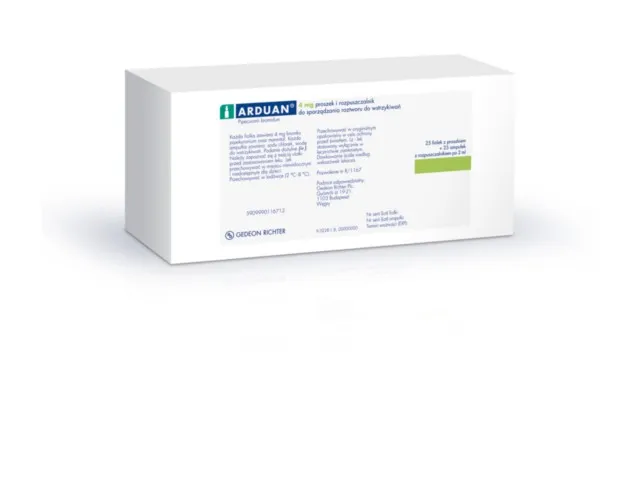
Table of Contents
Package leaflet: Information for the user
ARDUAN, 4 mg, powder and solvent for solution for injection
Pipecuronii bromidum
Please read all of this leaflet carefully before the medicine is administered, as it contains
important information for the patient.
- Keep this leaflet as you may need to read it again.
- If you have any further questions, please ask your doctor or pharmacist.
- This medicine has been prescribed for a specific individual. Do not pass it on to others. It may harm other people even if their symptoms are the same.
- If you experience any adverse reactions, including any not listed in this leaflet, tell your doctor or pharmacist. See section 4.
Contents of the leaflet
- What Arduan is and what it is used for
- Important information before using Arduan
- How to use Arduan
- Possible side effects
- How to store Arduan
- Contents of the pack and other information
1. What Arduan is and what it is used for
Arduan is a non-depolarizing muscle relaxant that competitively blocks the transmission of impulses from the motor nerve ending to the striated muscle by binding to the nicotinic receptor located at the motor end plate of the striated muscle, in competition with acetylcholine.
In contrast to depolarizing neuromuscular blocking agents such as succinylcholine, Arduan does not cause fascicular muscle twitching and has no hormonal effects. The neuromuscular blocking action is limited to striated muscles.
It also lacks ganglion-blocking, vagolytic, or sympathomimetic effects, even at doses many times greater than the ED90 dose (the dose required to achieve 90% receptor depression).
Dose-response studies have shown that the ED50 and ED90 doses of Arduan during balanced anaesthesia are 0.03 and 0.05 mg/kg body weight, respectively. A dose of 0.05 mg/kg body weight provides adequate muscle relaxation for various surgical procedures for an average duration of 40 to 50 minutes.
The time from administration to the onset of maximum neuromuscular blockade (onset time) depends on the dose administered and ranges from 1.5 to 5 minutes. The shortest onset times occur with doses of 0.07–0.08 mg/kg body weight. Further dose increases result in only slight reductions in onset time, but significantly prolong the duration of effect.
Indications for use:
- Endotracheal intubation and skeletal muscle relaxation during general anaesthesia. It may be used during various surgical procedures requiring muscle relaxation lasting longer than 20–30 minutes.
- As a component of artificial ventilation.
2. Important information before using Arduan
When not to use Arduan:
- if the patient is allergic to pipecuronium bromide or any of the other ingredients of this medicine (listed in section 6);
- in cases of myasthenia gravis.
Warnings and precautions
Before starting treatment with Arduan, discuss this with your doctor or pharmacist.
- Due to the effect of Arduan on respiratory muscles, it may be administered only in the presence of a person specialized in artificial ventilation, and in facilities where conditions for artificial ventilation are available.
- Generally, anaphylactic and anaphylactoid reactions to neuromuscular blocking agents have been described in the literature. Although only a few such cases have been reported with Arduan, the medicinal product should be administered only in settings where such reactions can be treated immediately.
- Arduan has no significant cardiovascular effects within the range of muscle-paralyzing doses. Minor, clinically insignificant changes (usually a decrease) in heart rate, systolic and diastolic blood pressure, and cardiac output may occur. These changes are likely related to the effects of other drugs (fentanyl, thiopental, halothane) used concomitantly during induction of anesthesia.
- Given the above, the use and dosage of vagolytic drugs as premedication should be considered. (The stimulating effects of concomitantly used anesthetics and the type of surgical intervention should naturally be taken into account.)
- In patients with diseases that may alter the effect of Arduan, the use of a peripheral nerve stimulator is recommended. It may help prevent overdosing and assist in assessing the recovery of neuromuscular transmission.
The following factors may affect the pharmacokinetics and/or muscle-relaxing effect of
Arduan:
Neuromuscular disorders
In patients with neuromuscular disorders – except myasthenia gravis (in which the use of Arduan is contraindicated) – Arduan should be administered cautiously, as these disorders may lead to either increased or decreased muscle relaxation.
Before surgery, non-depolarizing muscle relaxants should not be used for endotracheal intubation. Concomitant administration of anesthetics and agents affecting neuromuscular transmission (benzodiazepines) is not recommended. Anticholinesterase agents should be administered at the end of the surgical procedure, 10 to 15 minutes before the desired therapeutic effect is required. After surgery, the physician should consider planned prolonged mechanical ventilation. Transition to spontaneous breathing should occur under monitoring of neuromuscular blockade and respiratory parameters.
Cardiovascular insufficiency
In such patients, the physician should consider a possible delay in the onset of action of Arduan, and thus a later intubation.
Malignant hyperthermia
Neither in experimental nor in clinical settings has malignant hyperthermia been observed in association with Arduan administration. Since muscle relaxants are never used as monotherapy, and malignant hyperthermia during anesthesia is possible even in the absence of known triggering factors, clinicians should be familiar with early signs, diagnostic methods, and treatment of malignant hyperthermia.
Other
As with other neuromuscular blocking agents, acid-base balance and electrolyte homeostasis should be corrected before anesthesia.
Reduced body temperature may prolong the effect of the drug.
Hypokalemia (decreased potassium concentration in blood), cardiac glycosides, diuretics (water pills), hypermagnesemia (increased magnesium concentration in blood), hypocalcemia (decreased calcium concentration in blood), dehydration, acidosis, hypoproteinemia (decreased plasma protein concentration in blood), hypercapnia (respiratory acidosis due to excess carbon dioxide in blood), and cachexia (body wasting due to nutritional deficiencies) may intensify or prolong the effect of Arduan.
Similar to other non-depolarizing muscle relaxants, Arduan may shorten the partial thromboplastin time and prothrombin time (a test assessing plasma clotting time in the presence of calcium ions after thromboplastin administration – a factor causing conversion of prothrombin to thrombin present in blood platelets, i.e., thrombocytes).
Consult your doctor, even if the above warnings refer to conditions that occurred in the past.
Use of Arduan in patients with impaired kidney and/or liver function:
Liver dysfunction
In liver cirrhosis, the onset of action of pipecuronium, involving neuromuscular blockade, may be prolonged, while the duration of clinical muscle relaxation remains unchanged. In extrahepatic cholestasis, the elimination half-life may be prolonged, primarily due to increased volume of distribution.
Renal insufficiency
In patients with renal insufficiency, the duration of action is prolonged. The physician should appropriately reduce the dose of Arduan.
Arduan and other medicines
Inform your doctor or pharmacist about all medicines currently used or recently used, as well as any medicines you plan to use.
The effect of Arduan may be influenced by other medicines taken before or during surgery.
The following medicines may affect the action of Arduan:
Enhancement and/or prolongation of effect.
- inhalational anesthetics (halothane, methoxyflurane, diethyl ether, enflurane, isoflurane, cyclopropane),
- intravenous anesthetics (ketamine, fentanyl, propanidid, barbiturates, etomidate, gammahydroxybutyrate),
- high doses of local anesthetics,
- other non-depolarizing muscle relaxants administered before suxamethonium,
- certain antibiotics and chemotherapeutic agents (aminoglycosides and polypeptide antibiotics, imidazole derivatives, metronidazole and others),
- diuretics, beta-blockers, thiamine, MAO inhibitors, guanidine, protamine, phenytoin, alpha-blockers, calcium antagonists, magnesium salts,
- most antiarrhythmic drugs, including quinidine and intravenous lidocaine, enhance the blockade caused by non-depolarizing muscle relaxants.
Reduction of effect.
Long-term administration of corticosteroids, neostigmine, edrophonium, pyridostigmine, noradrenaline, azathioprine, theophylline, KCl, NaCl, CaCl before administration of Arduan.
Increase or decrease in effect.
Prior administration of depolarizing muscle relaxants (depending on dose, timing, and individual sensitivity).
Other
Gentamicin and ampicillin administered during surgery do not affect the action of the drug and therefore can be used simultaneously without causing adverse effects. As with other muscle relaxants, Arduan may reduce prothrombin time and partial thromboplastin time.
Pregnancy, breastfeeding, and effects on fertility
If the patient is pregnant or breastfeeding, suspects she may be pregnant, or is planning to have a child, she should consult her doctor or pharmacist before using this medicine.
Pregnancy
There is insufficient data on the use of Arduan during pregnancy in humans to assess potential fetal risk. Arduan should be administered to pregnant women only if the benefits outweigh the risks.
Caesarean section
Clinical studies using Arduan as an adjunct to general anesthesia for caesarean section indicate that Arduan does not affect Apgar scores, muscle tone, or cardiovascular adaptation of the newborn. No other adverse effects in neonates have been observed.
Pharmacokinetic studies have shown that very small amounts of pipecuronium bromide cross the placental barrier and enter umbilical cord blood.
Breastfeeding
Consult your doctor before using the medicine.
Due to lack of information on passage of the drug into breast milk, breastfeeding is not recommended after anesthesia until approval is obtained from the attending physician.
Driving and operating machinery
The patient must not drive or operate machinery until authorized by the anesthesiologist or surgeon.
Driving and operating dangerous machinery are not recommended within 24 hours after the end of the muscle-relaxing effect of Arduan.
Arduan contains sodium
The medicine contains less than 1 mmol (23 mg) of sodium per vial, meaning the medicine is considered "sodium-free".
3. How to use Arduan
Arduan is administered intravenously (into a vein). The dose will be determined by the physician based on body weight, clinical condition, expected duration of surgery, and concomitantly administered medications.
Only freshly prepared solution should be used.
Arduan must not be mixed with other solutions or drugs in the same syringe or infusion bag.
Recommended dosing
When determining individual dosing, the physician should consider: type of anesthesia, expected duration of the surgical procedure, possible interactions with other drugs administered before and during anesthesia, concomitant diseases, and the patient's general condition. The use of a peripheral nerve stimulator is recommended to monitor muscle relaxation and recovery of muscle strength. Arduan is intended for intravenous administration, both as rapid bolus injections (in which case administration into intravenous cannulae with continuous infusion flow is recommended) to maintain muscle relaxation, and as continuous infusion to ensure an adequate period of muscle relaxation.
Like other neuromuscular blocking agents, Arduan should be administered only by or under the supervision of an experienced clinician, and only when appropriate equipment for performing artificial ventilation of the lungs is readily available.
The dosing recommendations provided below should be regarded as general guidelines for initial and maintenance doses to ensure adequate muscle relaxation during medium- to long-duration surgical procedures performed under general anesthesia, with or without administration of Arduan to facilitate endotracheal intubation (balanced anesthesia).
Adults
The initial dose enabling intubation and initiation of the surgical procedure is 0.06 mg/kg to 0.10 mg/kg. After administration of this dose, conditions sufficient for intubation are achieved within 150 to 180 seconds, and muscle relaxation lasts for 60 to 90 minutes.
The initial dose enabling initiation of the surgical procedure after intubation performed with succinylcholine is 0.05 mg/kg. After administration of this dose, muscle relaxation lasts for 30 to 60 minutes.
The dose for maintenance of muscle relaxation is 0.01 mg/kg to 0.02 mg/kg. Each subsequent dose prolongs the duration of muscle relaxation by approximately 30 to 60 minutes.
In patients with renal impairment, doses exceeding 0.04 mg/kg are not recommended due to prolonged neuromuscular blocking effect.
Reversal of muscle relaxation
Neuromuscular blockade induced by Arduan usually resolves spontaneously. If necessary, the muscle relaxant effect can be reversed by intravenous administration of anticholinergic agents: 0.5 mg to 2 mg of neostigmine methylsulfate and 0.6 mg to 1.20 mg of atropine sulfate (administered in separate syringes). The use of a peripheral nerve stimulator or observation of clinical signs of recovery from motor blockade allows assessment of return of muscle strength. If needed, reversal agents may be administered repeatedly.
Use of a higher than recommended dose of Arduan
In case of overdose and prolonged neuromuscular blockade, the patient should be artificially ventilated until spontaneous respiration is restored. Simultaneously, the physician should administer an antidote in the form of cholinesterase inhibitors at appropriate doses (e.g., neostigmine, pyridostigmine, edrophonium) until respiratory function is regained. Breathing will be continuously monitored by the physician.
If you have any further questions regarding the use of this medicine, consult your physician or pharmacist.
4. Possible adverse reactions
Like any medicine, this medicine can cause adverse reactions, although not everyone will experience them.
Although only a few cases of anaphylactic reactions following administration of Arduan have been reported,
appropriate equipment and medications must always be available.
The following adverse reactions have been reported rarely (may affect up to 1 in 1,000 people):
- Acute allergic shock (anaphylactic reactions);
- Central nervous system (CNS) disorders;
- Atrial fibrillation, myocardial ischaemia, extrasystoles;
- Arterial hypertension, thrombosis;
- Atelectasis, dyspnoea, laryngospasm;
- Rash, urticaria;
- Muscle atrophy;
- Urinary retention.
The following adverse reactions have been reported with unknown frequency (frequency cannot be estimated
from the available data):
- Low blood pressure (hypotension);
- Slight decrease in heart rate (bradycardia).
Reporting of adverse reactions
If any adverse reactions occur, including any possible adverse reactions not listed in this leaflet,
inform a doctor or pharmacist. Adverse reactions can be reported directly to the Department of Monitoring Adverse Drug Reactions, Office for Registration of Medicinal Products, Medical Devices and Biocidal Products
Al. Jerozolimskie 181C
02-222 Warsaw
Tel.: + 48 22 49 21 301
Fax: + 48 22 49 21 309
Website: https://smz.ezdrowie.gov.pl
Adverse reactions can also be reported to the marketing authorization holder.
Reporting adverse reactions helps to provide more information on the safety of the medicine.
5. How to store the medicine Arduan
Keep the medicine out of sight and reach of children.
Do not use this medicine after the expiry date stated on the carton following "EXP". The expiry date refers to the last day of the stated month.
Store in a refrigerator (2 °C - 8 °C). Keep in the original packaging to protect from light.
Medicines must not be disposed of via wastewater or household waste. Ask your pharmacist how to dispose of medicines no longer in use. This will help protect the environment.
6. Contents of the packaging and other information
What Arduan contains
Each vial contains 4 mg of pipecuronium bromide.
Other ingredients:
Vial: mannitol.
Ampoule (solvent): sodium chloride, water for injections.
What Arduan looks like and contents of the pack
Powder for solution for injection: white or almost white, sterile lyophilisate.
Solvent for solution for injection: clear, colourless, sterile solution.
25 vials with 4 mg powder + 25 ampoules with 2 ml solvent (0.9% sodium chloride solution) in a cardboard box.
Marketing Authorisation Holder and Manufacturer
Gedeon Richter Plc.
Gyömrői út 19-21
Budapest
Hungary
For further information about this medicinal product, please contact:
GEDEON RICHTER POLSKA Sp. z o.o.
Medical Department
ul. Ks. J. Poniatowskiego 5
05-825 Grodzisk Mazowiecki
Tel. +48 (22)755 96 48
[email protected]
fax: +48 (22) 755 96 24