Anagrelid nordic
Poland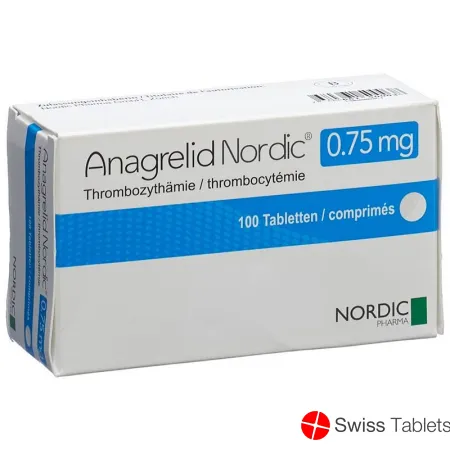
Table of Contents
Package leaflet: Information for the user
Anagrelid Nordic, 0.5 mg, tablets
Anagrelid Nordic, 0.75 mg, tablets
Anagrelid Nordic, 1 mg, tablets
Anagrelid
Please read all of this leaflet carefully before taking this medicine, because it contains
important information for you.
- Keep this leaflet, as you may need to read it again.
- If you have any questions, please consult your doctor or pharmacist.
- This medicine has been prescribed for a specific individual. Do not share it with others. This medicine may harm other people, even if their symptoms are the same.
- If you experience any adverse effects, including any not listed in this leaflet, inform your doctor or pharmacist. See section 4.
Leaflet contents:
- What Anagrelid Nordic is and what it is used for
- Important information before taking Anagrelid Nordic
- How to take Anagrelid Nordic
- Possible side effects
- How to store Anagrelid Nordic
- Contents of the pack and other information
1. What Anagrelid Nordic is and what it is used for
Anagrelid Nordic is used to reduce an elevated number of platelets (thrombocytes)
in patients with essential thrombocythaemia, a condition in which the body produces too many platelets.
A significantly increased number of blood platelets may cause problems with the circulatory system
(circulatory disturbances) and blood clotting. Reducing the number of platelets lowers the risk of
serious complications.
2. Important information before using Anagrelid Nordic
When not to use Anagrelid Nordic
- If the patient is allergic to anagrelid or any of the other ingredients of this medicine (listed in section 6);
- If the patient has severe heart disorders;
- If the patient has severe liver function impairment;
- If the patient has severe kidney function impairment.
Warnings and precautions
Before starting treatment with Anagrelid Nordic, consult a doctor:
- If the patient has heart disease;
- If the patient has congenital or family history of prolonged QT interval (a heart condition visible on ECG, the recording of the heart's electrical activity), or if the patient is taking other medicines that cause changes in ECG, or if the patient has low levels of electrolytes such as potassium, magnesium or calcium (see section "Anagrelid Nordic and other medicines");
- If the patient has liver or kidney problems.
When administered concomitantly with acetylsalicylic acid (a substance also known as aspirin, present in many medicines used to relieve pain and reduce fever, as well as in medicines preventing blood clotting), there is an increased risk of serious bleeding (haemorrhage) (see section "Anagrelid Nordic and other medicines").
Anagrelid Nordic and other medicines
Tell your doctor or pharmacist about all medicines the patient is currently taking or has recently taken, as well as any medicines the patient plans to take.
Inform your doctor if the patient is taking any of the following medicines:
- Medicines that may alter heart rhythm, e.g. sotalol, amiodarone;
- Medicines used to treat heart diseases, such as milrinone, enoximone, amrinone, olprinone and cilostazol;
- Acetylsalicylic acid (a substance also known as aspirin, present in many medicines used to relieve pain and reduce fever, as well as in medicines preventing blood clotting);
- Other medicines used to treat disorders affecting platelet count, e.g. clopidogrel;
- Fluvoxamine, used to treat depression;
- Certain types of antibiotics used to treat infections, such as enoxacin;
- Omeprazole, used to reduce gastric acid secretion;
- Theophylline, used to treat severe asthma and breathing problems;
- Oral contraceptives: severe diarrhoea during treatment with this medicine may reduce the effectiveness of the oral contraceptive, therefore an additional method of contraception (e.g. condom) is recommended. Please refer to the instructions provided in the patient leaflet included in the packaging of the oral contraceptive pill.
The effect of Anagrelid Nordic or the mentioned medicines may be altered if taken simultaneously.
If in doubt, consult your doctor or pharmacist.
Anagrelid Nordic with food and drink
Food delays the absorption of Anagrelid Nordic, but does not significantly affect its overall effect on the body.
Do not drink grapefruit juice, as it may prolong the elimination of the medicine from the body.
Pregnancy and breastfeeding
If the patient is pregnant or planning to become pregnant, she should inform her doctor.
Pregnant women should not take Anagrelid Nordic. Women of childbearing potential should use effective contraception during treatment with Anagrelid Nordic.
If the patient is breastfeeding or planning to breastfeed, she should inform her doctor.
Anagrelid Nordic should not be used during breastfeeding. The patient should stop breastfeeding while taking Anagrelid Nordic.
Driving and operating machinery
Dizziness has been reported in some patients taking Anagrelid Nordic. If dizziness occurs, the patient should not drive or operate machinery.
Anagrelid Nordic contains lactose
This medicine contains lactose. If the patient has been previously diagnosed with intolerance to certain sugars, the patient should consult a doctor before taking this medicine.
3. How to use Anagrelid Nordic
Adults
This medicine should always be used as directed by the physician.
The physician will determine the most appropriate dose for each patient.
The usual starting dose of Anagrelid Nordic is 0.5 mg to 1 mg once daily for at least one week.
After this period, the physician may increase or decrease the number of tablets taken to establish the most appropriate dose for the patient, allowing the most effective treatment. The maximum dose is 5 mg per day.
The tablet may be divided into equal doses.
Do not take more tablets than prescribed by the physician.
Use in children and adolescents
Because experience with the use of Anagrelid Nordic in children and adolescents is limited, this medicine should not be used in children and adolescents under 18 years of age.
Patients with liver or kidney disorders
If the patient has liver or kidney disease, the treating physician will decide whether the patient can be treated with Anagrelid Nordic.
Method of administration
Anagrelid Nordic tablets should be taken with an adequate amount of fluid.
Use of a higher than recommended dose of Anagrelid Nordic
If a higher dose of Anagrelid Nordic than recommended has been taken, or if the medicine has been taken by someone else, contact a physician or pharmacist immediately. Show the Anagrelid Nordic packaging. High doses of the medicine may lead to decreased blood pressure, accompanied by dizziness, vomiting, and heart rhythm disturbances.
Missed dose of Anagrelid Nordic
The patient should take the tablet as soon as they remember. The next dose should be taken at the usual time. Do not take a double dose to make up for a missed dose.
Discontinuation of Anagrelid Nordic
Do not stop taking Anagrelid Nordic without consulting the physician. After discontinuation of treatment with Anagrelid Nordic, platelet count will return to pre-treatment levels within 14 days.
If you have any further doubts regarding the use of this medicine, consult your physician or pharmacist.
4. Possible adverse reactions
Like all medicines, this medicine can cause adverse reactions, although not everybody will experience them.
If any serious adverse reactions occur in a patient, or any adverse reaction not listed in this leaflet, inform a doctor or pharmacist immediately.
Serious adverse reactions:
Uncommon (may occur in up to 1 in 100 people):
- Severe disturbances in heart rate or heart rhythm (ventricular tachycardia, supraventricular tachycardia)
- Heart failure (symptoms include shortness of breath, chest pain, swelling of the lower limbs due to fluid accumulation)
- Kidney failure (passing very small amounts of urine or complete cessation of urine)
Rare (may occur in up to 1 in 1000 people):
- Severe disturbances in heart rate or heart rhythm (atrial fibrillation)
- Heart attack (symptoms include severe chest pain and shortness of breath)
If any of the above-mentioned adverse reactions occur, contact a doctor immediately.
Other adverse reactions:
Very common (may occur in more than 1 in 10 people):
Headache.
Common (may occur in up to 1 in 10 people):
Reduction in red blood cells (anaemia), blood spots under the skin, oedema, vertigo, insomnia, abnormal sensations or feelings such as tingling or "pins and needles", rapid heartbeat, irregular or strong heartbeats (palpitations), high blood pressure, nosebleeds, diarrhoea, nausea, indigestion, rash, back pain, fatigue.
Uncommon (may occur in up to 1 in 100 people):
Reduction in platelets (thrombocytopenia), bleeding, bruising, weight gain, depression, nervousness, dry mouth, migraine, conjunctivitis, visual disturbances, ringing in the ears (tinnitus), fainting, shortness of breath or dyspnoea, lung infection, increased blood pressure in the lungs causing symptoms such as shortness of breath, fatigue, chest pain or oedema, vomiting, flatulence, stomach pain, constipation, hair loss, itching of the skin, joint pain, muscle pain, cystitis, pain, weakness.
Rare (may occur in up to 1 in 1000 people):
Severe chest pain (angina pectoris), dizziness upon standing (especially from sitting or lying down), loss of appetite, gastritis (symptoms include pain, nausea, vomiting), fluid accumulation around the lungs, lung infection (pneumonia), asthma, increased need to urinate at night, increased liver enzyme activity, influenza-like symptoms, chills, general malaise.
The following adverse reactions have been reported, but their exact frequency is unknown:
Irregular heart rhythm (torsade de pointes), respiratory system disease causing scarring in lung tissue (symptoms include shortness of breath), kidney inflammation (tubulointerstitial nephritis).
Reporting of adverse reactions
If any adverse reactions occur, including any adverse reactions not listed in this leaflet, inform a doctor or pharmacist. Adverse reactions can be reported directly to the Department of Monitoring Adverse Drug Reactions, Office for Registration of Medicinal Products, Medical Devices and Biocidal Products, Al. Jerozolimskie 181 C, 02-222 Warsaw, Tel.: +48 22 49 21 301, Fax: +48 22 49 21 309, e-mail: [email protected]
Adverse reactions can also be reported to the marketing authorisation holder.
Reporting adverse reactions helps provide more information on the safety of this medicine.
5. How to store Anagrelid Nordic
Store the blister in the outer packaging to protect from light. Store the bottle tightly closed to protect from light.
Keep the medicine out of the sight and reach of children.
Do not use this medicine after the expiry date stated on the bottle, cardboard box or blister under "Expiry date (EXP)". The expiry date refers to the last day of the stated month.
Medicines must not be disposed of via wastewater or household waste. Ask your pharmacist how to dispose of medicines no longer required. These measures help protect the environment.
6. Contents of the pack and other information
What Anagrelid Nordic contains
The active substance is anagrelide.
Anagrelid Nordic, 0.5 mg: Each tablet contains 0.5 mg anagrelide (as anagrelide hydrochloride monohydrate).
Anagrelid Nordic, 0.75 mg: Each tablet contains 0.75 mg anagrelide (as anagrelide hydrochloride monohydrate).
Anagrelid Nordic, 1 mg: Each tablet contains 1 mg anagrelide (as anagrelide hydrochloride monohydrate).
The other ingredients are: anhydrous lactose, povidone (K30), crospovidone (type B), microcrystalline cellulose, and magnesium stearate.
What Anagrelid Nordic looks like and contents of the pack
Anagrelid Nordic, 0.5 mg are white to almost white, round tablets with a diameter of approximately 6.5 mm, marked with "0.5" on one side and a score line on the other.
Anagrelid Nordic, 0.75 mg are white to almost white, round tablets with a diameter of approximately 8 mm, marked with "0.75" on one side and a score line on the other.
Anagrelid Nordic, 1 mg are white to almost white, round tablets with a diameter of approximately 9 mm, marked with "1.0" on one side and a score line on the other.
The tablets can be divided into equal doses.
Packs:
Polyethylene bottles with child-resistant closure containing 100 tablets.
PVC/PVDC/Aluminium blisters in packs containing 100 tablets.
Marketing Authorisation Holder
Nordic Group B.V.
Siriusdreef 41
2132 WT Hoofddorp
The Netherlands
Manufacturer:
QPharma AB
Agneslundsvägen 27
21215 Malmö
Sweden
This medicinal product is authorised in the European Economic Area under the following names:
Austria: Anagrelid Nordic 0.5 mg Tabletten
Anagrelid Nordic 0.75 mg Tabletten
Anagrelid Nordic 1 mg Tabletten
Bulgaria: Anagrelid Nordic 0.5 mg tablets
Анагрелид Нордик 0,5 mg, таблетки
Anagrelid Nordic 0.75 mg tablets
Анагрелид Нордик 0,75 mg, таблетки
Anagrelid Nordic 1 mg tablets
Анагрелид Нордик 1 mg, таблетки
Italy: REDESK
Czech Republic: Anagrelid Nordic
Poland: Anagrelid Nordic
Romania: Anagrelidă Nordic 0.5 mg, comprimate
Anagrelidă Nordic 0.75 mg, comprimate
Anagrelidă Nordic 1.0 mg, comprimate
Slovakia: Anagrelid Nordic 0.5 mg tablety
Anagrelid Nordic 0.75 mg tablety
Anagrelid Nordic 1.0 mg tablety