Amikacin adamed
Poland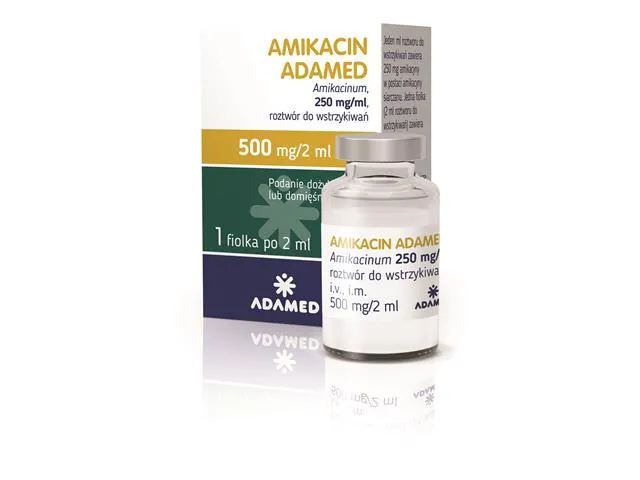
Table of Contents
- Patient Information Leaflet
- 1. What Amikacin Adamed is and what it is used for
- 2. Important information before using Amikacin Adamed
- 3. How to use Amikacin Adamed
- 4. Possible adverse reactions
- 5. How to store Amikacin Adamed
- 6. Contents of the pack and other information
- Information intended exclusively for medical professionals
Patient Information Leaflet
Amikacin Adamed, 250 mg/mL, solution for injection
Amikacinum
Please read all of this leaflet carefully before using this medicine, because it contains
important information for you.
- Keep this leaflet, as you may need to read it again.
- If you have any further questions, please ask your doctor or nurse.
- This medicine has been prescribed for a specific individual. Do not pass it on to others. It may harm someone else even if their symptoms are the same.
- If you experience any side effects, including any not listed in this leaflet, tell your doctor or nurse. See section 4.
Table of contents
- What Amikacin Adamed is and what it is used for
- What you need to know before using Amikacin Adamed
- How to use Amikacin Adamed
- Possible side effects
- How to store Amikacin Adamed
- Contents of the pack and other information
1. What Amikacin Adamed is and what it is used for
The active substance in Amikacin Adamed is amikacin, an aminoglycoside antibiotic with bactericidal activity against susceptible bacteria.
Amikacin Adamed is indicated for short-term treatment of severe infections caused by bacteria sensitive to amikacin, such as:
- respiratory tract infections,
- bone and joint infections,
- skin and soft tissue infections,
- intra-abdominal infections, including peritonitis,
- infections of burn wounds and surgical wounds (including in vascular surgery),
- severe, complicated and recurrent urinary tract infections (in uncomplicated cases, amikacin should be used only if the causative bacteria are resistant to other antibiotics),
- sepsis, usually in combination with a β-lactam antibiotic,
- central nervous system infections.
2. Important information before using Amikacin Adamed
When not to use Amikacin Adamed:
- if the patient is allergic to amikacin or to any of the other ingredients of this medicine (listed in section 6);
- if the patient suffers from myasthenia gravis (excessive muscle weakness);
- if the patient is allergic to any aminoglycoside antibiotic (e.g. streptomycin, gentamicin, tobramycin, neomycin) or has previously experienced severe toxic reactions to these antibiotics – cross-sensitivity to drugs in this group may occur.
Warnings and precautions
Before starting treatment with Amikacin Adamed, discuss the following with your doctor:
- if the patient has impaired kidney function,
- if the patient has hearing disorders,
- if the patient has previously been treated with any aminoglycoside antibiotic, especially if symptoms of toxicity (kidney or hearing damage) occurred during such treatment,
- if the patient suffers from muscle disorders, e.g. Parkinson's disease,
- if the patient is simultaneously receiving anaesthetic agents or large amounts of citrated stored blood,
- if the patient or members of their family have a disease associated with mitochondrial mutation (a genetic disorder) or hearing loss caused by antibiotic drugs, it is recommended to inform the doctor or pharmacist before taking an aminoglycoside; certain mitochondrial mutations may increase the risk of hearing loss after administration of this medicine. Before administering Amikacin Adamed, the doctor may recommend genetic testing.
Before starting and during treatment with Amikacin Adamed, the doctor will closely monitor the patient, paying particular attention to hearing and kidney function. The following will be monitored in the patient:
- kidney function, especially in patients with renal impairment or symptoms of kidney failure that occurred during treatment, and in elderly patients,
- hearing,
- blood levels of amikacin (if necessary).
If any of the following factors apply to the patient, there is an increased risk of harmful effects of the medicine on hearing or nerves:
- impaired kidney function,
- advanced age (≥65 years),
- dehydration,
- receiving high doses of this medicine,
- treatment lasting longer than 5–7 days, even in patients who have already been cured.
The first signs of harmful effects on hearing or nerves after administration of this medicine may include:
- difficulty hearing high-pitched sounds (hearing loss affecting high frequencies),
- dizziness,
- tingling or numbness of the skin, muscle twitching, seizures.
If the patient experiences any of these symptoms, they should inform the doctor immediately.
If symptoms of kidney failure occur or worsen, the doctor will reduce the daily dose and/or extend the intervals between doses. If severe kidney failure occurs, amikacin administration will be discontinued.
Treatment with amikacin should also be stopped if tinnitus or hearing loss occurs.
During treatment, the patient should drink plenty of fluids; intravenous fluid replacement may be necessary to prevent accumulation of amikacin in the kidneys and damage to renal tubules.
In patients with reduced urine output and inappropriate antibiotic dosing, the drug may accumulate in the body and cause adverse effects. If this occurs, the doctor may perform hemodialysis or peritoneal dialysis.
Like other antibiotics, amikacin may lead to overgrowth of organisms resistant to it, in which case appropriate treatment will be initiated.
Following intravitreal injection of amikacin (injection into the eye), cases of central retinal artery occlusion have been reported, sometimes leading to permanent vision loss.
Children
Aminoglycosides should be used with caution in premature infants and newborns due to immature kidney function in these patients.
Amikacin Adamed and other medicines
Inform the doctor about all medicines currently or recently taken by the patient, as well as any medicines the patient plans to take.
Amikacin Adamed may affect the action of other medicines. Other medicines may also affect the action of Amikacin Adamed.
In particular, inform the doctor if the patient is taking any of the following medicines:
- medicines that may damage the kidneys, hearing or nervous system, such as: cisplatin, platinum compounds – drugs used in cancer treatment, cyclosporine, tacrolimus – immunosuppressive drugs, drugs used to treat infections, such as: bacitracin, cephaloridine, amphotericin B, paromomycin, viomycin, polymyxin B, colistin, vancomycin, and aminoglycoside antibiotics (e.g. streptomycin, gentamicin, tobramycin, neomycin);
- beta-lactam antibiotics (penicillins) in patients with severe renal impairment may reduce the effectiveness of Amikacin Adamed;
- muscle relaxants or anaesthetic agents such as ether, halothane, tubocurarine, succinylcholine, decamethonium, atracurium, rocuronium, vecuronium, or transfusion of large amounts of blood containing citrate as an anticoagulant may cause neuromuscular blockade and respiratory muscle paralysis;
- rapidly acting diuretics, especially when administered intravenously, such as mannitol, ethacrynic acid, furosemide, may cause hearing damage and even irreversible deafness – concomitant use of these drugs should be avoided;
- indomethacin – an anti-inflammatory drug, may increase amikacin plasma concentrations in newborns;
- bisphosphonates – drugs used to treat osteoporosis and similar conditions, when used concomitantly with Amikacin Adamed, may lead to decreased blood calcium levels;
- thiamine (vitamin B_) – may undergo degradation due to reaction with sodium metabisulfite contained in the Amikacin Adamed solution.
Pregnancy and breastfeeding
If the patient is pregnant or breastfeeding, suspects she may be pregnant, or is planning to have a child, she should consult her doctor before using this medicine.
Pregnancy
Use of Amikacin Adamed during pregnancy is permitted only if, in the doctor's opinion, it is absolutely necessary for the mother.
Amikacin crosses the placenta into fetal circulation and amniotic fluid and may cause fetal harm.
Breastfeeding
Use of this medicine in breastfeeding women should be avoided. If amikacin must be used in a mother, the doctor will decide whether to discontinue breastfeeding or stop treatment.
Driving and operating machinery
The effect of amikacin on the ability to drive and operate machinery has not been specifically established. However, if the patient experiences adverse effects such as dizziness or balance disturbances, they should not drive or operate machinery.
Amikacin Adamed contains sodium metabisulfite
This medicine may rarely cause severe hypersensitivity reactions and bronchospasm.
Amikacin Adamed contains sodium
This medicine contains 1.98 mmol (45 mg) of sodium (main component of table salt) in the maximum daily dose (1.5 g). This corresponds to 2.25% of the maximum recommended daily intake of sodium in the diet for adults.
3. How to use Amikacin Adamed
This medicine should always be used exactly as prescribed by the doctor. In case of doubts, consult
your doctor.
Amikacin Adamed is administered by intramuscular injection or intravenous infusion
(in a drip).
The dosage and method of administration appropriate for a given patient are determined by the doctor, depending on body weight, age, kidney function, and the type and severity of infection.
After administration of the recommended dose, in uncomplicated infections caused by susceptible bacterial strains, the patient's response to treatment should become evident within 24 to 48 hours.
If no response to treatment occurs within three to five days, the doctor will consider discontinuing
this medicine and initiating alternative therapy, following reassessment of microbial susceptibility to antibiotics.
Detailed dosage instructions, as well as directions for use and preparation of the medicine, are provided at the end of this leaflet under the section “Information intended exclusively for healthcare professionals”.
Use of a higher than recommended dose of Amikacin Adamed
If the patient suspects having received an overdose of Amikacin Adamed, the doctor should be informed immediately. The doctor will decide whether to administer calcium (e.g., as calcium gluconate or calcium lactobionate in a 10–20% solution) to prevent neuromuscular blockade, and whether to initiate hemodialysis, peritoneal dialysis, or continuous arteriovenous hemofiltration. In newborns and infants, exchange transfusion of blood may be necessary.
Missed dose of Amikacin Adamed
If the patient suspects that a dose of Amikacin Adamed has been missed, the doctor should be informed as soon as possible.
If there are any further doubts concerning the use of this medicine, consult the doctor or nurse.
4. Possible adverse reactions
Like all medicines, this medicine can cause adverse reactions, although not everyone will experience them.
The following adverse reactions may occur during treatment with Amikacin Adamed.
If any severe adverse reactions occur, such as:
- ringing in the ears, worsening of hearing,
- reduced urine output,
- breathing difficulties,
- skin complaints, rash,
you should immediately inform your doctor, as it may be necessary to discontinue treatment with
Amikacin Adamed and initiate additional therapy.
Other possible adverse reactions
Uncommon adverse reactions (may occur in fewer than 1 in 100 people):
- infections caused by drug-resistant bacteria or yeasts,
- nausea, vomiting,
- rash.
Rare adverse reactions (may occur in fewer than 1 in 1,000 people):
- anaemia, increased number of a certain type of white blood cells (eosinophils) in blood,
- decreased magnesium concentration in blood,
- tingling or numbness, tremor, headache, disturbances in balance,
- loss of vision (after injection into the eye),
- tinnitus, hearing loss,
- low blood pressure,
- itching, urticaria,
- muscle cramps, joint pain,
- reduced urine volume (oliguria),
- in blood tests: increased levels of nitrogen and urea,
- in urine tests: presence of protein, white or red blood cells,
- fever.
Adverse reactions with unknown frequency (frequency cannot be estimated from available data):
- allergic reactions, including severe allergic reactions,
- muscle paralysis,
- hearing loss,
- apnoea, bronchospasm,
- acute kidney failure, toxic kidney damage,
- in urine tests: presence of cells.
Reporting of adverse reactions
If any adverse symptoms occur, including any adverse reactions not listed in this leaflet, inform your doctor or nurse. Adverse reactions can be reported directly to the Department of Monitoring Adverse Drug Reactions at the Office for Registration of Medicinal Products, Medical Devices and Biocidal Products,
Al. Jerozolimskie 181C, 02-222 Warsaw,
Tel.: + 48 22 49 21 301,
Fax: + 48 22 49 21 309,
Website: https://smz.ezdrowie.gov.pl
Adverse reactions can also be reported to the marketing authorisation holder.
Reporting adverse reactions helps provide more information on the safety of this medicine.
5. How to store Amikacin Adamed
No special storage requirements apply.
The diluted solution may be stored for 24 hours at a temperature of 2°C to 8°C.
Keep the medicine out of the sight and reach of children.
Do not use this medicine after the expiry date stated on the container following: "EXP".
Medicines should not be disposed of via wastewater or household waste. Ask your pharmacist how to dispose of medicines no longer required. Such measures help protect the environment.
6. Contents of the pack and other information
What Amikacin Adamed contains
- The active substance is amikacin. One mL of solution contains 250 mg of amikacin as amikacin sulfate. One vial (2 mL of injection solution) contains 500 mg of amikacin as amikacin sulfate.
- Other ingredients are: sodium citrate, sodium metabisulfite (E 223), sulfuric acid, water for injections. See section 2: "Amikacin Adamed contains sodium".
What Amikacin Adamed looks like and contents of the pack
Amikacin Adamed is a clear, colourless or slightly yellow aqueous solution for injection.
The pack consists of a 4 mL vial made of colourless type I glass, closed with a bromobutyl rubber stopper and an aluminium seal with a plastic flip-off cap, placed in a cardboard box.
Pack size: 1 vial containing 2 mL of solution in a cardboard box.
Marketing Authorisation Holder
Adamed Pharma S.A.
Pieńków, ul. M. Adamkiewicza 6A
05-152 Czosnów
Poland
Manufacturer
Adamed Pharma S.A.
Pieńków, ul. M. Adamkiewicza 6A
05-152 Czosnów
Poland
ANFARM HELLAS S.A
53-57 Perikleous str., Gerakas
15344, Attiki,
Greece
For further information about this medicine, please contact the Marketing Authorisation Holder:
Adamed Pharma S.A.
Pieńków, ul. M. Adamkiewicza 6A
05-152 Czosnów
Poland
tel.: +48 22 732 77 00
Information intended exclusively for medical professionals
Dosage
Before calculating the appropriate dose, the patient's body weight must be determined.
Renal function should be monitored by measuring serum creatinine concentration or by calculating endogenous creatinine clearance. Blood urea nitrogen (BUN) levels are less reliable in this case. Renal function should be reassessed periodically during treatment.
Whenever possible, serum amikacin concentrations should be measured to ensure adequate, but not excessively high, levels are maintained. It is recommended to periodically measure both peak and trough serum concentrations during treatment, the latter immediately before the next dose.
Peak serum concentrations (measured 30–90 minutes after administration) should not exceed 35 μg/mL, and trough concentrations (measured just before the next dose) should not exceed 10 μg/mL. Dosage should be adjusted accordingly. In patients with normal renal function, the product may be administered once daily; in such cases, peak serum concentrations may exceed 35 μg/mL.
Treatment usually lasts 7 to 10 days. The total daily dose of amikacin for all routes of administration should not exceed 15 to 20 mg/kg body weight/day. In severe or complicated infections requiring treatment longer than 10 days, the continued use of amikacin disulfate injections should be re-evaluated. If treatment is continued, renal function, hearing, vestibular function, and serum amikacin concentrations should be closely monitored. The safety of amikacin use beyond 14 days has not been established.
After administration of the recommended dose in uncomplicated infections caused by susceptible microorganisms, clinical response should be observed within 24 to 48 hours.
If there is no clear clinical response within 3 to 5 days, treatment should be discontinued and microbial susceptibility re-evaluated. Lack of response to treatment may be due to microbial resistance or the presence of infection foci requiring surgical drainage.
Premature Infants
The recommended dose for premature infants is 7.5 mg/kg body weight every 12 hours (see sections 4.4 and 5.2).
Newborns
The recommended initial loading dose is 10 mg/kg body weight, followed by 7.5 mg/kg body weight every 12 hours (see sections 4.4 and 5.2).
Infants from 4 weeks of age and children up to 12 years of age
The recommended intramuscular or intravenous dose (slow intravenous infusion) in children with normal renal function is 15 to 20 mg/kg body weight/day, administered either once daily or as 7.5 mg/kg body weight every 12 hours.
For the treatment of endocarditis and in febrile neutropenic patients, the product should be administered twice daily due to insufficient data supporting the efficacy of once-daily administration.
Adults and adolescents over 12 years of age
The recommended intramuscular or intravenous dose for adults and adolescents with normal renal function (creatinine clearance ≥50 mL/min) is 15 mg/kg body weight/day, which may be given as a single daily dose or divided into two equal doses of 7.5 mg/kg body weight administered every 12 hours. The total daily dose should not exceed 1.5 g.
For the treatment of endocarditis and in febrile neutropenic patients, the product should be administered twice daily due to insufficient data supporting the efficacy of once-daily administration.
Elderly Patients
Amikacin is eliminated by the kidneys. Whenever possible, renal function should be assessed and dosage adjusted as described in the section on dosage in patients with renal impairment.
Life-threatening infections and (or) infections caused by Pseudomonas
The dose in adults may be increased to 500 mg every eight hours, but should not exceed 1.5 g/day and should not be administered for longer than 10 days. The maximum total dose for adults should not exceed 15 g.
Urinary tract infections (other than those caused by Pseudomonas )
A dose of 7.5 mg/kg body weight/day in two divided doses (equivalent to 250 mg twice daily in adults) is recommended. Since amikacin activity increases with pH, concomitant administration of alkalizing agents may be considered.
Renal impairment
In patients with impaired renal function (creatinine clearance <50 mL/min), administration of the recommended total daily dose as a single dose is not advised, as this would result in prolonged exposure to high trough concentrations. Refer to the dosage adjustment guidelines provided below for patients with renal impairment.
In patients with renal impairment receiving amikacin two or three times daily, serum amikacin concentrations should be monitored using appropriate assay methods whenever possible. Dosage may be adjusted either by administering the standard dose at longer intervals or by giving a reduced dose without changing the dosing interval.
Both approaches are based on creatinine clearance or serum creatinine concentration, as these values correlate with aminoglycoside half-life in patients with impaired renal function. When applying these regimens, the patient's clinical status and laboratory parameters should be closely monitored, and dosage regimens adjusted as necessary, taking into account any ongoing dialysis.
Prolonged intervals between standard doses
If creatinine clearance is unknown and the patient is clinically stable, the dosing interval (in hours) between standard single doses (i.e., the dose of 7.5 mg/kg body weight given twice daily in patients with normal renal function) can be estimated by multiplying the patient's serum creatinine concentration (in mg/100 mL) by nine. For example, if serum creatinine is 2 mg/100 mL, the recommended single dose (7.5 mg/kg body weight) should be administered every 18 hours.
Dosing interval for amikacin 7.5 mg/kg body weight according to serum creatinine concentration.
| Serum creatinine concentration [mg/100 mL] | × | Interval between doses of amikacin 7.5 mg/kg i.m. [hours] |
| 1.5 | 13.5 | |
| 2.0 | 18 | |
| 2.5 | 22.5 | |
| 3.0 | 27 | |
| 3.5 | 31.5 | |
| 4.0 | 36 | |
| 4.5 | 40.5 | |
| 5.0 | 45 | |
| 5.5 | 49.5 | |
| 6.0 | 54 |
Reduced doses administered at regular intervals
If renal function is impaired and administration of amikacin sulfate by injection at regular intervals is indicated, the dose should be reduced. In these patients, serum amikacin concentrations should be measured to ensure accurate dosing and to avoid excessive serum amikacin levels. If serum amikacin monitoring is not possible and the patient's condition is stable, the most easily measurable indicators of the degree of renal impairment that can guide dosing are serum creatinine concentration and creatinine clearance.
Treatment should be initiated with a standard loading dose of 7.5 mg/kg body weight. This dose is the same as that usually recommended for patients with normal renal function, as described above.
To determine the maintenance dose administered every 12 hours, the loading dose should be reduced proportionally to the reduction in the patient's creatinine clearance:
Maintenance dose administered every 12 hours =
(patient's current creatinine clearance [mL/min] × calculated loading dose [mg])
/ normal creatinine clearance [mL/min]
An alternative approximate method for determining reduced doses administered every 12 hours (for patients with known steady-state serum creatinine concentrations) is to divide the usual recommended dose by the patient's serum creatinine concentration.
The above dosing regimens are not rigid recommendations but serve as guidelines for dosing when serum amikacin concentration monitoring is not feasible.
Due to the possibility of significant changes in renal function during therapy, serum creatinine concentrations should be frequently monitored and the dosing regimen adjusted as necessary.
Route of administration
Amikacin sulfate can be administered intramuscularly or intravenously.
For the treatment of most infections, intramuscular administration is recommended. However, in life-threatening infections or in patients in whom intramuscular administration is not feasible, the product may be given intravenously either as a slow injection over 2 to 3 minutes (bolus) or by infusion (0.25% over 30 minutes).
Recommendations for intravenous administration
In adults, the product should be administered after appropriate dilution as a slow infusion lasting from 30 to 60 minutes.
In children, the volume of solvent used depends on the amikacin dose tolerated by the patient. The solution is usually administered by infusion over 30 to 60 minutes. Infants should receive the infusion over 1 to 2 hours.
Amikacin should not be mixed with other drugs but should be administered separately, according to the recommended dose and route of administration.
When co-administered with another antibiotic, the drugs should be injected at different body sites or administered in separate infusions.
Instructions for preparation of the medicinal product for administration
No dilution is required prior to intramuscular administration.
Preparation of intravenous infusion solutions
Intravenous infusions are prepared by diluting the contents of the vial in one of the commonly used infusion fluids to achieve an antibiotic concentration between 2.5 and 5 mg/mL. For example, 500 mg of amikacin may be diluted in 100 or 200 mL of one of the following solutions:
0.9% sodium chloride solution,
5% glucose solution.
In neonates, infants, and children, smaller volume infusions adjusted to the patient's body weight should be used.
Prepared infusion solutions, which do not contain a preservative, may be stored at 2°C to 8°C for no longer than 24 hours.