Aldactone
Poland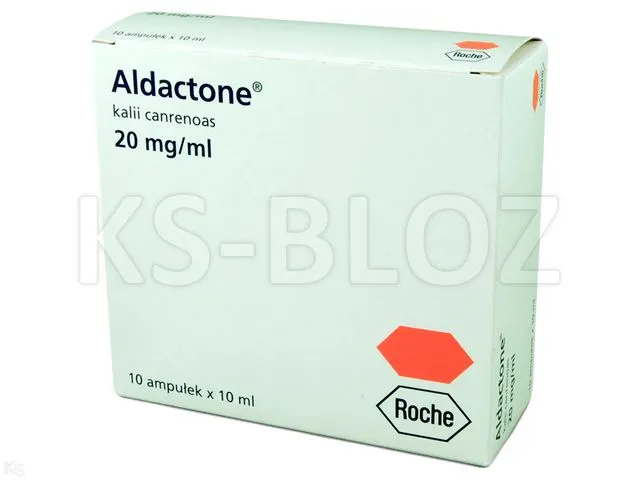
Table of Contents
Package leaflet: Information for the user
Warning!
Keep this leaflet. Information on the immediate packaging in a foreign language.
Aldactone (Aldactone 10 ml Canrenoate)
20 mg/ml solution for injection
Potassium canrenoate
Aldactone and Aldactone 10 ml Canrenoate are different trade names for the same medicinal product.
Please read this leaflet carefully before using the medicine, as it contains
important information for the patient.
- Keep this leaflet, so that you can read it again if necessary.
- If you have any doubts, please consult your doctor or pharmacist.
- This medicine has been prescribed for a specific individual. Do not pass it on to others. The medicine may harm someone else, even if their symptoms are the same.
- If you experience any adverse reactions, including any not listed in this leaflet, tell your doctor, pharmacist, or nurse. See section 4.
Table of contents of the leaflet:
- What Aldactone is and what it is used for
- Important information before using Aldactone
- How to use Aldactone
- Possible side effects
- How to store Aldactone
- Contents of the package and other information
1. What Aldactone is and what it is used for
Aldactone is an aldosterone antagonist, i.e. it blocks the binding of aldosterone to its receptor, thereby preventing the reabsorption of sodium and promoting potassium retention.
Potassium canrenoate exerts its effects only in the presence of aldosterone, and its action may be inhibited by increasing aldosterone concentrations. It inhibits aldosterone biosynthesis only at very high doses.
Potassium canrenoate enhances the excretion of sodium and chlorides, slightly increases calcium excretion, and reduces the excretion of ammonium, magnesium, and potassium ions, causing urine alkalization.
Potassium canrenoate has too weak a diuretic effect to be used as a conventional diuretic. The diuretic effect can only be enhanced by concomitant administration with loop or thiazide diuretics.
By reducing glomerular filtration, potassium canrenoate may increase blood urea nitrogen levels.
Depending on the severity of hyperaldosteronism, the diuretic effect appears within 3 to 6 hours after intravenous administration and may last up to 72 hours. A stable diuretic effect is achieved after 2 weeks of treatment.
Indications for use:
- primary hyperaldosteronism;
- secondary hyperaldosteronism associated with severe chronic liver diseases accompanied by edema and ascites;
- secondary hyperaldosteronism in chronic heart failure with edema;
- cases where oral administration of aldosterone antagonists is not possible and when the effect of other diuretics is insufficient. Page 1 of 7
2. Important information before using Aldactone
When not to use Aldactone
Do not use this medicine if:
- the patient is allergic to the active substance, spironolactone, or to any of the other ingredients of this medicine (listed in section 6),
- hyperkalemia (elevated potassium levels in the blood) or hyponatremia (reduced sodium levels in the blood) is present,
- renal dysfunction with serum creatinine concentration above 1.8 mg/dL and creatinine clearance below 30 mL/min,
- acute renal failure or anuria (lack of urine production by the kidneys or absence of urine in the bladder due to blocked ureters),
- during pregnancy and breastfeeding.
Warnings and precautions
Before starting treatment with Aldactone, discuss this with your doctor, pharmacist, or nurse.
Close medical supervision is particularly required in the following cases:
- impaired kidney function (serum creatinine concentration between 1.2 mg/dL and 1.8 mg/dL or creatinine clearance between 60 mL/min and 30 mL/min),
- patients predisposed to acidosis and/or hyperkalemia due to underlying disease (e.g., diabetes),
- hypotension,
- hypovolemia.
Fluid and electrolyte balance: Fluid and electrolyte status should be regularly monitored, especially in elderly patients and in those with impaired kidney or liver function.
Hyperkalemia may occur in patients with impaired kidney function or after excessive potassium intake and may cause irregular heartbeat, which can lead to death.
If hyperkalemia develops, treatment with Aldactone should be discontinued and, if necessary, active measures should be taken to reduce potassium levels to normal.
Hyponatremia may occur, particularly when Aldactone is used concomitantly with other diuretic medicines.
Reversible hyperchloremic metabolic acidosis, usually in combination with hyperkalemia, has been observed in several patients with decompensated cirrhosis of the liver, even when kidney function was normal.
Urea: Reversible increase in blood urea concentration has occurred during Aldactone therapy, mainly in patients with impaired kidney function.
Caution should be exercised when using Aldactone in patients at risk of acidosis and those at risk of hyperkalemia (e.g., in diabetes).
Close monitoring of serum potassium concentration is required in patients with impaired kidney function and serum creatinine concentration between 1.2 and 1.8 mg/dL or creatinine clearance below 60 mL/min/1.73 m² body surface area, as well as in patients receiving Aldactone concomitantly with other medicines that may increase potassium levels (see "Aldactone and other medicines").
Results of radioimmunoassays used to measure blood digoxin concentration may be falsely elevated in patients treated with Aldactone. This is thought to be due to the use of insufficiently specific antibodies.
Aldactone may falsely elevate cortisol measurements using the Mattingly method.
Page 2 of 7
Carcinogenic effects have been observed in animal studies with long-term administration; therefore, treatment with Aldactone should be as short as possible, and the need for continued administration should always be reconsidered.
Use of Aldactone may lead to positive results in doping tests.
Using Aldactone as a doping agent may pose serious health risks.
Pregnancy, breastfeeding, and fertility
If the patient is pregnant or breastfeeding, suspects she may be pregnant, or is planning to become pregnant, she should consult her doctor before using this medicine.
Use during pregnancy and breastfeeding is contraindicated.
There is no available information on the effect of Aldactone on human fertility.
Driving and operating machinery
Aldactone, even when used as directed, may alter the patient's reaction time to an extent that impairs the ability to drive or operate machinery. This is particularly relevant during the initial phase of treatment, when previously used medicines are replaced, when additional medicines are introduced, or when alcohol is consumed concurrently.
Aldactone and other medicines
Inform your doctor about all medicines currently or recently taken, as well as any medicines planned for future use.
Concomitant use of Aldactone with:
- diuretics may enhance their effect,
- carbenoxolone may reduce the effect of the latter,
- non-steroidal anti-inflammatory drugs (NSAIDs) may increase the risk of hyperkalemia,
- other potassium-sparing diuretics (triamterene, amiloride), potassium supplements, or angiotensin-converting enzyme (ACE) inhibitors may lead to a life-threatening increase in serum potassium concentration,
- ACE inhibitors may increase serum creatinine concentration,
- concomitant use of furosemide and ACE inhibitors may lead to acute renal failure,
- acetylsalicylic acid, indomethacin, and other compounds inhibiting prostaglandin synthesis may reduce the effect of potassium canrenoate,
- digoxin may lead to increased serum digoxin concentration,
- epinephrine or norepinephrine may reduce the cardiovascular effects of these agents.
Potassium canrenoate may modify results of radioimmunoassays used to measure blood digoxin concentration.
Aldactone contains sodium and potassium
The medicine contains 37.1 mg of sodium (a main component of table salt) per ampoule. This corresponds to 1.9% of the maximum recommended daily dietary sodium intake for adults.
The medicine contains less than 1 mmol (39 mg) of potassium per dose, meaning the medicine is considered "potassium-free."
The medicine may cause pain at the injection site.
3. How to use Aldactone
This medicine should always be used as directed by the physician. If in doubt, consult your doctor.
Page 3 of 7
The recommended dose is 200 mg to 400 mg (1–2 ampoules) per day, depending on the severity of hyperaldosteronism. In exceptional cases, the dose may be increased up to 800 mg (4 ampoules) per day. Usually, 200 mg (one ampoule) is administered once daily.
Use in children and adolescents
In neonates, infants, and children, the daily dose should be adjusted according to age and clinical condition, divided into three separate doses administered as slow, short intravenous infusions at hourly intervals.
Recommended dosing is typically:
- Children with body weight up to 50 kg – initial dose maximum 4 to 5 mg/kg/day, followed by maximum 2 to 3 mg/kg/day.
- Infants – maximum initial dose 2 to 3 mg/kg/day, followed by maximum 1.5 to 2 mg/kg/day.
The medicine should be administered intravenously at a rate not exceeding 1 ampoule (10 ml) over 2 to 3 minutes to avoid local venous irritation and nausea. The medicine should not be injected into small veins.
In patients receiving high doses of Aldactone or when improved drug tolerance is required, potassium canrenoate may be administered in divided doses or via intravenous infusion lasting approximately 30 minutes.
In patients with renal impairment and serum creatinine levels between 1.2 mg/dl and 1.8 mg/dl, and creatinine clearance below 60 ml/min, treatment with Aldactone may be carried out provided that serum potassium levels are frequently monitored.
The ampoule should be opened immediately before administration. Prolonged storage of an opened ampoule may lead to clouding of the solution. Any unused portion remaining in the ampoule must not be reused.
Slight opalescence of the solution does not affect drug tolerance. However, if visible cloudiness is present, which may exceptionally result from improper storage, the solution must not be administered. Only a clear solution, free from visible particulate matter, should be used.
Accidental intra-arterial injection may be harmful; therefore, before starting administration, it must be confirmed that the needle is positioned within a vein.
Administration of a higher than recommended dose of Aldactone
Overdose of potassium canrenoate may lead to drowsiness, disturbances in consciousness, and electrolyte imbalances.
There is no specific antidote known.
Drowsiness and disturbances in consciousness usually resolve after dose reduction or discontinuation of the drug.
4. Possible adverse reactions
Like any medicine, this medicine can cause adverse reactions, although not everyone will experience them.
The possible adverse reactions listed below are classified according to system organ classes. The frequency of occurrence is defined as follows: very common (≥ 1/10); common (≥ 1/100 to < 1/10); uncommon (≥ 1/1000 to < 1/100); rare (≥ 1/10 000 to < 1/1000); very rare (< 1/10 000); not known (frequency cannot be estimated from the available data).
Common (may affect up to 1 in 10 people)
- Headache, excessive drowsiness (lethargy), ataxia
Uncommon (may affect up to 1 in 100 people)
- Hyperkalaemia
- In women – breast tenderness, menstrual disorders (amenorrhoea or intermenstrual bleeding), postmenopausal bleeding
- In men – breast hypersensitivity and gynaecomastia. Impaired potency and decreased libido may occur
Rare (may affect up to 1 in 1000 people)
- Hyperchloraemic metabolic acidosis, hyponatraemia, increased blood uric acid levels. Electrolyte imbalances may cause the following symptoms: cardiac arrhythmias, fatigue, muscle weakness, muscle cramps, dizziness.
- Hypotension
- Bone demineralisation, osteomalacia
- Hirsutism
- Voice disorders (hoarseness) or lowering of voice pitch. In some cases, both in men and women, voice disorders may persist despite discontinuation of treatment. Therefore, in individuals for whom voice is particularly important (e.g. actors or teachers), the therapeutic benefits should be carefully weighed against the risks of treatment
- Nausea, vomiting, diarrhoea, crampy abdominal pain, gastric or intestinal ulceration, possibly with bleeding
- Thrombocytopenia, eosinophilia in patients with liver cirrhosis
- Dizziness
- Transient confusional state, which resolves after dose reduction or temporary interruption of treatment
- Pain at the injection site
Not known (frequency cannot be estimated from the available data)
- Vasculitis
- Redness, urticaria, desquamation, vasculitis, erythema annulare, pseudo-lupus and lichenoid skin lesions, alopecia, alopecia areata
- Agranulocytosis
- Liver damage, hepatitis
Reporting of adverse reactions
If any adverse reactions occur, including any not listed in this leaflet, inform your doctor, pharmacist or nurse. Adverse reactions can also be reported directly to the Department of Monitoring Adverse Reactions to Medicinal Products at the Office for Registration of Medicinal Products, Medical Devices and Biocidal Products
Al. Jerozolimskie 181C
02-222 Warsaw
Tel.: +48 (22) 49 21 301
Fax: +48 (22) 49 21 309
Website: https://smz.ezdrowie.gov.pl
Reporting adverse reactions helps to provide more information on the safety of the medicine.
5. How to store Aldactone
Keep this medicine out of the sight and reach of children.
Do not store above 25°C. Store the ampoules in the outer packaging to protect from light.
Page 5 of 7
Do not use this medicine after the expiry date stated on the packaging. The expiry date refers to the last day of the stated month.
Medicines must not be disposed of via wastewater or household waste. Ask your pharmacist how to dispose of medicines no longer required. Such measures help protect the environment.
6. Contents of the pack and other information
What Aldactone contains
- The active substance is potassium canrenoate (1 vial of 10 ml contains 200 mg of potassium canrenoate).
- Other ingredients: sodium carbonate, sodium chloride, potassium hydroxide, water for injections.
What Aldactone looks like and contents of the pack
A 10 ml glass vial.
10 vials in a cardboard box.
A clear, colourless to slightly yellow solution in a glass vial.
For further information, contact the responsible party or the parallel importer.
Marketing Authorisation Holder in Germany, the country of export:
RIEMSER Pharma GmbH
An der Wiek 7
17493 Greifswald - Insel Riems
Germany
Manufacturer:
RIEMSER Pharma GmbH
An der Wiek 7
17493 Greifswald - Insel Riems
Germany
Cenexi SAS
52, rue Marcel et Jacques Gaucher
94120 Fontenay-sous-Bois
France
Parallel Importer:
Delfarma Sp. z o.o.
ul. Św. Teresy od Dzieciątka Jezus 111
91-222 Łódź
Poland
Repackaged in:
Delfarma Sp. z o.o.
ul. Św. Teresy od Dzieciątka Jezus 111
91-222 Łódź
Poland
German Marketing Authorisation Number (country of export): 6618119.00.00
Parallel Import Authorisation Number: 174/14
Page 6 of 7
Page 7 of 7