Aethoxysklerol 3%
Poland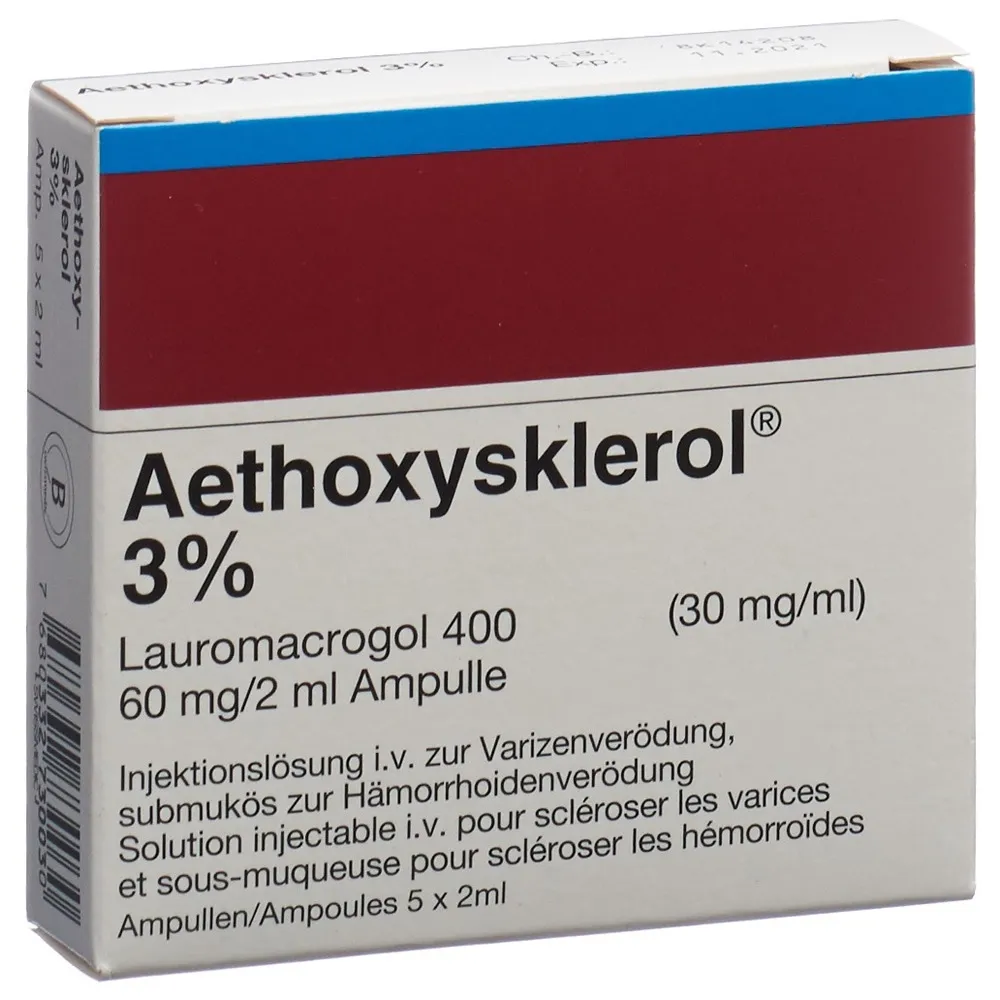
Table of Contents
- Package leaflet: information for the user
- 1. What Aethoxysklerol 3% is and what it is used for
- 2. Information before using Aethoxysklerol 3%
- 3. How to use Aethoxysklerol 3%
- 4. Possible adverse reactions
- 5. How to store Aethoxysklerol 3%
- 6. Contents of the pack and other information
- Information intended exclusively for healthcare professionals:
Chemische Fabrik Kreussler & Co. Aethoxysklerol 3% (amp.)
GmbH
Package leaflet: information for the user
Aethoxysklerol 3%, 30 mg/ml solution for injection
Lauromacrogolum 400
Please read the entire leaflet carefully before using the medicine, as it
contains important information for the patient.
- Keep this leaflet for future reference.
- If you have any questions, consult your doctor or nurse.
- If you experience any adverse reactions, including those not listed in this leaflet, inform your doctor or nurse. See section 4.
Table of contents
- What Aethoxysklerol 3% is and what it is used for
- Important information before using Aethoxysklerol 3%
- How to use Aethoxysklerol 3%
- Possible side effects
- How to store Aethoxysklerol 3%
- Contents of the pack and other information
1. What Aethoxysklerol 3% is and what it is used for
Aethoxysklerol 3% is a sclerosing agent (sclerotherapy), intended for injection via a fine needle directly into a vein, where it delivers lauromacrogol 400—previously also known as polidocanol or macrogol lauryl ether—causing fibrosis of the vessel wall, leading to closure and disappearance of the varicose vein. Aethoxysklerol 3% is indicated for sclerotherapy of varicose veins of the lower limbs and for sclerotherapy of first- and second-degree haemangiomas.
2. Information before using Aethoxysklerol 3%
When not to use Aethoxysklerol 3%:
- if the patient is allergic to lauromacrogol 400 or any of the other ingredients of this medicine (listed in section 6)
- if the patient has an acute, serious illness (particularly untreated)
- if the patient is immobilized
- if the patient has severe peripheral arterial obstructive disease (stage III and IV according to Fontaine classification)
- if the patient has thromboembolic disorders
- if the patient has a high risk of thrombosis (e.g. confirmed hereditary predisposition to thrombosis or multiple risk factors such as use of hormonal contraceptives or hormone replacement therapy, obesity, smoking, or prolonged periods of immobilization)
- if the patient has acute inflammatory conditions in the anal region in case of sclerotherapy of haemorrhoids
- if sclerotherapy is to be performed with microfoam: if the patient has symptoms caused by a diagnosed heart hole (diagnosed, symptomatic left-to-right shunt).
Exercise particular caution when using Aethoxysklerol 3% if:
- bronchial asthma and high predisposition to allergies are present
- fever is present
- the patient has a very poor general health condition
Particular caution is required in the following cases:
- sclerotherapy of leg varicose veins:
- if leg swelling due to fluid accumulation is present and cannot be treated with compression therapy
- if there is skin inflammation at the site where sclerotherapy is to be performed
- if symptoms of occlusion of the smallest and thinnest vessels are present, e.g. due to diabetes (microangiopathy), and reduced sensation (neuropathy) in patients with limited mobility
Sclerotherapy with microfoam:
-
if the patient has a diagnosed heart hole, even if it causes no symptoms (diagnosed, asymptomatic left-to-right shunt)
-
if the patient has previously experienced visual impairment or nerve disturbances (visual or neurological symptoms) after prior microfoam sclerotherapy
-
sclerotherapy of haemorrhoids:
-
if chronic inflammatory bowel disease is present (e.g. Crohn's disease)
-
if blood hypercoagulability is present
Warnings and precautions
Before starting treatment with Aethoxysklerol 3%, consult a doctor or nurse.
Sclerotherapy of varicose veins
This medicine must not be administered intra-arterially due to the risk of causing necrosis, which may lead to amputation. In such a case, the patient must be urgently treated by a vascular surgeon. Administration of the medicine in the facial area may cause reversal of blood flow in the arteries and consequently lead to permanent visual disturbances (blindness). In certain locations, e.g. in case of varicose veins near the ankle joint, the risk of accidental intra-arterial injection may be higher; therefore, particular caution should be exercised and only small amounts of the medicine should be administered.
Sclerotherapy of haemorrhoids
During sclerotherapy of haemorrhoids, the doctor must take care not to damage the internal anal sphincter muscle, as this could lead to fecal incontinence. In men, no more than 0.5 ml of Aethoxysklerol 3% should be administered when the haemorrhoid is located at the 11 o'clock position due to the proximity of the urethra and the prostate gland.
Aethoxysklerol 3% and other medicines
Inform your doctor about all medicines currently used or recently used, as well as any medicines the patient plans to use.
The active substance lauromacrogol 400 is also used as a local analgesic (local anesthetic agent). Therefore, if it is used simultaneously with another anesthetic within 24 hours, there is a risk of enhanced effect, which may slow down heart function.
Pregnancy and breastfeeding
If the patient is pregnant or breastfeeding, suspects she may be pregnant, or is planning to have a child, she should consult a doctor before using this medicine.
Aethoxysklerol 3% should not be used in pregnant women except in cases of absolute necessity. There are no adequate data on the use of Aethoxysklerol 3% in pregnant women. Animal studies have not shown clear evidence of developmental abnormalities.
If sclerotherapy is necessary in breastfeeding women, breastfeeding should be interrupted for 2 to 3 days, as studies in humans have not been conducted to determine whether lauromacrogol 400 passes into breast milk.
Driving and operating machinery
This medicine does not affect the ability to drive or operate machinery.
This medicine contains 5% v/v ethanol (alcohol), i.e. up to 84 mg per dose, equivalent to 2 ml of beer or 0.83 ml of wine per dose. Harmful in patients with alcohol-related disease. This should be taken into account when administering to pregnant or breastfeeding women, children, and patients in high-risk groups such as those with liver disease or epilepsy.
This medicine contains less than 1 mmol (39 mg) of potassium per dose, meaning the medicine is considered "potassium-free". This medicine contains less than 1 mmol (23 mg) of sodium per dose, meaning the medicine is considered "sodium-free".
3. How to use Aethoxysklerol 3%
This medicine should always be used exactly as prescribed by the physician. In case of doubt, consult your doctor.
Aethoxysklerol 3% is indicated for sclerotherapy of medium and large varicose veins of the lower limbs, as well as for sclerotherapy of first- and second-degree haemorrhoidal nodules.
This medicine may be administered in liquid form or as a standardized, homogeneous, fine-bubble, sticky microfoam.
Recommended dose
Depending on the size of the varicose veins being treated and the individual condition of each patient, the physician will decide on the appropriate treatment regimen. In case of uncertainty, the smallest possible dose should be selected.
The daily dose must not exceed 2 mg of lauromacrogol 400 per kg of body weight. This means that in a patient weighing 70 kg, no more than 4.6 ml of 3% solution should be administered per day.
In routine cases, regardless of patient body weight and the concentration of lauromacrogol 400 used, the maximum recommended volume of microfoam per session and per day is 10 ml. Higher volumes of microfoam may be used following individual benefit-risk assessment.
In patients with a known history of drug hypersensitivity, during the first obliteration procedure, no more than one injection should be performed. In subsequent sessions, lauromacrogol 400 may be administered in several injections, provided the total dose does not exceed the maximum recommended dose.
Sclerotherapy of medium-sized varicose veins of the lower limbs
Depending on the diameter of the varicose veins being treated, Aethoxysklerol 2% or 3% is used. During the first procedure, only one injection of 0.5 to 1 ml of Aethoxysklerol 2% or 3% in liquid form should be administered. Depending on treatment outcome and the size of the treated area, during subsequent sessions several injections may be performed, each not exceeding 2 ml of liquid, provided the maximum dose is not exceeded.
When administering Aethoxysklerol 2% as microfoam, e.g. for treating perforator veins or feeding veins, up to 2 ml of microfoam may be injected per puncture. When administering Aethoxysklerol 2% or 3% as microfoam, e.g. for treating varicose tributary veins, up to 4 ml of microfoam may be injected per puncture for small tributary veins and up to 6 ml for large tributary veins.
Sclerotherapy of large varicose veins of the lower limbs
During the first procedure, only one injection of 1 ml of Aethoxysklerol 3% in liquid form should be administered. Depending on treatment efficacy and the size of the treated area, during subsequent sessions 2 to 3 injections may be performed, each not exceeding 2 ml, provided the maximum dose is not exceeded.
When administering Aethoxysklerol 3% as microfoam, e.g. for treating varicose tributary veins, up to 4 ml of microfoam may be injected per puncture for small tributary veins and up to 6 ml for large tributary veins.
Sclerotherapy of first- and second-degree haemorrhoidal nodules
No more than 3 ml of Aethoxysklerol 3% should be administered during a single procedure. Depending on treatment response, a maximum of 1 ml of Aethoxysklerol 3% should be administered per nodule, exclusively via submucosal injection. In men, when nodules are located near the prostatic gland and urethra, no more than 0.5 ml of the medicine should be administered.
Methods of administration
Sclerotherapy of varicose veins of the lower limbs
All injections must be administered intravenously; needle position must be verified (e.g. by blood aspiration).
Regardless of the method of venous puncture (in a standing patient using an infusion cannula or in a sitting patient using a pre-filled syringe), the injection must be performed only with the lower limb placed in a horizontal position.
For performing sclerotherapy, single-use syringes with smooth plunger movement and needles of various gauges depending on indication are recommended.
When injecting the product in microfoam form, the lower limb may be placed horizontally or elevated approximately 30–45° above horizontal level. Direct puncture and injection into non-visible veins should be performed under duplex ultrasound (USG) guidance.
The needle used must not be smaller than 25G.
Depending on the severity and extent of varicose veins, several treatment sessions at one- to two-week intervals may be necessary.
Note:
Local thrombi that may form in some cases should be removed by puncturing and expressing them.
Compression after injection of Aethoxysklerol 3%
After dressing the puncture site, a compression bandage or elastic stocking should be applied. After application, the patient should walk for 30 minutes, preferably near the clinic.
Following sclerotherapy with liquid Aethoxysklerol, compression should be applied immediately after injection.
Following microfoam sclerotherapy, the patient's leg should initially be immobilized for approximately 2–5 minutes. The Valsalva maneuver and muscle activation should be avoided during this time. Compression should not be applied immediately but 5–10 minutes after injection.
Compression should be maintained for several days up to several weeks after the injection, depending on the extent and severity of the varicose veins.
To prevent slippage of the bandage, especially on the thigh or limbs with a conical shape, it is recommended to use an additional foam dressing underneath the proper compression bandage.
Successful sclerotherapy depends on careful and consistent post-procedural compression therapy.
Sclerotherapy of first- and second-degree haemorrhoidal nodules
Injections must be administered exclusively submucosally and directly into the nodule, above the dentate line (Z-line), directed toward the vascular pedicle.
Particular caution is required near the internal anal sphincter due to the risk of sphincter muscle damage and consequent fecal incontinence. In the treatment of haemorrhoidal nodules at the 11 o'clock position in men, the injected volume must not exceed 0.5 ml of Aethoxysklerol 3% due to proximity to the urethra and prostatic gland.
Depending on the severity of haemorrhoidal nodules, several treatment sessions at one- or two-week intervals may be necessary.
Use in children
Aethoxysklerol is not indicated for use in children and adolescents.
Administration of a dose higher than recommended of Aethoxysklerol 3%
Sclerotherapy of medium and large varicose veins of the lower limbs
Administration of a dose higher than recommended may result in local tissue necrosis, particularly after perivenous injection.
Sclerotherapy of first- and second-degree haemorrhoidal nodules
Administration of a dose higher than recommended may lead to local tissue necrosis with possible extension to surrounding tissues.
4. Possible adverse reactions
Like all medicines, this medicine can cause adverse reactions, although not everyone will experience them.
The following adverse reactions have been reported worldwide with the use of lauromacrogol 400. In some cases, symptoms were troublesome but in most cases transient.
Since reports were usually from spontaneous notifications, without reference to a defined patient population and without a control group, it is not possible to determine the exact frequency or establish a causal relationship with the medicine for each reported event. However, some estimation of frequency is possible based on long-term experience.
Sclerotherapy of varicose veins of the lower limbs
Local adverse reactions (e.g. necrosis), particularly of the skin and deeper tissues (and rarely nerves), have been observed following accidental injection into surrounding tissue (perivascular injection). The occurrence of adverse reactions is dose- and concentration-dependent. Additionally, the following adverse reactions have been observed:
Very rare (may occur in no more than 1 in 10,000 patients): anaphylactic shock, angioedema, generalized urticaria, asthma (asthma attacks), cerebral circulation disorders, hemiplegia, headache, migraine (rarely with microfoam sclerotherapy), local sensory disturbances (paraesthesia), reduced sensation in the oral cavity, loss of consciousness, dizziness, speech disorders, coordination disorders, disorientation, visual impairment (visual disturbances) (rarely with microfoam sclerotherapy), cardiac arrest, broken heart syndrome (stress-induced cardiomyopathy), palpitations, irregular heartbeat (tachycardia, bradycardia), pulmonary embolism, fainting, vascular or cardiac collapse, vasculitis, dyspnoea, chest discomfort (feeling of chest pressure), cough, taste disturbances, nausea, vomiting, excessive hair growth at the site of sclerotherapy, fever, sudden redness, malaise, weakness, blood pressure disturbances.
Rare (may occur in no more than 1 in 1,000 patients): deep vein thrombosis (possible association with underlying diseases), limb pain.
Uncommon (may occur in no more than 1 in 100 patients): thrombophlebitis of superficial veins, phlebitis, allergic dermatitis, contact urticaria, erythema, skin allergic reactions, necrosis, induration, swelling, nerve damage.
Common (may occur in no more than 1 in 10 patients): neovascularization (formation of blood vessels based on pre-existing vessels), bruising, skin discoloration, ecchymosis, pain (short-term at the site of sclerotherapy), thrombosis at injection site (local blood clots within varicose veins).
Sclerotherapy of first- and second-degree haemorrhoidal nodes:
During obliteration of haemorrhoidal nodes, the following adverse reactions have been observed: burning, pain, discomfort, unpleasant sensation, particularly in men during the procedure in the 11 o'clock area. These reactions are transient, although rarely they may persist for 2 to 3 days. Sclerotherapy of haemorrhoidal nodes is painless, provided the correct technique is used, as there are no sensitive nerve fibres in the area of injection. The following additional reactions have been observed:
Very rare (may occur in no more than 1 in 10,000 patients): anaphylactic shock, angioedema, generalized urticaria, asthma (asthma attacks), loss of consciousness, disorientation, dizziness, palpitations, fainting, vascular or cardiac collapse, nausea, erectile dysfunction, fever, abnormal blood pressure.
Rare (may occur in no more than 1 in 1,000 patients): bleeding at injection site, thrombosis at injection site (within the haemorrhoidal node), necrosis (local, rarely with possible extension to surrounding tissue).
Uncommon (may occur in no more than 1 in 100 patients): proctitis, allergic dermatitis, contact urticaria, skin reactions, anal itching, induration.
Common (may occur in no more than 1 in 10 patients): mucosal burning sensation, pain at injection site, discomfort, pressure sensation.
Reporting of adverse reactions
If any adverse reactions occur, including any adverse reactions not listed in this leaflet, inform your doctor, pharmacist, or nurse. Adverse reactions can be reported directly to the Department of Monitoring of Adverse Drug Reactions of the Office for Registration of Medicinal Products, Medical Devices and Biocidal Products:
Al. Jerozolimskie 181C
02-222 Warsaw
Phone: 22 49-21-301
Fax: 22 49-21-309
Website: https://smz.ezdrowie.gov.pl.
Adverse reactions can also be reported to the marketing authorization holder.
Reporting adverse reactions helps provide more information on the safety of the medicine.
5. How to store Aethoxysklerol 3%
Keep this medicine out of the sight and reach of children.
Store below 25°C.
Do not use this medicine after the expiry date stated on the packaging.
The immediate packaging is intended for single use only.
6. Contents of the pack and other information
What Aethoxysklerol 3% contains
The active substance is lauromacrogol 400.
The other ingredients are: ethanol 96%, disodium phosphate dihydrate, potassium dihydrogen phosphate, water for injections.
What Aethoxysklerol 3% looks like and contents of the pack
The pack contains 5 ampoules. 1 ampoule of 2 ml contains 60 mg of lauromacrogol 400.
Marketing Authorisation Holder and Manufacturer
Chemische Fabrik Kreussler & Co. GmbH
Rheingaustr. 87-93
65203 Wiesbaden
Germany
For further information, please contact:
Alfasigma Polska Sp. z o.o.
Al. Jerozolimskie 96, 00-807 Warsaw
Tel: 22 824 03 64
email: [email protected]
Information intended exclusively for healthcare professionals:
Special warnings
Aethoxysklerol must be administered by a physician experienced in performing sclerotherapy procedures. When preparing the standardized microfoam for varicose vein sclerotherapy, instructions regarding appropriate methods must be followed.
Sclerotherapy of varicose veins
Sclerosing medicinal products must never under any circumstances be injected into arteries, as this may cause severe tissue necrosis, potentially leading to the need for amputation. In the event of such occurrence, immediate contact with a vascular surgeon is required.
Indications for use in the facial area must be carefully evaluated with regard to all possible sclerosing agents, because intravenous injection may lead to reversal of pressure in the arteries, resulting in irreversible visual disturbances (blindness).
In certain body regions, such as the feet and ankles, the risk of inadvertent intra-arterial injection may be increased. Therefore, only small amounts of the medicinal product at low concentration should be used, and particular caution must be exercised during treatment.
Management of poisoning due to incorrect administration of the medicinal product
a) Intra-arterial injection
- Leave the cannula in place; if already removed, re-identify the puncture site
- Inject 5 to 10 ml of local anesthetic without adrenaline
- Administer heparin at a dose of 10,000 IU
- Apply cotton and keep the ischemic limb in a dependent position
- As a precaution, hospitalize the patient (vascular surgery)
b) Perivenous injection
Depending on the amount and concentration of subcutaneously injected Aethoxysklerol, inject 5 to 10 ml of physiological saline at the injection site, preferably mixed with hyaluronidase. If the patient experiences severe pain, a local anesthetic (without adrenaline) may be administered.
Sclerotherapy of first- and second-degree hemorrhoidal nodules
During treatment of hemorrhoidal nodules, care must be taken to avoid damage to the internal anal sphincter, which could lead to fecal incontinence.
In the treatment of hemorrhoidal nodules at the "eleven o'clock" position in men, the injected volume must not exceed 0.5 ml of Aethoxysklerol 3%, due to the proximity of other organs (urethra and prostate gland).
Emergency and corrective measures
Anaphylactic reactions
Anaphylactic reactions are rare but may be life-threatening. The physician providing medical care must be prepared to initiate emergency measures and have access to an appropriate emergency kit.
Treatment with beta-blockers or angiotensin-converting enzyme (ACE) inhibitors may affect the management of emergency procedures in anaphylactic shock due to their impact on the circulatory system.