Votrient
Italy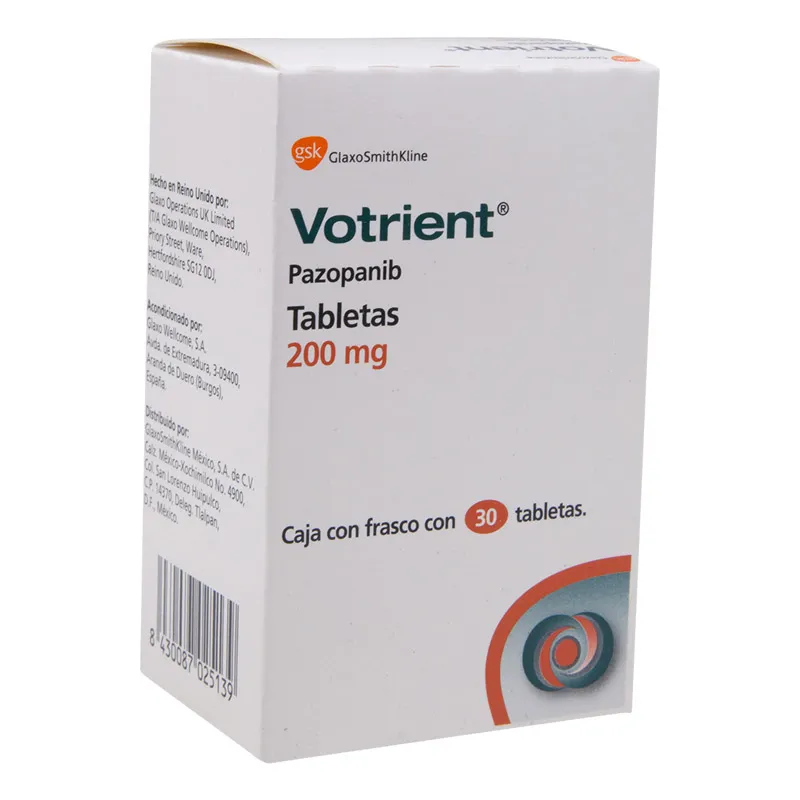
Table of Contents
Patient Information Leaflet
Votrient 200 mg film-coated tablets, 400 mg film-coated tablets
pazopanib
Please read all of this leaflet carefully before you start taking this medicine because it contains important information for you.
- Keep this leaflet. You may need to read it again.
- If you have any questions, ask your doctor or pharmacist.
- This medicine has been prescribed for you only. Do not pass it on to other people, even if their symptoms seem identical to yours, as it may be harmful to them.
- If you experience any side effects, including those not listed in this leaflet, tell your doctor or pharmacist. See section 4.
Contents of this leaflet:
- What Votrient is and what it is used for
- What you need to know before taking Votrient
- How to take Votrient
- Possible side effects
- How to store Votrient
- Contents of the pack and other information
1. What Votrient is and what it is used for
Votrient is a type of medicine called a protein kinase inhibitor. It works by blocking the activity of proteins involved in the growth and spread of cancer cells.
Votrient is used in adults to treat:
- advanced kidney cancer or cancer that has spread to other organs.
- certain types of soft tissue sarcoma, which is a type of tumour affecting the body's supportive tissues. It can occur in muscles, blood vessels, fatty tissue, or other tissues that support, surround, and protect organs.
2. What you should know before taking Votrient
Do not take Votrient
- if you are allergic to pazopanib or to any of the other ingredients of this medicine (listed in section 6). Check with your doctor if you think this applies to you.
Warnings and precautions
Talk to your doctor before taking Votrient:
- if you have a heart condition.
- if you have a liver condition.
- if you have previously had heart failure or a heart attack.
- if you have previously had a lung collapse.
- if you have had problems related to bleeding, blood clots, or narrowing of the arteries.
- if you have had stomach or intestinal problems, such as a perforation (hole) or a fistula (abnormal passage forming between parts of the intestine).
- if you have thyroid problems.
- if you have problems with kidney function.
- if you have or have had an aneurysm (a weakened and bulging blood vessel wall) or a tear in the wall of a blood vessel. Inform your doctor if any of these apply to you. Your doctor will decide whether Votrient is suitable for you. Additional tests may be needed to check that your kidneys, heart, and liver are functioning properly.
High blood pressure and Votrient
Votrient can increase blood pressure. Your blood pressure will be monitored before starting and during treatment with Votrient. If you have high blood pressure, you will be treated with medicines to lower it.
Inform your doctor if you have high blood pressure.
If you are about to undergo surgery
Your doctor will stop Votrient at least 7 days before surgery because the medicine may affect wound healing. Treatment will be restarted once the wound has healed adequately.
Conditions to which you should pay attention
Votrient may worsen certain conditions or cause serious side effects. To reduce the risk of any problems, you should be aware of certain symptoms while taking Votrient. See section 4.
Children and adolescents
Votrient is not recommended for people under 18 years of age. It is not yet known how it works in this age group. Furthermore, it should not be used in children under 2 years of age due to safety concerns.
Other medicines and Votrient
Tell your doctor or pharmacist if you are taking, have recently taken, or might take any other medicines. This includes herbal medicines and other medicines you can buy without a prescription.
Some medicines can affect how Votrient works and may increase the likelihood of side effects. In turn, Votrient can affect how other medicines work. These include:
- clarithromycin, ketoconazole, itraconazole, rifampicin, telithromycin, voriconazole (used to treat infections).
- atazanavir, indinavir, nelfinavir, ritonavir, saquinavir (used to treat HIV).
- nefazodone (used to treat depression).
- simvastatin and possibly other statins (used to treat high cholesterol levels).
- medicines that reduce stomach acid. The type of medicine you are taking to reduce stomach acid (e.g. proton pump inhibitors, H-_2 antagonists, or antacids) may affect how you should take Votrient. Speak to your doctor or nurse for advice. Inform your doctor or pharmacist if you are taking any of these medicines.
Votrient with food and drink
Do not take Votrient with food, as this affects how the medicine is absorbed. Take it at least 2 hours after a meal or 1 hour before a meal (see section 3).
Do not drink grapefruit juice while being treated with Votrient, as this may increase the risk of side effects.
Pregnancy, breastfeeding and fertility
Votrient is not recommended if you are pregnant. The effects of Votrient during pregnancy are unknown.
- Inform your doctor if you are pregnant or planning to become pregnant.
- Use a reliable method of contraception while taking Votrient and for at least 2 weeks after stopping it, to prevent pregnancy.
- If you become pregnant during treatment with Votrient, inform your doctor.
You must not breastfeed while taking Votrient. It is not known whether the components of Votrient pass into breast milk. Discuss this with your doctor.
If you are a male patient (even if you have had a vasectomy) and have a partner who is pregnant or who could become pregnant (including those using other contraceptive methods), you must use a condom during sexual intercourse while taking Votrient and for at least 2 weeks after the last dose.
Fertility may be affected by treatment with Votrient. Talk to your doctor about this.
Driving and using machines
Votrient may cause side effects that could affect your ability to drive or operate machinery.
Avoid driving or operating machinery if you feel confused, tired, weak, or if your energy levels are low.
Votrient contains sodium
This medicine contains less than 1 mmol (23 mg) of sodium per film-coated tablet, i.e. essentially ‘sodium-free’.
3. How to take Votrient
Take this medicine exactly as your doctor has told you. If you are unsure, consult your doctor or pharmacist.
How much to take
The recommended dose is 800 mg taken once daily. This dose can be taken as 2 tablets of 400 mg or as 4 tablets of 200 mg. The 800 mg dose once daily is the maximum daily dose. Your doctor may need to reduce your dose if you experience side effects.
When to take it
Do not take Votrient with food. Take it at least two hours after a meal or one hour before a meal.
For example, you could take it two hours after breakfast or one hour before lunch. Take Votrient at approximately the same time each day.
Swallow the tablets whole with water, one after the other. Do not break or crush the tablets, as this may affect how the medicine is absorbed and may increase the risk of side effects.
If you take more Votrient than you should
If you take too many tablets, contact your doctor or pharmacist for advice. If possible, show them the pack or this leaflet.
If you forget to take Votrient
Do not take a double dose to make up for the forgotten dose. Take only the next dose at the usual time.
Do not stop Votrient without medical advice
Take Votrient for as long as your doctor recommends. Do not stop unless your doctor tells you to.
4. Possible side effects
Like all medicines, this medicine can cause side effects, although not everybody gets them.
Serious possible side effects
Brain swelling (reversible posterior leukoencephalopathy syndrome)
Votrient may rarely cause brain swelling, which can be life-threatening. Symptoms include:
- loss of speech
- changes in vision
- seizures (epileptic fits)
- confusion
- high blood pressure Stop taking Votrient and seek immediate medical help if you experience any of these symptoms, or if you have a headache accompanied by any of these symptoms.
Hypertensive crisis (sudden and severe increase in blood pressure)
Votrient may occasionally cause a sudden and severe increase in blood pressure. This is known as a hypertensive crisis. Your doctor will monitor your blood pressure while you are taking Votrient. Signs and symptoms of a hypertensive crisis may include:
- severe chest pain
- severe headache
- blurred vision
- confusion
- nausea
- vomiting
- severe anxiety
- shortness of breath
- seizures (epileptic fits)
- fainting Stop taking Votrient and seek immediate medical help if you develop a hypertensive crisis.
Heart problems
The risk of these problems may be higher in people with existing heart conditions or who are taking other medicines. You will be monitored for any heart problems while taking Votrient.
Heart dysfunction/heart failure, heart attack
Votrient may affect the heart's pumping activity and may increase the likelihood of having a heart attack. Signs and symptoms include:
- irregular or rapid heartbeat
- fast heartbeat
- fainting
- chest pain or pressure
- pain in arms, back, neck, or jaw
- shortness of breath
- swelling in legs Seek immediate medical help if you experience any of these symptoms.
Changes in heart rhythm (QT prolongation)
Votrient may affect the heart rhythm, which in some people may lead to a potentially serious heart condition known as torsade de pointes. This may result in a very rapid heartbeat causing sudden loss of consciousness.
Inform your doctor if you notice any unusual changes in your heartbeat, such as a heartbeat that is too fast or too slow.
Stroke
Votrient may increase the likelihood of having a stroke. Signs and symptoms of stroke may include:
- numbness or weakness on one side of the body
- difficulty speaking
- headache
- dizziness Seek immediate medical help if you experience any of these symptoms.
Bleeding
Votrient may cause serious bleeding in the gastrointestinal tract (such as stomach, esophagus, rectum, or intestine), or in the lungs, kidneys, mouth, vagina, and brain, although this is not common. Symptoms include:
- passing blood in stools or black stools
- blood in urine
- stomach pain
- coughing or vomiting blood Seek immediate medical help if you experience any of these symptoms.
Perforation and fistula
Votrient may cause a tear (perforation) in the stomach or intestine or the development of an abnormal connection between two parts of the digestive tract (a fistula). Signs and symptoms may include:
- severe stomach pain
- nausea and/or vomiting
- fever
- development of a hole (perforation) in the stomach or intestine from which pus mixed with blood and foul-smelling discharge is released Seek immediate medical help if you experience any of these symptoms.
Liver problems
Votrient may cause liver problems that can lead to serious conditions such as liver dysfunction and liver failure, which may be fatal. Your doctor will monitor liver enzymes while you are taking Votrient. Signs that the liver may not be working properly may include:
- yellowing of the skin or whites of the eyes (jaundice)
- dark urine
- fatigue
- nausea
- vomiting
- loss of appetite
- pain in the right side of the stomach (abdomen)
- easy bruising Seek immediate medical help if you experience any of these symptoms.
Blood clots
Deep vein thrombosis (DVT) and pulmonary embolism
Votrient may cause blood clots in veins, especially in the legs (deep vein thrombosis or DVT), which may travel to the lungs (pulmonary embolism). Signs and symptoms may include:
- sudden chest pain
- shortness of breath
- rapid breathing
- leg pain
- swelling of arms and hands or legs and feet
Thrombotic microangiopathy (TMA)
Votrient may cause blood clots in small blood vessels in the kidneys and brain, accompanied by a decrease in red blood cells and cells involved in blood clotting (thrombotic microangiopathy, TMA). Signs and symptoms may include:
- easy bruising
- high blood pressure
- fever
- confusion
- drowsiness
- seizures (epileptic fits)
- reduced urine output Seek immediate medical help if you experience any of these symptoms.
Tumour lysis syndrome
Votrient may cause rapid breakdown of tumour cells, leading to tumour lysis syndrome, which in some people may be fatal. Symptoms may include irregular heartbeat, seizures (fits), confusion, muscle cramps or spasms, or reduced urine production. Seek immediate medical help if you experience any of these symptoms.
Infections
Infections occurring while taking Votrient may become severe. Symptoms of infections may include:
- fever
- flu-like symptoms such as cough, fatigue, and body aches that do not go away
- shortness of breath and/or wheezing
- pain when urinating
- cuts, scratches, or wounds that are red, warm, swollen, or painful Seek immediate medical help if you experience any of these symptoms.
Lung inflammation
Rarely, Votrient may cause inflammation of the lungs (interstitial lung disease, pneumonia), which in some people may be fatal. Symptoms include shortness of breath or persistent cough. While taking Votrient, you will be monitored for any lung problems.
Seek immediate medical help if you experience any of these symptoms.
Thyroid problems
Votrient may reduce the amount of thyroid hormone produced by the body. This may cause weight gain and fatigue. While taking Votrient, your thyroid hormone levels will be monitored.
Inform your doctor if you notice significant weight gain or fatigue.
Blurred or impaired vision
Votrient may cause separation or tearing of the inner layer at the back of the eye (retinal detachment or tear). This may lead to blurred or impaired vision.
Inform your doctor if you notice any changes in your vision.
Possible side effects (including possible serious side effects by relevant frequency category).
Very common side effects (may affect more than 1 in 10 people):
- high blood pressure
- diarrhoea
- nausea or vomiting
- stomach pain
- loss of appetite
- weight loss
- taste disturbances or loss of taste
- mouth pain
- headache
- tumour site pain
- lack of energy, feeling weak or tired
- change in hair colour
- unusual hair loss or thinning
- loss of skin pigment
- rash, possibly with skin peeling
- redness and swelling of the palms of the hands or soles of the feet Inform your doctor or pharmacist if any of these side effects worsen or become bothersome.
Very common side effects that may be evident from blood or urine tests:
- increased liver enzymes
- reduced albumin in the blood
- protein in the urine
- reduced number of platelets in the blood (cells that help blood to clot)
- reduced number of white blood cells in the blood
Common side effects (may affect up to 1 in 10 people)
- indigestion, bloating, flatulence
- nosebleeds
- dry mouth or mouth ulcers
- infections
- unusual drowsiness
- difficulty sleeping
- chest pain, shortness of breath, leg pain, and swelling of legs/feet. These may be signs of a blood clot in the body (thromboembolism). If the clot breaks loose, it may travel to the lungs and this may be life-threatening or even fatal.
- the heart becomes less effective at pumping blood around the body (cardiac dysfunction)
- slow heartbeat
- bleeding from mouth, rectum, or lung
- dizziness
- blurred vision
- hot flushes
- swelling of face, hands, ankles, feet, or eyelids due to fluid
- tingling, weakness, or numbness in hands, arms, legs, or feet
- skin disorders, redness, itching, dry skin
- nail disorders
- burning, pricking, itching, or tingling sensation on the skin
- feeling cold, with chills
- excessive sweating
- dehydration
- muscle, joint, tendon, or chest pain, muscle spasms
- hoarseness
- shortness of breath
- cough
- coughing up blood
- hiccups
- collapsed lung with trapped air between the lung and chest wall, often causing shortness of breath (pneumothorax) Inform your doctor or pharmacist if any of these side effects become bothersome.
Common side effects that may be evident from blood or urine tests:
- reduced thyroid gland activity
- liver function abnormalities
- increased bilirubin (a substance produced by the liver)
- increased lipase (an enzyme involved in digestion)
- increased creatinine (a substance produced by muscles)
- changes in blood levels of various other chemicals/enzymes. Your doctor will inform you of blood test results.
Uncommon side effects (may affect up to 1 in 100 people)
- stroke
- temporary interruption of blood supply to the brain (transient ischaemic attack)
- interruption of blood supply to part of the heart or heart attack (myocardial infarction)
- interruption of blood supply to part of the heart (myocardial ischaemia)
- blood clots accompanied by a decrease in red blood cells and clotting cells (thrombotic microangiopathy, TMA). These may damage organs such as the brain and kidneys
- increased number of red blood cells in the blood
- sudden onset of shortness of breath, especially when accompanied by acute chest pain and/or rapid breathing (pulmonary embolism)
- serious bleeding in the gastrointestinal tract (such as stomach, oesophagus, or intestine), or in kidneys, vagina, and brain
- heart rhythm disorders (QT prolongation)
- hole (perforation) in the stomach or intestine
- abnormal passage forming between parts of the intestine (fistula)
- heavy or irregular menstrual periods
- sudden sharp increase in blood pressure (hypertensive crisis)
- inflammation of the pancreas (pancreatitis)
- inflamed liver that is not working properly or damaged
- yellowing of the skin or whites of the eyes (jaundice)
- inflammation of the lining of the abdominal cavity (peritonitis)
- runny nose
- rash that may be itchy or inflamed (flat or raised spots or blisters)
- frequent bowel movements
- increased sensitivity of the skin to sunlight
- reduced sensitivity, especially of the skin
- skin wound that does not heal (skin ulcer)
Rare side effects (may affect up to 1 in 1,000 people)
- inflammation of the lungs (pneumonia)
- widening and weakening of a blood vessel wall or a tear in a blood vessel wall (aneurysms and arterial dissections)
Not known (frequency cannot be estimated from available data):
- tumour lysis syndrome resulting from rapid breakdown of tumour cells
- liver failure
Reporting of side effects
If you experience any side effect, including those not listed in this leaflet, talk to your doctor or pharmacist. You can also report side effects directly via the national reporting system listed in Annex V. Reporting side effects can help provide more information on the safety of this medicine.
5. How to store Votrient
Keep this medicine out of the sight and reach of children.
Do not use this medicine after the expiry date (Exp.) stated on the bottle and outer packaging. The expiry date refers to the last day of that month.
This medicine does not require any special storage conditions.
Do not dispose of medicines via wastewater or household waste. Ask your pharmacist how to dispose of medicines no longer required. This will help protect the environment.
6. Package contents and other information
What Votrient contains
- The active substance in Votrient is pazopanib (as hydrochloride). Each 200 mg film-coated tablet of Votrient contains 200 mg of pazopanib. Each 400 mg film-coated tablet of Votrient contains 400 mg of pazopanib.
- The excipients in the 200 mg and 400 mg tablets are: hypromellose, macrogol 400, magnesium stearate, microcrystalline cellulose, polysorbate 80, povidone (K30), sodium starch glycolate, titanium dioxide (E171). The 200 mg tablets also contain red iron oxide (E172).
Description of the appearance of Votrient and package contents
The 200 mg film-coated tablets of Votrient are capsule-shaped, pink, with the imprint GS JT on one side. They are available in bottles containing 30 or 90 tablets.
The 400 mg film-coated tablets of Votrient are capsule-shaped, white, with the imprint GS UHL on one side. They are available in bottles containing 30 or 60 tablets.
Not all pack sizes may be marketed in your country.
Marketing Authorization Holder
Novartis Europharm Limited
Vista Building
Elm Park, Merrion Road
Dublin 4
Ireland
Manufacturer
Lek Pharmaceuticals d.d.
Verovškova 57
1526 Ljubljana
Slovenia
Novartis Pharmaceutical Manufacturing LLC
Verovškova ulica 57
1000 Ljubljana
Slovenia
Glaxo Wellcome, S.A.
Avda. Extremadura, 3
09400 Aranda De Duero, Burgos
Spain
Novartis Farmacéutica S.A.
Gran Via de les Corts Catalanes, 764
08013 Barcelona
Spain
Novartis Pharma GmbH
Sophie-Germain-Strasse 10
90443 Nuremberg
Germany
For further information on this medicinal product, please contact the local representative of the Marketing Authorization Holder:
België/Belgique/Belgien Lietuva
Novartis Pharma N.V. SIA Novartis Baltics Lietuvos filialas
Tél/Tel: +32 2 246 16 11 Tel: +370 5 269 16 50
България Luxembourg/Luxemburg
Novartis Bulgaria EOOD Novartis Pharma N.V.
Тел: +359 2 489 98 28 Tél/Tel: +32 2 246 16 11
Česká republika Magyarország
Novartis s.r.o. Novartis Hungária Kft.
Tel: +420 225 775 111 Tel.: +36 1 457 65 00
Danmark Malta
Novartis Healthcare A/S Novartis Pharma Services Inc.
Tlf: +45 39 16 84 00 Tel: +356 2122 2872
Deutschland Nederland
Novartis Pharma GmbH Novartis Pharma B.V.
Tel: +49 911 273 0 Tel: +31 88 04 52 555
Eesti Norge
SIA Novartis Baltics Eesti filiaal Novartis Norge AS
Tel: +372 66 30 810 Tlf: +47 23 05 20 00
Ελλάδα Österreich
Novartis (Hellas) A.E.B.E. Novartis Pharma GmbH
Τηλ: +30 210 281 17 12 Tel: +43 1 86 6570
España Polska
Novartis Farmacéutica, S.A. Novartis Poland Sp. z o.o.
Tel: +34 93 306 42 00 Tel.: +48 22 375 4888
France Portugal
Novartis Pharma S.A.S. Novartis Farma - Produtos Farmacêuticos, S.A.
Tél: +33 1 55 47 66 00 Tel: +351 21 000 8600
Hrvatska România
Novartis Hrvatska d.o.o. Novartis Pharma Services Romania SRL
Tel. +385 1 6274 220 Tel: +40 21 31299 01
Ireland Slovenija
Novartis Ireland Limited Novartis Pharma Services Inc.
Tel: +353 1 260 12 55 Tel: +386 1 300 75 50
Ísland Slovenská republika
Vistor hf. Novartis Slovakia s.r.o.
Sími: +354 535 7000 Tel: +421 2 5542 5439
Italia Suomi/Finland
Novartis Farma S.p.A. Novartis Finland Oy
Tel: +39 02 96 54 1 Puh/Tel: +358 (0)10 6133 200
Κύπρος Sverige
Novartis Pharma Services Inc. Novartis Sverige AB
Τηλ: +357 22 690 690 Tel: +46 8 732 32 00
Latvija
SIA Novartis Baltics
Tel: +371 67 887 070
Other sources of information
More detailed information on this medicinal product is available on the website of the European Medicines Agency: http://www.ema.europa.eu