Praluent
Italy
Table of Contents
- Package leaflet: Information for the user
- Praluent 75 mg solution for injection in a pre-filled pen, 150 mg solution for injection in a pre-filled pen, 300 mg solution for injection in a pre-filled pen
- Instructions for use
- Instructions for use
- Instructions for use
- Instructions for use
- Instructions for use
- Instructions for use
- Package leaflet: information for the user
- Praluent 75 mg solution for injection in pre-filled syringe, 150 mg solution for injection in pre-filled syringe
- Instructions for use
- Instructions for use
Package leaflet: Information for the user
Praluent 75 mg solution for injection in a pre-filled pen, 150 mg solution for injection in a pre-filled pen, 300 mg solution for injection in a pre-filled pen
alirocumab
Please read all of this leaflet carefully before you start using this medicine because it contains important information for you.
- Keep this leaflet. You may need to read it again.
- If you have any questions, ask your doctor, pharmacist or nurse.
- This medicine has been prescribed for you only. Do not pass it on to other people, even if their symptoms are the same as yours, as it may be harmful to them.
- If you get any side effects, talk to your doctor or pharmacist. This includes any side effects not listed in this leaflet. See section 4.
Contents of this leaflet:
- What Praluent is and what it is used for
- What you need to know before you use Praluent
- How to use Praluent
- Possible side effects
- How to store Praluent
- Contents of the pack and other information
1. What Praluent is and what it is used for
What Praluent is
- Praluent contains the active substance alirocumab.
- Praluent is a monoclonal antibody (a type of specialised protein designed to bind to a specific target substance in the body). Monoclonal antibodies are proteins that recognise and bind to just one other protein. Alirocumab binds to PCSK9.
How Praluent works
Praluent helps lower levels of "bad" cholesterol (also known as LDL cholesterol).
Praluent blocks a protein called PCSK9.
- PCSK9 is a protein secreted by liver cells.
- "Bad" cholesterol is normally removed from the blood by binding to specific "receptors" (binding sites) in the liver.
- PCSK9 reduces the number of these receptors in the liver, resulting in higher than normal levels of "bad" cholesterol.
- By blocking PCSK9, Praluent increases the number of available receptors to help remove "bad" cholesterol, thereby lowering its levels.
What Praluent is used for
- Adults with high blood cholesterol levels (hypercholesterolaemia, heterozygous familial and non-familial, or mixed dyslipidaemia) and children and adolescents aged 8 years and older with heterozygous familial hypercholesterolaemia (HeFH).
- Adults with high blood cholesterol levels and cardiovascular disease to reduce cardiovascular risk.
It is administered:
- in combination with a statin (a medicine commonly used to treat high cholesterol) or other cholesterol-lowering medicines, if the maximum dose of a statin does not sufficiently lower cholesterol levels,
or
- alone or in combination with other cholesterol-lowering medicines when statins are not tolerated or cannot be used. Continue to follow a cholesterol-lowering diet while taking this medicine.
2. What you need to know before using Praluent
Do not use Praluent
- if you are allergic to alirocumab or to any of the other ingredients of this medicine (listed in section 6).
Warnings and precautions
Tell your doctor, pharmacist, or nurse before using Praluent.
If you develop a severe allergic reaction, stop using Praluent and contact your doctor immediately.
Severe allergic reactions such as hypersensitivity including angioedema (difficulty breathing, or swelling of the face, lips, throat, or tongue), nummular eczema (reddish spots on the skin, sometimes accompanied by blisters), and hypersensitivity vasculitis (a specific form of hypersensitivity reaction with symptoms such as diarrhoea, skin rash, or purple spots on the skin) have occurred. For allergic reactions that may occur during the use of Praluent, see section 4.
Inform your doctor if you have liver or kidney disease before using this medicine, as Praluent has been studied in only a small number of patients with severe renal disease and has not been studied in patients with severe hepatic disease.
Children and adolescents
Do not administer Praluent to children under 8 years of age, as there is no experience with the use of this medicine in this age group.
Other medicines and Praluent
Tell your doctor, pharmacist, or nurse if you are taking, have recently taken, or might take any other medicines.
Pregnancy and breastfeeding
If you are pregnant, suspect you may be pregnant, are planning a pregnancy, or are breastfeeding, consult your doctor or pharmacist before using this medicine.
Praluent is not recommended during pregnancy or breastfeeding.
Driving and using machines
This medicine is not expected to affect the ability to drive or operate machinery.
3. How to use Praluent
Use this medicine exactly as instructed by your doctor, pharmacist, or nurse. If you have any doubts, consult your doctor, pharmacist, or nurse.
How much medicine to inject
Your doctor will tell you the correct dose for you and how often to inject (75 mg or 150 mg every 2 weeks, or 300 mg every 4 weeks/monthly). Your doctor will monitor your cholesterol levels and may adjust the dose (increase or decrease) during treatment.
Always check the label on the pen to make sure you have the correct medicine at the correct concentration.
When to administer the injection
Adults
Inject Praluent every 2 weeks (for doses of 75 mg or 150 mg) or every 4 weeks/monthly (for the 300 mg dose). To administer the 300 mg dose, either one 300 mg injection or two consecutive 150 mg injections at two different injection sites must be given.
Children and adolescents aged 8 years and older with heterozygous familial hypercholesterolemia (HeFH):
Inject Praluent every 2 weeks (for doses of 75 mg or 150 mg) or every 4 weeks/monthly (for doses of 150 mg or 300 mg).
In adolescents aged 12 years and older, Praluent should be administered by an adult or under adult supervision.
In children under 12 years of age, Praluent should be administered by a caregiver.
Before the injection
Praluent must reach room temperature before use.
Read the detailed instructions for use in the package leaflet before injecting Praluent.
Where to administer the injection
Praluent is injected under the skin into the thigh, abdomen, or upper arm. Refer to the detailed instructions for use in the package leaflet for guidance on injection sites.
Learning how to use the pre-filled pen
Before using the pen for the first time, your doctor, pharmacist, or nurse will show you how to inject Praluent.
- Always read the “Instructions for Use” included in the package.
- Always use the pen as described in the “Instructions for Use.”
If you use more Praluent than you should
If you use more Praluent than you should, contact your doctor, pharmacist, or nurse.
If you forget to use Praluent
If you miss a dose of Praluent, inject the missed dose as soon as possible. Then continue with your regular dosing schedule. This way, you will maintain the original treatment schedule. If you have any doubts about when to inject Praluent, contact your doctor, pharmacist, or nurse.
If you stop using Praluent
Do not stop treatment with Praluent without first informing your doctor. If you stop treatment with Praluent, your cholesterol levels may increase.
If you have any questions about the use of this medicine, consult your doctor, pharmacist, or nurse.
4. Possible side effects
Like all medicines, this medicine can cause side effects, although not everyone gets them.
If you develop a severe allergic reaction, stop using Praluent and contact your doctor immediately.
Severe allergic reactions have sometimes occurred (may affect up to 1 in 1,000 people), such as hypersensitivity (difficulty breathing), nummular eczema (reddish spots on the skin, sometimes accompanied by blisters), and hypersensitivity vasculitis (a specific form of hypersensitivity reaction with symptoms such as diarrhoea, accompanied by a skin rash or purplish spots on the skin).
Other side effects are:
Common (may affect up to 1 in 10 people)
- redness, itching, swelling, pain/tenderness at the injection site (injection site reactions)
- signs and symptoms of upper respiratory tract infections, such as sore throat, runny nose, sneezing
- itching.
Rare (may affect up to 1 in 1,000 people)
- itchy red lumps or hives (urticaria).
Not known
The following side effects have been reported after Praluent has been marketed, but how often they occur is not known:
- flu-like illness
- breathing difficulties or swelling of the face, lips, throat or tongue (angioedema).
Reporting of side effects
If you get any side effect, including those not listed in this leaflet, talk to your doctor or pharmacist.
You can also report side effects directly via the national reporting system listed in Annex V. By reporting side effects, you can help provide more information on the safety of this medicine.
5. How to store Praluent
Keep this medicine out of the sight and reach of children.
Do not use this medicine after the expiry date stated on the label and carton after
Exp. The expiry date refers to the last day of the month indicated.
Store in a refrigerator (2°C – 8°C). Do not freeze.
Keep the pen in its outer packaging to protect the medicine from light.
If necessary, individual pre-filled pens may be stored outside the refrigerator at temperatures below 25°C for
up to 30 days. Protect from light. After removal from the refrigerator, Praluent must be used within 30 days or discarded.
Do not use the medicine if it changes colour, becomes cloudy, or if flakes or visible particles are present.
After use, dispose of the pen into a puncture-resistant container. Ask your doctor, pharmacist, or nurse how to dispose of the container properly. Do not recycle the container.
Do not dispose of any medicine via wastewater or household waste. Ask your pharmacist how to dispose of medicines no longer required. This will help protect the environment.
6. Package contents and other information
What Praluent contains
- The active substance is alirocumab.
Praluent 75 mg solution for injection in a pre-filled pen
Each pre-filled pen contains 75 milligrams of alirocumab.
Praluent 150 mg solution for injection in a pre-filled pen
Each pre-filled pen contains 150 milligrams of alirocumab.
Praluent 300 mg solution for injection in a pre-filled pen
Each pre-filled pen contains 300 milligrams of alirocumab.
- The other components are histidine, sucrose, polysorbate 20 and water for injections.
Description of the appearance of Praluent and contents of the pack
Praluent is a clear, colourless to pale yellow, injectable solution contained in a pre-filled pen.
Praluent 75 mg solution for injection in a pre-filled pen
Each pre-filled pen with a green button contains 1 mL of solution and delivers a single dose of 75 milligrams of alirocumab.
Packs containing 1, 2 or 6 pre-filled pens are available.
Each pre-filled pen without an activation button contains 1 mL of solution and delivers a single dose of 75 milligrams of alirocumab.
Packs containing 1, 2 or 3 pre-filled pens without an activation button are available, as well as multi-packs containing 6 (2 packs of 3) pre-filled pens without an activation button.
Praluent 150 mg solution for injection in a pre-filled pen
Each pre-filled pen with a grey button contains 1 mL of solution and delivers a single dose of 150 milligrams of alirocumab.
Packs containing 1, 2 or 6 pre-filled pens are available.
Each pre-filled pen without an activation button contains 1 mL of solution and delivers a single dose of 150 milligrams of alirocumab.
Packs containing 1, 2 or 3 pre-filled pens without an activation button are available, as well as multi-packs containing 6 (2 packs of 3) pre-filled pens without an activation button.
Praluent 300 mg solution for injection in a pre-filled pen
Each pre-filled pen without an activation button contains 2 mL of solution and delivers a single dose of 300 milligrams of alirocumab.
Packs containing 1 or 3 pre-filled pens without an activation button are available.
Not all pack sizes and presentations may be marketed.
Marketing Authorisation Holder
Sanofi Winthrop Industrie
82 avenue Raspail
94250 Gentilly
France
Manufacturer
Sanofi-Aventis Deutschland GmbH
Industriepark Hoechst
Brüningstraße 50
65926 Frankfurt am Main
Germany
Manufacturer
Genzyme Ireland Ltd
IDA Industrial Park
Old Kilmeaden Road
Waterford
Ireland
For further information on this medicinal product, please contact the local representative of the Marketing Authorisation Holder:
België/Belgique/Belgien Lietuva
Sanofi Belgium Swixx Biopharma UAB
Tél/Tel: +32 (0)2 710 54 00 Tel: +370 5 236 91 40
България Luxembourg/Luxemburg
Swixx Biopharma EOOD Sanofi Belgium
Тел.: +359 (0)2 4942 480 Tél/Tel: +32 (0)2 710 54 00 (Belgique/Belgien)
Česká republika Magyarország
Sanofi s.r.o. SANOFI-AVENTIS Zrt.
Tel: +420 233 086 111 Tel.: +36 1 505 0050
Danmark Malta
Sanofi A/S Sanofi S.r.l.
Tlf: +45 45 16 70 00 Tel: +39 02 39394275
Deutschland Nederland
Sanofi-Aventis Deutschland GmbH Sanofi B.V.
Tel.: 0800 52 52 010 Tel: +31 20 245 4000
Tel. aus dem Ausland: +49 69 305 21 131
Eesti Norge
Swixx Biopharma OÜ sanofi-aventis Norge AS
Tel: +372 640 10 30 Tlf: +47 67 10 71 00
Ελλάδα Österreich
Sanofi-Aventis Μονοπρόσωπη AEBE sanofi-aventis GmbH
Τηλ: +30 210 900 16 00 Tel: +43 1 80 185 – 0
España Polska
sanofi-aventis, S.A Sanofi Sp. z o.o.
Tel: +34 93 485 94 00 Tel.: +48 22 280 00 00
France Portugal
Sanofi Winthrop Industrie Sanofi - Produtos Farmacêuticos, Lda.
Tél: 0 800 222 555 Tel: +351 21 35 89 400
Appel depuis l’étranger: +33 1 57 63 23 23
Hrvatska România
Swixx Biopharma d.o.o. Sanofi Romania SRL
Tel: +385 1 2078 500 Tel: +40 (0) 21 317 31 36
Ireland Slovenija
sanofi-aventis Ireland Ltd. T/A SANOFI Swixx Biopharma d.o.o.
Tel: +353 (0) 1 403 56 00 Tel: +386 1 235 51 00
Ísland Slovenská republika
Vistor hf. Swixx Biopharma s.r.o
Sími: +354 535 7000 Tel: +421 2 208 33 600
Italia Suomi/Finland
Sanofi S.r.l. Sanofi Oy
Tel: 800 131212 (technical enquiries) Puh/Tel: +358 (0) 201 200 300
800 536389 (other enquiries)
Κύπρος Sverige
C.A. Papaellinas Ltd. Sanofi AB
Τηλ: +357 22 741741 Tel: +46 (0)8 634 50 00
Latvija United Kingdom (Northern Ireland)
Swixx Biopharma SIA sanofi-aventis Ireland Ltd. T/A SANOFI
Tel: +371 6 616 47 50 Tel: +44 (0) 800 035 2525
More detailed information on this medicinal product is available on the European Medicines Agency website: http://www.ema.europa.eu.
Praluent pre-filled pen
Instructions for use
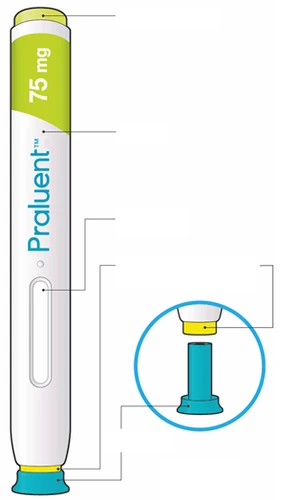
The parts of the Praluent pen are illustrated in this image.
Important information
- The medicine is injected subcutaneously; it can be self-administered or administered by someone else (a caregiver).
- This pen is for single injection use only and must be discarded after use.
- In adolescents aged 12 years and older, it is recommended that Praluent be administered by an adult or under adult supervision.
- In children under 12 years of age, Praluent must be administered by a caregiver.
What to do
✓ Keep the Praluent pen out of sight and reach of children.
✓ Read all instructions carefully before using the Praluent pen.
✓ Follow the instructions every time you use a Praluent pen.
What not to do
Do not touch the yellow safety device.
Do not use the pen if it has been dropped or is damaged.
Do not use the pen if the blue cap is missing or not securely attached.
Do not reuse the pen.
Do not shake the pen.
Do not freeze the pen.
Do not expose the pen to direct sunlight.
Keep this leaflet. If you have any doubts, consult your doctor, pharmacist, or nurse
or call the local representative of the marketing authorization holder indicated in the
package leaflet.
STEP A: Preparing for injection
Before starting, the following materials are required:
- the Praluent pen
- alcohol wipes
- cotton wool or gauze
- a puncture-resistant container (see Step B, 8).
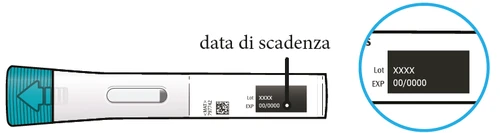
Check the label on the pen.
a) Confirm that you have the correct product and correct dose.
- Check the expiry date: do not use the medicine if this date has passed.
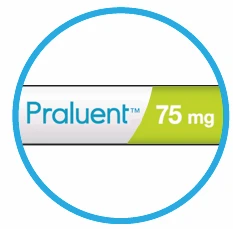
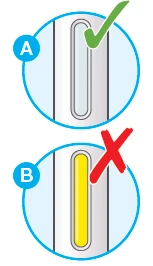
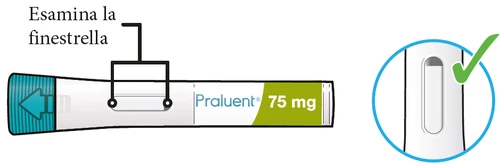
Examine the viewing window.
- Check that the liquid is clear, colourless to pale yellow, and free from particles – if not, do not use it (see Figure A).
- Small air bubbles may be present. This is normal.
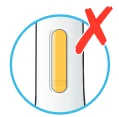
- Do not use the pen if the viewing window appears completely yellow (see Figure B).
Allow the pen to warm to room temperature for 30–40 minutes.
- Do not heat the pen; allow it to warm naturally.
- Do not return the pen to the refrigerator.

30–40
minutes
Prepare the injection site.
- Wash your hands with soap and water and dry them with a towel.
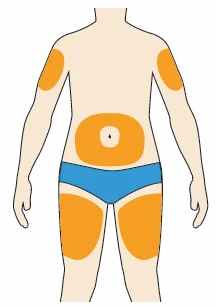
- The injection can be given in the thigh, abdomen (except for the area within 5 cm immediately surrounding the navel), or outer side of the upper arm (see illustration).
- The injection may be administered while standing or sitting.
- Clean the skin at the injection site with an alcohol wipe.
- Do not inject into areas where the skin is tender, hardened, red, or warm.
- Do not inject near a visible vein.
- Use a different site each time you give an injection.
- Do not inject Praluent together with other injectable medicines at the same site.
STEP B: How to perform the injection
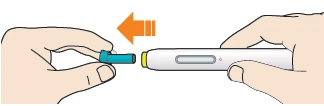
After completing all steps in “Step A: Preparing for injection”, remove the blue cap.
- Remove the cap only when you are ready to perform the injection.
- Do not replace the blue cap.
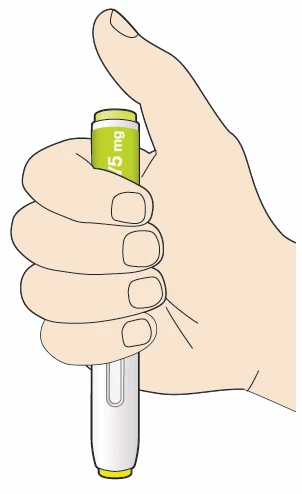
Hold the Praluent pen this way.
- Do not touch the yellow safety device.
- Make sure you can see the viewing window.
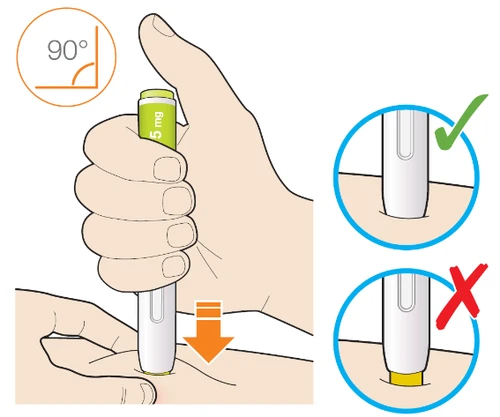
Press the yellow safety device against the skin at an angle of approximately 90°.
- In children under 12 years of age, the skin must be pinched before and during the injection.
- In adolescents aged 12 years and older and in adults, pinching the skin may be necessary to stabilize the injection site.
- Press and hold the pen firmly against the skin until the yellow safety device is no longer visible. The pen will not work if the yellow safety device is not fully pressed.
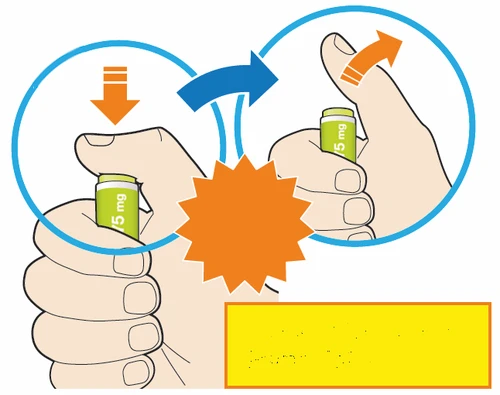
Press and immediately release the green button with your thumb.
- You will hear a click. The injection has now started.
- The viewing window will begin to turn yellow.
Click!
Continue to hold the pen against the skin after releasing the button.
- The injection may take up to 20 seconds.
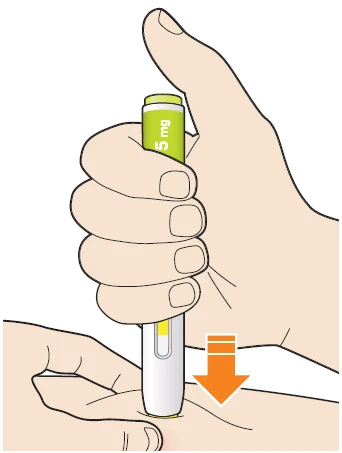
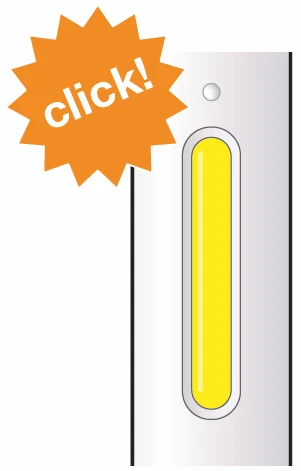
Before removing the pen, check that the viewing window has turned yellow.
- Remove the pen only after the viewing window has turned yellow.
- The injection is complete when the viewing window has turned completely yellow; you may hear a second click.
- If the viewing window does not turn completely yellow, contact the local representative of the marketing authorization holder for assistance. Do not administer a second injection without first consulting your doctor, pharmacist, or nurse.
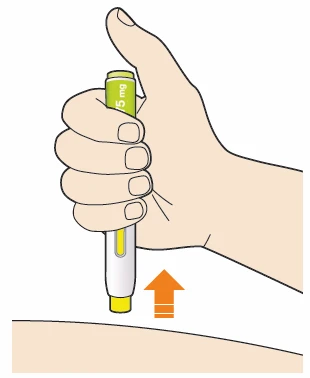
Remove the pen from the skin.
- Do not rub the skin after the injection.
- If bleeding occurs, press cotton wool or gauze against the site until bleeding stops.
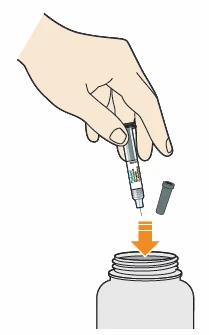
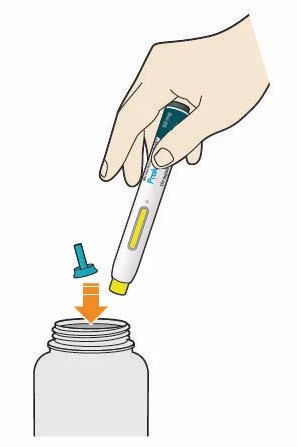
Dispose of the pen and cap
- Do not replace the blue cap.
- Immediately after use, dispose of the pen and cap in a puncture-resistant container.
- Ask your doctor, pharmacist, or nurse how to dispose of the container.
- Always keep the container out of sight and reach of children.
Praluent pre-filled pen
Instructions for use
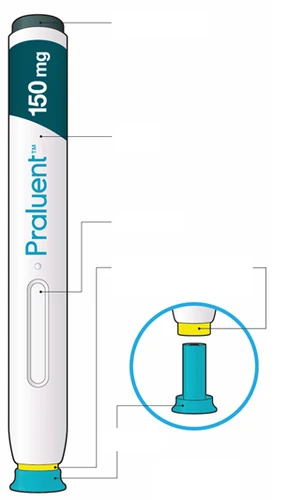
The parts of the Praluent pen are illustrated in this image.
For single use only
Important information
- The medicine is injected subcutaneously; it may be self-administered or administered by someone else (a caregiver).
- This pen is for one injection only and must be discarded after use.
- In adolescents aged 12 years and older, it is recommended that Praluent be administered by an adult or under adult supervision.
- In children under 12 years of age, Praluent must be administered by a caregiver.
What to do
✓ Keep the Praluent pen out of sight and reach of children.
✓ Read all instructions carefully before using the Praluent pen.
✓ Follow the instructions every time you use a Praluent pen.
What not to do
Do not touch the yellow safety device.
Do not use the pen if it has been dropped or damaged.
Do not use the pen if the blue cap is missing or not securely attached.
Do not reuse the pen.
Do not shake the pen.
Do not freeze the pen.
Do not expose the pen to direct sunlight.
Keep this leaflet. If you have any doubts, consult your doctor, pharmacist, or nurse
or contact the local representative of the marketing authorization holder listed in
the package leaflet.
STEP A: Preparing for injection
Before starting, the following materials are required:
- the Praluent pen
- alcohol swabs
- cotton wool or gauze
- a sharps-resistant container (see Step B, 8).
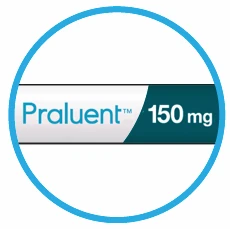
Check the pen label.
- Make sure you have the correct product and correct dose.
- Check the expiration date: do not use the medicine if this date has passed.
Examine the viewing window.
- Check that the liquid is clear, colourless to pale yellow, and free from particles; do not use if not (see Figure A).
- Small air bubbles may be present. This is normal.
- Do not use the pen if the viewing window appears completely yellow (see Figure B).
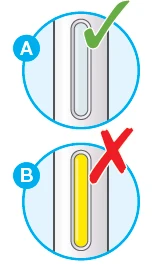
Allow the pen to warm to room temperature for 30–40 minutes.
- Do not heat the pen; allow it to warm on its own.
- Do not return the pen to the refrigerator.

30–40
minutes
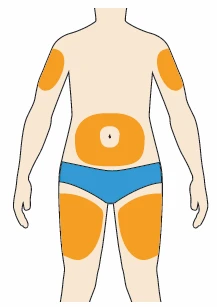
Prepare the injection site.
- Wash hands with soap and water and dry with a towel.
- The injection can be given in the thigh, abdomen (except for the area within 5 cm of the navel), or the outer side of the upper arm (see illustration).
- The injection may be administered while standing or sitting.
- Clean the skin at the injection site with an alcohol swab.
- Do not inject into areas where the skin is tender, hardened, red, or warm.
- Do not inject near a visible vein.
- Use a different injection site each time.
- Do not inject Praluent together with other injectable medicines at the same site.
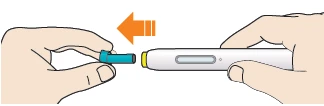
STEP B: How to perform the injection
After completing all steps in “Step A: Preparing for injection”, remove the blue cap.
- Remove the cap only when ready to administer the injection.
- Do not replace the blue cap.
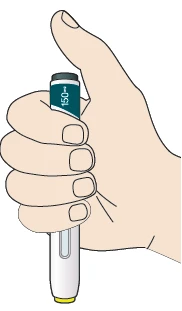
Hold the Praluent pen this way.
- Do not touch the yellow safety device.
- Make sure you can see the viewing window.
Press the yellow safety device against the skin at an angle of approximately 90°.
- In children under 12 years of age, it is necessary to pinch the skin before and during the injection.
- In adolescents aged 12 years and older and in adults, pinching the skin may be necessary to stabilize the injection site.
- Press and hold the pen firmly against the skin until the yellow safety device is no longer visible. The pen will not work if the yellow safety device is not fully pressed.
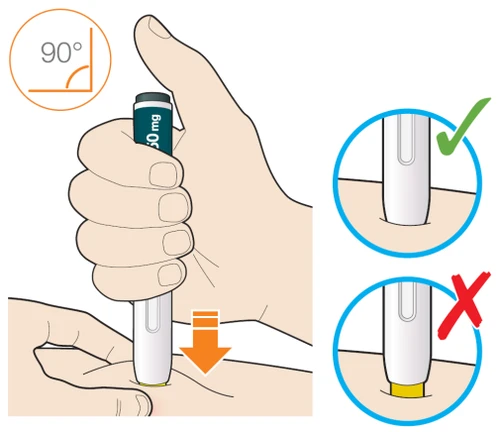
Press and immediately release the grey button with your thumb.
- You will hear a click. The injection has now started.
- The viewing window will begin to turn yellow.
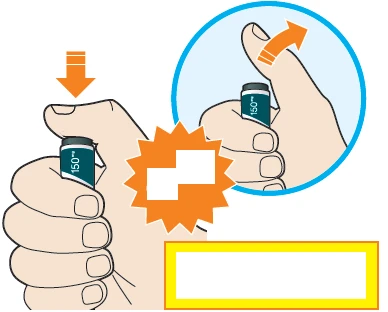
Click!
Continue holding the pen against the skin after releasing the button.
- The injection may take up to 20 seconds.
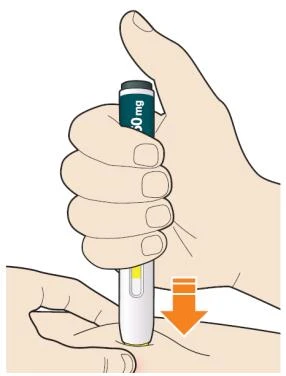
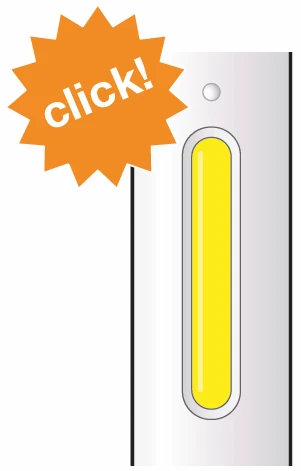
Before removing the pen, check that the viewing window has turned yellow.
- Remove the pen only after the viewing window has turned yellow.
- The injection is complete when the viewing window is completely yellow; you may hear a second click.
- If the viewing window does not turn completely yellow, contact the local representative of the marketing authorization holder for assistance. Do not administer a second injection without first consulting your doctor, pharmacist, or nurse.
Remove the pen from the skin.
- Do not rub the skin after injection.
- If bleeding occurs, press a cotton wool or gauze pad over the site until bleeding stops.
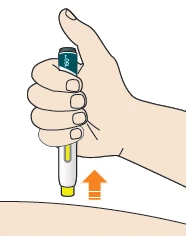
Dispose of the pen and cap
- Do not replace the blue cap.
- Immediately after use, dispose of the pen and cap in a sharps-resistant container.
- Ask your doctor, pharmacist, or nurse how to dispose of the container.
- Always keep the container out of sight and reach of children.
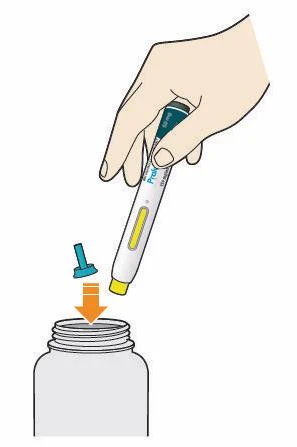
Praluent pre-filled pen
Instructions for use
The parts of the Praluent pen are illustrated in this image.
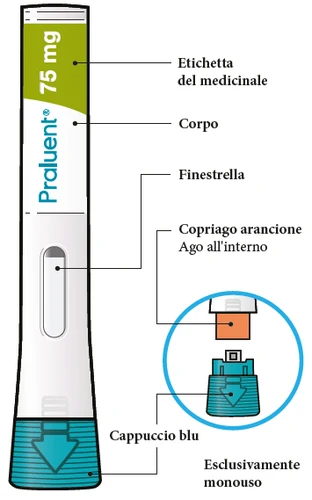
Important information
- This device is a single-use, prefilled pen. It contains 75 mg of Praluent (alirocumab) in 1 mL. The Praluent pen contains the medicine prescribed by your doctor.
- The medicine is injected subcutaneously and may be self-administered or administered by someone else (a caregiver).
- It is important that you do not administer injections to yourself or to another person unless you have been properly trained by a healthcare professional.
- This pen is for one injection only and must be discarded after use.
What to do
✓ Keep the Praluent pen out of sight and reach of children.
✓ Read all instructions carefully before using the Praluent pen.
✓ Follow the instructions each time you use a Praluent pen.
✓ Store in a refrigerator (2 °C - 8 °C).
✓ Keep the pen in its outer packaging to protect it from light.
What not to do
Do not touch the orange needle cap.
Do not use the pen if it has been dropped or damaged.
Do not use the pen if the blue cap is missing or not securely attached.
Do not reuse the pen.
Do not shake the pen.
Do not freeze the pen.
Do not expose the pen to excessive heat.
Do not expose the pen to direct sunlight.
Keep this leaflet. If you have any doubts, consult your doctor, pharmacist, or nurse
or call the local representative of the marketing authorization holder
indicated in the package leaflet.
STEP A: Preparing for injection
1. Examine the pen label
a. Check that you have the correct product and the correct dose.
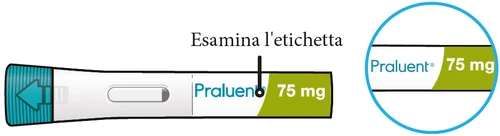
b) Check the expiration date: do not use if this date has been exceeded.
Do not use the Praluent pen if it has fallen on a hard surface or is damaged.
2. Examine the viewing window
a. Check that the liquid is clear, colorless to pale yellow, and free from particles.
Small air bubbles may be present. This is normal.
Do not use this medicine if the solution has changed color or is cloudy, or if it contains
deposits or particles.
Do not use if the viewing window appears completely yellow.
A yellow color in the viewing window indicates that the device has already been used.
3. Allow the pen to warm up and gather the necessary supplies
a. Allow the pen to warm up to room temperature for 45 minutes.
Do not heat the pen; let it warm up on its own.
Do not expose the pen to direct sunlight.
Do not put the pen back in the refrigerator.
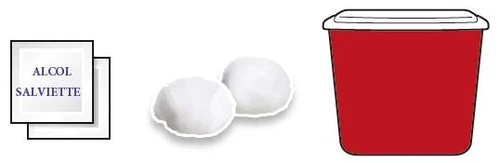
b. While waiting for the pen to reach room temperature, gather the following supplies:
- alcohol wipes
- a cotton ball or gauze pad
- a puncture-resistant container (see Step B9 “Disposal”).
4. Prepare the injection site
a. Wash your hands with water and soap and dry them with a towel.
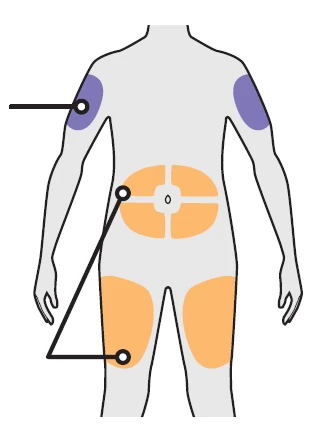
b. The injection can be given (see illustration):
• in the upper part of the thigh
• in the abdomen (except for the area within 5 cm immediately surrounding the navel)
• on the outer side of the upper arm (can only be administered by the person caring for the patient)
c. Clean the skin at the injection site with an alcohol swab.
- The injection may be given while standing or sitting.
- Change the injection site each time an injection is administered. Do not inject in areas where the skin is tender, hardened, red, or warm.
- Do not inject near a visible vein.
- Do not inject Praluent together with other injectable medications at the same site.
STEP B: How to administer the injection
5. Remove the cap
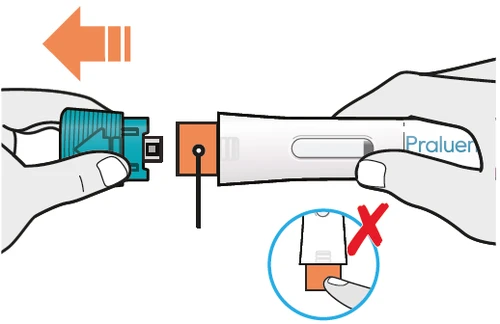
Remove the blue cap and set it aside.
Do not rotate the blue cap.
Do not remove the blue cap until you are ready to perform the injection.
Do not touch the orange needle cap. The needle is inside the orange needle cap. Do not reattach the
blue cap. Do not use the pen if the blue cap is missing or not securely attached.
6. Pinch the skin and position the pen
a. Pinch the skin to keep the injection site steady. This is recommended for children under
12 years of age.
b. When the orange cap is positioned against the skin, hold the pen in place ensuring you can see the viewing window.
c. Place the orange cap against the skin at an angle of approximately 90° degrees.
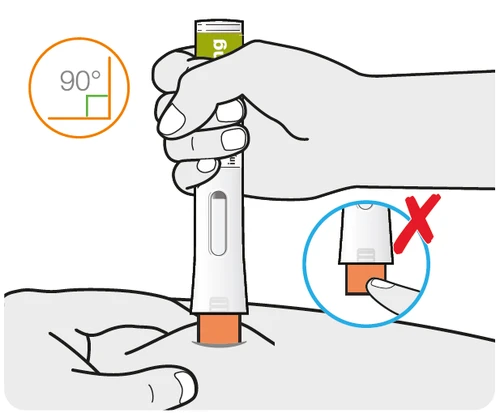
Do not press the pen against the skin until you are ready to inject.
Do not touch the orange cap. The needle is located inside the orange cap.
7. Administer the injection (press → keep pressing → check)
a. Press the pen against the skin until the orange needle cover is fully
inserted into the pen and keep it pressed firmly.
The injection will not start if the orange needle cover is not fully pressed in.
There will be a click when the injection starts. The viewing window will begin to turn yellow.
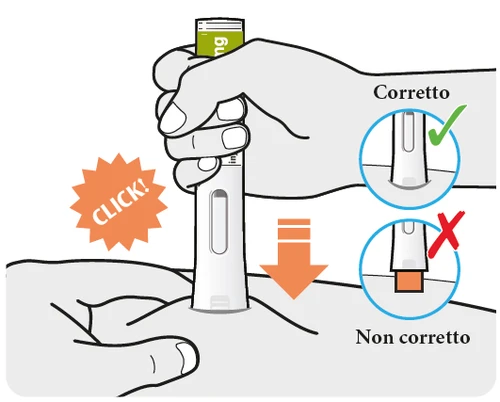
b. Continue to hold the pen against the skin. You may hear a second click.
c. Check that the entire viewing window has turned yellow.
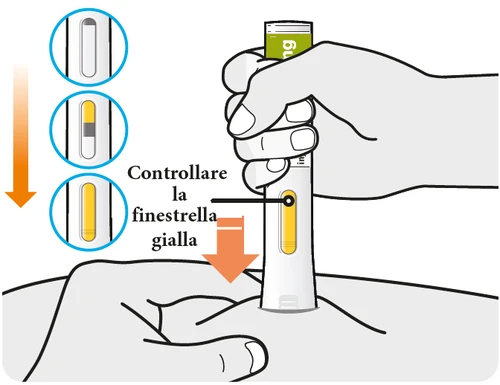
If the viewing window has not turned completely yellow, remove the pen and contact the
local representative of the marketing authorization holder listed on the package leaflet.
Do not administer a second injection without first consulting your doctor, pharmacist, or
nurse.
8. Remove
a. Remove the pen from the skin.
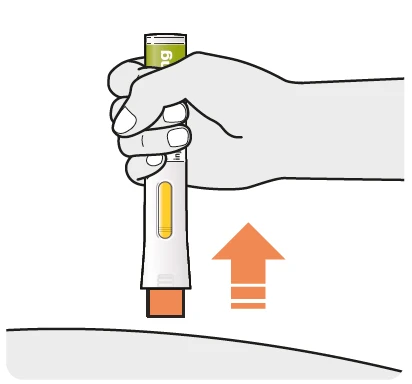
Do not rub the skin after injection.
b. If bleeding occurs, press a cotton ball or gauze on the injection site until bleeding stops.
a. Dispose of the pen and cap into a puncture-resistant container immediately after use.
Do not reattach the blue cap.
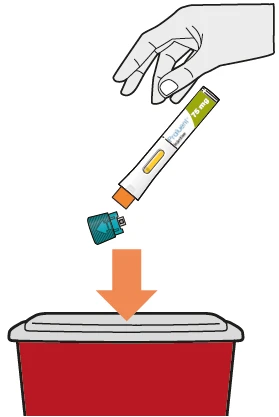
b. Ask your doctor, pharmacist, or nurse how to properly dispose of the container.
c. Always keep the container out of sight and reach of children.
Praluent pre-filled pen
Instructions for use
The parts of the Praluent pen are illustrated in this image.
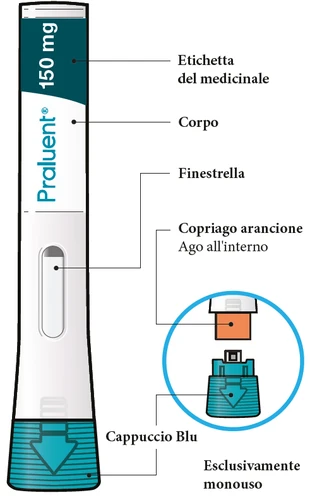
Important information
- This device is a single-use, pre-filled pen. It contains 150 mg of Praluent (alirocumab) in 1 mL. The Praluent pen contains the medicine prescribed by your doctor.
- The medicine is injected subcutaneously; it may be self-administered or administered by someone else (a caregiver).
- It is important that you do not administer injections to yourself or to anyone else unless you have been properly trained by a healthcare professional.
- This pen is for one injection only and must be discarded after use.
What to do
✓ Keep the Praluent pen out of sight and reach of children.
✓ Read all instructions carefully before using the Praluent pen.
✓ Follow the instructions every time you use a Praluent pen.
✓ Store in a refrigerator (2 °C - 8 °C).
✓ Keep the pen in its outer packaging to protect it from light.
What not to do
Do not touch the orange needle cap.
Do not use the pen if it has been dropped or damaged.
Do not use the pen if the blue cap is missing or not securely attached.
Do not reuse the pen.
Do not shake the pen.
Do not freeze the pen.
Do not expose the pen to excessive heat.
Do not expose the pen to direct sunlight.
Keep this leaflet. If you have any doubts, consult your doctor, pharmacist, or nurse
or call the local representative of the marketing authorization holder
indicated in the package leaflet.
STEP A: Preparing for injection
1. Examine the pen label
a. Check that you have the correct product and correct dose.
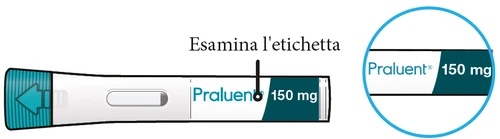
b. Check the expiration date: do not use if this date has been exceeded.
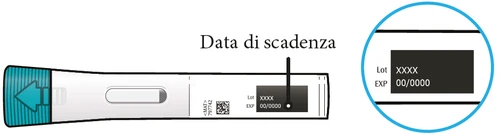
Do not use the Praluent pen if it has fallen on a hard surface or is damaged.
2. Examine the viewing window
a. Check that the liquid is clear, colorless to pale yellow, and free from particles.
Small air bubbles may be present. This is normal.
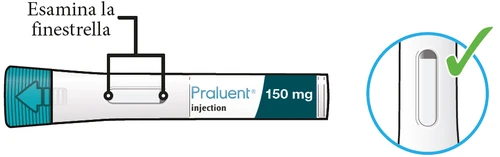
Do not use this medicine if the solution has changed color or is cloudy, or if it contains
deposits or particles.
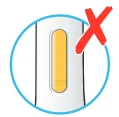
Do not use if the viewing window appears completely yellow.
A yellow color in the viewing window indicates that the device has already been used.
3. Allow the pen to warm up and gather the necessary supplies
a) Allow the pen to warm up to room temperature for 45 minutes.
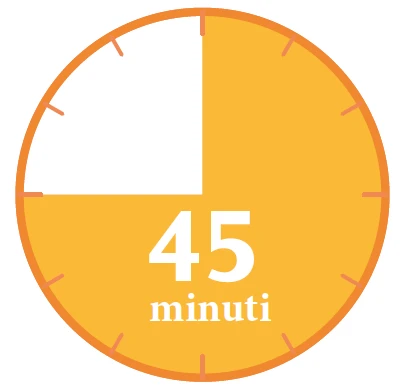
Do not heat the pen; allow it to warm up on its own.
Do not expose the pen to direct sunlight.
Do not put the pen back into the refrigerator.
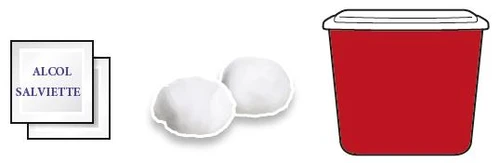
b. While waiting for the pen to reach room temperature, gather the following supplies:
- alcohol wipes
- cotton ball or gauze pad
- a puncture-resistant container (see Step B9 “Disposal”).
4. Prepare the injection site
a. Wash hands with water and soap and dry them with a towel.
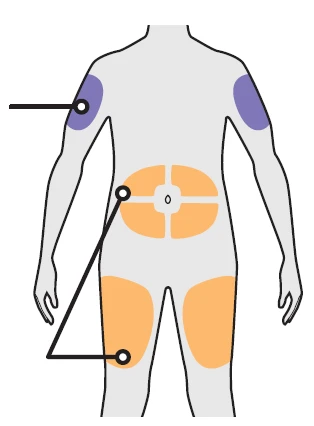
b. The injection can be administered (see illustration):
• on the upper thigh
• on the abdomen (except for the area within 5 cm immediately surrounding the navel)
• on the outer side of the upper arm (can only be administered by the person caring for the patient)
c. Clean the skin at the injection site with an alcohol wipe.
- The injection can be given while standing or sitting.
- Change the injection site each time an injection is administered.
- Do not inject in areas where the skin is tender, hardened, red, or warm.
- Do not inject near a visible vein.
- Do not inject Praluent together with other injectable medications at the same site.
STEP B: How to administer the injection
5. Remove the cap
a. Remove the blue cap and set it aside.
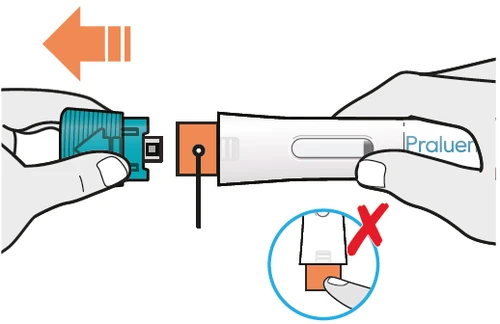
Do not rotate the blue cap.
Do not remove the blue cap until you are ready to perform the injection.
Do not touch the orange needle cover. The needle is located inside the orange needle cover.
Do not reattach the blue cap.
Do not use the pen if the blue cap is missing or not securely attached.
6. Pinch the skin and position the pen
a. Pinch the skin to hold the injection site steady. This is recommended for children under
12 years of age.
b. When the orange needle cap is positioned against the skin, hold the pen in place making sure you can see the
view window.
c. Place the orange needle cap against the skin at an angle of approximately 90° degrees.
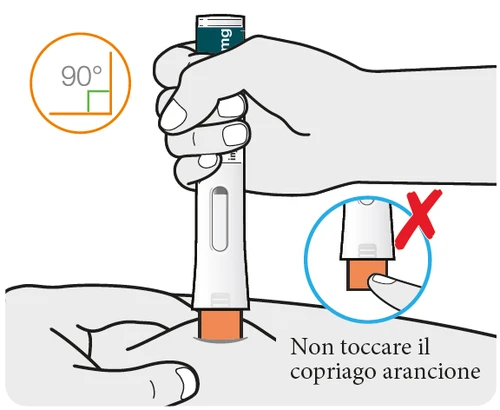
Do not press the pen against the skin until you are ready to inject.
Do not touch the orange needle cap. The needle is inside the orange needle cap.
7. Administer the injection (press → hold → check)
a. Press the pen against the skin until the orange needle cover is fully inserted into the pen and keep it pressed.
The injection will not start if the orange needle cover is not fully pressed in.
There will be a click when the injection starts. The viewing window will begin to turn yellow.
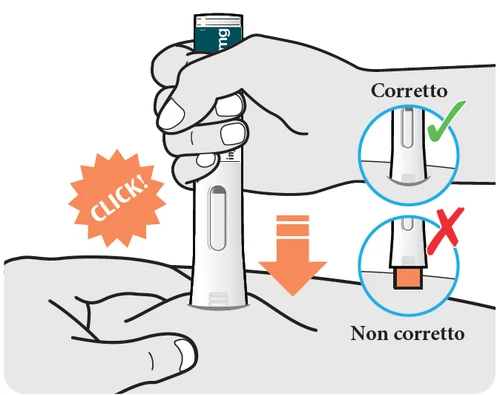
b. Continue to hold the pen against the skin. You may hear a second click.
c. Check that the entire viewing window has turned yellow.
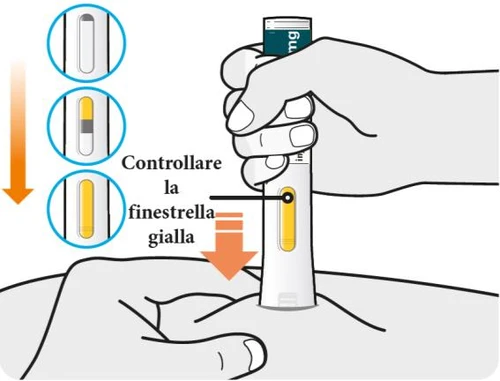
If the viewing window has not turned completely yellow, remove the pen and contact the local representative of the marketing authorization holder listed in the package leaflet.
Do not administer a second injection without first consulting your doctor, pharmacist, or nurse.
8. Remove
a. Remove the pen from the skin.
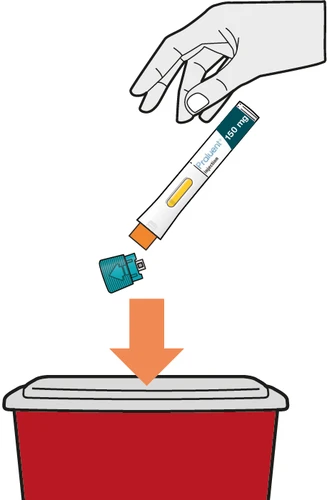
Do not rub the skin after the injection.
b. If bleeding occurs, press a cotton ball or gauze pad on the injection site until bleeding stops.
a. Immediately after use, dispose of the pen and cap into a puncture-resistant container.
Do not re-cap the blue cap.
b. Ask your doctor, pharmacist, or nurse how to properly dispose of the container.
c. Always keep the container out of sight and reach of children.
Praluent pre-filled pen
Instructions for use
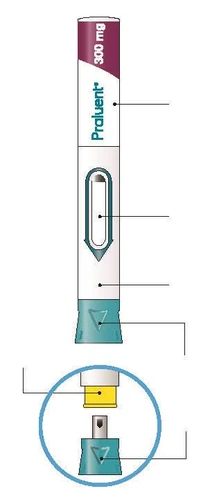
The parts of the Praluent pen are illustrated in this image.
Important information
- The medicine is injected subcutaneously; it may be self-administered or administered by someone else (a caregiver).
- It is important that you or anyone else only administer injections if you have been properly trained by a healthcare professional.
- This pen is for a single injection only and must be discarded after use.
What to do
✓ Keep the Praluent pen out of sight and reach of children.
✓ Read all instructions carefully before using the Praluent pen.
✓ Follow the instructions every time you use a Praluent pen.
What not to do
Do not touch the yellow safety device.
Do not use the pen if it has been dropped or is damaged.
Do not use the pen if the blue cap is missing or not securely attached.
Do not reuse the pen.
Do not shake the pen.
Do not freeze the pen.
Do not expose the pen to excessive heat.
Do not expose the pen to direct sunlight.
Keep this leaflet. If you have any doubts, consult your doctor, pharmacist, or nurse
or contact the local representative of the marketing authorization holder indicated in the package leaflet.
STEP A: Preparing for injection
Before starting, the following materials are required:
- the Praluent pen
- alcohol wipes
- a cotton ball or gauze
- a puncture-resistant container (see Step B, 7).
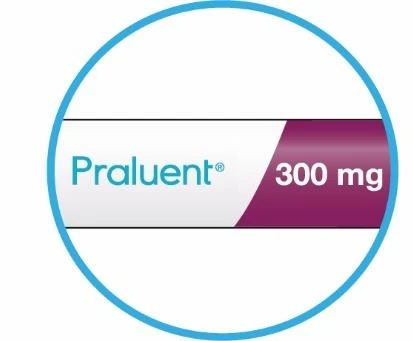
Check the label on the pen.
- Make sure you have the correct product and correct dose.
- Check the expiration date: do not use the medicine if this date has passed.
- Do not use the Praluent pen if it has been dropped on a hard surface or is damaged.
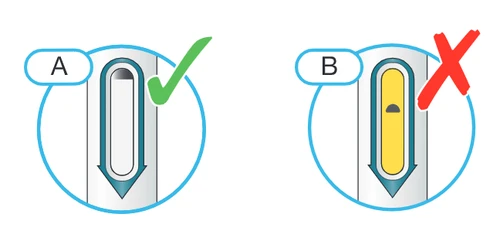
Examine the viewing window.
- Check that the liquid is clear, colourless to pale yellow, and free of particles (see Figure A).
- Do not use this medicine if the solution has changed colour or is cloudy, or if it contains deposits or particles.
- Small air bubbles may be present. This is normal.
- Do not use the pen if the viewing window appears completely yellow (see Figure B).
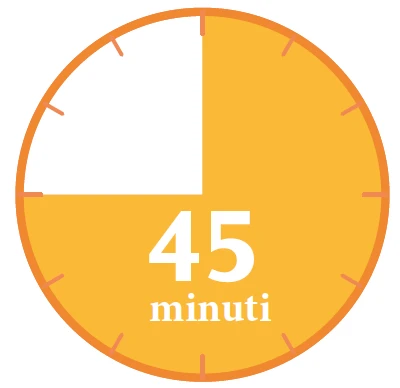
Allow the pen to warm to room temperature for 45 minutes.
- This is important to ensure the full dose is delivered and helps minimize discomfort.
- Do not actively warm the pen; allow it to warm on its own.
- Do not return the pen to the refrigerator.

minutes
Prepare the injection site.
- Wash your hands with soap and water and dry them with a towel.
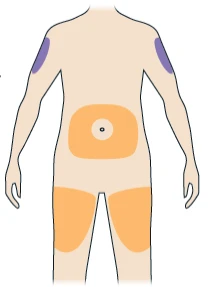
- The injection can be given (see illustrations):
– in the upper thigh
– in the abdomen (except for the 5 cm area immediately surrounding the navel)
– or on the outer side of the upper arm (only administered by a caregiver) - The injection can be given while standing or sitting.
- Clean the skin at the injection site with an alcohol wipe.
- Do not inject into areas where the skin is tender, hard, red, or warm.
- Do not inject into areas adjacent to a visible vein.
- Change (rotate) the injection site each time you give an injection.
- If it is necessary to use the same injection site, ensure you do not inject into the exact same spot as before.
- Do not inject Praluent together with other injectable medicines at the same site.
Recommended injection sites

STEP B: How to perform the injection
After completing all steps in “Step A: Preparing for injection”, remove the blue cap.
- Remove the cap only when you are ready to give the injection.
- Do not replace the blue cap.
- Do not use the pen if the blue cap is missing or not securely attached.
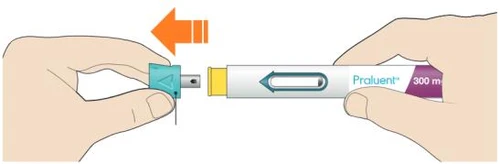
Hold the Praluent pen this way.
- Do not touch the yellow safety device. The needle is inside the yellow safety device.
- Make sure you can see the viewing window.
- Do not press the pen against the skin until you are ready for injection.
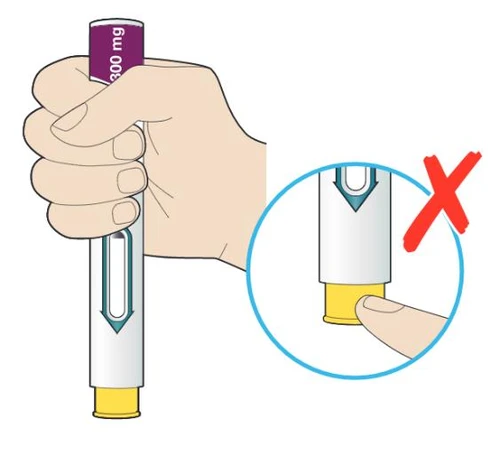
Do not touch the yellow
safety device
Press the yellow safety device against the skin at an angle of approximately 90°.
- Pinch the skin to keep the injection site steady.
- Press the pen firmly against the skin until the yellow safety device is fully retracted into the pen and hold it in place (see figure).
- The injection will not start if the yellow safety device is not fully pressed.
- You will hear a click when the injection starts. The viewing window will begin to turn yellow.
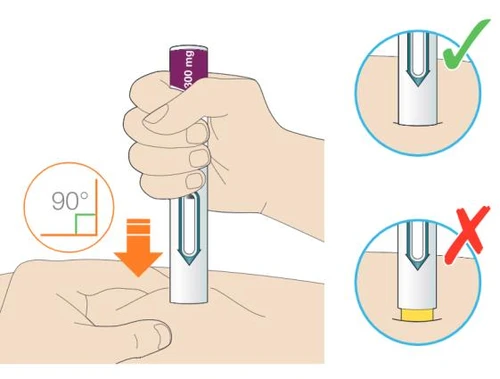
Correct
Incorrect
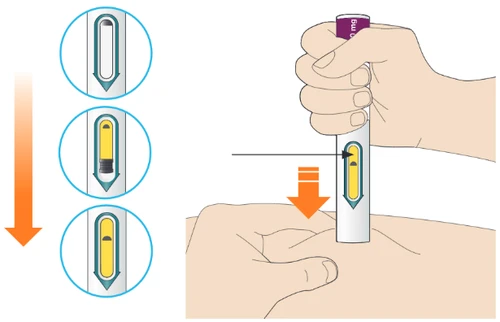
Continue to hold the pen against the skin
- You may hear a second click
- Check that the entire viewing window has turned yellow
- Then, slowly count to 5
Before removing the pen, check again that the viewing window has turned yellow.
- If the viewing window has not turned completely yellow, remove the pen and contact the local representative of the marketing authorization holder for assistance.
- Do not administer a second injection without first consulting your doctor, pharmacist, or nurse.
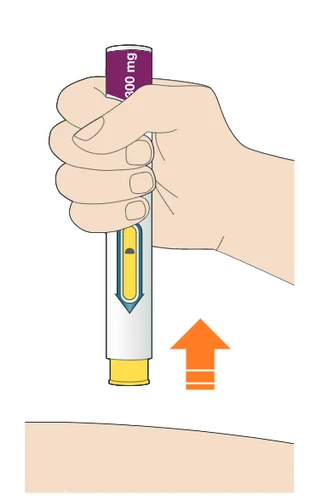
Remove the pen from the skin.
- Do not rub the skin after the injection.
- If bleeding occurs, press a cotton ball or gauze on the site until bleeding stops.
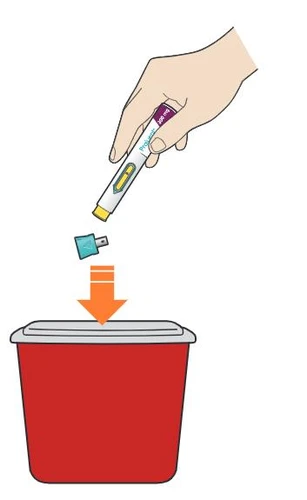
Dispose of the pen and cap
- Do not replace the blue cap.
- Immediately after use, dispose of the pen and cap in a puncture-resistant container.
- Ask your doctor, pharmacist, or nurse how to dispose of the container.
- Always keep the container out of sight and reach of children.
Praluent pre-filled pen
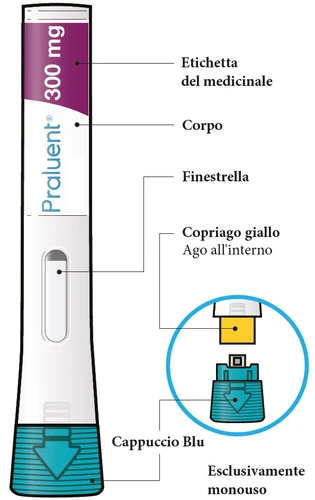
Instructions for use
The parts of the Praluent pen are illustrated in this image.
Important information
- This device is a single-use, pre-filled pen. It contains 300 mg of Praluent (alirocumab) in 2 mL. The Praluent pen contains the medicine prescribed by your doctor.
- The medicine is injected under the skin; it may be self-administered or administered by someone else (a caregiver).
- It is important that you do not administer the injections to yourself or to anyone else unless you have been properly trained by a healthcare professional.
- This pen is for one injection only and must be discarded after use.
What to do
✓ Keep the Praluent pen out of sight and reach of children.
✓ Read all instructions carefully before using the Praluent pen.
✓ Follow the instructions every time you use a Praluent pen.
✓ Store in a refrigerator (2 °C - 8 °C).
✓ Keep the pen in its outer packaging to protect it from light.
What not to do
Do not touch the yellow needle cap.
Do not use the pen if it has been dropped or damaged.
Do not use the pen if the blue cap is missing or not securely attached.
Do not reuse the pen.
Do not shake the pen.
Do not freeze the pen.
Do not expose the pen to excessive heat.
Do not expose the pen to direct sunlight.
Keep this leaflet. If you have any doubts, consult your doctor, pharmacist, or nurse
or call the local representative of the marketing authorization holder
listed in the package leaflet.
STEP A: Preparing for injection
1. Examine the pen label
a. Check that you have the correct product and the correct dose.
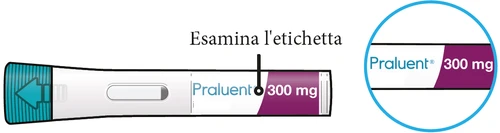
b. Check the expiration date: do not use if this date has been exceeded.
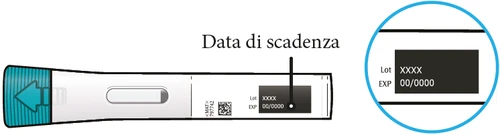
Do not use the Praluent pen if it has been dropped on a hard surface or is damaged.
2. Examine the viewing window
a. Check that the liquid is clear, colorless to pale yellow, and free from particles.
Small air bubbles may be present. This is normal.
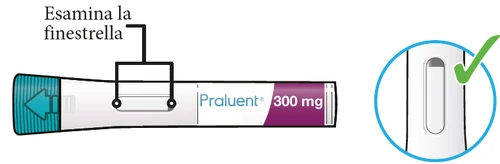
Do not use this medicine if the solution has changed color or is cloudy, or if it contains deposits or
particles.
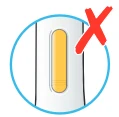
Do not use if the viewing window appears completely yellow.
A yellow color in the viewing window indicates that the device has been used.
3. Allow the pen to warm up and gather the necessary supplies
a) Allow the pen to warm up to room temperature for 45 minutes.
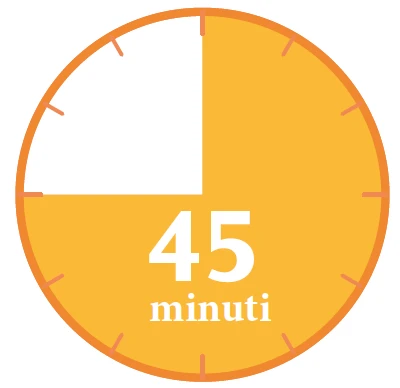
Do not heat the pen; let it warm up on its own.
Do not expose the pen to direct sunlight.
Do not put the pen back in the refrigerator.
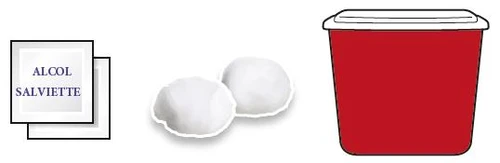
b. While waiting for the pen to reach room temperature, gather the following supplies:
- alcohol wipes
- a cotton ball or gauze pad
- a puncture-resistant container (see Step B9 “Disposal”).
4. Prepare the injection site
a. Wash hands with water and soap and dry them with a towel.
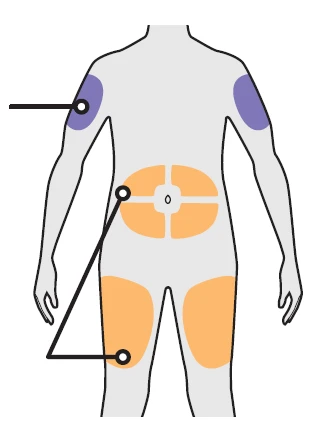
b. The injection can be administered (see illustration):
• on the upper thigh
• on the abdomen (except for the area within 5 cm immediately surrounding the navel)
• on the outer side of the upper arm (can only be administered by the person caring for the patient)
c. Clean the skin at the injection site with an alcohol wipe.
- The injection may be given while standing or sitting.
- Change the injection site each time an injection is administered.
- Do not inject in areas where the skin is tender, hardened, red, or warm.
- Do not inject near a visible vein.
- Do not inject Praluent together with other injectable medications at the same site.
STEP B: How to administer the injection
5. Remove the cap
a. Remove the blue cap and set it aside.
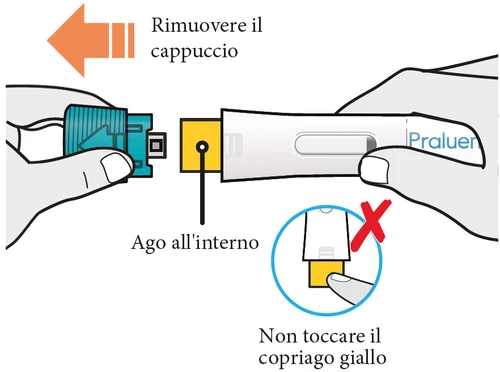
Do not rotate the blue cap.
Do not remove the blue cap until ready to perform the injection.
Do not touch the yellow needle cover. The needle is located inside the yellow needle cover.
Do not reattach the blue cap.
Do not use the pen if the blue cap is missing or not securely attached.
6. Pinch the skin and position the pen
a. Pinch the skin to keep the injection site steady. This is recommended for children under 12 years of age.
b. When the yellow needle cap is placed against the skin, hold the pen in place ensuring you can see the viewing window.
c. Place the yellow needle cap on the skin at an angle of approximately 90°.
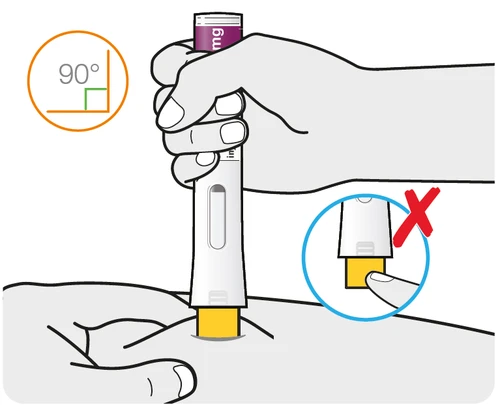
Do not touch
the yellow needle cap
Do not press the pen against the skin until you are ready to inject.
Do not touch the yellow needle cap. The needle is located inside the yellow needle cap.
7. Administer the injection (press → keep pressing → check)
a. Press the pen against the skin until the yellow needle cover is fully inserted into the pen and keep it pressed.
The injection will not start if the yellow needle cover is not fully pressed.
There will be a click when the injection starts. The viewing window will begin to turn yellow.
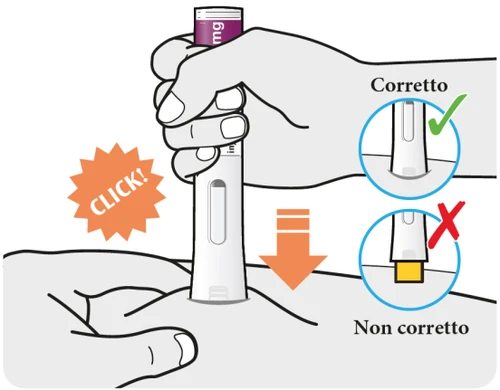
b. Continue to hold the pen against the skin. You may hear a second click.
c. Check that the entire viewing window has turned yellow.
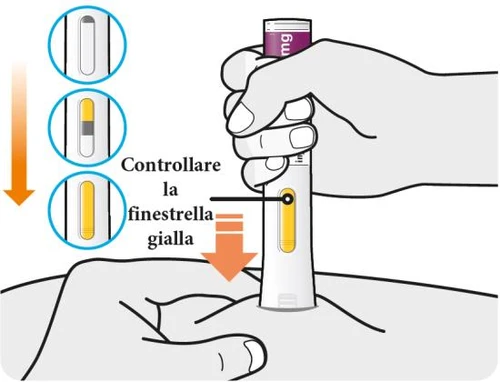
If the viewing window has not turned completely yellow, remove the pen and contact the local representative of the marketing authorization holder listed on the package leaflet.
Do not administer a second injection without first consulting your doctor, pharmacist, or nurse.
8. Remove
a. Remove the pen from the skin.
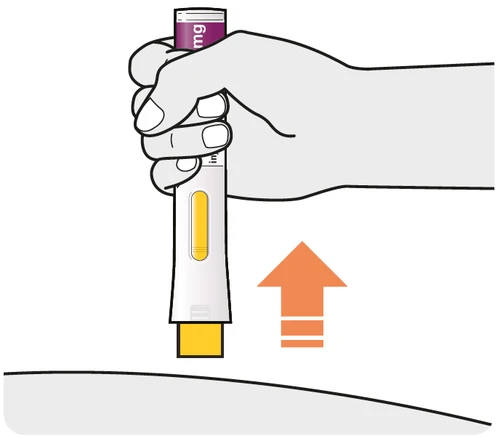
Do not rub the skin after injection.
b. If bleeding occurs, press a cotton ball or gauze on the injection site until bleeding stops.
9. Disposal
a. Dispose of the pen and cap immediately into a puncture-resistant container after use.
Do not recap the blue cap.
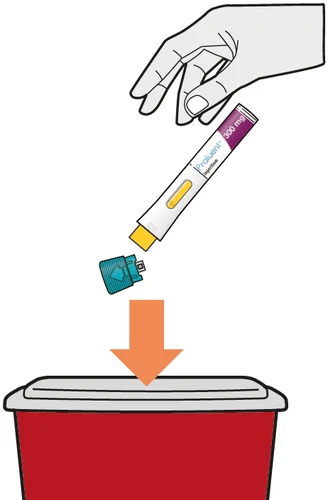
b. Ask your doctor, pharmacist, or nurse how to dispose of the container.
c. Always keep the container out of sight and reach of children.
Package leaflet: information for the user
Praluent 75 mg solution for injection in pre-filled syringe, 150 mg solution for injection in pre-filled syringe
alirocumab
Please read this leaflet carefully before using this medicine because it contains important information for you.
- Keep this leaflet. You may need to read it again.
- If you have any questions, ask your doctor, pharmacist, or nurse.
- This medicine has been prescribed for you only. Do not give it to others, even if their symptoms are the same as yours, as it may be harmful.
- If you experience any side effect, including those not listed in this leaflet, contact your doctor or pharmacist. See section 4.
Contents of this leaflet:
- What Praluent is and what it is used for
- What you need to know before using Praluent
- How to use Praluent
- Possible side effects
- How to store Praluent
- Contents of the pack and other information
1. What Praluent is and what it is used for
What Praluent is
- Praluent contains the active substance alirocumab.
- Praluent is a monoclonal antibody (a type of specialised protein designed to bind to a specific target substance in the body). Monoclonal antibodies are proteins that recognise and bind to just one other protein. Alirocumab binds to PCSK9.
How Praluent works
Praluent helps lower levels of "bad" cholesterol (also called LDL cholesterol).
Praluent blocks a protein called PCSK9.
- PCSK9 is a protein secreted by liver cells.
- "Bad" cholesterol is normally removed from the blood by binding to specific "receptors" (binding sites) in the liver.
- PCSK9 reduces the number of these receptors in the liver, resulting in higher than normal levels of "bad" cholesterol.
- By blocking PCSK9, Praluent increases the number of available receptors to help remove "bad" cholesterol, thereby lowering its levels.
What Praluent is used for
- Adults with high blood cholesterol levels (hypercholesterolaemia, heterozygous familial and non-familial, or mixed dyslipidaemia) and children and adolescents aged 8 years and older with heterozygous familial hypercholesterolaemia (HeFH).
- Adults with high blood cholesterol levels and cardiovascular disease to reduce cardiovascular risk.
It is administered:
- together with a statin (a medicine commonly used to treat high cholesterol) or other cholesterol-lowering medicines, if the maximum dose of a statin does not lower cholesterol levels sufficiently, or
- alone or together with other cholesterol-lowering medicines, when statins are not tolerated or cannot be used. Continue to follow a cholesterol-lowering diet while taking this medicine.
2. What you need to know before using Praluent
Do not use Praluent
- if you are allergic to alirocumab or to any of the other ingredients of this medicine (listed in section 6).
Warnings and precautions
Tell your doctor, pharmacist, or nurse before using Praluent.
If you develop a severe allergic reaction, stop using Praluent and contact your doctor immediately.
Severe allergic reactions such as hypersensitivity including angioedema (difficulty breathing or swelling of the face, lips, throat, or tongue), nummular eczema (reddish spots on the skin, sometimes accompanied by blisters), and hypersensitivity vasculitis (a specific form of hypersensitivity reaction with symptoms such as diarrhea, skin rash, or purplish spots on the skin) have occurred. For allergic reactions that may occur during the use of Praluent, see section 4.
Inform your doctor if you have liver or kidney disease before using this medicine, as Praluent has been studied in only a limited number of patients with severe renal disease and has not been studied in patients with severe hepatic disease.
Children and adolescents
Do not administer Praluent to children under 8 years of age, as there is no experience with the use of this medicine in this age group.
Other medicines and Praluent
Tell your doctor, pharmacist, or nurse if you are taking, have recently taken, or might take any other medicines.
Pregnancy and breastfeeding
If you are pregnant, suspect you may be pregnant, planning a pregnancy, or breastfeeding, consult your doctor or pharmacist before using this medicine.
Praluent is not recommended during pregnancy or breastfeeding.
Driving and using machines
This medicine is not expected to affect the ability to drive vehicles or operate machinery.
3. How to use Praluent
Use this medicine exactly as instructed by your doctor, pharmacist, or nurse. If you have any doubts, consult your doctor, pharmacist, or nurse.
How much medicine to inject
Your doctor will tell you the correct dose for you and how often to administer the injection (75 mg or 150 mg every 2 weeks, or 300 mg every 4 weeks/monthly). Your doctor will monitor your cholesterol levels and may adjust the dose (increase or decrease) during treatment.
Always check the label on the syringe to make sure you have the correct medicine at the correct concentration.
When to administer the injection
Inject Praluent every 2 weeks (for the 75 mg or 150 mg doses) or every 4 weeks/monthly (for the 300 mg dose). To administer the 300 mg dose, two consecutive 150 mg injections must be given at two different injection sites.
The pre-filled syringe is not suitable for use in children and adolescents aged 8 years and older.
Before the injection
Praluent must reach room temperature before use.
Read the detailed instructions for use in the package leaflet before injecting Praluent.
Where to administer the injection
Praluent is injected under the skin into the thigh, abdomen, or upper arm.
Read the detailed instructions for use in the package leaflet regarding where to administer the injection.
Learning how to use the pre-filled syringe
Before using the syringe for the first time, your doctor, pharmacist, or nurse will show you how to inject Praluent.
- Always read the "Instructions for Use" included in the package.
- Always use the syringe as described in the "Instructions for Use."
If you use more Praluent than you should
If you use more Praluent than prescribed, contact your doctor, pharmacist, or nurse.
If you forget to use Praluent
If you miss a dose of Praluent, inject the missed dose as soon as possible. Then take the next dose as scheduled. This way, you will continue with the original dosing schedule. If you have any doubts about when to inject Praluent, contact your doctor, pharmacist, or nurse.
If you stop using Praluent
Do not stop treatment with Praluent without first discussing it with your doctor. If you stop treatment with Praluent, your cholesterol levels may increase.
If you have any questions about using this medicine, consult your doctor, pharmacist, or nurse.
4. Possible side effects
Like all medicines, this medicine can cause side effects, although not everybody gets them.
If you develop a severe allergic reaction, stop using Praluent and contact your doctor immediately.
Severe allergic reactions have sometimes occurred (may affect up to 1 in 1,000 people), such as
hypersensitivity (difficulty breathing), nummular eczema (reddish spots on the skin, sometimes accompanied by blisters), and hypersensitivity vasculitis (a specific form of hypersensitivity reaction with symptoms such as diarrhoea, rash, or purple spots on the skin).
Other side effects are:
Common (may affect up to 1 in 10 people)
- redness, itching, swelling, pain/tenderness at the injection site (injection site reactions)
- signs and symptoms of upper respiratory tract infections such as sore throat, runny nose, sneezing
- itching.
Rare (may affect up to 1 in 1,000 people)
- itchy red lumps or hives (urticaria).
Frequency not known
The following side effects have been reported after the marketing of Praluent, but their frequency is
unknown:
- influenza-like illness
- breathing difficulties or swelling of the face, lips, throat, or tongue (angioedema).
Reporting of side effects
If you experience any side effect, including those not listed in this leaflet, talk to your doctor or pharmacist.
You can also report side effects directly via the national reporting system listed in Annex V. By reporting side effects, you can help provide more information on the safety of this medicine.
5. How to store Praluent
Keep this medicine out of the sight and reach of children.
Do not use this medicine after the expiry date stated on the label and carton after
Exp. The expiry date refers to the last day of the month.
Store in a refrigerator (2°C – 8°C). Do not freeze.
Keep the syringe in its outer packaging to protect the medicine from light.
If necessary, individual pre-filled syringes can be kept outside the refrigerator at temperatures below 25°C
for up to 30 days. Protect from light. After removal from the refrigerator, Praluent
must be used within 30 days or discarded.
Do not use the medicine if it changes colour, becomes cloudy, or if flakes or visible particles are present.
After use, dispose of the syringe in a puncture-resistant container. Ask your doctor,
pharmacist, or nurse how to dispose of the container. Do not recycle the container.
Do not dispose of any medicine via wastewater or household waste.
Ask your pharmacist how to dispose of medicines you no longer use. This will help protect
the environment.
6. Package contents and other information
What Praluent contains
- The active substance is alirocumab.
Praluent 75 mg solution for injection in pre-filled syringe
Each single-use syringe contains 75 milligrams of alirocumab.
Praluent 150 mg solution for injection in pre-filled syringe
Each single-use syringe contains 150 milligrams of alirocumab.
- The other components are histidine, sucrose, polysorbate 20, and water for injections.
Description of the appearance of Praluent and contents of the pack
Praluent is a clear, colourless to pale yellow injectable solution contained in a pre-filled syringe.
Praluent 75 mg solution for injection in pre-filled syringe
Each pre-filled syringe with a green plunger contains 1 mL of solution and delivers a single dose of 75 milligrams of alirocumab.
Pre-filled syringes are available in packs of 1, 2, or 6.
Praluent 150 mg solution for injection in pre-filled syringe
Each pre-filled syringe with a grey plunger contains 1 mL of solution and delivers a single dose of 150 milligrams of alirocumab.
Pre-filled syringes are available in packs of 1, 2, or 6.
Not all pack sizes and presentations may be marketed.
Marketing Authorisation Holder
Sanofi Winthrop Industrie
82 avenue Raspail
94250 Gentilly
France
Manufacturer
Sanofi Winthrop Industrie
1051 Boulevard Industriel
76580 Le Trait
France
For further information about this medicinal product, please contact the local representative of the Marketing Authorisation Holder:
België/Belgique/Belgien Lietuva
Sanofi Belgium Swixx Biopharma UAB
Tél/Tel: +32 (0)2 710 54 00 Tel: +370 5 236 91 40
България Luxembourg/Luxemburg
Swixx Biopharma EOOD Sanofi Belgium
Тел.: +359 (0)2 4942 480 Tél/Tel: +32 (0)2 710 54 00 (Belgique/Belgien)
Česká republika Magyarország
Sanofi s.r.o. SANOFI-AVENTIS Zrt.
Tel: +420 233 086 111 Tel: +36 1 505 0050
Danmark Malta
Sanofi A/S Sanofi S.r.l.
Tlf: +45 45 16 70 00 Tel: +39 02
Deutschland Nederland
Sanofi-Aventis Deutschland GmbH Sanofi B.V.
Tel.: 08005252010 Tel: +31 20 245 4000
Tel. aus dem Ausland: +49 69 305 21 131
Eesti Norge
Swixx Biopharma OÜ sanofi-aventis Norge AS
Tel: +372 640 10 30 Tlf: +47 67 10 71 00
Ελλάδα Österreich
Sanofi-Aventis Μονοπρόσωπη AEBE sanofi-aventis GmbH
Τηλ: +30 210 900 16 00 Tel: +43 1 80 185 – 0
España Polska
sanofi-aventis, S.A Sanofi Sp. z o.o.
Tel: +34 93 485 94 00 Tel.: +48 22 280 00 00
France Portugal
Sanofi Winthrop Industrie Sanofi - Produtos Farmacêuticos, Lda.
Tél: 0 800 222 555 Tel: +351 21 35 89 400
Appel depuis l’étranger: +33 1 57 63 23 23
Hrvatska România
Swixx Biopharma d.o.o. Sanofi Romania SRL
Tel: +385 1 2078 500 Tel: +40 (0) 21 317 31 36
Ireland Slovenija
sanofi-aventis Ireland Ltd. T/A SANOFI Swixx Biopharma d.o.o.
Tel: +353 (0) 1 403 56 00 Tel: +386 1 235 51 00
Ísland Slovenská republika
Vistor hf. Swixx Biopharma s.r.o.
Sími: +354 535 7000 Tel: +421 2 208 33 600
Italia Suomi/Finland
Sanofi S.r.l. Sanofi Oy
Tel: 800 131212 (technical enquiries) Puh/Tel: +358 (0) 201 200 300
800 536389 (other enquiries)
Κύπρος Sverige
C.A. Papaellinas Ltd. Sanofi AB
Τηλ: +357 22 741741 Tel: +46 (0)8 634 50 00
Latvija United Kingdom (Northern Ireland)
Swixx Biopharma SIA sanofi-aventis Ireland Ltd. T/A SANOFI
Tel: +371 6 616 47 50 Tel: +44 (0) 800 035 2525
More detailed information on this medicinal product is available on the European Medicines Agency website: http://www.ema.europa.eu.
Praluent pre-filled syringe
Instructions for use
The parts of the Praluent syringe are illustrated in this image.
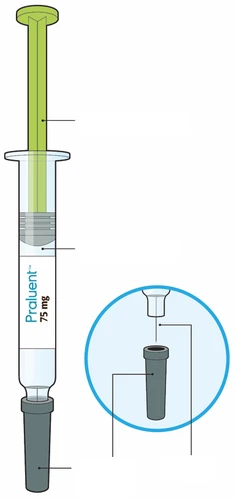
Green plunger
Syringe barrel
Needle
Needle cap
Important information
- The medicine is injected subcutaneously; it may be self-administered or administered by someone else (a caregiver).
- This syringe is for a single injection only and must be discarded after use.
- This syringe is intended for use in adults only.
What to do
✓ Keep the Praluent syringe out of sight and reach of children.
✓ Read all instructions carefully before using the Praluent syringe.
✓ Follow the instructions each time you use a Praluent syringe.
What not to do
Do not touch the needle.
Do not use the syringe if it has been dropped or is damaged.
Do not use the syringe if the grey needle cap is missing or not securely attached.
Do not reuse the syringe.
Do not shake the syringe.
Do not freeze the syringe.
Do not expose the syringe to direct sunlight.
Keep this leaflet. If you have any doubts, consult your doctor, pharmacist, or nurse
or contact the local representative of the marketing authorization holder listed in the
package leaflet.
STEP A: Preparing for injection
Before starting, the following materials are required:
- the Praluent syringe
- alcohol wipes
- cotton ball or gauze
- a puncture-resistant container (see Step B, 6).
Before starting.
- Remove the syringe from its packaging by holding it at the barrel.
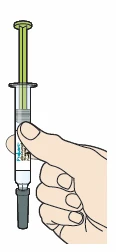
Examine the syringe label.
- Check that you have the correct product and correct dose (green plunger for 75 mg/mL).
- Check the expiration date: do not use the medicine if this date has passed.
- Check that the liquid is clear, colorless to pale yellow, and free of particles—if not, do not use it.
- Check that the syringe is not open or damaged.
Allow the syringe to warm to room temperature for 30–40 minutes.
- Do not heat the syringe; allow it to warm on its own.
- Do not return the syringe to the refrigerator.

30–40
minutes
Prepare the injection site.
- Wash your hands with soap and water and dry them with a towel.
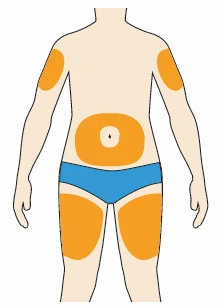
- You may administer the injection in the thigh, abdomen (except for the area within 5 cm of the navel), or upper arm (see illustration).
- The injection may be given while standing or sitting.
- Clean the skin at the injection site with an alcohol wipe.
- Do not inject into areas where the skin is tender, hardened, red, or warm.
- Do not inject into areas adjacent to a visible vein.
- Use a different site each time you give an injection.
- Do not inject Praluent together with other injectable medicines at the same site.
STEP B: How to perform the injection
After completing all steps in “Step A: Preparing for injection,” remove the
needle cap.
- Remove the needle cap only when ready to perform the injection.
- Hold the syringe in the middle of the barrel, with the needle pointing away from yourself.
- Keep your hand away from the plunger.
- Air bubbles may be present. This is normal. Do not remove any air bubbles from the syringe before injection.
- Do not re-cap the grey needle cap.
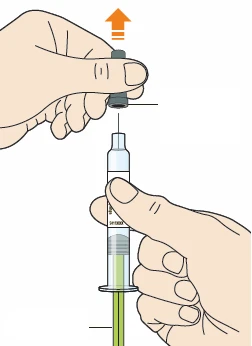
Needle cap
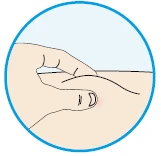
Plunger
If needed, pinch the skin.
- Use your thumb and index finger to grasp a skin fold at the injection site.
- Maintain this grip throughout the entire injection.
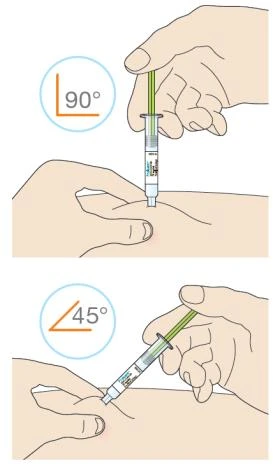
Insert the needle into the skin fold with a quick, firm motion.
- Use a 90° angle if you can pinch 5 cm of skin.
- Use a 45° angle if you can only pinch 2 cm of skin.
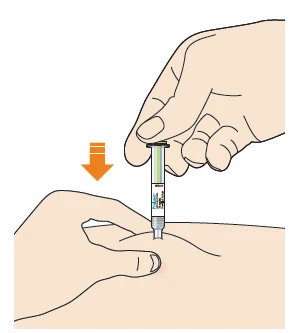
Press the plunger.
- Inject the entire solution by slowly and evenly pushing the plunger.
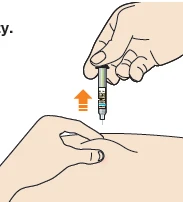
Before removing the needle, check that the syringe is empty.
- Do not remove the syringe before it is completely empty.
- Remove the needle from the skin at the same angle at which it was inserted.
- Do not rub the skin after injection.
- If bleeding occurs, press a cotton ball or gauze over the site until bleeding stops.
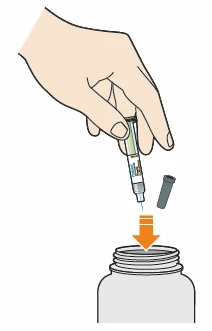
Dispose of the syringe and needle cap.
- Do not re-cap the grey needle cap.
- Do not reuse the syringe.
- Immediately after use, place the syringe and needle cap into a puncture-resistant container.
- Ask your doctor, pharmacist, or nurse how to dispose of the container.
- Always keep this container out of sight and reach of children.
Praluent pre-filled syringe
Instructions for use
The parts of the Praluent syringe are illustrated in this image.
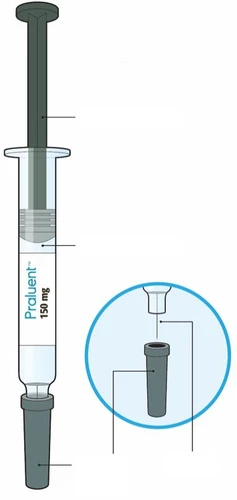
Gray plunger
Syringe barrel
Needle
Gray needle cap
Important information
- The medicine is injected subcutaneously; it can be self-administered or administered by someone else (a caregiver).
- This syringe is for single injection use only and must be discarded after use.
- This syringe is intended for use in adults only.
What to do
✓ Keep the Praluent syringe out of sight and reach of children.
✓ Read all instructions carefully before using the Praluent syringe.
✓ Follow the instructions every time you use a Praluent syringe.
What not to do
Do not touch the needle.
Do not use the syringe if it has been dropped or damaged.
Do not use the syringe if the gray needle cap is missing or not securely attached.
Do not reuse the syringe.
Do not shake the syringe.
Do not freeze the syringe.
Do not expose the syringe to direct sunlight.
Keep this leaflet. If you have any doubts, consult your doctor, pharmacist, or nurse
or contact the local representative of the marketing authorization holder listed in the
package leaflet.
STEP A: Preparing for injection
Before starting, the following materials are required:
- the Praluent syringe
- alcohol wipes
- cotton ball or gauze
- a puncture-resistant container (see Step B, 6).
Before starting.
- Remove the syringe from its packaging by holding it by the barrel.
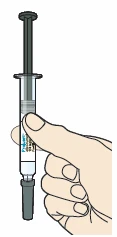
Examine the syringe label.
- Check that you have the correct product and correct dose (gray plunger for 150 mg/mL).
- Check the expiration date: do not use the medicine if this date has passed.
- Check that the liquid is clear, colorless to pale yellow, and free from particles—if not, do not use it.
- Check that the syringe is not open or damaged.
Allow the syringe to warm to room temperature for 30–40 minutes.
- Do not heat the syringe; allow it to warm naturally.
- Do not return the syringe to the refrigerator.

30–40
minutes
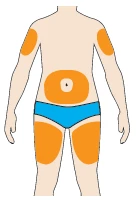
Prepare the injection site.
- Wash your hands with soap and water and dry them with a towel.
- The injection can be given in the thigh, abdomen (except the area within 5 cm of the navel), or upper arm (see illustration).
- The injection may be administered while standing or sitting.
- Clean the skin at the injection site with an alcohol wipe.
- Do not inject into areas where the skin is tender, hardened, red, or warm.
- Do not inject into areas adjacent to a visible vein.
- Use a different injection site each time.
- Do not inject Praluent together with other injectable medicines at the same site.
STEP B: How to administer the injection
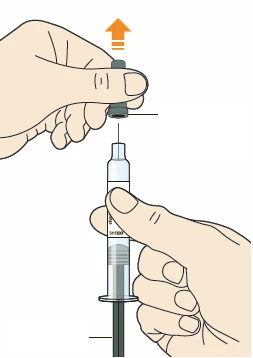
After completing all steps in “Step A: Preparing for injection,” remove the
needle cap.
- Remove the needle cap only when ready to administer the injection.
- Hold the syringe by the barrel, with the needle pointing away from yourself.
- Keep your hand away from the plunger.
- Air bubbles may be present. This is normal. Do not remove any air bubbles from the syringe before injection.
- Do not replace the gray needle cap.
Needle cap
Plunger
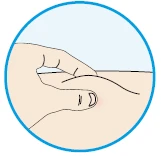
If necessary, pinch the skin.
- Use your thumb and index finger to grasp a skin fold at the injection site.
- Keep holding the skin fold throughout the injection.
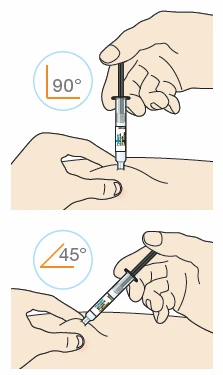
Insert the needle into the skin fold with a quick, firm motion.
- Use a 90° angle if you can pinch 5 cm of skin.
- Use a 45° angle if you can only pinch 2 cm of skin.
Press the plunger.
- Inject the entire solution by pressing the plunger slowly and evenly.
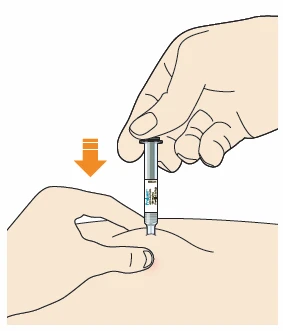
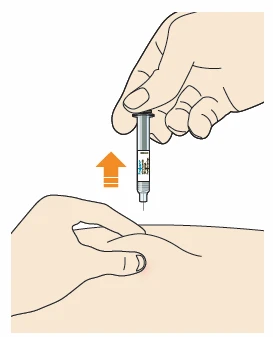
Before removing the needle, check that the syringe is empty.
- Do not remove the syringe before it is completely empty.
- Remove the needle from the skin at the same angle used for insertion.
- Do not rub the skin after injection.
- If bleeding occurs, press a cotton ball or gauze over the injection site until bleeding stops.
Dispose of the syringe and needle cap.
- Do not replace the gray needle cap.
- Do not reuse the syringe.
- Immediately after use, place the syringe and needle cap into a puncture-resistant container.
- Ask your doctor, pharmacist, or nurse how to dispose of the container properly.
- Always keep this container out of sight and reach of children.