Potassion
Italy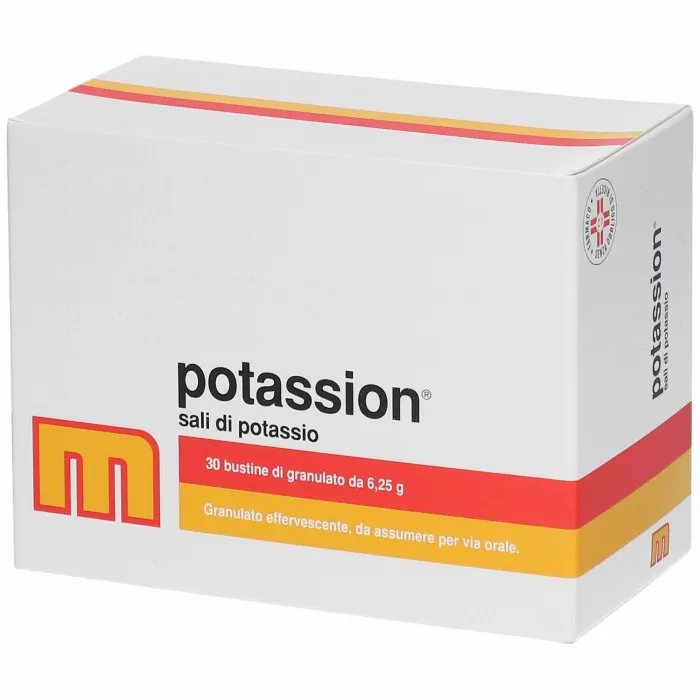
Table of Contents
Patient Information Leaflet
POTASSION effervescent granules
Potassium salts
Please read this leaflet carefully before taking this medicine as it contains important information for you.
Always take this medicine exactly as described in this leaflet or as your doctor or pharmacist has instructed.
- Keep this leaflet. You may need to read it again.
- If you need more information or advice, consult your pharmacist.
- If you experience any side effects, including those not listed in this leaflet, contact your doctor or pharmacist. See section 4.
- Contact your doctor if you do not notice any improvement or if you experience worsening of symptoms after a few days.
Contents of this leaflet:
- What POTASSION is and what it is used for
- What you need to know before taking POTASSION
- How to take POTASSION
- Possible side effects
- How to store POTASSION
- Contents of the pack and other information
1. What POTASSION is and what it is used for
POTASSION is a combination of salts that supply the body with the appropriate amount of potassium to maintain the balance of salts and fluids in the blood (water-salt re-equilibration).
POTASSION is indicated for the treatment of:
potassium deficiency in the body, even during acidosis (a condition in which there is an increase in acidic substances in the blood).
Consult your doctor if you do not feel better or feel worse after a few days.
2. What you need to know before taking POTASSION
Do not take POTASSION
- if you are allergic to potassium succinate, potassium malate, potassium citrate, potassium tartrate, potassium bicarbonate, or to any of the other ingredients of this medicine (listed in section 6);
- if you have high levels of potassium in the blood (hyperkalaemia) due to:
- increased levels of acidic substances in the blood (systemic acidosis, including diabetic acidosis);
- severe kidney problems (renal failure) or adrenal gland problems (adrenocortical insufficiency);
- intense and rapid fluid loss from the body (states of intense and rapid dehydration);
- severe burns;
- conditions that may cause tissue damage and death, such as haemolysis, crush syndrome, or other conditions;
- treatment with medicines used to increase urine elimination that reduce potassium loss (potassium-sparing diuretics).
- if you suffer from stomach or intestinal problems (gastrointestinal tract disorders).
Warnings and precautions
Talk to your doctor or pharmacist before taking POTASSION.
During treatment with this medicine, your doctor must carefully monitor your health status through specific tests (ionogram, measurement of blood pH, ECG), especially if you suffer from chronic kidney problems (chronic kidney disease).
To reduce the risk of unwanted effects on the stomach and intestinal mucosa, take the medicine diluted in water and after meals (see section "How to take POTASSION").
If you suffer from renal insufficiency or if there is a concurrent and unsuspected source of potassium (food, potassium salts, or other medicines), you may experience symptoms of overdose (see section "If you take more POTASSION than you should"). In this case, stop treatment immediately and inform your doctor without delay.
Other medicines and POTASSION
Inform your doctor or pharmacist if you are taking, have recently taken, or might take any other medicines.
Do not take POTASSION together with medicines that increase urine elimination and reduce potassium loss (potassium-sparing diuretics) such as amiloride, spironolactone, triamterene.
Inform your doctor if you have heart problems and need to take, together with POTASSION, medicines used to treat heart rhythm disorders (antiarrhythmics).
Pregnancy and breastfeeding
If you are pregnant, think you may be pregnant, are planning a pregnancy, or are breastfeeding, consult your doctor or pharmacist before taking this medicine.
Driving and using machines
This medicine does not affect the ability to drive or use machinery.
POTASSION contains sucrose
This medicine contains 4.498 g of sucrose per sachet. If your doctor has diagnosed you with an intolerance to certain sugars, contact him or her before taking this medicine.
3. How to take POTASSION
Take this medicine exactly as stated in this leaflet or as instructed by your doctor or pharmacist. If you have any doubts, consult your doctor or pharmacist.
The recommended dose in adults ranges from 1 to 8 sachets or more per day.
You may take POTASSION without water, chewing it slowly in small amounts, or by dissolving the contents of the sachet in a small glass of water (see section “Warnings and precautions”).
Take the medicine after meals.
Use in children
In children, the dose will be determined by the doctor.
If you take more POTASSION than you should
If you take too much of this medicine, the following symptoms may occur:
- muscle weakness (muscular asthenia);
- lack of motivation (apathy);
- mental confusion;
- loss of muscle function (muscular paralysis);
- severe heart and circulatory problems (cardiocirculatory collapse), due to inhibition of heart activity (cardiac arrest).
The doctor will determine the most appropriate treatment depending on the severity of the symptoms.
In case of accidental ingestion or overdose of POTASSION, contact your doctor immediately or go to the nearest hospital.
If you forget to take POTASSION
Do not take a double dose to make up for a forgotten dose.
If you have any doubts about the use of this medicine, consult your doctor or pharmacist.
4. Possible side effects
Like all medicines, this medicine can cause side effects, although not everyone gets them.
The following side effects may occur:
Frequency not known (frequency cannot be estimated from the available data):
- nausea;
- vomiting;
- abdominal pain;
- diarrhoea;
- bleeding (haemorrhage);
- injuries, bleeding and disorders of intestinal function (ulceration, perforation, intestinal stenosis).
Reporting of side effects
If you experience any side effect, including those not listed in this leaflet, talk to your doctor or pharmacist.
You can also report side effects directly via the national reporting system at
www.agenziafarmaco.gov.it/it/responsabili. By reporting side effects, you can help provide more information on the safety of this medicine.
5. How to store POTASSION
Keep this medicine out of the sight and reach of children.
Do not use this medicine after the expiry date stated on the packaging after “Exp.”.
The expiry date refers to the last day of that month.
Do not dispose of any medicine via wastewater or household waste. Ask your pharmacist how to dispose of medicines you no longer use. This will help protect the environment.
6. Package contents and other information
What POTASSION contains
- The active substances are: potassium succinate, potassium malate, potassium citrate, potassium tartrate, potassium bicarbonate. Each single-dose sachet contains: 0.100 g of potassium succinate (equivalent to 0.0401 g of K, corresponding to 1.03 mEq), 0.100 g of potassium malate (equivalent to 0.0370 g of K, corresponding to 0.95 mEq), 0.250 g of potassium citrate (equivalent to 0.0954 g of K, corresponding to 2.45 mEq), 0.050 g of potassium tartrate (equivalent to 0.0172 g of K, corresponding to 0.44 mEq), 0.500 g of potassium bicarbonate (equivalent to 0.1947 g of K, corresponding to 4.99 mEq);
- The other components are: tartaric acid, lemon flavoring, raspberry flavoring, sucrose.
Description of the appearance of POTASSION and package contents
Potassion is an effervescent granulate in single-dose sachets.
Pack sizes: 30 to 40 sachets of 6.25 g.
Marketing Authorization Holder
ACARPIA Farmaceutici S.r.l.
Viale L. Majno, 18
20129 Milan (Italy)
Manufacturer
S.I.I.T. – Via Ariosto, 50/60 – Trezzano sul Naviglio (MI) – Italy