Pennsaid
Italy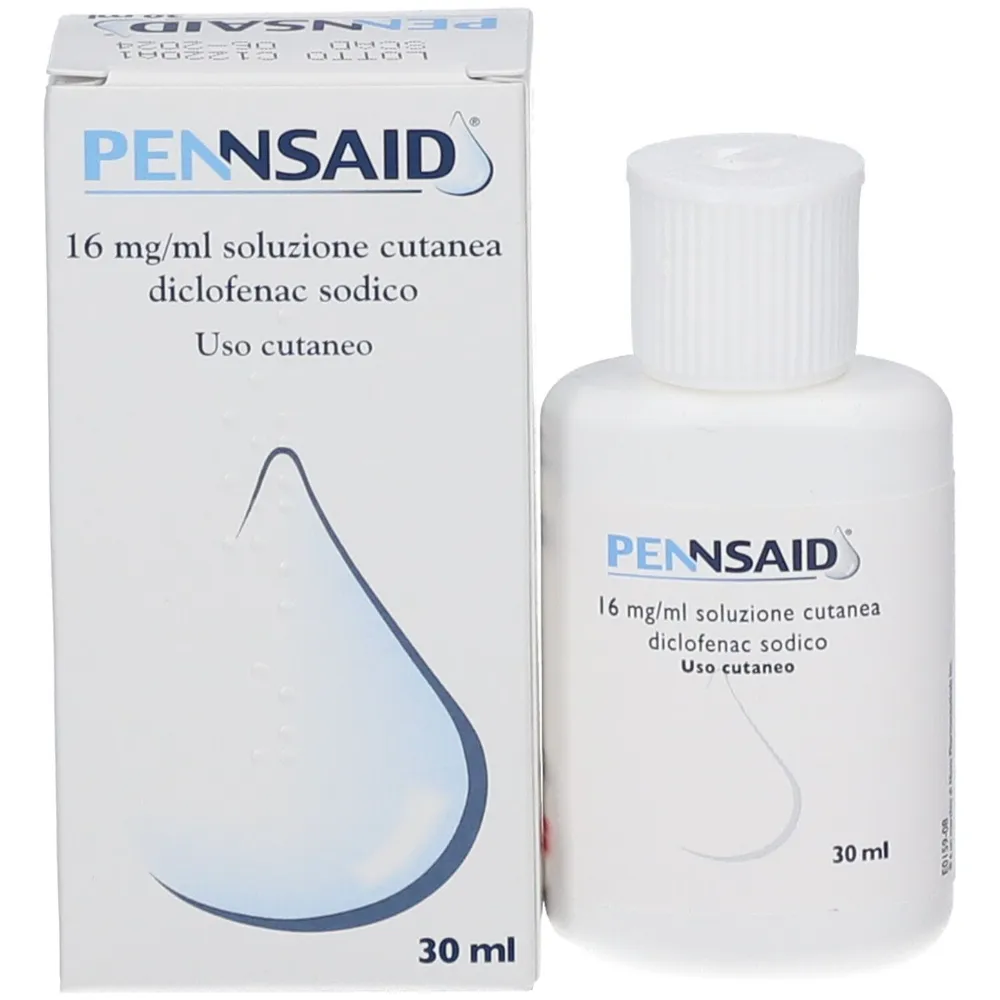
Package leaflet: Information for the patient
PENNSAID 16 mg/ml Topical solution
sodium diclofenac
Please read this leaflet carefully before using this medicine because it contains important information for you.
Use this medicine exactly as described in this leaflet or as your doctor or pharmacist has instructed you.
- Keep this leaflet. You may need to read it again.
- If you need more information or advice, consult your pharmacist.
- If you experience any side effects, including those not listed in this leaflet, consult your doctor or pharmacist. See section 4.
- Consult your doctor if you do not notice any improvement or if you notice a worsening of symptoms.
Contents of this leaflet:
- What PENNSAID is and what it is used for
- What you need to know before using PENNSAID
- How to use PENNSAID
- Possible side effects
- How to store PENNSAID
- Contents of the pack and other information
1. What PENNSAID is and what it is used for
PENNSAID is a non-steroidal anti-inflammatory drug (NSAID) commonly used to
relieve pain associated with osteoarthritis of a superficial joint (for example, the knee or
elbow).
2. What you need to know before using PENNSAID
Do not use PENNSAID:
- if you are allergic (hypersensitive) to diclofenac, dimethyl sulfoxide (DMSO), or to any of the other ingredients of this medicine (listed in section 6).
- if you are pregnant or breastfeeding.
- if you have ever had an allergic reaction to acetylsalicylic acid (ASA) or to any other NSAIDs such as ibuprofen, associated with difficulty in breathing, skin rash, or runny nose.
Warnings and precautions
Talk to your doctor or pharmacist before using PENNSAID.
If you have or have had stomach ulcers, or if you have a tendency to bleeding, or if you are elderly, consult your doctor or pharmacist before using this solution.
Do not use PENNSAID on joints affected by pre-existing skin diseases (e.g., psoriasis), unless otherwise directed by your doctor.
Wash your hands after applying PENNSAID to avoid contact with eyes, mucous membranes, and untreated skin areas.
Do not apply PENNSAID if you have liver or kidney problems.
Do not cover the treated area with occlusive dressings (impermeable or non-breathable bandages or plasters).
No other medicine should be applied to the same area while using PENNSAID.
PENNSAID is for external use only. If PENNSAID is accidentally ingested, do not induce vomiting. Seek immediate medical advice.
Children
The use of PENNSAID is not recommended in children.
Other medicines and PENNSAID
Inform your doctor or pharmacist if you are taking, have recently taken, or might take any other medicines.
Especially if you are already taking or using:
- diclofenac tablets or other NSAID tablets for pain/inflammation (e.g., aspirin).
- cardiac glycosides (e.g., digoxin), used to treat heart problems.
- lithium (used to treat certain mental disorders).
- medicines for diabetes.
- anticoagulants (e.g., anticoagulant tablets such as warfarin, heparin).
- diuretics (water tablets).
- oral steroids (an anti-inflammatory medicine).
- methotrexate (for certain inflammatory diseases and some types of cancer).
- cyclosporine (used to treat certain inflammatory diseases and after organ transplants).
- quinolone antibiotics (for infections).
- medicines used to treat heart conditions or hypertension, such as beta-blockers or ACE inhibitors.
- if you have previously had a reaction to dimethyl sulfoxide (DMSO) (e.g., hives, itching, or shortness of breath).
Pregnancy and breastfeeding
If you are pregnant, think you might be pregnant, planning to become pregnant, or are breastfeeding, consult your doctor or pharmacist before using this medicine.
Pregnancy
Do not use PENNSAID if you are pregnant (see section 2 “Do not use PENNSAID”).
Breastfeeding
Do not use PENNSAID if you are breastfeeding (see section 2 “Do not use PENNSAID”).
Driving and operating machinery
If you experience headache, dizziness, mental confusion, or drowsiness after using PENNSAID, do not drive or operate machinery.
PENNSAID contains
dimethyl sulfoxide, which may be irritating to the skin.
3. How to use Pennsaid
Use this medicine exactly as stated in this leaflet or as directed by your doctor or pharmacist. If you have any doubts, consult your doctor or pharmacist.
The area of skin to be treated should be washed with soap and water and left to dry before applying PENNSAID.
The dose depends on the size of the joint being treated. Apply between 20 and 40 drops four times a day, or as recommended by your physician. Do not exceed the maximum of 40 drops four times a day per joint. Apply a few drops of solution at a time, spreading them evenly over the affected area with the hand or fingers. Rubbing is not necessary.
Wash your hands after application.
Route of administration
PENNSAID is for topical use only.
Use in children
PENNSAID is not recommended for use in children.
4. Possible side effects
Like all medicines, this medicine can cause side effects, although not everybody will get them.
Mild skin reactions such as dryness, tingling, itching, rash or skin eruptions may occur. Unpleasant breath may also occur in some cases.
Other side effects may include constipation, dyspepsia and flatulence. Photoallergic reactions and contact dermatitis have also been reported following topical use of diclofenac.
If you develop a skin reaction or any other symptoms, consult your doctor or pharmacist. In the rare event of wheezing, stop treatment immediately and consult a doctor without delay.
Since PENNSAID is applied to a relatively large area of skin for a prolonged period, the possibility of systemic side effects similar to those of oral diclofenac cannot be completely ruled out.
The possible systemic adverse effects are described as follows:
Uncommon: may affect up to 1 in 100 people
- Epigastric, gastric or abdominal pain, abdominal cramps, nausea, dyspepsia, anorexia, diarrhoea, vomiting and flatulence.
- Dizziness, headache and vertigo
- Increase in AST, ALT (≥ 3 times the upper normal limit).
Rare: may affect up to 1 in 1,000 people
- Gastrointestinal bleeding (bloody diarrhoea, melena, haematemesis), gastric and intestinal ulceration with or without bleeding or perforation.
- Somnolence, malaise, difficulty concentrating and fatigue.
- Palpitations, angina and arrhythmias
- Urticaria
- Liver function disorders including hepatitis, with or without jaundice.
- Hypersensitivity reactions such as asthma in patients sensitive to ASA, e.g. bronchospasm; systemic anaphylactic/anaphylactoid reactions including hypotension.
Not known: frequency cannot be estimated from the available data
- Lower gastrointestinal disorders (e.g. non-specific haemorrhagic colitis, exacerbation of ulcerative colitis or Crohn's disease), intestinal stricture resembling diaphragm disease, hyperacidity, stomatitis, glossitis, coated tongue, oesophageal lesions, constipation and pancreatitis, taste alterations.
- Sensory disturbances including paraesthesia, memory impairment, disorientation, insomnia, irritability, convulsions, depression, anxiety, nightmares, tremor, psychotic reactions and aseptic meningitis.
- Visual disturbances (blurred vision, diplopia)
- Impaired hearing, tinnitus
- Exacerbation of heart failure and hypertension
- Vasculitis
- Bullous eruption, erythema, eczema, erythema multiforme, Stevens-Johnson syndrome, Lyell's syndrome (toxic epidermal necrolysis), erythroderma (exfoliative dermatitis), hair loss, increased sensitivity of the skin to sunlight. Purpura, including allergic purpura.
- Burning sensation at the application site
- Dry skin
- Acute renal failure, nephrotic syndrome, urinary abnormalities (e.g. haematuria and proteinuria), interstitial nephritis and papillary necrosis.
- Thrombocytopenia, leucopenia, agranulocytosis, haemolytic anaemia, aplastic anaemia and anaemia secondary to gastrointestinal bleeding.
- Pneumonitis
PENNSAID contains dimethylsulfoxide (DMSO), which may cause somnolence and headache and may be irritating to the skin.
Reporting of side effects
If you experience any side effects, including those not listed in this leaflet, talk to your doctor or pharmacist. You can also report side effects directly via the national reporting system at https://www.aifa.gov.it/content/segnalazioni-reazioni-avverse.
By reporting side effects, you can help provide more information on the safety of this medicine.
5. How to store PENNSAID
Keep this medicine out of the sight and reach of children.
Do not use this medicine after the expiry date stated on the label.
The expiry date refers to the last day of that month.
Do not store above 25°C. Do not refrigerate.
PENNSAID must not be used for more than 12 weeks after first opening.
PENNSAID is a colourless to pink or orange transparent liquid. If the medicine changes to any other colour,
return it to the pharmacist.
Do not dispose of any medicine via wastewater. Ask your pharmacist how to dispose of medicines you no longer use.
This will help protect the environment.
6. Package contents and other information
What PENNSAID contains
- The active substance is diclofenac sodium.
- Each ml (approximately 40 drops) of the cutaneous solution contains 16 mg of the active substance, diclofenac sodium.
- The other excipients are: dimethyl sulfoxide (DMSO), ethanol, glycerin, propylene glycol, and purified water.
Description of the appearance of PENNSAID and contents of the pack
The solution is a transparent liquid, colourless to pink or orange.
PENNSAID is supplied in opaque white plastic bottles, sealed with a plastic cap fitted with a dropper.
The product is available in 15 ml, 30 ml and 60 ml bottle sizes.
Not all pack sizes may be marketed.
Marketing Authorisation Holder and Manufacturer
Marketing Authorisation Holder:
Recordati Industria Chimica e Farmaceutica S.p.A., Via Matteo Civitali 1, 20148 Milano, Italy
Manufacturer:
Vianex S.A. - PLANT A, 12km National-Road Athinon-Lamias, Metamorfosi Attiki, 14451, Greece
This medicinal product is authorised in the European Economic Area countries under the following names:
AT Pennsaid 16 mg/ml Lösung zum Auftragen auf die Haut
EL Pennsaid 16 mg/ml δερματικό διάλυμα
IT Pennsaid 16 mg/ml soluzione cutanea
PT Pennsaid 16 mg/ml solução cutânea