Miglustat Accord
Italy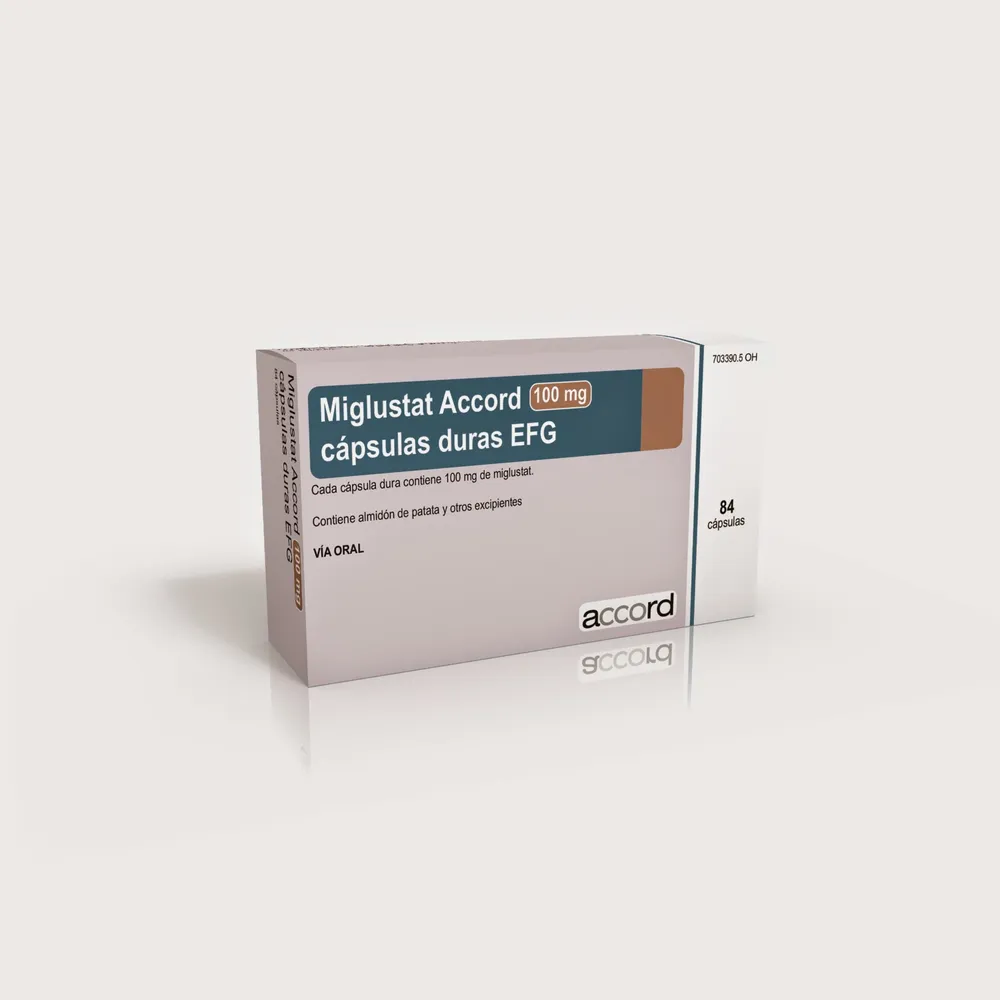
Table of Contents
Package leaflet: Information for the user
Miglustat Accord 100 mg capsules
Generic Medicine
Please read all of this leaflet carefully before you start taking this medicine because it contains important information for you.
- Keep this leaflet. You may need to read it again.
- If you have any questions, ask your doctor or pharmacist.
- This medicine has been prescribed for you only. Do not give it to other people, even if their symptoms are the same as yours, as it may be harmful.
- If you get any side effects, talk to your doctor or pharmacist. This includes any possible side effects not listed in this leaflet. See section 4.
Contents of this leaflet:
- What Miglustat Accord is and what it is used for
- What you need to know before you take Miglustat Accord
- How to take Miglustat Accord
- Possible side effects
- How to store Miglustat Accord
- Contents of the pack and other information
1. What Miglustat Accord is and what it is used for
Miglustat Accord contains the active substance miglustat, which belongs to a group of medicines that affect metabolism. It is used to treat two diseases:
- Miglustat Accord is used to treat mild to moderate type 1 Gaucher disease in adults.
Type 1 Gaucher disease is characterised by the accumulation, in certain cells of the immune system, of a substance called glucosylceramide that is not properly eliminated from your body. This accumulation may lead to enlargement of the liver and spleen, abnormalities in blood cells, and bone disease.
The usual treatment for type 1 Gaucher disease is enzyme replacement therapy. Miglustat Accord is used only if a patient is considered unsuitable for treatment with enzyme replacement therapy.
Miglustat Accord is also used to treat progressive neurological symptoms in Niemann-Pick disease type C in adults and children.
If you have Niemann-Pick disease type C, fats such as glycosphingolipids accumulate within brain cells. This can cause neurological problems such as slowed eye movements, loss of balance, difficulty swallowing, memory problems, and seizures.
Miglustat Accord works by inhibiting an enzyme called glucosylceramide synthase, which is responsible for the first step in the synthesis of most glycosphingolipids.
2. What you need to know before taking Miglustat Accord
Do not take Miglustat Accord
- if you are allergic to miglustat or to any of the other ingredients of this medicine (listed in section 6).
Warnings and precautions
Talk to your doctor or pharmacist before taking Miglustat Accord
- if you have kidney problems
- if you have liver problems
Before and during treatment with Miglustat Accord, your doctor will carry out the following checks:
- an examination to assess the condition of the nerves in your arms and legs;
- measurement of vitamin B12 levels;
- monitoring of growth if you are a child or adolescent with Niemann-Pick disease type C;
- monitoring of platelet count.
The reason these tests are performed is that, during treatment with Miglustat Accord, some patients have experienced tingling or numbness in their hands and feet, or weight loss. These tests will help your doctor determine whether such effects are due to your underlying disease or other pre-existing conditions, or to side effects of Miglustat Accord (for further information see section 4).
If you have diarrhoea, your doctor may decide to modify your diet to reduce lactose and carbohydrate intake such as sucrose (cane sugar), or decide not to take Miglustat Accord with food, or may temporarily reduce the dose. In some cases, your doctor may prescribe anti-diarrhoeal medicines such as loperamide. Cases of Crohn's disease (an inflammatory disease affecting the intestine) have been reported in patients with Niemann-Pick disease type C treated with Miglustat Accord. If diarrhoea does not respond to the above measures or if you have any other abdominal symptoms, consult your doctor. In such cases, your doctor may decide to carry out further investigations to determine whether your symptoms may be due to another cause.
Male patients must use reliable contraceptive methods during treatment with Miglustat Accord and for 3 months after stopping treatment.
Children and adolescents
Do not administer this medicine to children and adolescents (under 18 years of age) with type 1 Gaucher disease, as it is not known whether the medicine is effective in this disease.
Other medicines and Miglustat Accord
Inform your doctor or pharmacist if you are taking, have recently taken, or might take any other medicines.
Inform your doctor if you are taking other medicines containing imiglucerase, which are sometimes used concomitantly with Miglustat Accord. These may reduce your body's exposure to Miglustat Accord.
Pregnancy, breastfeeding and fertility
If you are pregnant, think you may be pregnant, or are planning to become pregnant, you must not take Miglustat Accord. Your doctor will be able to provide you with further information. While taking Miglustat Accord, you must use an effective method of contraception. Do not breastfeed while taking Miglustat Accord.
Male patients must continue to use reliable contraceptive methods during treatment with Miglustat Accord and for 3 months after treatment ends.
If you are pregnant, breastfeeding, think you may be pregnant or are planning to become pregnant, ask your doctor or pharmacist for advice before taking this medicine.
Driving and using machines
Miglustat Accord may cause dizziness. If you feel dizzy, you are advised not to drive or operate tools or machinery.
Miglustat Accord contains sodium
This medicine contains less than 1 mmol of sodium (23 mg) per capsule, i.e. essentially "sodium-free".
3. How to take Miglustat Accord
Take this medicine exactly as prescribed by your doctor. If you have any doubts, consult your doctor or pharmacist.
For type 1 Gaucher disease: The usual dose for adults is one capsule (100 mg) three times a day (morning, midday and evening), up to a maximum of three capsules per day (300 mg).
For Niemann-Pick disease type C: For adults and adolescents (over 12 years of age), the usual dose is 2 capsules (200 mg) three times a day (morning, afternoon and evening).
This corresponds to a maximum daily dose of six capsules (600 mg).
For children under 12 years of age, the doctor will adjust the dose of the medicine to be used for Niemann-Pick disease type C.
If you have kidney problems, you may initially be given a lower dose. Your doctor may decide to reduce the dose; for example: one capsule (100 mg) once or twice a day if you experience diarrhoea while taking Miglustat Accord (see section 4). Your doctor will decide and inform you how long the treatment should last.
Miglustat Accord can be taken on an empty stomach or with food. The capsule must be swallowed whole with a glass of water.
If you take more Miglustat Accord than you should
If you take more capsules than prescribed, consult your doctor immediately. Miglustat has been used in clinical studies at doses up to 3000 mg, which caused reductions in white blood cell counts and other adverse effects similar to those described in section 4.
If you forget to take Miglustat Accord
Take the next capsule at your usual scheduled time. Do not take a double dose to make up for the missed dose.
If you stop taking Miglustat Accord
Do not stop taking Miglustat Accord without first talking to your doctor.
If you have any questions about how to use this medicine, consult your doctor or pharmacist.
4. Possible side effects
Like all medicines, this medicine can cause side effects, although not everyone gets them.
Serious side effects:
Some patients have experienced tingling or numbness in the hands and feet (commonly observed).
These could be signs of peripheral neuropathy, caused by side effects of Miglustat Accord or possibly due to underlying conditions. To evaluate these symptoms, your doctor will perform certain tests before and during treatment with Miglustat Accord (see section 2).
If you experience any of these effects, please seek medical advice from your doctor as soon as possible.
If you experience mild tremor , usually trembling of the hands , seek medical advice from your doctor as soon as possible. Tremor often resolves without the need to discontinue treatment.
Sometimes your doctor may need to reduce the dose or stop treatment with Miglustat Accord to make the tremor disappear.
Very common – (may affect more than 1 in 10 people)
Among the most common side effects are: diarrhoea, flatulence (excessive intestinal gas), abdominal (gastric) pain, weight loss and reduced appetite.
If you lose weight when starting treatment with Miglustat Accord, do not be alarmed. Weight loss usually stabilizes as treatment continues.
Common – (may affect up to 1 in 10 people)
Common side effects of treatment include headache, dizziness, paresthesia (tingling or numbness), abnormal coordination, hypoesthesia (reduced sensitivity to touch), dyspepsia (heartburn), nausea (feeling unwell), constipation and vomiting, abdominal swelling or discomfort (gastric), thrombocytopenia (reduced platelet levels in the blood). Neurological symptoms and thrombocytopenia may be due to the underlying disease.
Other possible side effects include: muscle weakness or spasms, fatigue, chills and malaise, depression, sleep disturbances, memory problems, and decreased libido.
Most patients experience one or more of these side effects, usually at the beginning of treatment or intermittently during treatment. These cases are mostly mild and disappear very quickly. If any of these side effects cause discomfort, consult your doctor. They may reduce your dose of Miglustat Accord or recommend other medicines to counteract the side effects.
Reporting of side effects
If you experience any side effect , including those not listed in this leaflet, talk to your doctor or pharmacist . You can also report side effects directly via the national reporting system at https://www.aifa.gov.it/content/segnalazioni-reazioni-avverse.
By reporting side effects, you can help provide more information on the safety of this medicine.
5. How to store Miglustat Accord
Keep this medicine out of the sight and reach of children.
Do not use this medicine after the expiry date stated on the carton after Exp. The expiry date refers to the last day of that month.
This medicine does not require any special storage conditions.
Do not dispose of medicines via wastewater or household waste. Ask your pharmacist how to dispose of medicines you no longer use. This will help protect the environment.
6. Pack contents and other information
What Miglustat Accord contains
- The active substance is miglustat.
- The other components are Sodium starch glycolate (Type A), Povidone K30, Magnesium stearate, Titanium dioxide (E171) and Gelatin.
Description of the appearance of Miglustat Accord and pack contents
Miglustat Accord is a 100 mg hard gelatin capsule, white in colour, filled with white to off-white granules, packaged in PVC/PE/PCTFE-Aluminium blisters.
Pack sizes: 14 x 1 or 84 x 1 capsules.
Not all pack sizes may be marketed.
Marketing Authorisation Holder and Manufacturer
Marketing Authorisation Holder
Accord Healthcare S.L.U.
Moll De Barcelona S/N, Worldtrade Center, Edificio EST, 6th floor
08039 Barcelona, Spain
Manufacturer
G.L. Pharma GmbH
Schlossplatz 1
Lannach – 8502
Austria