Midazolam Hameln
Italy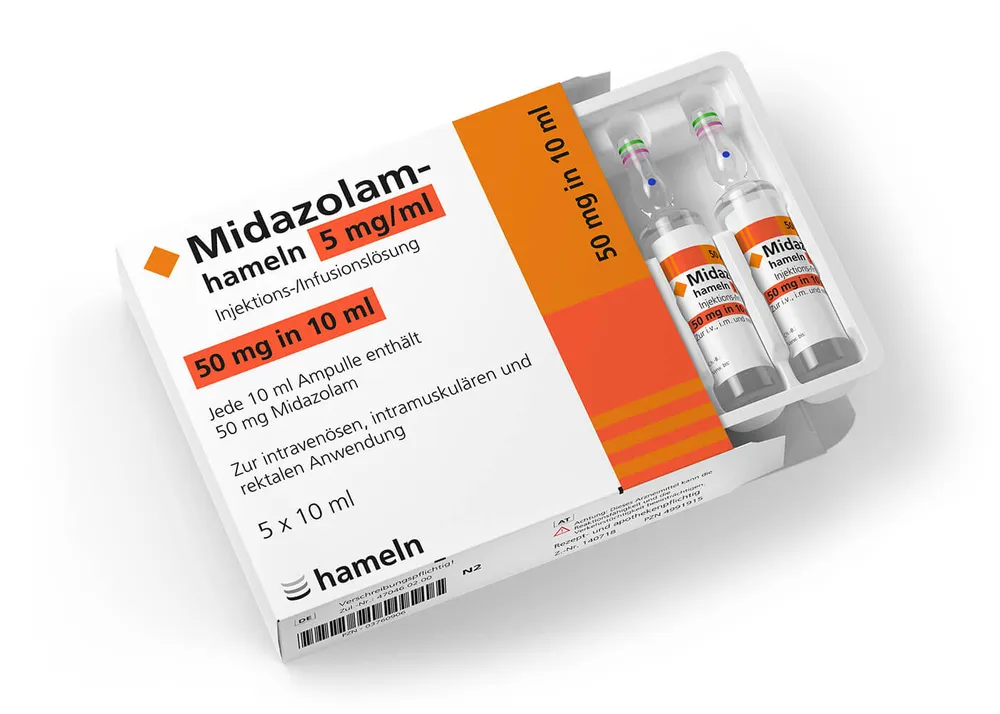
Table of Contents
PACKAGE LEAFLET: INFORMATION FOR THE USER
Midazolam-hameln 5 mg/ml, injectable solution or solution for infusion
Generic Medicine
midazolam
Please read this leaflet carefully before using this medicine because it contains
important information for you.
- Keep this leaflet. You may need to read it again.
- If you have any questions, ask your doctor or nurse.
- If you experience any side effects, including those not listed in this leaflet, inform your doctor or nurse. See section 4.
Contents of this leaflet:
- What Midazolam-hameln is and what it is used for
- What you need to know before using Midazolam-hameln
- How to use Midazolam-hameln
- Possible side effects
- How to store Midazolam-hameln
- Contents of the pack and other information
1. WHAT MIDAZOLAM-HAMELN IS AND WHAT IT IS USED FOR
Midazolam-hameln belongs to a group of medicines called "benzodiazepines".
Midazolam-hameln acts very rapidly to cause drowsiness or induce sleep.
It is also a sedative and relaxes muscles.
Midazolam-hameln is used in adults:
- as a general anaesthetic to induce or maintain sleep.
Midazolam-hameln is also used in adults and children:
- to induce calmness and drowsiness in intensive care. This is referred to as "sedation".
- before and during a medical examination or procedure where you need to remain awake. It makes you calm and drowsy. This is called "conscious sedation".
- to induce calmness and drowsiness before administration of an anaesthetic.
2. WHAT YOU NEED TO KNOW BEFORE USING MIDAZOLAM-HAMELN
Do not use Midazolam-Hameln:
- if you are allergic (hypersensitive) to midazolam or to any of the other ingredients of this medicine (listed in section 6).
- if you are allergic to other benzodiazepines, such as diazepam or nitrazepam.
- if you have severe breathing problems and Midazolam-Hameln is administered to induce "conscious sedation". You must not use Midazolam-Hameln if any of the conditions described above apply to you. If you have any doubts, ask your doctor or nurse before receiving this medicine.
Warnings and precautions
Talk to your doctor or nurse before using Midazolam-Hameln:
-
if you are over 60 years old.
-
if you have a chronic illness, such as respiratory or kidney problems, or liver or heart problems.
-
if you have a condition that makes you very weak, tired, and fatigued.
-
if you have a disease called "myasthenia gravis" that causes muscle weakness.
-
if you have had problems with alcohol.
-
if you have had problems with drugs.
If any of the conditions described above apply to you (or if you have any doubts), discuss them with your doctor or nurse before using Midazolam-Hameln. -
Children
Talk to your doctor or nurse if any of the conditions described above apply to your child.
In particular, inform your doctor or nurse if your child has breathing problems.
Other medicines and Midazolam-Hameln
Inform your doctor or nurse if you are taking, have recently taken, or might take any other medicines. This includes medicines obtained without a prescription and herbal medicines. This is because Midazolam may affect how other medicines work. Similarly, other medicines may affect how Midazolam works.
In particular, inform your doctor or nurse if you are taking any of the following medicines:
- medicines for depression
- hypnotic medicines (to help you sleep)
- sedatives (to make you calm)
- tranquillizers (for anxiety or to help you sleep)
- carbamazepine or phenytoin (may be used for epileptic seizures and convulsions)
- rifampicin (for tuberculosis)
- HIV medicines known as "protease inhibitors" (such as saquinavir)
- antibiotics known as "macrolides" (such as erythromycin and clarithromycin)
- medicines for fungal infections (such as ketoconazole, voriconazole, fluconazole, itraconazole, posaconazole)
- strong opioid painkillers
- atorvastatin (for high cholesterol)
- antihistamines (for allergic reactions)
- St. John’s Wort (a herbal remedy for depression)
- medicines for high blood pressure called "calcium antagonists" (such as diltiazem)
If any of the conditions described above apply to you (or if you have any doubts), consult your doctor or nurse before receiving Midazolam-Hameln.
The concomitant use of Midazolam-Hameln and opioids (strong analgesics, medicines for addiction treatment, and some cough medicines) increases the risk of drowsiness, breathing difficulties (respiratory depression), coma, and can be life-threatening. For this reason, concomitant use should only be considered when no other treatment options are possible.
However, if your doctor prescribes Midazolam-Hameln together with opioids, the dose and duration of concomitant treatment must be limited by your doctor.
Inform your doctor about all opioid medicines you are taking and carefully follow the doctor’s dosing recommendations. It may be helpful to inform friends or family members to watch for the signs and symptoms listed above.
Contact your doctor if you experience any of these symptoms.
Midazolam-Hameln and alcohol
Do not drink alcoholic beverages after receiving Midazolam, as this may cause marked drowsiness and breathing problems.
Pregnancy and breastfeeding
Inform your doctor before receiving Midazolam-Hameln if you are pregnant or think you may be pregnant. Your doctor will decide whether this medicine is suitable for you.
After receiving Midazolam-Hameln, do not breastfeed for 24 hours, as Midazolam-Hameln may pass into breast milk.
Driving and using machines
After treatment with Midazolam-Hameln, do not drive or operate tools or machinery until your doctor tells you it is safe to do so.
This is because Midazolam-Hameln may cause drowsiness and affect your level of alertness. It may also affect concentration and coordination. This could reduce your ability to drive or use tools and machinery. After treatment, you must be accompanied home by an adult capable of taking care of you.
Midazolam-Hameln contains sodium
This medicine contains less than 1 mmol (23 mg) of sodium per ml, i.e., essentially 'sodium-free'.
3. HOW TO USE MIDAZOLAM-HAMELN
Midazolam-Hameln will be administered to you by a doctor or nurse in a medical facility such as a hospital, clinic, or physician's office, equipped with appropriate monitoring devices and resources to manage any adverse effects. In particular, your breathing, heart, and circulation will be monitored.
The use of Midazolam-Hameln is not recommended in infants under 6 months of age.
However, if the doctor considers it necessary, it may be administered to infants under 6 months who are in intensive care.
How Midazolam-Hameln will be administered to you
Midazolam-Hameln will be administered to you in one of the following ways:
- By slow injection into a vein (intravenous injection).
- As a drip into a vein (intravenous infusion).
- By injection into a muscle (intramuscular injection).
- Rectally.
Dosage of Midazolam-Hameln
The dose of Midazolam-Hameln varies from patient to patient. The doctor will determine the dose based on your age, weight, and general health status. It will also depend on the reason for treatment, your response to therapy, and whether you are receiving other medications simultaneously.
After administration of Midazolam-Hameln
After treatment, you must be accompanied home by a responsible adult who can care for you. This is because Midazolam-Hameln may cause drowsiness and reduce your level of alertness. It may also affect your concentration and coordination.
If Midazolam-Hameln is administered to you for a prolonged period, such as during intensive care therapy, your body may begin to adapt to the medicine. This means the medicine may become less effective over time.
If you receive more Midazolam-Hameln than you should
The medicine will be administered by a doctor or nurse, which makes it unlikely that you will receive an overdose. However, if an overdose is accidentally administered, you may experience one or more of the following symptoms:
- Drowsiness and loss of coordination and reflexes.
- Difficulty speaking and unusual eye movements.
- Low blood pressure, which may cause dizziness or lightheadedness.
- Slowed or stopped breathing or heartbeat, and loss of consciousness (coma).
Prolonged use of Midazolam-Hameln for sedation during intensive care therapy
If Midazolam-Hameln is administered for a prolonged period, the following effects may occur:
- The medicine may lose its effectiveness.
- You may become dependent on the medicine, and upon discontinuation, withdrawal symptoms may occur (see below "Discontinuation of Midazolam-Hameln").
Discontinuation of Midazolam-Hameln
If you have been administered Midazolam-Hameln for a prolonged period, such as during intensive care therapy, withdrawal symptoms may occur upon stopping the medicine, including:
- Mood changes
- Seizures
- Headache
- Muscle pain
- Difficulty falling asleep (insomnia)
- Intense feelings of worry (anxiety), tension, agitation, confusion, or irritability
- Seeing and possibly hearing things that are not actually present (hallucinations)
The doctor will gradually reduce the dose, which will help prevent withdrawal symptoms.
4. POSSIBLE ADVERSE REACTIONS
Like all medicines, this medicine can cause adverse reactions, although not everyone experiences them. The following adverse reactions have been reported, but their frequency is unknown and cannot be estimated based on the available data.
Stop Midazolam-hameln and contact your doctor immediately if you notice any of the
following side effects. These may be life-threatening and require immediate
medical treatment
- A severe allergic reaction (anaphylactic shock). Signs may include sudden rash, itching or hives, and swelling of the face, lips, tongue, or other parts of the body. You may also experience shortness of breath, asthma, or difficulty breathing.
- Heart attack (cardiac arrest). Signs may include chest pain.
- Breathing problems, which sometimes lead to respiratory arrest.
- Muscle spasms around the larynx, causing suffocation. Life-threatening adverse reactions are more likely in adults over 60 years of age, and in individuals who already have respiratory or cardiac problems. These adverse reactions are more likely if the injection is administered too rapidly or at a high dose. Other possible adverse reactions
Nervous system and mental problems
- Decreased alertness
- Confusional state
- Feeling of happiness or excitement (euphoria)
- Tiredness, drowsiness, or prolonged sedation
- Seeing or possibly hearing things that are not really present (hallucinations)
- Disturbance of consciousness (delirium)
- Headache
- Dizziness
- Difficulty in muscle coordination
- Seizures in premature infants and newborns
- Temporary memory loss. The duration of this adverse reaction depends on the amount of midazolam administered. Occasionally, this effect has lasted for a prolonged period.
- Feeling agitated, restless, angry, or aggressive. You may also experience uncontrolled muscle spasms or tremors (tremors). These effects are more likely if a high dose of midazolam has been administered or if it has been given too quickly. They are also more common in children and elderly patients.
Heart and circulation
- Fainting
- Slow heart rate
- Flushing of the face and neck (hot flushes)
- Low blood pressure, which may cause dizziness or lightheadedness
Respiration
- Hiccups
- Shortness of breath
Mouth, stomach, and intestines
- Dry mouth
- Constipation
- Nausea or vomiting
Skin
- Itching
- Rash, including hives
- Redness, pain, blood clots, or swelling at the injection site
Systemic reactions
- Allergic reactions, including rash and asthma
- Swelling of the skin/mucous membranes (angioedema)
- Increased risk of falls and fractures in patients taking concomitant sedatives (including alcoholic beverages)
- Withdrawal syndrome (see section 3 "Discontinuation of Midazolam-hameln")
- Drug abuse
Elderly patients
- Elderly patients treated with benzodiazepines, such as midazolam, have an increased risk of falling and fracturing bones.
- Life-threatening adverse reactions are also more frequent in adults over 60 years of age.
Reporting of adverse reactions
If you experience any adverse reaction, including those not listed in this leaflet, contact your doctor or nurse. You may also report adverse reactions via: https://www.aifa.gov.it/content/segnalazioni-reazioni-avverse. By reporting adverse reactions, you can help provide more information on the safety of this medicine.
5. HOW TO STORE MIDAZOLAM-HAMELN
- The doctor or pharmacist is responsible for the storage of Midazolam-Hameln. They are also responsible for the proper disposal of any unused Midazolam-Hameln.
- Keep this medicine out of the sight and reach of children.
- Do not use this medicine after the expiry date stated on the packaging after "Exp.:". The expiry date refers to the last day of that month.
- Do not use this medicine if the vial or packaging is damaged.
- Keep vials in the outer packaging to protect the medicine from light.
- Do not store above 25°C. Do not freeze.
6. PACK CONTENTS AND OTHER INFORMATION
What Midazolam-hameln contains
- The active substance is midazolam (as midazolam hydrochloride). In Midazolam-hameln 5 mg/ml, each millilitre of solution contains 5 mg of midazolam (as midazolam hydrochloride).
- The other components are sodium chloride, hydrochloric acid and water for injections.
Description of the appearance of Midazolam-hameln and pack contents
Midazolam-hameln is contained in a colourless glass vial. It is a clear, colourless solution (injectable solution or solution for infusion).
The following pack sizes are available for Midazolam-hameln 5 mg/ml, injectable solution or solution for infusion:
- 1 ml glass vials: packs of 5, 10, 25, 50 or 100
- 2 ml glass vials: packs of 5, 10, 25, 50 or 100
- 3 ml glass vials: packs of 5, 10, 25, 50 or 100
- 5 ml glass vials: packs of 5, 10, 25, 50 or 100
- 10 ml glass vials: packs of 5, 10, 25, 50 or 100
- 18 ml glass vials: packs of 5, 10, 25, 50 or 100
Not all pack sizes may be marketed.
Marketing Authorisation Holder
hameln pharma gmbh
Inselstraße 1
31787 Hameln
Germany
Manufacturer
Siegfried Hameln GmbH
Langes Feld 13
31789 Hameln
Germany
HBM Pharma s.r.o.
Sklabinská 30
03680 Martin
Slovakia
hameln rds s.r.o.
Horná 36
900 01 Modra
Slovakia
This medicinal product is authorised in the European Economic Area Member States under the following names:
| IT | Midazolam-hameln 5 mg/ml, injectable solution or for infusion |
| NL | Midazolam Hikma 1 mg/ml, 5 mg/ml, solution for injection / infusion |
| PT | Midazolam Hameln 1 mg/ml, 5mg/ml, injectable solution or for perfusion |
The following information is intended exclusively for doctors and healthcare professionals:
GUIDE FOR THE PREPARATION OF:
Midazolam-hameln 5 mg/ml, solution for injection or infusion
The following is a summary of information regarding the preparation of Midazolam-hameln 5 mg/ml, solution for injection or infusion.
It is important that you read the entire content of this information before preparing this medicinal product.
For complete prescribing information and other details, please consult the Summary of Product Characteristics.
1. PRESENTATION
Midazolam-hameln 5 mg/ml is a clear, colourless injectable solution in colourless glass vials containing 1 ml, 2 ml, 3 ml, 5 ml, 10 ml or 18 ml of solution.
2. PREPARATION
Instructions for dilution
The medicinal product must not be diluted with other parenteral solutions except those described below.
For continuous intravenous infusion, the injectable solution of Midazolam-hameln may be diluted at a ratio of 15 mg of midazolam per 100–1000 ml of one of the following infusion solutions: 0.9% NaCl, 5% and 10% dextrose, and Ringer's solution.
Chemical and physical stability of the dilutions has been demonstrated for 3 days at room temperature.
From a microbiological standpoint, the diluted solutions should be used immediately.
If not used immediately, the in-use storage times and conditions prior to use are the direct responsibility of the user and normally should not exceed 24 hours at 2°C–8°C, unless the dilution was carried out under controlled and validated aseptic conditions.
3. INCOMPATIBILITIES
If the medicinal product is mixed with other medicines, their compatibility must be verified before administration.
Midazolam precipitates in solutions containing bicarbonate. In theory, the injectable solution of midazolam is probably unstable in solutions with neutral or alkaline pH. When mixed with albumin, sodium amoxicillin, sodium ampicillin, bumetamide, disodium dexamethasone phosphate, dimenhydrinate, sodium floxacillin, furosemide, sodium hydrocortisone hemisuccinate, sodium pentobarbital, perfenazine, prochlorperazine edisylate, ranitidine, or sodium thiopental or trimethoprim-sulfamethoxazole, an immediate white precipitate forms.
When mixed with sodium nafcillin, immediate opalescence occurs, followed by a white precipitate. With ceftazidime, opalescence occurs.
When mixed with sodium methotrexate, a yellow precipitate forms. With clonidine hydrochloride, a color change towards orange is observed. With sodium omeprazole, a color change towards brown occurs, followed by formation of a brown precipitate. With sodium foscarnet, gas is produced.
Midazolam must not be mixed with acyclovir, albumin, alteplase, disodium acetazolamide, diazepam, enoximone, flecainide acetate, fluorouracil, imipenem, sodium mezlocillin, sodium phenobarbital, sodium phenytoin, potassium canrenoate, sodium sulbactam, theophylline, tromethamine, or urokinase.